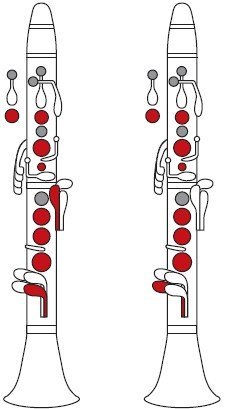
The A# half-whole diminished scale alternates half and whole steps starting on A#: A# – B – C# – D – E – F – G – G#. For clarinetists, use the downloadable fingering chart (free at MartinFreres.net) to see standard fingerings for written A# (sounding A# on B? clarinet is written B#; see transposition notes).
What is the A# Half-Whole Diminished Scale?
The A# half-whole diminished scale is an eight-note symmetric scale built by alternating half steps and whole steps starting on A#. Its pitch content is A# – B – C# – D – E – F – G – G#. Clarinetists use it for dominant-function harmony, altered tensions, and fast chromatic patterns in both classical and jazz contexts.
Because the pattern repeats every minor third, the A# half-whole diminished scale shares its pitch collection with C#, E and G diminished collections. This symmetry makes it powerful for modulation and improvisation but also confusing without a clear fingering plan. A dedicated fingering chart helps clarify how the pattern lies across the clarinet registers.
The half-whole diminished scale contains 8 notes, repeats every 3 semitones, and outlines 4 interchangeable dominant chords in one pattern.
A# Half-Whole Diminished Scale: Notes, Written vs. Sounding (B? Clarinet)
On a B? clarinet, written notes sound a major second lower. For the A# half-whole diminished scale, this transposition can cause confusion, especially around enharmonic spellings like A#/B? and B#/C. Understanding written vs sounding pitch is important when reading charts or transcribing recordings.
The theoretical pitch set for the A# half-whole diminished scale is: A# – B – C# – D – E – F – G – G#. On B? clarinet, if you want to sound that exact collection, you must read and finger each note a whole step higher: B# – C# – D# – E – F# – G – A – A#. In practice, many clarinetists and arrangers respell these notes enharmonically for readability.
For scale practice and fingering charts, most players think in written pitch, not sounding pitch. That means you will usually see the scale notated as written A# half-whole diminished, even though the sounding pitch is G# half-whole diminished. The fingering chart in this guide uses written pitch to match standard clarinet pedagogy.
B? clarinet transposes by 2 semitones. Written A# on B? clarinet sounds G#, and written B# sounds A#.
When working with pianists or backing tracks, clarify whether they are naming the scale by sounding pitch (G# half-whole diminished) or by your written pitch (A# half-whole diminished). Jazz players often choose the name that best matches the underlying chord symbol, such as B7alt or G#7.
Free Clarinet Fingering Chart for the A# Half-Whole Diminished Scale (Download & Diagram)
A dedicated fingering chart for the A# half-whole diminished scale helps you visualize how the alternating half and whole steps cross the break and throat tone region. The downloadable chart at MartinFreres.net presents the scale in written pitch, ascending and descending, across low, middle, and upper registers.
The chart shows each written note with a standard Boehm-system fingering diagram. Left-hand and right-hand keys are shaded, side keys and pinky keys are clearly indicated, and alternate fingerings are marked where intonation or facility often benefits from a different choice. This is especially useful for throat B and C, and for clarion E and F.
For quick reference, here is the core written-note sequence for a typical two-octave A# half-whole diminished scale on B? clarinet, starting on low A#:
- Low register: A# – B – C# – D – E – F – G – G#
- Crossing the break: A# – B – C# – D
- Upper clarion: E – F – G – G# (and optionally A# above)
Use the downloadable PDF to see exactly which pinky keys and side keys are recommended at each point. Print it and keep it in your practice folder, or load it on a tablet for lessons and rehearsals.
The downloadable chart shows 3 full octaves of the A# half-whole diminished scale, with at least 2 alternate fingerings marked for critical tuning notes.
How to Play the A# Half-Whole Diminished on Clarinet: Technique Tips and Fingerings
To play the A# half-whole diminished scale cleanly, start by isolating the written note sequence and mapping it to familiar fingerings. Begin in the chalumeau register on low A#, then ascend slowly, focusing on even tone and smooth finger motion rather than speed.
For low A#, use the standard B? fingering with the left-hand thumb, left-hand first finger, and right-hand first finger, plus the bottom right-hand pinky key. Move to B with the same left-hand fingering but switch to the lower left-hand pinky key. For C#, use the standard chromatic fingering with the right-hand pinky on the low C#/G# key.
As you continue to D and E, keep the fingers close to the keys and avoid lifting more than necessary. The half-whole pattern means you will frequently use chromatic fingerings, so relaxed hands and minimal motion are important. Practice in front of a mirror to check for unnecessary finger lifting.
Crossing the break from throat A# and B to clarion C# and D is often the most difficult part. Use a firm, supported air stream and anticipate the right-hand fingers so they arrive slightly early. Many players find it helpful to practice the break notes in rhythmic patterns, such as dotted eighth and sixteenth, to coordinate fingers and tongue.
In the upper clarion, aim for a consistent embouchure and voicing. The scale's chromatic nature can exaggerate any instability in tongue position. Think of saying “ee” for higher notes and “eh” for lower notes, keeping the tongue high and forward to stabilize pitch and response.
Historical Context and Notable Uses (Classical & Jazz)
The half-whole diminished scale emerged as a recognizable color in late Romantic and early 20th-century composition. Composers like Alexander Scriabin and Nikolai Rimsky-Korsakov used diminished collections to blur tonal centers and create heightened tension, often in orchestral and piano works that later influenced wind writing.
Igor Stravinsky exploited diminished harmonies and scales in works such as “The Rite of Spring” (1913) and “L'Histoire du soldat” (1918). Clarinet passages in these scores often outline symmetric collections similar to the half-whole diminished scale, especially in transitional and climactic sections. Scores and parts are readily available on IMSLP for detailed study.
Arnold Schoenberg and the Second Viennese School also drew on symmetric scales, including diminished collections, as they moved toward atonality. In works like “Pierrot Lunaire” (1912), the clarinet lines sometimes outline diminished patterns that foreshadow later systematic uses of the half-whole diminished scale in jazz and contemporary music.
In jazz, the half-whole diminished scale became a central tool for improvisers over dominant seventh chords. Clarinetists like Benny Goodman and Artie Shaw used diminished runs and arpeggios in the 1930s and 1940s, even if they did not always label them as half-whole diminished. Recordings on labels like Victor and Bluebird document these early uses.
By the bebop era, players such as Charlie Parker and Dizzy Gillespie codified the scale's role over V7b9 and V7alt chords. Clarinetists who later embraced modern jazz, including Buddy DeFranco, used the half-whole diminished scale explicitly as a core part of their improvisational language. AllMusic and Naxos discographies provide extensive listening references.
Field Note (Martin Freres Archive): Period Martin Freres clarinets from the early 20th century show keywork optimized for chromatic agility, reflecting the growing use of symmetric scales and complex harmonies in orchestral and salon music of that era.
Application in Repertoire and Improvisation: Examples and Practice Ideas
The A# half-whole diminished scale is most often applied over dominant chords that resolve a half step up or down. For example, over a written B7b9 chord (sounding A7b9 for B? clarinet), the A# half-whole diminished scale provides chord tones, altered tensions, and strong leading tones into the tonic chord.
In classical repertoire, you may not see the scale labeled explicitly, but diminished runs appear in works like the Debussy “Premiere Rhapsodie” and the Nielsen Clarinet Concerto. Analyze fast chromatic passages to identify where a half-whole diminished pattern can simplify fingering and memorization.
For jazz improvisation, practice the A# half-whole diminished scale over backing tracks that feature B7b9, B7alt, or G#7 chords. Start with simple patterns: ascending and descending scales, then 3-note and 4-note cells such as A#-C#-E-G or B-D-F-G#. Move these cells through different starting points to internalize the sound.
Another effective drill is to connect arpeggios within the scale. Outline B7 (B-D#-F#-A) and then add the diminished color tones from the scale, such as C#, E, G, and G#. This approach helps you hear the scale as an extension of the chord rather than a separate, abstract pattern.
Teachers can assign short etudes that focus on diminished patterns, asking students to mark where the A# half-whole diminished scale appears. Over 4 weeks, students should aim to use the scale fluently in at least two standard tunes, such as “All The Things You Are” or “Autumn Leaves,” at moderate tempos.
Instrument Anatomy: Keys, Vents, and Mechanisms that Affect This Scale
The clarinet's Boehm-system keywork and register venting strongly influence how the A# half-whole diminished scale feels under the fingers. The scale crosses the throat tone region, the register break, and the side-key area, all of which depend on precise venting and key alignment for clean response.
Throat tones (G, G#, A, A#) rely on small tone holes and shared vents. In the A# half-whole diminished scale, throat A# and B often appear in quick succession. Any leak or misaligned pad in this region will cause instability or sharp pitch. Knowing which keys control which vents helps you diagnose problems.
Above the break, the register key and left-hand first finger hole act together to produce clarion notes like B, C, and C#. When you move through the scale pattern, you frequently switch between register-key combinations and full right-hand coverage. Smooth operation of the bridge mechanism between upper and lower joints is important.
Side keys and pinky keys handle chromatic notes such as C#, F, and G#. In the A# half-whole diminished scale, these notes appear often, so comfortable hand position and properly regulated spring tension matter. On some older clarinet models, side key placement can make fast diminished runs more awkward.
Transposing clarinets like B? and A share the same basic fingering patterns, but the written pitch changes. Fingering charts for the A# half-whole diminished scale should always specify whether they are written for B? clarinet, A clarinet, or another instrument, to avoid confusion when switching instruments in orchestral or chamber settings.
Practice Exercises, Etudes, and Suggested Routines
To master the A# half-whole diminished scale, build a structured routine that covers slow practice, articulation, and application. Start each session with long tones on key notes of the scale, such as A#, C#, E, and G, focusing on stable intonation and centered tone in both chalumeau and clarion registers.
Next, practice the scale in quarter notes at a slow tempo, such as ? = 60, using legato tonguing. Aim for even finger motion and identical tone quality on every note. Gradually increase the tempo over several days, but only when you can play the scale three times in a row without mistakes.
Add rhythmic variations: play the scale in triplets, dotted rhythms, and groups of five or seven notes. This trains your fingers to handle the pattern in real musical contexts, not just straight runs. Include both ascending and descending forms, and start on different scale degrees to break the habit of always beginning on A#.
For articulation, practice the scale in staccato, slurred pairs, and mixed patterns such as two slurred, two tongued. Jazz players should add swing eighths and accent patterns that emphasize chord tones on strong beats. Classical players can adapt articulation patterns from standard etudes by Rose or Baermann.
Set measurable goals: after 1 week, aim for clean scales at ? = 80 in eighth notes. After 4 weeks, target ? = 120 in triplets. After 3 months, you should be able to insert short diminished runs from this scale into repertoire excerpts and improvisations at performance tempo.
Maintenance and Setup Tips to Improve Intonation and Response
Good maintenance and setup make a noticeable difference when playing chromatic scales like the A# half-whole diminished. Start with a basic pad check: gently close each key with light finger pressure and test for leaks by drawing air through the instrument or using a feeler gauge under the pad.
Key regulation is also critical. If one key closes before another in a linked mechanism, certain notes in the scale will speak late or sound stuffy. A qualified technician can adjust key heights, spring tension, and cork thickness so that the fingers feel balanced and the tone remains even across the pattern.
Reed choice affects response on chromatic passages. Select a reed strength that allows clear articulation and easy altissimo without forcing. Many advancing players use strengths between 3.0 and 3.5 on a medium-facing mouthpiece. Break in new reeds gradually over several days to stabilize their response.
Mouthpiece tip opening and facing length influence how easily the scale speaks, especially at soft dynamics. A moderate tip opening often provides the best compromise between flexibility and control. If diminished runs feel resistant or unstable, consult a teacher or technician about trying a different mouthpiece or ligature.
Regular swabbing, key oiling, and cork grease application keep mechanisms quiet and responsive. For players who practice diminished scales daily, schedule a professional checkup at least once a year, or more often if you notice sudden changes in intonation or response on specific notes within the scale.
Troubleshooting Common Problems with the A# Half-Whole Diminished Scale
Many clarinetists encounter similar issues when practicing the A# half-whole diminished scale: squeaks at the break, uneven tone in throat tones, and sharp or flat tendencies on certain chromatic notes. A systematic troubleshooting approach helps you solve these problems efficiently.
If you hear squeaks when crossing the break, first check your voicing. Keep the tongue high and forward, and avoid biting. Then slow the passage and watch your fingers in a mirror to ensure all holes close fully before the register key engages. If the problem persists, test for leaks in the upper joint.
For unstable throat tones, experiment with alternate fingerings. For example, adding the right-hand first finger to throat A# or B can darken the tone and improve pitch. Some players also add the left-hand E/B key for better resonance. Test these options with a tuner to find the best compromise for your instrument.
Sharp or flat notes within the scale often respond to small voicing adjustments. Lower the tongue slightly for sharp notes, and raise it for flat ones. You can also use alternate fingerings: for example, try different pinky options for low C# or G# to adjust pitch and response in fast passages.
On the stand or on a gig, quick fixes include switching to a more stable reed, slightly pulling out or pushing in the barrel for global tuning, and simplifying fingerings if necessary. Prioritize musical clarity over theoretical perfection when you must choose between a difficult fingering and a clean, in-tune line.
Archive References, Recordings, and Further Listening
To deepen your understanding of the A# half-whole diminished scale, study scores and recordings where diminished collections play a central role. IMSLP offers free access to orchestral and chamber scores by Stravinsky, Debussy, and Nielsen, allowing you to analyze clarinet parts that use symmetric scales and chromatic runs.
For historical recordings, explore Benny Goodman and Artie Shaw sessions from the 1930s and 1940s, many of which are documented on AllMusic and reissued on labels like Naxos Jazz. Listen for fast diminished runs over dominant chords, then transcribe short phrases and identify where the half-whole diminished scale appears.
Modern jazz clarinet recordings by players such as Buddy DeFranco and Eddie Daniels provide clear examples of half-whole diminished usage at advanced levels. Focus on solos over standards with strong V7-I motion, and compare your own practice of the A# half-whole diminished scale to their phrasing and articulation.
Teachers and students can build a small reference library that includes theory texts discussing symmetric scales, clarinet method books with chromatic etudes, and annotated scores. Over time, this archive becomes a practical resource for understanding how the A# half-whole diminished scale functions in real music.
Key Takeaways
- The A# half-whole diminished scale alternates half and whole steps and is best understood in written pitch for B? clarinet practice.
- A clear fingering chart and awareness of written vs sounding notes prevent confusion when working with pianists and recordings.
- Consistent maintenance, smart alternate fingerings, and structured practice routines lead to reliable, musical use of this scale in repertoire and improvisation.
FAQs
What is the A# Half-Whole Diminished Scale?
The A# half-whole diminished scale is an eight-note symmetric scale built by alternating half steps and whole steps starting on A#. Its notes are A# – B – C# – D – E – F – G – G#. Clarinetists use it mainly over dominant seventh chords with altered tensions to create strong harmonic pull.
How do I read the A# fingering chart for B? clarinet (written vs sounding)?
On B? clarinet, the fingering chart shows written notes, which sound a whole step lower. Written A# sounds G#, written B# sounds A#, and so on. When you follow the A# half-whole diminished fingering chart, you are practicing the written scale, which corresponds to a sounding G# half-whole diminished scale.
Where is the A# half-whole diminished scale used in repertoire?
You rarely see the A# half-whole diminished scale labeled explicitly, but its pitch collection appears in chromatic runs and diminished passages in works by Debussy, Nielsen, and Stravinsky. In jazz, it is used over dominant chords such as B7b9 or G#7, especially in bebop and modern styles.
Can I use alternate fingerings to improve tuning in this scale?
Yes. Alternate fingerings are often helpful for throat tones, low C#/G#, and certain clarion notes. For example, adding right-hand fingers to throat A# or B can stabilize pitch, and choosing different pinky options for C# or G# can improve intonation. Test each option with a tuner and your teacher.
Is there a free downloadable fingering chart and audio example?
Yes. You can access a free downloadable fingering chart for the A# half-whole diminished scale at MartinFreres.net, formatted for B? clarinet in written pitch. Many teachers also create simple audio examples or backing tracks so students can hear and practice the scale in context.
What maintenance steps help reduce squeaks on diminished scale passages?
To reduce squeaks, check for pad leaks, especially near the register key and throat tones, and ensure key regulation is correct. Use a well-balanced reed and a comfortable mouthpiece setup, and keep the instrument clean and well-oiled. Combined with good voicing and relaxed fingers, these steps greatly improve reliability.