If you have ever fallen in love with those shadowy, unstable movie moments right before the big reveal, you have already heard the spirit of the C Locrian scale on clarinet. It is the sound of a floor that never quite feels solid, a harmony that always leans forward and refuses to sit still. For curious Bb clarinet players, this strange little mode is like opening a secret door in your tone and imagination.
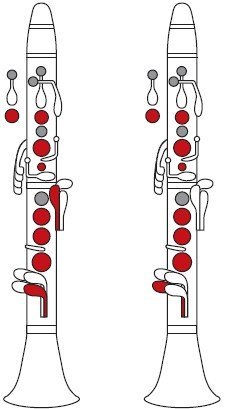
Receive a free PDF of the chart with clarinet fingering diagrams for every note!
The C Locrian scale on Bb clarinet is a seven-note mode built from C to B using lowered second, third, fifth, sixth, and seventh degrees. It creates a tense, unstable color that helps clarinetists develop intonation, expressive control, and a darker palette for jazz, film music, and contemporary pieces.
The C Locrian scale: a shadowy story in seven notes
The C Locrian scale is the oddball cousin in the family of modes. On Bb clarinet, its sound is smoky and fragile, like a whispered idea from the lower chalumeau register that grows teeth as you climb into the clarion. Every note feels slightly unsettled because the fifth degree is lowered, which means there is no stable home chord built on C. You are always one step away from falling into something else.
Composers and improvisers love this for scenes of suspense, spiritual searching, and twisted lullabies. Think of those half-lit passages in modern concertos or the way a jazz soloist can turn a simple vamp into a haunted question. That unsettled flavor is exactly where the C Locrian scale shines.
In the Locrian mode, the 2nd, 3rd, 5th, 6th, and 7th scale degrees are flattened. On clarinet, this pushes your ear toward careful intonation and makes even slow long tones feel like tiny dramas.
From plainsong to jazz club: how Locrian crept into clarinet music
The story of Locrian starts long before the Bb clarinet existed. Medieval singers used modes like Phrygian and Lydian in Gregorian chant, but Locrian was considered too unstable to stand on its own. It was more myth than daily tool. When the clarinet arrived in the 18th century, players like Anton Stadler and Heinrich Baermann flirted with exotic modes mainly in passing, weaving them briefly through chromatic lines in works by Mozart, Weber, and Spohr.
In the classical era, you hear Locrian colors hiding inside chromatic passages rather than as full scales. Listen to Carl Maria von Weber's Clarinet Concerto No. 1 in F minor or his Concertino: in several tense orchestral transitions, the clarinet line brushes past Locrian fragments, using that diminished fifth to light a fuse under the harmony.
By the late Romantic period, composers like Brahms and Reger thickened the harmonic soup. In Brahms's Clarinet Quintet in B minor, careful ears will catch moments where inner voices and clarinet lines outline Locrian-like shapes to bend the mood darker. It is never labeled, but the sound is there, glinting in the harmonies like a secret spice.
In the 20th century, everything changed. Modernists and film composers began using Locrian colors freely. Clarinetists in orchestras playing scores by Igor Stravinsky, Dmitri Shostakovich, and later John Williams met this sound again in dramatic tuttis and solo lines that hinted at Locrian over diminished and half-diminished chords. Even if the part says “Allegro agitato” instead of “Please use C Locrian here,” that is often what you are hearing.
Clarinet legends who lived in Locrian colors
Even if they did not shout it from the stage, many clarinet greats have leaned on the C Locrian scale or similar Locrian shapes in their phrasing. Each one used that restless sound in a personal way.
Classical voices: Sabine Meyer, Martin Frost, and Richard Stoltzman
Listen to Sabine Meyer playing Nielsen's Clarinet Concerto or the dark passages in the first movement of the Mozart Clarinet Concerto in A major. Though the piece is not Locrian, her handling of diminished arpeggios and chromatic scales often suggests Locrian tension. On difficult runs where the harmony circles around a diminished chord, practicing C Locrian is a smart shortcut to capturing her alert, razor-sharp intonation.
Martin Frost brings a similar language into his recordings of Anders Hillborg's Clarinet Concerto “Peacock Tales” and Kalevi Aho's Concerto. These pieces use stacked dissonances, half-diminished chords, and modal mixtures. When the clarinet screams or whispers over a shifting bed of strings, you can trace lines that outline Locrian shapes, including C Locrian, as the harmony sways under him.
Richard Stoltzman, especially in his recordings of contemporary American works and his crossover albums, treats diminished sonorities almost like blues language. In cadenzas and improvised ornaments, you can hear him move along Locrian-like rails, turning harmonic tension into something vocal and pleading.
Jazz innovators: Benny Goodman, Artie Shaw, Buddy DeFranco
In jazz, the C Locrian scale feels right at home over C half-diminished (Cmin7b5) harmony. Benny Goodman did not talk about modes on the bandstand, but in his solos on ballads like “Body and Soul,” his lines over diminished passing chords often spell out Locrian shapes. He glides through them as if the scale were just another extension of his ear.
Artie Shaw, especially in darker tunes and film cues, rides those half-diminished colors like a singer who loves unresolved endings. His solos on arrangements of “Nightmare” and the moodier parts of “Frenesi” contain phrases where C Locrian or its relatives sit right under the fingers, especially over iiø7 chords leading to V7.
Buddy DeFranco helped bring bebop language to the clarinet. In his recordings of standards like “Star Eyes” and “I'll Remember April,” listen when the chords move through iiø7-V7b9 progressions in minor keys. Those rapid, angular lines often come from Locrian and altered scales. Practicing C Locrian fingering on Bb clarinet is one way to reverse-engineer his clarity on such quick turns.
Klezmer and beyond: Giora Feidman and David Krakauer
In klezmer, the clarinet dances around scales with flattened seconds and sharpened leading tones. Giora Feidman, on pieces like “Shir HaLeilot” or “Nigun,” dips into melodic shapes that resemble Locrian when he leans on the diminished fifth and flattened second to stretch the cry of the melody. The clarinet's chalumeau register turns those notes into sighs and wails.
David Krakauer, in albums like “Klezmer Madness!” and his work with Kronos Quartet, threads modern harmony into traditional motifs. When the band sits on a tense harmony, he often shapes his improvisation with clusters that feel very Locrian: b2 rubbing against the root, b5 grinding for extra grit. Practicing your C Locrian scale gives you a vocabulary for these crunchy phrases.
Iconic pieces and moments where C Locrian whispers
Few pieces write “C Locrian” in the part, but its DNA is woven into many clarinet favorites. Here are some spots where C Locrian or similar Locrian fragments show their face.
- Weber: Clarinet Concerto No. 2 in E flat major – Rapid arpeggios over diminished chords in the first movement reward a Locrian mindset for secure finger patterns and pitch.
- Brahms: Clarinet Trio in A minor, Op. 114 – Slow, aching lines over shifting harmony use flattened seconds and diminished fifths that echo Locrian colors.
- Stravinsky: The Soldier's Tale – The clarinet part dances through dissonant orchestral punches, often skating along half-diminished sonorities that feel Locrian at heart.
- Messiaen: Quartet for the End of Time – In the “Abime des oiseaux” movement, Locrian-like cells appear where the clarinet suspends tension against piano and cello harmonies later in the work.
- Film scores by John Williams and Alexandre Desplat – In darker scenes with solo clarinet, such as suspenseful moments in “Harry Potter” or “The Grand Budapest Hotel,” you can often trace Locrian-inflected lines over half-diminished and altered chords.
Jazz standards give even clearer openings. Over a minor iiø7-V7-i progression in C minor, clarinetists often use C Locrian on the D half-diminished chord transposed for Bb clarinet, and related Locrian shapes around passing diminished chords. Practicing C Locrian on your instrument prepares your ear and fingers for those quick harmonic turns.
| Context | Typical Harmony | Why C Locrian Helps |
|---|---|---|
| Jazz iiø7 chord in C minor | Dmin7b5 leading to G7b9 | Practicing C Locrian sharpens hearing of b5 and b2, which translate smoothly to diminished and altered tones under the fingers. |
| Contemporary concerto passage | Stacked diminished chords | Locrian shapes guide finger choices and keep intonation steady on unstable harmonies in clarion and altissimo. |
| Klezmer-style lament | Drone with flattened second | C Locrian practice gives you a dark palette of b2 and b5 to color slides, trills, and bends on the mouthpiece and barrel. |
What C Locrian feels like on Bb clarinet
The emotional color of C Locrian is somewhere between a question and a warning. On Bb clarinet, the lowest notes of the scale in chalumeau feel smoky and hesitant, like the opening line of a confession. As you climb into clarion, those same intervals turn edgy, almost metallic, especially around the diminished fifth.
Spend a few minutes playing slow C Locrian scales with a tuner and a drone. You will hear how every interval carries tension. The flattened second rubs against the root. The flattened fifth stretches the line across a small canyon. Long tones become tiny scenes: each note is a character that never quite finds rest.
Jazz players use this to float over half-diminished chords without sounding bland. Classical players use it to shape suspenseful phrases so they feel intentional, not accidental. Klezmer and folk clarinetists use Locrian flavors to make the instrument cry, groan, and sigh using glissandi, grace notes, and vibrato from the diaphragm and throat.
Why the C Locrian scale matters for your playing
Learning C Locrian on Bb clarinet is not about collecting theory trivia. It is about building a darker, richer vocabulary in your fingers and ear. Once you know how this scale sounds and feels under different fingerings, you start recognizing it inside real music, from Brahms and Weber to Artie Shaw and David Krakauer.
It sharpens your intonation on tricky notes like written F sharp, B natural, and E flat when they appear as tender points in the line. It strengthens your control over half-hole and side-key combinations in the upper clarion. And it quietly prepares you for contemporary pieces where the printed notes might look wild, but your ear says: “Ah, that is just Locrian territory.”
A few fingering notes for the C Locrian fingering chart
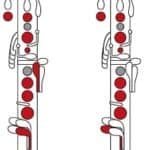
Your free fingering chart shows every written note for the C Locrian scale on Bb clarinet with clear diagrams, so there is no need for a long technical breakdown here. Still, a few hints can make the experience smoother.
Written C in the staff starts you off in comfortable chalumeau territory. As you climb through D flat and E flat, pay attention to your throat tones: use firm air and stable voicing so they match the color of low E and F. Near the top of the scale, experiment with alternate fingerings for B natural and C to keep the line even, especially when practicing slowly with a tuner.
- Play the written C Locrian scale slowly, one octave, using the chart.
- Repeat with a tuner, adjusting throat tones (D, E flat, E) until they match low F and open G.
- Add a second octave, focusing on smooth side-key transitions for A, B flat, and B.
- Improvise a short melody using only C Locrian notes over a held low C from the piano or a drone.
| Practice Block | Time | Focus |
|---|---|---|
| Slow scale (1 octave) | 5 minutes | Even tone on chalumeau notes, especially D flat and E flat. |
| Intonation check | 5 minutes | Match throat tones to low F using a tuner or drone. |
| Melodic play | 10 minutes | Create short phrases using only C Locrian, varying dynamics from piano to forte. |
Using C Locrian in real music: quick reference
Once the fingering feels natural, the fun starts when you plug C Locrian into actual music for Bb clarinet. Use it as a color, not a rulebook.
- Over a written Cmin7b5 chord in a jazz chart, try running bits of the C Locrian scale in eighth notes, then resolving to E flat or G in the next bar.
- In a contemporary solo piece with a long diminished or half-diminished passage, lightly outline C Locrian in your mind to stabilize your finger pattern.
- In a klezmer-style improvisation, hover around the flattened second and fifth of C Locrian and use slides, trills, and turns to lean into the dissonance.
| Pattern | Usage | Benefit |
|---|---|---|
| C – D flat – E flat – F | Opening fragment for suspenseful phrases | Builds control over b2 and b3 while keeping finger motion simple. |
| G flat – A flat – B flat – C | Upper fragment for jazz or klezmer licks | Trains smooth side-key work and clarion resonance. |
| C – E flat – G flat – B flat | Arpeggio-style outline | Highlights Locrian character with b3 and b5 for a darker color. |
For more scale stories and printable charts, you might enjoy reading about the Bb clarinet G minor scale, the bright and open Bb clarinet C major scale, or the flexible Bb clarinet D Dorian scale for jazz and folk tunes.
Key Takeaways
- The C Locrian scale on Bb clarinet gives you a dark, unstable color perfect for suspense, jazz iiø7 chords, and modern concert music.
- Practicing C Locrian refines intonation on diminished intervals and strengthens control over throat tones and side keys.
- Use the free fingering chart as a visual anchor, then turn the scale into melodies inspired by clarinet legends across genres.
Frequently Asked Questions
What is Bb clarinet C Locrian scale fingering?
The Bb clarinet C Locrian scale fingering is the pattern of written notes from C to B that form the Locrian mode: C, D flat, E flat, F, G flat, A flat, B flat, C. Using standard chalumeau and clarion fingerings, it highlights flattened intervals and trains your ear for half-diminished harmony.
How is the C Locrian scale different from C minor on clarinet?
C Locrian and C natural minor share some notes, but Locrian flattens the second and fifth degrees. That means D becomes D flat and G becomes G flat. This destroys the stable tonic chord on C and gives the scale a more unstable, suspenseful sound than regular C minor on Bb clarinet.
Where can I use C Locrian in jazz clarinet improvisation?
Use C Locrian over Cmin7b5 chords or any half-diminished harmony that leads to a dominant chord, such as in minor iiø7-V7-i progressions. It works well on darker ballads, modal tunes, and transitional bars where diminished chords connect stronger tonal centers in your solo.
Why should classical clarinetists practice C Locrian?
Classical clarinetists meet Locrian colors in diminished and half-diminished passages in works by Weber, Brahms, Nielsen, and many contemporary composers. Practicing C Locrian steadies intonation on tense intervals, improves throat tone reliability, and makes difficult chromatic runs feel more organized under the fingers.
How often should I practice the C Locrian scale on Bb clarinet?
Try adding C Locrian to your warmup two or three times per week for 10 to 15 minutes. Combine slow scale work, intonation checks, and short melodic improvisations. This frequency is enough to keep the sound fresh in your ear without taking time away from other core scales and études.