The E Bebop Dominant Scale is an eight-note dominant bebop scale built on E: E F# G# A B C# D D# E. It adds a chromatic passing tone (D#) to the standard dominant scale and is used for bebop-style improvisation; free clarinet fingering charts and printable PDF downloads available.
What is the E Bebop Dominant Scale?
The E Bebop Dominant Scale is an 8-note scale used in jazz improvisation, especially in bebop. Its notes are: E, F#, G#, A, B, C#, D, D#, E. It is built on the E Mixolydian mode, with an added chromatic passing tone between the flat 7 (D) and the root (E). This extra note helps keep chord tones on strong beats at fast tempos.
On clarinet, the E Bebop Dominant Scale is most often used when you are improvising over an A7 chord (concert pitch) on a B-flat clarinet, or over a B7 chord on an A clarinet. The scale gives you a clear, idiomatic way to outline dominant harmony while still sounding fluid and melodic in a bebop style.
Historical context: bebop on the clarinet
The bebop dominant scale grew out of the 1940s jazz language shaped by Charlie Parker, Dizzy Gillespie, and Bud Powell. Clarinetists like Buddy DeFranco, Jimmy Hamilton, and later Eric Dolphy adapted this vocabulary to the clarinet, bringing the instrument into the modern jazz era after the swing period of Benny Goodman and Artie Shaw.
Buddy DeFranco in particular made systematic use of bebop scales over dominant chords. Recordings such as his versions of “Opus 1” and “A Fine Romance” show long, flowing lines where chromatic passing tones keep chord tones aligned with strong beats. The extra note in the bebop dominant scale became a practical solution for playing eighth-note lines at high tempos without losing harmonic clarity.
Archival collections at the Library of Congress and the Smithsonian Institution preserve live broadcasts, studio takes, and lead sheets that document this shift in language. Transcriptions of solos by DeFranco, Jimmy Hamilton with the Duke Ellington Orchestra, and Eric Dolphy on albums like “Outward Bound” reveal frequent use of bebop dominant patterns, including the E-based form over A7 and B7 chords.
E Bebop Dominant Scale: notes, interval structure, and theory
The E Bebop Dominant Scale is built from the E Mixolydian mode with one added passing tone. The basic E Mixolydian scale is: E, F#, G#, A, B, C#, D, E. To create the bebop dominant form, you insert D# between D and E, giving: E, F#, G#, A, B, C#, D, D#, E.
The interval structure from E is: whole step (F#), whole step (G#), half step (A), whole step (B), whole step (C#), half step (D), half step (D#), half step (E). Functionally, the scale degrees are: 1, 2, 3, 4, 5, 6, b7, 7, 1. That chromatic 7th degree (D#) is the key to the bebop sound.
In bebop theory, this extra note lets you run continuous eighth notes while landing chord tones (1, 3, 5, b7) on downbeats. Over an A7 chord (concert), the E Bebop Dominant Scale on B-flat clarinet outlines the chord tones C#, E, G, and A in a predictable rhythmic grid. This makes your lines sound both harmonically clear and rhythmically locked in.
Clarinet fingering chart (free download) – E Bebop Dominant Scale
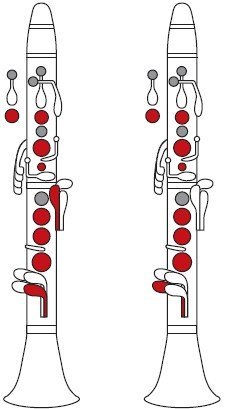
Clarinetists often struggle to find a bebop-specific fingering chart that shows practical alternates for chromatic notes. For the E Bebop Dominant Scale, a clear chart helps you navigate the D and D# area smoothly, especially at fast tempos. Our free PDF fingering chart focuses on the E Bebop Dominant Scale from low E up through the clarion and altissimo registers.
The chart includes standard fingerings for E, F#, G#, A, B, C#, D, D#, and E, plus recommended alternate fingerings for D and D#. It is laid out for B-flat clarinet, with transposition notes for A clarinet. Each note diagram highlights which tone holes and keys are active, including the register key, side keys, and pinky keys.
You can download the free printable E Bebop Dominant Scale fingering chart as a PDF. The file includes a one-octave and two-octave scale layout, broken two-note patterns, and a small section of suggested bebop licks using the scale. The PDF is suitable for studio printing or digital use on tablets.
Practical fingerings and alt fingerings for tricky notes
On clarinet, the trickiest notes in the E Bebop Dominant Scale are usually D and D#, especially when you cross the break. These notes sit at the boundary between chalumeau and clarion registers and rely on precise coordination of the left-hand index finger, register key, and right-hand pinky keys. Good alternate fingerings can smooth awkward passages.
For low D (below the staff), use the standard fingering: left hand thumb and first three fingers, right hand first three fingers, plus the right-hand low D pinky key. For low D#, use the same basic fingering but switch to the D# (E-flat) pinky key. Many players prefer the right-hand D#/E-flat key for fast passages, but some choose the left-hand key when the right pinky is busy.
For middle D (just above the staff), the standard fingering is left-hand thumb, first and second fingers, plus the register key. Middle D# (E-flat) often uses the same fingering with the right-hand first finger added, or a side key fingering depending on your instrument. Experiment with both to find the best intonation and response on your clarinet.
Instrument anatomy and keywork involved
The E Bebop Dominant Scale engages almost every part of the clarinet's keywork. E and F# use the left-hand main tone holes and the right-hand lower stack. G# involves the left-hand pinky key. A and B rely on the upper stack and register key. C# typically uses a right-hand pinky or side key, depending on register and context.
D and D# are where most players feel mechanical strain. These notes combine the register key, left-hand index tone hole, and either side keys or pinky keys. Small leaks in the upper joint pads or misaligned pinky keys can make D and D# stuffy or unstable. Understanding which keys move for each fingering helps you diagnose problems quickly.
For altissimo E in extended bebop lines, players often use fingerings that add right-hand fingers or side keys to stabilize pitch. These fingerings vary by instrument, so consult your technician or teacher for options that match your clarinet. The downloadable chart includes one reliable altissimo E option suitable for most modern instruments.
Transposition: playing the E Bebop Dominant Scale on B-flat and A clarinets
Clarinetists must think in transposition when using the E Bebop Dominant Scale in real music. On a B-flat clarinet, written E sounds as concert D. On an A clarinet, written E sounds as concert C. Knowing which concert chord you are outlining helps you choose the right written scale for the chart in front of you.
On B-flat clarinet, the written E Bebop Dominant Scale (E F# G# A B C# D D# E) works well over a concert D7 chord. If the band is playing an A7 chord (concert), you would instead play a written B Bebop Dominant Scale to match that harmony. Many jazz students mistakenly play the concert scale instead of the written scale, which throws off the harmony.
On A clarinet, written E Bebop Dominant outlines a concert C major or C7 area. To outline a concert B7 chord, you would play a written F# Bebop Dominant Scale. When practicing, label your scales both as written and concert to train your brain. For example: “Written E Bebop Dominant (concert D)” for B-flat clarinet.
Transposition practice tips
To internalize transposition, practice the E Bebop Dominant Scale in three ways: as written on B-flat clarinet, as written on A clarinet, and as concert pitch on piano or a tuning app. Say the concert chord aloud while you play the written scale. This links your ear, your fingers, and your harmonic understanding.
Another useful drill is to play along with a backing track in concert D7 and use your written E Bebop Dominant Scale on B-flat clarinet. Then switch to an A clarinet and adjust your written scale to match the same concert harmony. This exercise quickly reveals any transposition confusion and helps you correct it.
Daily practice routines and exercises using the E Bebop Dominant Scale
To make the E Bebop Dominant Scale part of your natural language, you need short, focused daily routines. Aim for 10 to 15 minutes per day dedicated just to this scale. Work on tone, finger coordination, and rhythmic control, not only speed. Consistent, slow practice builds the facility you need for fast bebop tempos.
Start with one-octave scales in quarter notes at a moderate tempo, such as 60 beats per minute. Then move to two-octave scales in eighth notes, ascending and descending. Focus on even tone and clean finger motion across the break, especially between C#, D, D#, and E. Use a mirror to check hand position and finger height.
Next, practice broken patterns: 1-3-2-4, 1-4-2-5, and 1-5-2-6 across the scale degrees. These patterns reflect real bebop lines and help you navigate the chromatic D#. Finally, add articulation variations: slur two, tongue two; all slurred; all tongued; and accented offbeats. This prepares you for the phrasing demands of bebop solos.
Metronome milestones and player outcomes
Set clear tempo goals to track your progress. Start with eighth notes at 60 beats per minute. When you can play the scale and basic patterns cleanly five times in a row, increase by 5 bpm. Many intermediate players can reach 120 bpm in a few weeks of focused work, and advanced players often aim for 160 bpm or more.
Teachers can use these milestones as assessment metrics. For example, a lesson goal might be: “Play the E Bebop Dominant Scale in two octaves, in eighth notes at 100 bpm, with clean fingerings and stable intonation.” Over time, you should notice improved chromatic fluency, smoother break crossings, and more control over passing tones in your solos.
Applying the scale in improvisation and repertoire examples
The E Bebop Dominant Scale is most often used over dominant 7 chords a perfect fourth above E in concert pitch. On B-flat clarinet, written E Bebop Dominant works over concert D7. This chord appears in many standards, including “All The Things You Are,” “There Will Never Be Another You,” and “Confirmation” in certain keys.
To apply the scale, start by targeting chord tones on strong beats. For example, over a D7 chord, aim for E, G#, B, or D on beats 1 and 3 when using the written E Bebop Dominant Scale on B-flat clarinet. Use the D# passing tone on offbeats to connect D up to E or down to D, creating smooth chromatic motion.
Practice simple two-bar phrases where you ascend the scale for one bar and descend for the next, always landing a chord tone on beat 1 of each bar. Then experiment with classic bebop enclosures: approach a chord tone from a half step above and below using the D and D# notes. This creates the characteristic bebop tension and release.
Listening and transcription ideas
Listen to Buddy DeFranco on tunes with strong dominant harmony, such as “Out of Nowhere” or “How High the Moon.” Even if he is not literally running an E Bebop Dominant Scale, you will hear similar chromatic passing tones and chord-tone targeting. Try to sing and then play short fragments that feature the chromatic 7th degree.
Eric Dolphy's clarinet and bass clarinet work on albums like “Outward Bound” and “Out To Lunch” shows a more modern, angular use of bebop vocabulary. Isolate moments where he plays over dominant chords and identify where an E-based bebop dominant shape would fit. This helps you see the scale as a flexible tool, not a rigid pattern.
Choosing and setting up your clarinet for reliable bebop response
Fast bebop lines in the E Bebop Dominant Scale demand a clarinet setup that responds quickly and evenly, especially around D and D#. A well-regulated instrument, an appropriate mouthpiece, and a balanced reed all contribute to clean articulation and stable pitch. Poor setup often shows up first on chromatic passing tones.
Check that your pads seal fully, especially on the upper joint and around the register key. Small leaks make D and D# unstable or airy. Key regulation should allow the pinky keys to close fully without excessive force. A medium-open jazz mouthpiece paired with a medium-strength reed often provides enough flexibility for bending notes without losing control.
Reed strength and cut matter for bebop playing. Too hard a reed can make fast passages stiff and increase squeaks on D#. Too soft a reed can cause pitch sag and fuzzy attacks. Many jazz clarinetists settle around strength 3 on most brands, adjusting up or down slightly depending on embouchure and mouthpiece facing.
Maintenance steps and service intervals
Regular maintenance keeps your E Bebop Dominant passages reliable. Swab the instrument after every session, paying attention to the upper joint where condensation can affect the register key pad. Inspect corks and felts monthly to ensure smooth key travel, especially on pinky keys and side keys used for D# and C#.
Schedule professional servicing at least once a year if you play regularly, or every 6 to 9 months if you perform often. Ask your technician to check pad seating, spring tension, and key height specifically around the D, D#, and E fingerings. Historical notes from Martin Freres instruments show that even small misalignments in these areas can significantly affect response.
Troubleshooting common problems and quick fixes
Many clarinetists report squeaks or unstable tone on the D# in the E Bebop Dominant Scale. Before blaming your fingers, follow a simple diagnostic chain: reed, mouthpiece, voicing, then keywork. Often, a slightly warped reed or a pinched embouchure is the real cause, not the fingering itself.
If you squeak on D#, test your reed by playing long tones on open G and middle B. If those notes sound unstable, try a different reed. Next, check your voicing by playing the D# softly, with relaxed air and a slightly more open oral cavity. If the note stabilizes, your previous voicing was likely too tight or high.
When mechanical issues are suspected, finger D and D# slowly while watching the keywork in a mirror. Look for keys that do not close fully or that bounce. Gently press the pads with a thin cigarette paper to test for leaks. If you find leaks or inconsistent closure, a visit to a qualified technician is the safest fix.
Quick exercises to stabilize problem notes
Use slow, repeated slurs between C#, D, D#, and E in the middle register. Start at 60 bpm and play four slurred eighth notes on each pair of notes. Focus on minimal finger motion and steady air. This isolates the break-crossing mechanics that often cause squeaks in bebop lines.
Another useful drill is to play a simple four-note pattern: D – D# – E – D#, repeated in a loop. Start very softly and gradually increase volume while keeping the tone stable. This builds confidence on the chromatic passing tone and trains your embouchure to stay flexible but controlled.
Further listening, archival references, and recommended reading
To deepen your understanding of the E Bebop Dominant Scale in context, study recordings where clarinetists navigate dominant harmony with chromatic fluency. Buddy DeFranco's small group recordings, Jimmy Hamilton's work with Duke Ellington, and Eric Dolphy's modernist explorations all provide rich material for ear training and transcription.
Archival resources from the Library of Congress and the Smithsonian Jazz Oral History Program include interviews, scores, and live recordings that document how bebop language evolved. Many lead sheets in the JazzStandards database show dominant-heavy progressions where bebop dominant scales, including the E form, are especially useful.
For reading, look for jazz improvisation texts that discuss bebop scales and chord-tone targeting, along with clarinet-specific technique books that address break crossing and altissimo. Combining general jazz theory with clarinet-focused technical work gives you the best foundation for using the E Bebop Dominant Scale musically and confidently.
Key Takeaways
- The E Bebop Dominant Scale is E F# G# A B C# D D# E, adding D# as a chromatic passing tone to E Mixolydian.
- On clarinet, smooth fingerings for D and D# plus solid instrument setup are important for clean bebop lines.
- Regular practice with patterns, transposition drills, and listening to master clarinetists helps you apply this scale fluently in real music.
FAQ
What is the E Bebop Dominant Scale?
The E Bebop Dominant Scale is an 8-note dominant scale built on E: E, F#, G#, A, B, C#, D, D#, E. It starts from the E Mixolydian mode and adds the chromatic passing tone D# between the flat 7 (D) and the root (E). Jazz players use it to keep chord tones on strong beats in fast bebop lines.
How do I finger the D# (chromatic passing tone) on the clarinet for the E Bebop scale?
In the low register, D# (E-flat) uses the standard D fingering plus the D#/E-flat pinky key, usually on the right hand. In the middle register, D# often uses left-hand thumb, first and second fingers, register key, plus right-hand first finger or a side key, depending on your instrument. Choose the fingering that gives the best intonation and smoothest motion in your specific passage.
How do I play the E Bebop Dominant Scale on a B-flat clarinet?
On B-flat clarinet, play the written notes E, F#, G#, A, B, C#, D, D#, E. These sound as concert D, E, F#, G, A, B, C, C#, D. This written E Bebop Dominant Scale works well over a concert D7 chord. Practice it in one and two octaves, with attention to smooth fingerings across the break.
Where can I download the free E Bebop Dominant clarinet fingering chart?
You can download a free printable fingering chart for the E Bebop Dominant Scale as a PDF from this page. The chart includes standard and alternate fingerings for each note, transposition notes for B-flat and A clarinets, and a few short bebop patterns to practice. It is formatted for easy studio printing or tablet use.
Which recordings or solos best demonstrate the E Bebop Dominant Scale in use?
Listen to Buddy DeFranco on bebop standards, Jimmy Hamilton with Duke Ellington on dominant-heavy tunes, and Eric Dolphy on albums like “Outward Bound.” While they may not play the E Bebop Dominant Scale as a simple exercise, their lines over dominant chords often use the same chromatic passing tone concept that defines the bebop dominant scale.
Why does my clarinet squeak on the chromatic notes and how do I fix it?
Squeaks on chromatic notes like D# usually come from a combination of reed issues, tight voicing, and minor keywork problems. First, try a fresh, well-balanced reed and relax your throat and tongue position. Then check for leaks around the upper joint and register key. Slow slur exercises between C#, D, D#, and E help stabilize your embouchure and finger coordination.