If you have ever listened to a clarinet line that danced through a chord progression like it already knew the future, chances are you were hearing something built on the F Bebop Major Scale. On Bb clarinet, this scale feels like a secret door into the language of Benny Goodman, Buddy DeFranco, and so many late-night jam sessions where the reed is tired but the ideas refuse to sleep.
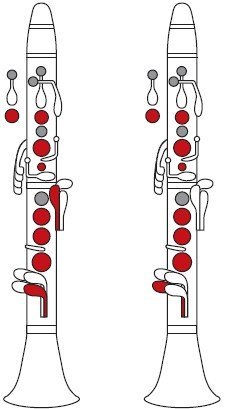
Receive a free PDF of the chart with clarinet fingering diagrams for every note!
The F Bebop Major Scale on Bb clarinet is an 8-note major scale with an added chromatic passing tone between the 5th and 6th degrees. It creates smooth, flowing jazz lines that keep chord tones on strong beats, giving clarinetists clear, swinging melodies over F major harmonies.
The sound of the F Bebop Major Scale: bright, swinging, and fearless
The F Bebop Major Scale is like taking an ordinary F major scale and giving it one extra spark. That added passing tone between C and D on the clarinet turns a simple run into a line that lands on chord tones almost by magic. It feels bright and confident, yet relaxed, like a soloist who smiles right before they leap into the high register.
On Bb clarinet, this scale shapes the way you hear F major in big band charts, small combo jazz, Latin grooves, and even in some modern classical writing. It lets phrases roll neatly across the bar line, keeping beats 1 and 3 filled with strong chord tones while the extra note slips between them like a dancer cutting across the floor.
The F Bebop Major Scale adds one chromatic note to the regular F major scale. That single extra pitch helps clarinetists land chord tones on strong beats, which is why it feels so stable and swinging in fast jazz tempos.
Clarinet legends who lived inside the F Bebop Major sound
You will not find many players who said “I practiced the F Bebop Major Scale for 3 hours today” in an interview, but you can hear it in their fingers. The language is in the solos, not the practice log.
Listen to Benny Goodman on recordings like “Air Mail Special” or “Seven Come Eleven” with Lionel Hampton and Charlie Christian. When the harmony sits on F major, those crisp, driving lines often outline the exact logic of the F Bebop Major Scale. You hear C, C#, D slipping through rapidly, keeping the swing feel locked to the ride cymbal.
Buddy DeFranco, one of the great bebop clarinetists, almost turned this sound into a personal calling card. Track down his versions of “Cherokee” or “Donna Lee” and focus on passages where the band lands on F major harmony. His phrasing, especially in the mid-register around written C, D, and E, runs straight through bebop major patterns, giving the clarinet a saxophone-like fluency without losing its liquid tone.
In more modern times, Eddie Daniels brings this same scale into a smoother, almost classical-infused style. On albums like “Breakthrough” with the London Symphony Orchestra or his live jazz recordings, his improvisations over F major often use bebop major runs that move across the break with the kind of clarity that makes every clarinetist secretly reach for a practice mute.
On the classical side, players such as Sabine Meyer and Martin Frost might not label what they play as “F Bebop Major,” yet in their interpretations of melodic lines in F major, you can often hear passing chromatic tones that echo the same logic. Listen to Frost in Nielsen's Clarinet Concerto or Meyer in Carl Maria von Weber's Concerto No. 1. Where they color a phrase with a quick chromatic connection around C and D, the flavor is not far from what bebop players do, just spoken with a different accent.
Klezmer artists, too, brush past bebop major colors, sometimes almost by accident. Giora Feidman and David Krakauer frequently bring bright, F major-driven tunes to life with chromatic slides and ornaments around the 5th and 6th degrees. On pieces like “Der Heyser Bulgar,” you can hear moments where the clarinet jumps through something that feels very close to an F Bebop Major run, even though the tradition grew separately from American jazz theory.
Iconic pieces and recordings where F Bebop Major shows its colors
The F Bebop Major Scale is not a “piece” you can program on a recital, but it hides inside a surprising number of clarinet moments across genres. Once your ear knows its sound, you start hearing it everywhere.
In big band repertoire, think of tunes that sit on F major grooves. Pieces like “Stompin' at the Savoy” or “King Porter Stomp” often pivot around F in arrangements by Fletcher Henderson or Benny Goodman. Clarinet choruses in these works frequently trace the same 8-note path you see in an F Bebop Major fingering chart, especially in shout choruses and clarinet improvisations.
In small-group jazz, listen to Artie Shaw on tunes like “Begin the Beguine” or “Nightmare.” When the harmony relaxes into F major, those liquid runs across the clarinet break often hint at bebop-style major lines, with that extra chromatic passing tone giving the line a sense of forward pull. Shaw was not a bebop player in the strict sense, but many of the same melodic tools show up in his phrasing.
With Buddy DeFranco, the connection becomes explicit. On his recordings of “What Is This Thing Called Love” or “I'll Remember April,” his lines over F major II-V-I chains are textbook examples of bebop major language. If you pause the recording and write down one of his 8-note F major runs, you will often find the exact pitch sequence of the F Bebop Major Scale sitting in front of you.
Even film composers tap into this color. In some F major cues for clarinet and strings, such as passages in scores by John Williams or Alexandre Desplat, the clarinet occasionally uses a quick chromatic passing tone between C and D to smooth a line in F. Although film scores do not usually label these as “bebop scales,” the sound is unmistakably related.
In chamber music, look at sections of the Brahms Clarinet Sonata in F minor, Op. 120 No. 1. When Brahms brightens to F major in the first movement, players sometimes choose expressive fingerings and tiny rubato gestures that add passing notes similar to bebop logic, especially in cadential phrases. Again, the theory came later, but the ears of great composers already reached for the same chromatic spice.
| Context | Scale Flavor | Typical Clarinet Use |
|---|---|---|
| Classical F major concerto (Weber, Krommer) | Pure F major, occasional chromatic passing notes | Expressive runs, cadenzas, lyrical lines across the break |
| Jazz solo over F major rhythm changes | F Bebop Major Scale and arpeggios | Fast 8-note lines, chord tone emphasis on beats 1 and 3 |
| Klezmer tune centered on F | F major with ornaments and chromatic approach notes | Slides, trills, expressive bends around C and D |
From Mozart and Stadler to bebop clubs: a short journey to F Bebop Major
The idea of F major on clarinet goes back to the earliest stars of the instrument. Anton Stadler, who inspired Mozart's Clarinet Concerto and Clarinet Quintet, played on an instrument with a different key system, but his lyrical phrasing in bright keys like F and C laid a foundation for how clarinetists think about singing in the upper register.
In the early 19th century, players like Heinrich Baermann shaped the clarinet sound that Carl Maria von Weber wrote for. When Weber sent his clarinet concertos into luminous F major passages, Baermann brought a vocal quality to those phrases. Chromatic passing notes were already part of his expressive palette, hinting at the sound that bebop theorists would later codify.
As the 20th century rolled in, jazz clarinetists picked up where the classical soloists left off, but added a new ingredient: swing. Players like Jimmie Noone and Sidney Bechet took major scales and began threading chromatic tones between chord tones in New Orleans and Chicago bands. F major, friendly to brass and reeds alike, became one of those keys that felt comfortable under the fingers.
The concept of the bebop scale, including the F Bebop Major Scale, solidified around the era of Charlie Parker and Dizzy Gillespie. Clarinetists such as Buddy DeFranco and later Eddie Daniels adopted this language and brought it directly to the Bb clarinet. Suddenly, the scale that classical players had hinted at through expressive chromaticism became a named, teachable pattern.
Today, contemporary clarinetists straddle both traditions. A player might spend the morning practicing Brahms's Clarinet Quintet and the afternoon transcribing a solo by Anat Cohen or Ken Peplowski, both of whom make generous use of bebop major colors when soloing in F. The F Bebop Major Scale is now a shared language that connects recital halls, jazz clubs, and even studio sessions for film and streaming soundtracks.
How the F Bebop Major Scale feels under the fingers and in the heart
Play an ordinary F major scale on Bb clarinet and it feels clean, direct, almost polite. Add that bebop passing tone between C and D, and suddenly the line tilts forward. Each note seems to lean into the next bar, like a story that refuses to end on this sentence.
Emotionally, the F Bebop Major Scale carries a kind of confident optimism. It is not as tense as an altered scale or as wistful as D minor. Instead, it feels like daylight: clear, rhythmic, and full of momentum. Clarinetists often describe the sensation as “locked in” or “riding the time” when those 8 notes line up perfectly with the rhythm section.
On the instrument, the scale encourages smooth motion across the break. Moving from the throat A, B b, and side keys into the long-tube notes for C, C#, and D asks the hand to relax. The reward is a sound that glides instead of hops. That physical ease frees the mind to focus on shape, emotion, and storytelling rather than thumb anxiety.
Why the F Bebop Major Scale matters for you, right now
If you are just starting to improvise, the F Bebop Major Scale gives you a safe playground over any F major or F6 chord. Right away, you can create lines that sound like they belong on a classic record, even if your articulation is still a bit clumsy and your reed has seen better days.
For advancing players, this scale becomes a key to more complex harmony. Once you can run it comfortably over F major, you can begin to connect it to C Bebop Major, B b Bebop Major, and their related II-V-I progressions. Suddenly, chord changes that used to feel like traffic jams become familiar streets with clear signposts.
For classical clarinetists, practicing F Bebop Major helps with fluid chromatic motion in repertoire by Ravel, Debussy, and Stravinsky, where lines in F major often hide quick passing tones. The same finger fluency you build on a bebop scale will make passages in the Rhapsody in Blue, the Stravinsky Three Pieces, and even Nielsen's Clarinet Concerto feel more secure.
Key Takeaways
- Use the F Bebop Major Scale on Bb clarinet to create swinging, chord-focused lines over F major and F6 harmonies.
- Listen to Benny Goodman, Buddy DeFranco, and Eddie Daniels to hear how this scale shapes real clarinet solos.
- Practice the scale slowly with clear finger motion across the break, then apply it to simple licks and short phrases.
A quick word on the F Bebop Major fingering chart
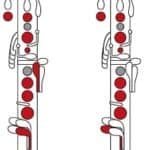
Your free F Bebop Major Scale fingering chart shows every note clearly for Bb clarinet, from the low register up through the clarion. You will see the usual F major notes plus a chromatic passing tone between the 5th and 6th scale degrees, written as C to C# to D. The diagrams keep the story simple so you can focus on sound and rhythm.
When you practice from the chart, keep the finger motions tiny and relaxed. Use a steady air stream and a gentle, centered embouchure so the throat tones match the resonance of written C, C#, and D above the break. The goal is not speed at first, but a line that sounds like one long breath, no matter how many keys you press.
Simple practice ideas to make F Bebop Major part of your voice
Instead of running the scale up and down mindlessly, treat each repetition as a miniature solo. Connect what you see on the fingering chart to phrases you hear from your favorite clarinetists.
- Play the F Bebop Major Scale slowly, two octaves if possible, with legato tonguing on every note.
- Accent beats 1 and 3 lightly to feel how the chord tones line up naturally.
- Turn 4-note sections of the scale into tiny licks, like C-D-E-F or A-B-C-C#-D.
- Improvise over an F drone or a simple F major backing track using only the 8 notes of the scale.
| Practice Focus | Time | Frequency |
|---|---|---|
| Slow F Bebop Major Scale, full range | 5 minutes | Daily |
| Short bebop licks in F | 10 minutes | 3 times per week |
| Play-along with an F major backing track | 10 minutes | 2 times per week |
Common F Bebop Major challenges and how to fix them
Every clarinetist who works on bebop scales meets the same little gremlins: uneven fingers, fuzzy throat tones, and missed breaks. A few simple adjustments can keep the music flowing.
| Problem | Likely Cause | Simple Fix |
|---|---|---|
| C to C# to D feels clumsy | Tension in right-hand fingers and thumb | Practice those 3 notes slowly as a loop, watching that the right-hand fingers hover close to the keys. |
| Throat tones sound dull compared to clarion | Weak air support and heavy embouchure pressure | Play long tones on written A and B b, then move directly into C and D using the same air speed. |
| Lines do not swing, even with correct notes | Rhythm not locked to the beat | Practice with a metronome on 2 and 4, lightly accenting chord tones on beats 1 and 3 of each measure. |
Frequently Asked Questions
What is Bb clarinet F bebop major scale fingering?
The Bb clarinet F Bebop Major Scale fingering is the pattern used to play an 8-note F major scale with a chromatic passing tone between the 5th and 6th degrees. On clarinet, you play F major plus C, C#, and D in sequence, which creates smooth, swinging lines over F major chords.
Why do jazz clarinetists use the F Bebop Major Scale?
Jazz clarinetists use the F Bebop Major Scale because it lines up chord tones with strong beats, especially in fast tempos. That extra chromatic note between C and D lets phrases feel both precise and fluid. Players like Buddy DeFranco and Eddie Daniels rely on it to keep their lines clear over complex harmony.
Is the F Bebop Major Scale only for jazz players?
No. While it is strongly associated with jazz and bebop, classical and klezmer clarinetists also benefit from its finger fluency and chromatic connections. Practicing F Bebop Major helps with technical control in orchestral excerpts, chamber music, and contemporary pieces that use rapid F major passages with passing tones.
How often should I practice the F Bebop Major Scale on Bb clarinet?
Short, regular sessions work best. Spending 5 to 10 minutes per day on the F Bebop Major Scale is usually enough to build solid technique and internalize the sound. Combine slow practice, short licks, and a few minutes of simple improvisation over F major harmony.
What pieces can I study to hear F Bebop Major in action?
Listen to Benny Goodman on big band recordings in F, Buddy DeFranco on bebop standards like “Cherokee,” and Eddie Daniels on F major tunes from his jazz albums. You can also notice similar colors in classical works that brighten to F major, such as sections of Weber concertos and Brahms sonatas.