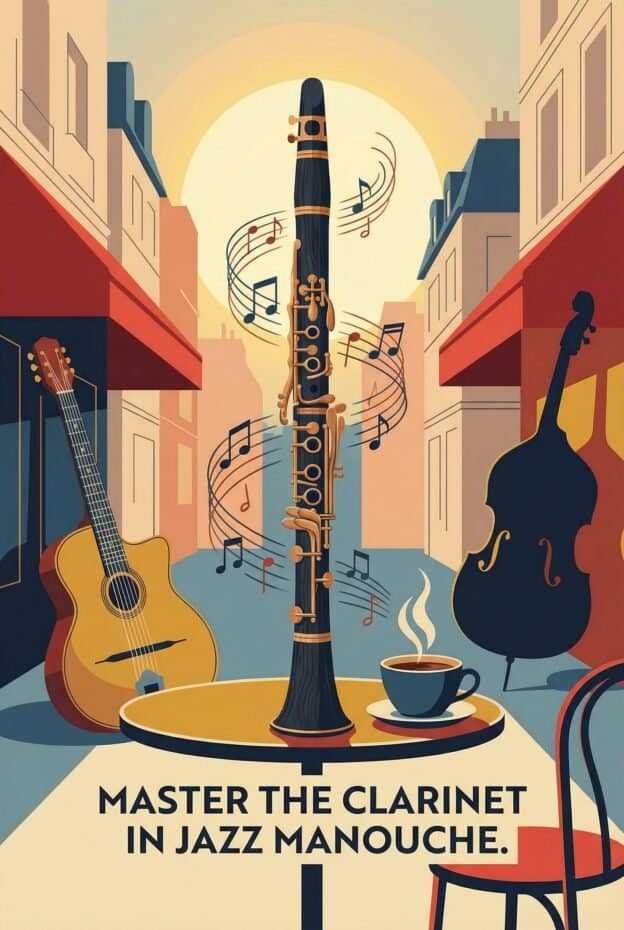
The clarinet in jazz manouche is the melodic, often improvisatory voice within Gypsy (Manouche) jazz – weaving lyrical lines, glissandi and swing phrasing around driving guitars and bass. Key players include Claude Luter and Léonard Garcin, and the style emphasizes rhythmic feel, arpeggiated solos and close ensemble interplay.
The Clarinet in Jazz Manouche: An Introduction
The clarinet in jazz manouche sits between the human voice and the violin, carrying agile melodies above the pulse of la pompe guitar and double bass. Its role is both lyrical and percussive, using articulation, glissandi and flexible tone color to cut through an acoustic ensemble without losing warmth or nuance.
For clarinetists who already play classical or straight-ahead jazz, this style demands a shift in phrasing, sound concept and time feel. The focus moves toward a vocal, speech-like attack, strong swing subdivision, and close interaction with rhythm guitar. Understanding this context helps you choose the right gear, practice methods and repertoire.
Typical small jazz manouche groups feature 2-3 guitars, 1 bass and 1 lead instrument. Clarinet appears as primary lead voice on at least 15-20% of documented post-war French Gypsy jazz recordings.
History and Cultural Context of Jazz Manouche
Jazz manouche grew from 1930s Paris, where Django Reinhardt, Stéphane Grappelli and the Quintette du Hot Club de France blended American swing with Roma (Manouche) musical traditions. Acoustic guitars replaced drum set, and the style developed in cafés, dance halls and radio broadcasts across France and Belgium.
Clarinet entered this world through French swing orchestras and small groups influenced by Benny Goodman, Sidney Bechet and New Orleans reed players. Parisian bandleaders around the Hot Club de France scene began using clarinet as a flexible lead voice that could match the agility of violin while echoing American big band colors.
Roma and Manouche musicians adapted clarinet to their own aesthetics: a vocal, sometimes raw tone, strong rhythmic drive, and melodic lines rooted in arpeggios, diminished patterns and ornamented major scales. Early radio archives from the Institut National de l'Audiovisuel (INA) and digitized 78s in Gallica show clarinet sharing melodies with violin and guitar in danceable swing tempos.
Claude Luter, active in Paris from the 1940s, bridged New Orleans and manouche aesthetics. His work with Sidney Bechet and French swing bands placed the clarinet at the center of a European jazz sound that coexisted with Django's legacy. Later, younger players like Léonard Garcin absorbed both Django's harmonic language and American bebop, bringing clarinet into modern Gypsy jazz festivals and jam sessions.
Django Reinhardt's key recording period for the Quintette du Hot Club de France spans roughly 1934-1939, with more than 100 sides. Clarinet features more prominently in post-war French recordings from about 1945-1960.
Key Clarinet Players and Definitive Recordings
Several clarinetists define how the instrument fits inside jazz manouche, each with a distinct tone, articulation and phrasing approach. Studying their recordings gives you a practical model for sound, time feel and repertoire choices in this style.
Claude Luter: Parisian Swing and Manouche Affinities
Claude Luter (1923-2006) was a central clarinet voice in post-war French jazz. Though often labeled a New Orleans specialist, his work intersected with the manouche world through shared venues, repertoire and musicians. His tone is warm and woody, with clear articulation and a strong sense of melodic storytelling.
Key recordings include his collaborations with Sidney Bechet in the late 1940s and 1950s, such as “Petite Fleur” and “Les Oignons.” While not strictly Gypsy jazz, these tracks show how a clarinet can float above a rhythm section with a singing vibrato and relaxed swing, concepts that transfer directly to jazz manouche ensembles.
Léonard Garcin and Contemporary Manouche Clarinet
Léonard Garcin represents a modern approach to clarinet in jazz manouche, blending Django-inspired harmony with contemporary jazz language. His playing features precise articulation, fast arpeggiated lines, and a centered tone that projects clearly over guitars without sounding harsh.
Look for recordings from French Gypsy jazz festivals and small-group sessions where Garcin appears with guitarists steeped in Django's tradition. Pay attention to how he uses dynamics and register shifts to build choruses, and how his lines often outline chord tones on strong beats, a core manouche habit.
Other Influential Voices and Crossovers
While not always labeled as jazz manouche specialists, several clarinetists offer models that adapt well to this idiom. Sidney Bechet's soprano sax and clarinet work, especially on French recordings, shows a vocal vibrato and blues-inflected phrasing that many manouche players admire.
American swing clarinetists like Benny Goodman and Artie Shaw provide examples of clear, projecting tone and strong rhythmic placement. Their approach to arpeggiated solos, chromatic approach tones and clean articulation can be adapted to Django-style progressions such as “Minor Swing” or “Djangology.”
A focused discography study of 15-20 albums featuring French swing and Gypsy jazz clarinet can provide over 150 solo choruses for transcription and analysis.
Clarinet Technique for Jazz Manouche: Essentials and Exercises
Clarinet technique for jazz manouche builds on classical fundamentals but shifts priorities toward time feel, articulation, flexible pitch and expressive inflection. The goal is a sound that can sing like a violin, speak like a saxophone, and still retain the clarinet's clarity in fast passages.
Time Feel and Swing Articulation
Jazz manouche favors a strong, even eighth-note flow with a subtle triplet feel, locked to the guitars' la pompe. Practice playing scales and arpeggios in eighth notes with a metronome on beats 2 and 4, accenting the upbeats lightly to match the guitar strum.
Use a mix of tongued and slurred notes: try tonguing on beats 1 and 3 while slurring into 2 and 4, then reverse. Transcribe short phrases from Django or clarinetists in this style and imitate their articulation pattern exactly, not just the pitches.
Glissandi, Scoops and Pitch Flexibility
Glissandi and scoops give clarinet lines a vocal, bluesy flavor. To practice, start with a slow gliss from written C to G in the chalumeau register, using finger slides and subtle embouchure relaxation instead of large jaw movements. Aim for a continuous, controlled smear, not a series of discrete notes.
Then apply small scoops into target notes on strong beats, especially at phrase beginnings. Keep the scoop short and rhythmic, returning to solid pitch quickly. Record yourself to avoid overdoing the effect, which can sound mannered if every note is bent.
Arpeggio-Based Lines and Django Harmony
Jazz manouche improvisation leans heavily on arpeggios, especially over dominant and minor chords. Practice broken arpeggios for ii-V-I progressions in common manouche keys like A minor, D minor and G major. Focus on outlining chord tones on beats 1 and 3.
Work with backing tracks for standards such as “Minor Swing,” “All Of Me” and “Nuages.” Start with simple one-octave arpeggios, then add chromatic approach notes and enclosures. Keep your lines rhythmically clear and singable, even at faster tempos.
Tone Color and Dynamic Control
Clarinet in jazz manouche often uses a slightly darker core tone than big-band lead clarinet, with enough edge to project acoustically. Long-tone exercises at mezzo-forte, then crescendo and decrescendo, help you control color without losing focus.
Practice playing the same phrase in three tone colors: warm and covered, bright and edgy, and a balanced middle. Use these colors to respond to the guitars: darker for ballads and intros, brighter for climactic choruses or when trading fours.
Suggested Daily Technical Routine
A 45-60 minute daily routine can support your manouche development. Spend 10 minutes on long tones and dynamics, 10 minutes on scales and arpeggios in swing eighths, 10 minutes on glissando and articulation drills, and 15-30 minutes on transcriptions and improvisation with backing tracks.
Rotate keys weekly, focusing on those favored by guitarists using standard manouche tuning: E minor, A minor, D minor, G major, C major and B-flat major. This keeps your fingers and ear aligned with common jam-session repertoire.
Instrument Anatomy and Setup for Gypsy Jazz Tone
Your clarinet setup has a direct impact on projection, warmth and response in a jazz manouche ensemble. Understanding how mouthpiece, barrel, bore and tone holes interact helps you choose gear that supports a flexible, singing sound without excessive resistance.
Mouthpiece Tip Opening and Facing
Mouthpiece choice shapes articulation and color. Many jazz-oriented clarinetists favor medium to medium-open tip openings, roughly in the 1.05 to 1.15 mm range, paired with reeds around strength 2.5 to 3. This balance offers easy response for glissandi while maintaining control in the altissimo.
A longer facing can give a smoother, more legato feel, useful for lyrical manouche ballads. Shorter facings often respond faster but may feel edgy. Test mouthpieces with your typical reeds and listen for how easily you can move between soft subtone and bright, projecting forte.
Ligatures and Reed Choice
Ligatures influence the attack and resonance. Fabric or leather ligatures often produce a warmer, rounder sound, while metal ligatures can add brilliance and focus. For jazz manouche, many players prefer a ligature that gives clear articulation without making the sound thin.
Reed strength should allow easy response in soft dynamics and during scoops. If you struggle to bend notes or start softly, your reed may be too hard. If the sound spreads and intonation suffers in the upper register, it may be too soft. Aim for a reed that feels stable at mezzo-forte but still flexible.
Barrel, Bore Profile and Tone Holes
The clarinet's barrel and bore profile affect projection and color. A slightly shorter barrel can raise pitch and add brilliance, useful when playing with guitars that tune a bit sharp. Some players use barrels designed for more focused projection, which can help in acoustic jam settings.
Poly-cylindrical bores, common in modern instruments, offer even intonation and a centered tone. Larger tone holes can increase volume but may require more embouchure control. When testing instruments, listen for how evenly notes speak across registers and how the sound carries in a room without amplification.
Visualizing the Setup
Imagine the clarinet as a series of acoustic chambers: mouthpiece and reed as the vibration source, barrel as the first resonator, upper and lower joints shaping color, and the bell helping projection. Small changes in mouthpiece and barrel often have the biggest audible impact for jazz manouche players.
Keep a simple diagram in your practice notebook labeling each part and noting how different setups feel in real gigs. Over time, you will learn which combinations work best for outdoor festivals, small cafés or studio recording.
Maintenance and Care: Keeping a Manouche-Ready Clarinet
Reliable response is important when you are trading choruses at a late-night jam. Regular maintenance keeps your clarinet sealing well, resisting weather changes and responding quickly for fast manouche lines. A clear routine saves you from squeaks and sticking keys on stage.
Daily Care: Swabbing and Moisture Control
After every session, run a clean, lint-free swab through each section of the clarinet, especially the upper joint where condensation collects. Avoid pulling the swab too fast, which can leave moisture behind. Gently wipe the tenons and corks with a dry cloth to prevent swelling.
Check tone holes for visible moisture before packing the instrument. A small piece of cigarette paper or pad paper can absorb water under a pad that tends to stick. Never leave the clarinet assembled in a damp case after a long set.
Reed Rotation and Storage
Maintain a rotation of at least 4-6 reeds, marking each with a number or date. Use a ventilated reed case that keeps reeds flat and allows air circulation. For outdoor festivals or humid venues, carry a few extra reeds in slightly different strengths.
If a reed feels waterlogged or unresponsive mid-gig, switch to a dry one rather than forcing it. Light sanding or polishing of the reed's back on fine paper can improve response, but avoid heavy adjustments right before a performance.
Seasonal Checks and Professional Service
Temperature and humidity shifts affect pads, corks and wood. At least once a year, have a qualified technician check pad seal, spring tension and tenon fit. For heavy gigging, a 6-month interval is safer, especially if you play many outdoor events.
Ask your technician to focus on silent key action and secure pad seating, which directly affect fast passages and soft attacks. Mention any specific issues you notice in manouche repertoire, such as unreliable throat tones or resistant altissimo notes.
Transport to Jams and Festivals
Use a sturdy, well-padded case with secure latches for travel to jam sessions and festivals. Avoid leaving the clarinet in a hot car or in direct sun between sets. If you move from a cold outdoor stage to a warm room, let the instrument acclimate before playing full-volume.
Carry a small maintenance kit: swab, pad papers, cork grease, spare reeds and a mini screwdriver. Quick fixes before a jam can prevent small mechanical issues from disrupting your improvisation.
Troubleshooting Common Performance Challenges
Jazz manouche settings highlight specific clarinet challenges: cutting through multiple guitars, staying in tune at fast tempos, and executing expressive glissandi without squeaks. Systematic troubleshooting helps you diagnose whether the issue is setup, technique or ensemble balance.
Blending vs Cutting Through Guitars
If you cannot hear yourself clearly, first adjust your position. Stand slightly in front of the rhythm guitars, with the bell angled across the group rather than straight down. Ask the rhythm players to keep their comping dynamic under control during clarinet solos.
On the technical side, use a slightly brighter tone and firmer articulation during solos, then return to a warmer color when playing melodies in unison with violin or guitar. Experiment with more focused mouthpiece and reed combinations if projection remains a problem.
Intonation in Fast Passages
Fast manouche lines can expose intonation issues, especially on throat tones and upper clarion notes. Practice scales and arpeggios slowly with a tuner, focusing on problem notes. Mark tendencies in your part and use alternate fingerings where appropriate.
In performance, prioritize solid rhythm and clear articulation over micro-adjusting every pitch. Slight pitch variations are acceptable in a lively acoustic setting as long as the overall line is confident and swinging.
Squeaks During Glissandi and Scoops
Squeaks often come from too much embouchure movement or uneven finger sliding during glissandi. Practice slow, small-interval glissandi, keeping the jaw stable and moving fingers smoothly. Use half-hole techniques carefully, avoiding sudden openings.
If squeaks persist, check your reed for chips or warping and ensure your mouthpiece tip opening is not too wide for your embouchure strength. Sometimes a slightly stronger reed improves stability during expressive bends.
Altissimo Response and Reed/Mouthpiece Mismatch
Weak altissimo notes can result from a reed that is too soft or a facing that does not suit your air support. Test altissimo long tones at mezzo-forte; if the pitch wobbles or breaks, try a slightly harder reed or adjust your voicing by thinking “ee” inside your mouth.
If you consistently struggle above written high C, consult a teacher or technician to evaluate your mouthpiece and setup. A small facing or tip opening change can make high notes more secure without sacrificing warmth.
Diagnostic Warm-up Routine
Before gigs, play a short diagnostic routine: long tones across registers, a slow chromatic scale, a few glissandi, and a simple arpeggio pattern in the key of the first tune. Listen for leaks, unstable notes or response issues and address them before the set starts.
Use this routine to decide which reed to play and whether any quick adjustments, such as tightening a loose screw, are needed. Over time, this habit reduces on-stage surprises.
Repertoire, Transcriptions and Practice Pathways
Building a focused repertoire and transcription library is the fastest way to internalize jazz manouche language on clarinet. Start with core tunes favored at jams, then expand to ballads, waltzes and lesser-known Django compositions.
Core Manouche Tunes for Clarinet
Begin with standards like “Minor Swing,” “All Of Me,” “Dark Eyes,” “Nuages” and “Swing Gitan.” These pieces appear frequently at jam sessions and cover common harmonic movements. Learn melodies by ear first, then add chord-tone-based improvisation.
As you progress, include tunes like “Djangology,” “Honeysuckle Rose” and “Les Yeux Noirs.” Practice playing melodies in different octaves and with varied articulation to explore the clarinet's range within each tune.
Transcription Strategy and Sources
Transcribe short clarinet solos by Claude Luter, Léonard Garcin and other French players, along with Django guitar lines that adapt well to clarinet. Focus on 4-8 bar phrases at first, writing them down and practicing them in multiple keys.
Use archival recordings from INA and digitized 78s from Gallica to find early French clarinet examples. When official transcriptions exist, compare them to your own work to refine your ear and rhythmic accuracy.
Structured Practice Pathways: 4, 12 and 24 Weeks
After 4 weeks of focused practice, aim to play a clean 8-bar solo on “Minor Swing” at a moderate tempo, using swing articulation and clear arpeggios. You should also be comfortable with basic glissandi into key notes and a stable, projecting tone.
By 12 weeks, target a repertoire of at least 6 manouche tunes memorized, including 2 ballads. You should be able to take a full chorus solo with coherent phrasing and interact with guitar comping through dynamics and call-and-response ideas.
At 24 weeks, work toward confident ensemble soloing at jam tempos, including trading fours and building multi-chorus solos. You should have several transcribed solos internalized and be able to adapt their ideas in new keys and tunes.
Suggested Weekly Practice Schedule
For 5 practice days per week, spend 15 minutes on technique, 15 minutes on transcription work, and 30 minutes on repertoire and improvisation. Dedicate one day to slow practice with a metronome and another to playing along with full recordings for feel and phrasing.
Record at least one tune per week and listen back critically, noting time feel, articulation clarity and tone consistency. Use these notes to shape the next week's focus.
Martin Freres and the Clarinet's Historical Legacy in Gypsy Jazz
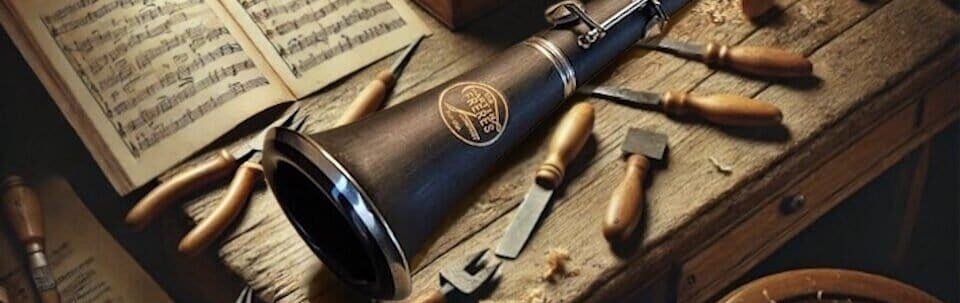
Martin Freres, known for its historical clarinet production in France, occupied the same cultural field that nurtured early jazz manouche and Parisian swing. Many French clarinetists in the mid-20th century encountered Martin Freres instruments in conservatories, dance bands and regional ensembles.
While not exclusively tied to Gypsy jazz, these clarinets contributed to the broader sound of French reed playing that surrounded Django Reinhardt's era. Their tonal character, often described as warm and vocal, aligned well with the acoustic, guitar-driven settings of cafés and dance halls.
Field Note: Archival photographs and catalogs in the Martin Freres collections show French clarinet models marketed to dance orchestras and popular music groups from the 1930s to the 1950s. These materials help document how clarinet, as an instrument, circulated in the same social spaces where jazz manouche flourished.
For historians and collectors, Martin Freres instruments offer a tangible link to the period when clarinet, accordion, violin and guitar coexisted in French popular music. Studying these instruments alongside recordings and concert programs deepens our understanding of the clarinet's role around the Gypsy jazz scene.
Live Performance, Ensemble Communication, and Jam Etiquette
Playing clarinet in a jazz manouche ensemble is as much about communication as technique. Strong listening skills, clear visual cues and respect for tradition help you fit into jams and gigs, whether at a local café or a major festival.
Balancing Roles: Melody, Solos and Support
Clarinet often alternates between lead melody, improvised solos and supportive fills. When another instrument is soloing, keep your volume low and your lines sparse, leaving space for the main voice. Short, tasteful responses at phrase ends can add energy without clutter.
When you take the melody, project confidently and keep the tempo steady. Avoid over-decorating the theme on the first chorus; save more elaborate variations for later, once the groove is established.
Visual and Rhythmic Communication
Use eye contact and small gestures to cue solos, endings and dynamic shifts. A simple nod can signal that you will take the next chorus or that you are ready to hand off to the guitarist. Agree on standard endings for common tunes before the set when possible.
Rhythmically, lock in with the rhythm guitar's right hand. Listen closely to the bass player's time feel and place your phrases so they complement the groove rather than fighting it. Slightly behind-the-beat phrasing can add relaxation on ballads, while more on-top placement suits faster swing.
Jam Session Etiquette for Clarinetists
At open jams, introduce yourself and ask about the tune list and keys commonly used. Volunteer tunes you know well rather than requesting obscure pieces. When many soloists are present, keep your solos concise and focused.
Respect unspoken hierarchies: give space to older or more experienced players, and support less confident musicians with clear melodies and solid time. Offer your clarinet voice as a complement to the guitars and violins, not as a competing lead at every turn.
Further Listening, Archival References, and Discography
Deep listening is central to mastering clarinet in jazz manouche. Combining commercial recordings with archival sources gives you a broader picture of how the instrument functioned in French jazz and popular music across decades.
Recommended Listening Path
Start with Django Reinhardt and the Quintette du Hot Club de France to internalize the core rhythmic and harmonic language. Then explore Claude Luter's recordings with Sidney Bechet for clarinet tone and phrasing ideas that translate well to manouche contexts.
Add modern Gypsy jazz albums featuring clarinet or strong reed sections, paying attention to how the clarinet balances with guitars and bass. Listen repeatedly to a small set of recordings until you can sing along with solos and comping patterns.
Archival Resources: INA and Gallica
The Institut National de l'Audiovisuel (INA) hosts radio broadcasts and television performances of French jazz from the mid-20th century, including clarinetists in swing and popular ensembles. These documents show how clarinet sounded in real performance situations of the era.
Gallica, the digital library of the Bibliothèque nationale de France, offers access to 78 rpm recordings, sheet music and periodicals. Searching for French clarinetists, dance orchestras and early jazz references can uncover lesser-known sides that enrich your stylistic vocabulary.
Discography Notes and Study Approach
Build a personal discography spreadsheet listing album titles, recording dates, personnel and standout clarinet tracks. Note which solos you plan to transcribe and any technical or stylistic features that catch your ear, such as unusual articulations or harmonic choices.
Revisit the same recordings over months and years. As your technique and understanding grow, you will hear new details in phrasing, dynamics and ensemble interaction that you missed initially.
Conclusion: Developing Your Personal Manouche Voice
Clarinet in jazz manouche offers a rich space for personal expression, grounded in a specific rhythmic and cultural tradition. By combining historical awareness, focused technical work and deep listening, you can shape a voice that honors the style while reflecting your own musical background.
Stay close to the core elements: strong time feel, clear arpeggio-based lines, expressive tone and responsive ensemble playing. Over time, your phrasing, sound and repertoire choices will naturally evolve into a distinctive manouche clarinet identity that can thrive in jams, concerts and recordings.
Key Takeaways
- Clarinet in jazz manouche relies on strong swing time, arpeggio-based lines and a flexible, vocal tone that projects over acoustic guitars.
- Historical context from 1930s Paris and post-war French swing informs both repertoire and sound concept for modern players.
- Setup choices in mouthpiece, reed and barrel directly affect projection, glissandi control and blending with guitars.
- Structured practice over 4, 12 and 24 weeks, combined with targeted transcriptions, leads to real progress in improvisation and ensemble confidence.
- Archival resources and historical instruments, including those documented in the Martin Freres collections, deepen understanding of the clarinet's role around the Gypsy jazz scene.
FAQ
What is clarinet in jazz manouche?
Clarinet in jazz manouche refers to the use of clarinet as a lead and ensemble voice within Gypsy (Manouche) jazz. It combines swing-era phrasing, arpeggiated lines and expressive techniques like glissandi with the acoustic, guitar-driven sound associated with Django Reinhardt and Roma musicians.
How does clarinet technique for Jazz Manouche differ from classical clarinet playing?
Compared to classical playing, jazz manouche clarinet uses more flexible pitch, varied articulation, and a stronger focus on swing time and groove. The tone often has a slightly brighter edge for projection, and players emphasize ear-based learning, improvisation and expressive effects like scoops and bends.
Which mouthpiece, reed and ligature combinations work best for Gypsy jazz tone?
Many players prefer a medium to medium-open mouthpiece tip opening around 1.05 to 1.15 mm, paired with reeds in the 2.5 to 3 strength range. Ligatures that balance warmth and clarity, such as fabric or well-designed metal models, help achieve a projecting yet round sound suitable for acoustic ensembles.
Where can I find authoritative clarinet transcriptions for Jazz Manouche solos?
Look for published collections of French swing and Gypsy jazz solos, as well as transcriptions in specialist magazines and online communities focused on manouche music. Archival recordings from INA and Gallica provide primary-source material you can transcribe yourself for deeper stylistic understanding.
How do I avoid squeaks and projection issues when soloing over loud guitars?
To avoid squeaks, keep embouchure stable during glissandi, use well-balanced reeds and check for leaks. For projection, choose a setup with enough brightness, position yourself where you can hear clearly, and use firm articulation and focused air support. Coordinate dynamics with the guitarists so the ensemble balance supports your solos.
Are there recommended recordings or archives to study the clarinet in Gypsy jazz?
Recommended sources include Claude Luter's recordings with Sidney Bechet, modern Gypsy jazz albums featuring clarinet, and archival French jazz broadcasts in INA. Gallica's digitized 78 rpm records and sheet music collections also offer valuable historical material for studying clarinet in the broader French swing and manouche context.
Related Posts: