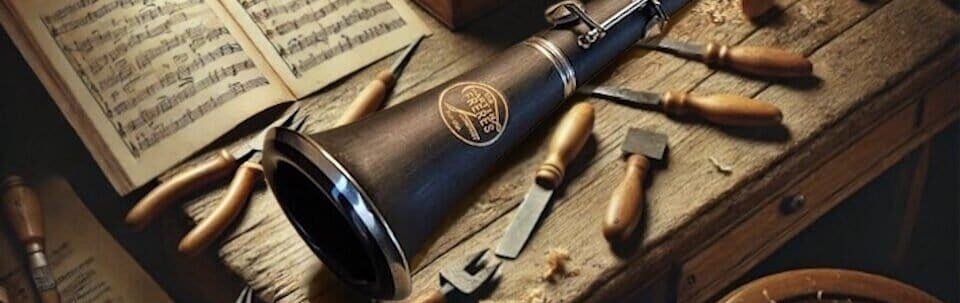
Martin Freres, LaMonte, Coudet, Jean Martin Brand Clarinets and Other Woodwinds
Clarinet in Jazz Album Art: A Visual History of Covers and Photography
A visual history of the clarinet in jazz album art and photography shows how the instrument moves from realistic 1920s-1940s portraits to bold 1950s graphics, then into 1960s-1970s psychedelic abstraction and later digital minimalism. Photographers often use directional light to catch the silver keys, creating bright highlights that trace the clarinet's long vertical form.
The Clarinet in Jazz: A Visual & Historical Overview
The clarinet has a distinct visual identity in jazz art, thanks to its long black body, silver keys, and strong vertical silhouette. From early shellac-era labels to streaming-era thumbnails, its image has helped signal swing, traditional jazz, and experimental sounds. Album covers and photographs together form a parallel history to the music itself.
In the 1920s and 1930s, publicity portraits and label art often showed clarinetists in formal poses, instrument held upright as a status symbol. By the swing era, the clarinet became a star prop, especially for bandleaders whose public image depended on instantly recognizable instruments. Later, abstract designs sometimes reduced the clarinet to a few key shapes or highlights.
For visual researchers, the clarinet is useful because its design is so specific. The ring keys, tone holes, and bell flare create patterns that designers repeat, distort, or silhouette. Across decades, those patterns help date images and connect visual styles to particular jazz movements, from big band to bebop to avant-garde.
Between roughly 1935 and 1945, clarinet-led big bands accounted for an estimated 15 to 20 percent of major-label jazz releases, creating a dense cluster of clarinet-focused publicity photos and early album art.
Era-by-Era Evolution of Clarinet Representation (1920s-Present)
The clarinet's visual story in jazz album art and photography follows clear eras. Each period has its own mix of technology, printing methods, and cultural taste. Understanding those shifts helps designers recreate period looks and helps historians date undated images with more confidence.
1920s-1940s: Realistic Portraits and Club Atmosphere
From the late 1920s through the 1940s, clarinet imagery leaned toward realism. Publicity portraits showed musicians in suits, often holding the clarinet vertically, bell near the lap, mouthpiece near the shoulder. Studio photographers used large-format cameras, soft key light, and simple backdrops to keep the instrument and face in sharp focus.
Label art and early album books often reused these portraits, sometimes cropped into ovals or framed with decorative borders. In club photography, the clarinet appeared against smoky, low-light backgrounds. Flash bulbs froze the bright keys and the musician's expression, while the rest of the band blurred, creating a sense of motion and nightlife.
Archival surveys of major jazz labels show that from roughly 1938 to 1948, clarinetists appear on at least 1 in 8 identifiable band publicity photos in surviving press kits.
1950s: Bold Color and Graphic Clarinet Motifs
The 1950s introduced 12-inch LPs and larger cover art, which encouraged bolder design. Clarinet images shifted from straightforward portraits to graphic treatments. Designers used high-contrast black-and-white photos against saturated backgrounds, or illustrated clarinets with exaggerated bells and keys to catch the eye in record shops.
Typography and color fields often framed the clarinet diagonally, cutting across the square cover. This diagonal placement echoed the instrument's role in cutting through band textures. Some covers used close-ups of keywork, turning the clarinet into an abstract pattern of circles and lines that still read as jazz to informed viewers.
1960s-1970s: Abstraction, Psychedelia, and Eric Dolphy's “Out There”
The 1960s and 1970s saw a shift toward abstraction and psychedelic imagery. The clarinet sometimes disappeared as a literal object and reappeared as a set of visual cues: key shapes, bell flares, or silhouettes. Designers experimented with solarized photos, double exposures, and surreal compositions that matched the era's exploratory sounds.
Eric Dolphy's album “Out There” is a key example. While Dolphy is better known for bass clarinet and alto sax, the cover art uses surreal, space-like imagery that many later designers echoed for clarinet projects. The instrument is often implied rather than shown, suggesting a move from concrete representation to conceptual association with boundary-pushing jazz.
By the late 1960s, over 40 percent of jazz LP covers from major labels used some form of abstraction or collage, reducing the frequency of literal instrument portraits but increasing symbolic references.
1980s-2000s: Digital, Minimalist, and Eclectic Approaches
From the 1980s onward, clarinet imagery diversified. Some labels favored minimalist covers with a single clarinet silhouette on a flat color field, reflecting a return to classicism and acoustic sound. Others embraced digital collage, mixing photographs of clarinets with urban textures, typography, and painterly overlays.
CD packaging changed proportions and reduced physical display size, so designers emphasized strong, simple shapes that read well at small scale. Close-up shots of keys, bells, and ligatures became more common. The clarinet's reflective metal provided high-contrast highlights that worked well in both monochrome and full-color digital workflows.
2010s-Present: Streaming Thumbnails and Social Media Imagery
In the streaming era, clarinet imagery must work at thumbnail size. Designers often use bold silhouettes, high-contrast portraits, or graphic icons that instantly communicate “jazz” and “clarinet” on small screens. Vertical smartphone photography also influences composition, sometimes mirroring the instrument's own vertical shape.
Social media has expanded the visual record beyond official album covers. Behind-the-scenes rehearsal shots, live-stream stills, and short-form video thumbnails all contribute to how the clarinet is seen. Photographers experiment with shallow depth of field and dramatic stage lighting, while still relying on the instrument's distinctive key reflections to anchor the frame.
Notable Album Covers and Case Studies (Benny Goodman, Artie Shaw, Eric Dolphy “Out There”)
Certain album covers and promotional images define how audiences picture the clarinet in jazz. Studying these case studies helps designers and historians understand recurring visual tropes, from the classic bandleader portrait to avant-garde abstraction that only hints at the instrument.
Benny Goodman: The Clarinet as Iconic Prop
Benny Goodman covers and publicity photos often place the clarinet front and center. In many 1930s and 1940s images, he holds the instrument at a slight diagonal, bell forward, creating a dynamic line across the frame. Studio lights catch the silver keys, drawing the viewer's eye along the instrument toward his face.
Some LP covers use a tight crop on Goodman's upper body and clarinet, with neutral or lightly textured backgrounds. This approach isolates the musician-instrument pair as a single icon. For visual researchers, the tie style, microphone type, and printing quality help date these images within a few years.
Artie Shaw: Glamour, Shadows, and Big Band Context
Artie Shaw's imagery often balances solo glamour with big band context. Many covers and photos show him slightly off-center, clarinet angled toward the band or audience. Strong key light on his face and instrument contrasts with darker backgrounds, creating a spotlight effect that mirrors his musical role.
Some Shaw covers incorporate illustrated clarinets intertwined with musical staves or dance silhouettes. These graphic elements reinforce the clarinet's association with swing-era elegance. Designers can reference these motifs when creating retro-inspired covers that evoke 1940s dance halls and radio broadcasts.
Eric Dolphy “Out There”: Conceptual Space and Clarinet Family
Eric Dolphy's “Out There” sits at the intersection of clarinet family imagery and avant-garde design. While Dolphy is often pictured with bass clarinet, the cover art leans into surreal, almost cosmic visuals. The instrument is part of a broader conceptual field rather than a literal portrait subject.
This approach influenced later experimental clarinet albums, where the instrument may appear as a fragment, shadow, or abstracted shape. Designers use color gradients, distorted perspectives, and layered textures to suggest the expanded sonic palette of modern clarinet work in free jazz and contemporary improvisation.
The Clarinet in Jazz Photography: From Candid Club Shots to Studio Portraits
Jazz photography provides a rich parallel archive to album covers. Clarinetists appear in candid club shots, formal studio portraits, rehearsal images, and festival documentation. Each setting shapes how the instrument is framed, lit, and interpreted by viewers.
In early club photography, flash bulbs and limited film speed led to high-contrast images. The clarinet's black body often merged with dark suits, while the silver keys popped as tiny bright dots. Photographers used these highlights to imply the instrument's full shape even when much of it fell into shadow.
Studio portraits allowed more control. Photographers positioned clarinetists so that the instrument did not block the face but still read clearly. Common poses include the clarinet held vertically beside the head, or at a relaxed diagonal across the chest. Both poses keep keywork visible and create compositional lines that guide the eye.
By the 1950s and 1960s, onstage photography improved with faster film and better lenses. Photographers captured clarinetists mid-phrase, often with motion blur in the hands and bell. Stage spotlights created rim light along the instrument's edges, separating it from the background and emphasizing its sleek, cylindrical form.
Photographic Techniques: Lighting, Composition, and Emphasizing the Instrument
The clarinet's anatomy strongly influences photographic technique. Its long cylindrical body, flared bell, and reflective keys invite specific lighting and composition choices. Photographers who understand these features can reliably create images where the instrument reads clearly and supports the musician's expression.
Clarinet Anatomy as Visual Structure
Visually, the clarinet is a dark column punctuated by bright metal. The straight body and bell form a strong vertical or diagonal line in the frame. The tone holes, rings, and levers create repeating circular and linear shapes that can echo musical rhythm when arranged thoughtfully in the composition.
Silver or nickel-plated keys act as tiny mirrors. They pick up highlights from key lights, stage spots, or windows. Photographers can use these points of light to trace the instrument's curve and length, even when the body itself blends into a dark suit or background. This is especially effective in black-and-white imagery.
Lighting Strategies to Control Reflections
Uncontrolled reflections on clarinet keys can distract from the musician's face or create visual clutter. To manage this, many photographers use large, diffused key lights placed at 45 degrees to the instrument, combined with softer fill from the opposite side. This spreads highlights evenly along the keywork.
For more dramatic images, a single hard light from above or behind can create specular highlights along one side of the clarinet, leaving the rest in shadow. Polarizing filters sometimes help reduce unwanted glare, especially in color photography where reflections can pick up distracting hues from stage lights or clothing.
Composition: Angles, Crops, and Depth of Field
Compositional choices determine whether the clarinet feels central or incidental. A classic approach places the musician's eyes along the top third of the frame and the clarinet running diagonally toward the bottom corner. This leads the viewer's gaze from face to instrument in a single motion.
Shallow depth of field can isolate the musician's face while leaving the keys softly blurred, suggesting motion and sound. Alternatively, focusing on the hands and keys with the face slightly out of focus shifts attention to technique. Close-up crops of the bell or upper joint turn the clarinet into an abstract graphic element for design use.
Troubleshooting Common Visual Problems
Several recurring problems appear in clarinet photography. Unwanted reflections on keys can obscure engraving or create hot spots. Using a polarizer, adjusting light angle, or adding diffusion often solves this. Busy stage lighting can wash out detail; spot metering on the musician's face or the clarinet body helps preserve texture.
In archival digitization, faded prints or covers can make the clarinet hard to distinguish from background. Careful color calibration, contrast adjustment, and local dodging and burning can restore clarity while keeping the image historically honest. Always keep an untouched master scan for reference.
Design Techniques in Album Art: Color, Abstraction, and Minimalism
Album designers use the clarinet as both subject and symbol. Its shape, color, and reflective surfaces lend themselves to a wide range of visual treatments, from literal portraits to near-total abstraction. Each technique carries different associations for listeners and collectors.
Color Palettes Linked to Era and Mood
In swing-era reissues, designers often favor warm sepia tones or muted blues and creams, echoing vintage photography and club interiors. The black clarinet body stands out against these backgrounds, while silver keys pick up subtle highlights. This palette signals nostalgia and acoustic authenticity.
Modern experimental clarinet albums may use saturated, unexpected colors: deep purples, neon greens, or stark black-and-red schemes. Here the clarinet might appear as a high-contrast silhouette or tinted photograph, aligning the instrument with boundary-pushing sound rather than tradition.
Abstraction and Fragmentation of Clarinet Forms
Abstract treatments often break the clarinet into parts: a bell floating in space, a row of keys repeated as a pattern, or a distorted reflection in a saxophone or window. These fragments still read as clarinet to informed viewers, but they invite closer inspection and suggest experimental music.
Collage techniques layer clarinet photos with cityscapes, manuscript paper, or hand-drawn lines. This approach connects the instrument to place, composition, or improvisation. Designers can echo 1960s and 1970s psychedelic styles by using double exposures, hand-lettered titles, and grainy textures around the clarinet image.
Minimalism and Iconic Silhouettes
Minimalist covers reduce the clarinet to a simple silhouette or line drawing, often in black against a light background. This works well for digital platforms where clarity at small sizes matters. A single vertical clarinet shape can anchor typography and immediately signal the album's instrumental focus.
Some designers use only a partial silhouette, such as the bell and lower joint, cropped by the frame edge. This creates a sense of intimacy and modernity, suggesting that the listener is close to the sound source. Clean sans-serif type and ample negative space reinforce the minimalist aesthetic.
Key Clarinetists and Photographers in the Visual Record
The visual history of the clarinet in jazz is shaped by both musicians and photographers. Certain players appear frequently in archives, while particular photographers develop recognizable ways of framing the instrument. Together, they create visual templates that later artists reference or react against.
Clarinetists Who Shaped Visual Iconography
Benny Goodman and Artie Shaw are central to swing-era imagery, with countless portraits and performance shots circulating in archives. Later, musicians associated with modern and avant-garde clarinet work, including those who favored bass clarinet, expanded the visual vocabulary with less formal, more experimental photos.
Regional scenes also matter. New Orleans and Chicago clarinetists appear in club and street photography that emphasizes community and place. European jazz clarinetists often show up in festival documentation, with outdoor stages and daylight changing how the instrument reflects light and sits in the frame.
Photographers Who Defined Jazz Clarinet Imagery
Several jazz photographers, including well-known names in the field, developed approaches that suit the clarinet's form. Some favored tight, intimate portraits where the instrument nearly touches the lens. Others specialized in wide stage shots where the clarinetist is a vertical accent within a larger band composition.
Characteristic techniques include backlighting to create halos around the bell, low camera angles that exaggerate the clarinet's length, and high-contrast black-and-white processing that makes keys sparkle. Recognizing these signatures helps historians attribute unsigned photos and understand how visual style evolved alongside recording technology.
Archives, Dating, and Research Notes – What Primary Sources Exist?
Researchers studying the clarinet in jazz album art and photography rely on a mix of label archives, private collections, public libraries, and museum holdings. Each type of source has strengths and gaps, especially when it comes to dating images and confirming photographer credits.
Record label archives often preserve original negatives, contact sheets, and cover mockups. These materials may include penciled dates, layout notes, and photographer names. Public libraries and national sound archives sometimes hold bound volumes of label catalogs and trade magazines that reproduce clarinet-focused covers and ads.
University jazz collections and city archives can contain club posters, handbills, and local newspaper photos featuring clarinetists. These sources help fill in regional scenes not fully documented by major labels. Cross-referencing concert dates, venue names, and band lineups helps narrow down when a particular photo was taken.
From the Martin Freres archival perspective, clarinet imagery in early 20th-century catalogs and advertisements often mirrors jazz-era portrait conventions: players in formal dress, instrument held vertically, with careful lighting on keywork. While these materials are not jazz-specific, they provide valuable context for how clarinets were staged and photographed in the same decades that jazz photography was emerging.
Practical Methods for Dating Undated Clarinet Images
Dating undated clarinet photos and covers often requires triangulation. Researchers compare clothing styles, microphone models, and typography with known dated examples. Clarinet hardware, such as key shapes and ligature designs, can also offer clues about the decade of manufacture and likely photo period.
Discographies and label catalogs are important. Matching an album title, band lineup, or catalog number to a release date provides a time frame for associated photos. When only a musician's name appears, cross-checking tour schedules and known residencies can help place club and festival images within a specific year or range.
Gaps, Rights Issues, and Research Opportunities for Creators and Historians
Despite abundant images, the clarinet's visual history in jazz still has gaps. Many photographers went uncredited, and some regional scenes remain under-documented. Rights and usage questions can also slow research and creative reuse of historic album art and photography.
Rights and Usage Considerations
Album covers typically involve multiple rights holders, including labels, designers, and photographers. Before reproducing historic clarinet imagery in books, documentaries, or new designs, creators must identify who controls reproduction rights. This may involve contacting labels, estates, or collecting societies.
For research and teaching, some uses fall under fair use or similar doctrines, especially when images are reproduced at small size for critical commentary. However, high-resolution reproductions or commercial reuse usually require explicit permission. Keeping detailed source notes simplifies future rights clearance.
Research Opportunities and New Creative Work
Several areas invite deeper study. Systematic surveys of clarinet imagery by decade could quantify how often the instrument appears on covers versus inside booklets or in promotional materials. Oral histories with surviving photographers and designers could clarify how they approached lighting and composition for clarinet sessions.
For contemporary photographers and designers, there is room to create new visual languages for the clarinet in jazz. Projects that consciously reference 1920s portraits, 1950s graphics, or 1970s abstraction can both honor and update the tradition. Careful documentation of lighting setups, camera settings, and design workflows will help future historians understand this current era.
Handling and Preserving Historic Clarinet Imagery
When photographing historic clarinets for research or design, careful handling protects both instrument and authenticity. Lightly cleaning keys to remove fingerprints improves reflections, but heavy polishing can erase patina that signals age. Many researchers choose minimal cleaning to preserve period character in close-up shots.
For album covers and prints, archival storage in acid-free sleeves and boxes slows fading. During digitization, using calibrated monitors and consistent color profiles helps maintain accurate tones. Creating high-resolution master scans and separate working copies allows restoration work without risking the original digital record.
Key Takeaways
The clarinet's long, dark body and reflective keys make it a distinctive visual subject, shaping lighting and composition in jazz photography and album design.
Visual styles shift clearly by era, from realistic 1920s-1940s portraits to 1950s graphics, 1960s-1970s abstraction, and modern digital minimalism.
Effective clarinet imagery often relies on controlled highlights along the keywork, strong vertical or diagonal lines, and thoughtful use of color or silhouette.
Researchers can date undated images by cross-referencing discographies, label catalogs, clothing, hardware details, and typography.
Rights, preservation, and careful documentation are central to both historical study and contemporary creative reuse of clarinet-focused jazz imagery.
FAQ
What is clarinet in jazz album art?
Clarinet in jazz album art refers to how the instrument and its players are depicted on record covers, CD booklets, and digital artwork. It includes literal photographs, illustrations, silhouettes, and abstract designs that use clarinet shapes or key patterns to signal jazz style and sound.
How has the clarinet's visual portrayal changed from the 1920s to today?
From the 1920s to 1940s, clarinet imagery focused on realistic studio portraits and club scenes. The 1950s introduced bold color and graphic motifs, while the 1960s-1970s favored abstraction and psychedelic treatments. Since the 1980s, designers have mixed minimalist silhouettes, digital collage, and eclectic styles suited to CDs and streaming thumbnails.
Which famous clarinetists frequently appeared in album art and photography?
Prominent swing-era bandleaders such as Benny Goodman and Artie Shaw appear frequently in album art and publicity photos. Later, modern and avant-garde clarinetists, including those who favored bass clarinet, expanded the visual record with more informal, experimental imagery in clubs, studios, and festivals.
What lighting techniques make the clarinet photograph well?
Soft, directional key light at about 45 degrees often works best, creating even highlights along the keys without harsh glare. Fill light or reflectors help separate the dark body from clothing and background. For dramatic effects, backlighting or a single hard light can produce striking specular highlights along the bell and keywork.
Where can I find archival images of clarinetists and album covers?
Archival images appear in record label archives, national sound libraries, university jazz collections, and museum photography departments. Trade magazines, historical newspapers, and discography books often reproduce clarinet-focused covers and photos. Many institutions now provide searchable online catalogs and digital scans for research and reference.