If the clarinet had a diary, the G minor scale (natural) would be one of its most honest confessions. Dark but not hopeless, tender but clear-headed, this scale sits beautifully under the fingers of the Bb clarinet and has been whispered, cried, and sung by clarinetists for more than two centuries.
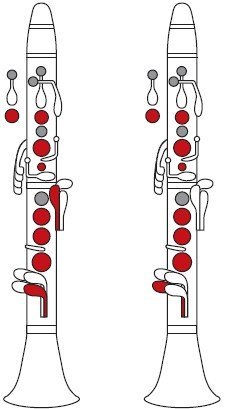
Receive a free PDF of the chart with clarinet fingering diagrams for every note!
The G minor scale (natural) on Bb clarinet is an eight-note pattern from G to G that uses two flats (B flat and E flat). It builds a warm, slightly dark sound that helps clarinetists strengthen finger coordination, develop expressive phrasing, and prepare for orchestral, jazz, and klezmer solos.
The sound and story of G natural minor on clarinet
Play a low G on your Bb clarinet, let it swell slightly, then climb through A, B flat, C, D, E flat, F, and back to G. You have just walked through the G minor scale (natural), the same sound that colors stormy symphonies, smoky jazz solos, and haunting klezmer lines.
This is not a flashy “look at me” key. G natural minor feels like a late-night walk after rain. The B flat and E flat pull the ear inward, giving the chalumeau register that husky, human quality that made composers fall in love with the clarinet in the first place.
Those two flats are the signature of G natural minor on Bb clarinet, shaping the color of countless orchestral passages, jazz choruses, and chamber music solos.
Clarinet legends who lived inside G minor
The history of the G minor scale on clarinet is written in the breath of players who turned simple notes into living stories.
In the classical era, Anton Stadler, Mozart's clarinet muse, helped show just how expressive minor keys could be on early clarinets. While the famous A major Concerto K.622 is brighter, listen to Mozart's Clarinet Quintet and the way inner lines slip through minor inflections. The finger patterns that would later crystallize as our G minor scale were part of Stadler's daily practice, feeding the flexible, singing sound Mozart adored.
Moving into the 19th century, Heinrich Baermann, collaborator of Carl Maria von Weber, brought a theatrical intensity to minor keys. Weber's operatic clarinet writing in pieces like the Concertino in E flat major, Op. 26, is full of passages where the clarinet shifts through minor regions that feel uncannily close to G natural minor patterns. Baermann's romantic slides, wide vibrato, and fearless chalumeau playing made listeners hear minor keys as raw emotion, not just harmony on a page.
Jump forward, and you find Sabine Meyer, Martin Frost, and Richard Stoltzman using minor scales as color palettes. In Meyer's recordings of Brahms's Clarinet Sonatas Op. 120, the way she shapes soft lower-register phrases shows real control of minor scale patterns like G natural minor. Frost's performances of contemporary works by Anders Hillborg and Krzysztof Penderecki use minor-key runs to flick from whisper to scream. Stoltzman, especially in his live performances of Debussy's Premiere Rhapsodie, turns scalar material into human speech, with G minor-like patterns pouring out of the clarinet in sighs and questions.
In jazz, Benny Goodman often leaned on the color of minor scales over blues progressions. Listen to his solos on tunes like Body and Soul or Stompin' at the Savoy. Even when the chart is not literally in G minor, the flavor of natural minor runs sits right under his fingers. You can hear the same vocabulary in Artie Shaw's introspective solos and in Buddy DeFranco's bebop lines, where scales like G natural minor are sliced, inverted, and spun into long chains of eighth notes.
Then there is the clarinet's soulful cousin: klezmer. Giora Feidman and David Krakauer have both shown how minor scales, including G natural minor and its relatives, can sound like weeping, laughter, and dance all at once. In Feidman's recordings of traditional tunes such as Shalom Aleichem or Freylekhs, listen for those natural minor runs that start in a low growl and bloom into a wail in the throat register.
Pieces and recordings where G minor quietly steals the show
Even when the title on the cover does not say “G minor,” the sound of the G minor scale (natural) is everywhere in clarinet literature and beyond.
Take J.S. Bach's orchestral suites and cantatas. Many clarinetists play arrangements of movements originally for oboe or violin. When those lines lie around the low written G to second-line G, the natural minor color fits the Bb clarinet beautifully. Baroque specialists on historical clarinets, such as Eric Hoeprich, often phrase these passages as if they are sung, leaning on the half steps of natural minor patterns.
In the romantic symphonic world, listen to the clarinet parts in Tchaikovsky's Symphony No. 4 or Symphony No. 6 “Pathétique”. The solo in the second movement of Symphony No. 6, though not literally in written G minor for Bb clarinet, uses figures that feel like G natural minor under the hand: stepwise motion, that B b and E b flavor, sighing from chalumeau to clarion.
Chamber music gives even more direct examples. In Brahms's Clarinet Trio in A minor, Op. 114 and the Clarinet Quintet in B minor, Op. 115, the clarinet spends a lot of time in shadowed minor territory where the fingerings mirror G minor scale patterns. The way players like Karl Leister, Sharon Kam, and Jorg Widmann phrase those lines shows how deeply they understand the expressive pull of natural minor.
On the jazz side, the vocabulary of G natural minor sneaks into tunes like Summertime, Minor Swing, and blues pieces in concert F or G minor. Clarinetists such as Anat Cohen and Ken Peplowski use natural minor runs as connective tissue between blues licks and arpeggios. Listen to Cohen's live recordings with her quartet, where she will slide from a G minor scale fragment straight into a bent note over a dominant chord, weaving classical finger fluency into improvisation.
Film and game composers love this sound too. The clarinet solos in scores by John Williams (for example, the darker passages in Schindler's List) or Alexandre Desplat often rely on minor scale material that sits comfortably in the G range of the Bb clarinet. Even if the notation on the page is in a different concert key, the feeling is the same: a quiet, speaking voice tracing a natural minor path.
From early clarinets to cinema: how G minor grew up
On early chalumeaux and classical period clarinets, playing in minor keys was both a challenge and an adventure. Extra keys were slowly added to make notes like E flat more reliable, which made scales such as G minor far more beautiful and secure.
By the time of Baermann and Weber, the clarinet had enough keys on the upper and lower joints that romantic composers could write long, singing phrases in minor keys without fear. The natural minor pattern, with its whole and half steps laid out in a singable way, encouraged composers to treat the clarinet like an operatic voice. Think of Weber's Clarinet Concerto No. 2 in E flat major: behind the fireworks are scale patterns that orbit minor centers very similar to G natural minor.
In the 20th century, as the Boehm system solidified and tuning stabilised, players such as Louis Cahuzac, Reginald Kell, and later Jack Brymer brought a vocal approach to minor keys. Their recordings of French works such as Poulenc's Sonata for Clarinet and Piano and Saint-Saens's Sonata for Clarinet, Op. 167 show a smooth, legato way of moving through natural minor patterns that students still imitate.
Meanwhile, jazz clarinetists in big bands and small groups were bending these same notes. Goodman's use of natural minor runs in arrangements for the Benny Goodman Orchestra helped bridge classical technique and swing phrasing. Later, Buddy DeFranco met bebop vocabulary head-on, and the clean, rapid G minor-based runs you hear in his recordings are pure scale work turned into quicksilver.
Today, G natural minor is just as relevant in contemporary works by composers such as John Adams, Osvoldo Golijov, and Paquito D'Rivera, where lines shift rapidly between tonal centers. Clarinetists in ensembles like the Berlin Philharmonic, the New York Philharmonic, and chamber groups such as the Ensemble Intercontemporain keep this scale alive every time a passage calls for that smoky, grounded minor color.
Why G natural minor feels the way it sounds
The G minor scale (natural) has a special balance. It is not as heavy as harmonic minor with its raised seventh, and it is less restless than melodic minor. On Bb clarinet, especially in the chalumeau and throat tones, the B b and E b soften the sound, like the edge taken off a bright light.
Play a simple melody using just notes from G natural minor and you get a voice that feels introspective but not defeated. That makes it perfect for musical characters who are thinking deeply: a lonely solo in a symphony, a reflective jazz chorus, or a quiet klezmer doina before the dance explodes.
Technically you are simply playing G, A, B b, C, D, E b, F, and back to G. Artistically, you are stepping into a long conversation with players who used those same eight notes to tell personal stories on stages from Vienna to New York to Tel Aviv.
What mastering G minor (natural) does for you
Working with the G minor scale on Bb clarinet is like training in a favorite gym. The fingerings feel familiar, yet the emotional range is huge. You learn to handle throat tones smoothly, move between the chalumeau and clarion registers with one air stream, and shape phrases that actually sound like something you would want to listen to.
Once G natural minor feels comfortable, you will recognize it in repertoire everywhere. That quick clarinet solo that caught your ear in a movie score? Often built from a natural minor pattern. That haunting klezmer phrase you want to copy from Giora Feidman? Underneath the ornaments, it is usually a minor scale like this one, bent and decorated.
| Skill | How G natural minor helps | Where you will feel it |
|---|---|---|
| Tone control | Long tones over low G to middle G teach smooth air and voicing | Brahms chamber music, lyrical movie themes |
| Finger fluency | Patterns with B b and E b improve pinky coordination | Weber concertos, fast klezmer passages |
| Phrasing | Natural minor encourages singing, speech-like lines | Jazz ballads, clarinet solos in film scores |
G natural minor on Bb clarinet: quick fingering notes
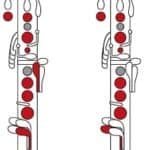
The free clarinet fingering chart for G minor (natural) shows each note with a clear diagram, so you can spend less time guessing and more time listening. On Bb clarinet, your written G minor scale from low G to the next G uses standard fingerings: low G with all main fingers down, A with first finger left hand, B b using the A key plus the first right-hand finger, and so on.
The main technical focus here is consistency. Keep the left-hand register key relaxed when you move from chalumeau to clarion, especially on notes like E b and F. Pay attention to the pinky keys on the lower joint for D and E b, and on the upper joint for F and G in the clarion. The chart will guide your fingers; your ear will guide your phrasing.
- Start on low G and play the scale slowly up and down.
- Listen for a smooth tone across B b and E b.
- Add simple rhythms: long-short, triplets, then even eighth notes.
- Change dynamics: very soft up, fuller sound down.
- Finish by improvising a short melody using only G natural minor.
A simple G minor practice routine you will actually use
You do not need hours. Just a focused 10-minute session with the G minor scale (natural) can change how your clarinet feels in your hands.
| Time | Exercise | Focus |
|---|---|---|
| 2 minutes | Long tones on G, B b, E b | Steady air, even embouchure |
| 3 minutes | Slow scale, 2 octaves if possible | Smooth finger changes, gentle register shifts |
| 3 minutes | Rhythmic patterns (triplets, accents) | Articulation, tongue placement on the reed |
| 2 minutes | Free melody in G natural minor | Expression, dynamics, personal style |
Common G minor scale issues and quick fixes
Most problems in G natural minor on Bb clarinet are small and fixable. A few minutes of focused listening can straighten out even the fussiest B b or E b.
| Problem | Likely cause | Quick adjustment |
|---|---|---|
| B b sounds stuffy | Closed throat or heavy jaw pressure | Think “ee” inside your mouth, relax the lower lip slightly |
| E b cracks in clarion | Uneven air support at the register break | Blow through the break, keep fingers close to the keys |
| Scale feels uneven | Rushed fingers, no rhythmic anchor | Use a metronome, play in slow eighth notes before speeding up |
Key Takeaways
- Treat the G minor scale (natural) as a color palette, not just an exercise: listen for its warm, introspective sound on Bb clarinet.
- Connect your practice to real music by hearing G natural minor in Brahms, jazz ballads, klezmer tunes, and film scores.
- Use the free fingering chart to make mechanics easy, then spend your energy on tone, phrasing, and expressive playing.
Frequently Asked Questions
What is G Minor Scale (Natural) on Bb clarinet?
The G minor scale (natural) on Bb clarinet is a scale using the notes G, A, B b, C, D, E b, F, and G. It has two flats and creates a warm, slightly dark sound. Clarinetists use it to build finger fluency, improve tone across registers, and shape expressive lines in many musical styles.
Why should I practice the G natural minor scale regularly?
Regular work on G natural minor strengthens your control over B b and E b, improves your register transitions, and deepens your sense of phrasing in minor keys. Because this pattern appears in classical, jazz, klezmer, and film music, confidence with this scale directly improves real repertoire playing.
How does G natural minor differ from G harmonic minor on clarinet?
G natural minor keeps F natural as the seventh note, while G harmonic minor raises it to F sharp. On clarinet, natural minor sounds smoother and more lyrical, while harmonic minor has a sharper, more dramatic pull into the top G. Both are useful, but natural minor is usually more comfortable for long, singing lines.
Which famous clarinet pieces use G minor-like patterns?
You can hear G minor-style patterns in Brahms's clarinet works, Weber concertos, jazz ballads by Benny Goodman, klezmer solos by Giora Feidman, and many film scores by John Williams and Alexandre Desplat. Even when the key signature is different, the natural minor pattern often shapes the clarinet's melodic lines.
How can I make my G minor scale sound more musical?
Think in phrases, not in single notes. Add dynamics, vary your articulation, and imagine your scale as the theme of a slow movement or a jazz ballad. Listen to players such as Sabine Meyer, Richard Stoltzman, and Anat Cohen, then try to echo their flowing, vocal approach when you play G natural minor.
For more clarinet stories, charts, and practice ideas, visit other scale and technique posts on Martin Freres and keep your G minor singing.