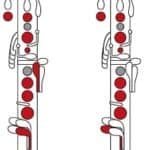
If the clarinet had a midnight voice, it would probably speak in the E minor scale (natural). There is something about E minor on a Bb clarinet that feels like a quiet conversation after a concert, when the lights are low, the reed is soft, and you are finally playing just for yourself.
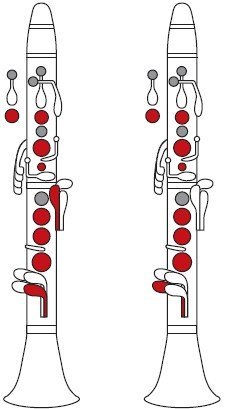
Receive a free PDF of the chart with clarinet fingering diagrams for every note!
The E minor scale (natural) on Bb clarinet is an 8-note stepwise pattern from low F# to top F# that uses one sharp (F#) and no accidentals in the pattern. It trains lyrical phrasing, even tone, and expressive control across the chalumeau and clarion registers for warm, singing clarinet playing.
The sound story of the E minor scale (natural)
E minor on Bb clarinet is one of those keys that feels like it already knows your secrets. It sits beautifully in the chalumeau register, where low G, A, B, and C wrap the listener in that dark, woody sound that made players fall in love with the instrument in the first place. Add the clarion D and E above the break, and suddenly the line sounds like it belongs in a Brahms clarinet sonata or a John Williams film score.
Technically, the E minor scale (natural) is simple: just one sharp, F#. Emotionally, it is anything but simple. That raised F gives the scale its pull, its quiet tension. When you move from E to F#, the clarinet throat tones and upper register start to glow, a bit like the opening of a story that you know will not have a tidy ending.
The natural E minor scale on Bb clarinet uses the same F# you already know from G major. That shared fingering makes E minor a comfortable key for players moving from bright major sounds into darker, more lyrical territory.
How great clarinetists sang through E minor
If you listen closely to your favorite clarinetists, you will start to hear E minor hiding inside solos, cadenzas, and quiet phrases that steal the show. The scale itself may not be announced, but its color is everywhere.
Think of Sabine Meyer playing Brahms. In the Clarinet Sonata in E flat major, Op. 120 No. 2, she often passes through E minor shapes in the development sections, especially in the first movement. Her legato between chalumeau F# and clarion B turns what could be a simple E minor passage into a human voice breathing on a single line. Listen to how she uses air and finger precision through that F# and G to keep the sound spinning.
Martin Frost, on his recordings of Carl Nielsen and Anders Hillborg, loves using E minor colors as a way to create suspense before wild modern explosions of sound. In Nielsen's Clarinet Concerto, while the piece is not in E minor, Frost shapes several scalar runs that trace the natural E minor pattern across the register break, especially around the clarion E and F#. Those moments feel like the clarinet is whispering before it shouts.
Go back further, to Heinrich Baermann and Carl Maria von Weber. Weber wrote passages that lean on E minor shapes in his Clarinet Concerto No. 1 in F minor and Concertino in E flat major. Baermann, the star clarinetist of his day, would have practiced scales obsessively on his 19th-century boxwood instrument, including natural minor patterns like E minor, to keep his embouchure flexible and his throat tones bright. Those old instruments loved darker keys, and E minor sat right in their sweet spot.
In the jazz world, Benny Goodman often slipped into E minor on Bb clarinet when transitioning between keys in tunes like Body and Soul and Stompin' at the Savoy. Listen to his small group recordings: the moments where he climbs through an E minor fragment from F# to B and back down feel like he is changing the emotional light in the room with just a few notes.
Artie Shaw used E minor patterns to add drama in ballads. In pieces like Begin the Beguine, he weaves in minor scale fragments that kiss E minor, especially when stretching phrases in the upper clarion register. That touch of sadness against a swing rhythm is part of what made his sound unforgettable.
For klezmer, players like Giora Feidman and David Krakauer lean heavily on natural minor and harmonic minor sounds that orbit around E minor-like shapes. Tunes such as Der Heyser Bulgar often pass through E minor-flavored phrases. On clarinet, the push from low E-like centers up to B and back through G and F# creates a singing cry that is both joyful and aching.
E minor through history: from baroque shadows to film scores
Long before the modern Bb clarinet found its way into jazz clubs and symphony halls, baroque composers were already in love with E minor. On the chalumeau and early clarinet, E minor felt like twilight: gentle but slightly haunted.
In baroque music, composers like Johann Melchior Molter and Telemann experimented with minor keys that sit comfortably on wind instruments. While many of their clarinet concertos favor D and F, their chamber writing often slips into E minor episodes, especially when lines pass through the range that we now call the chalumeau register. Those early clarinets, with fewer keys, made natural minor scales a test of pure finger coordination.
By the classical era, Anton Stadler, Mozart's clarinet muse, would have known the feel of E minor intimately, even though the Clarinet Concerto in A major, K. 622 is in a much brighter key. Listen to the Adagio of the concerto or the Clarinet Quintet in A major, K. 581: several passing passages outline E minor shapes, especially over dominant harmonies. The clarinet line briefly darkens, like a cloud crossing the sun.
The romantic era loved E minor. Johannes Brahms worked with clarinetist Richard Mühlfeld, and in pieces such as the Clarinet Trio in A minor, Op. 114 and Clarinet Quintet in B minor, Op. 115, the clarinet line shifts through E minor almost like a second home key. Repeated patterns F#-G-A-B across the break echo the natural E minor scale and demand smooth connection between barrel, upper joint, and lower joint.
In orchestral writing, composers such as Tchaikovsky and Dvorak often hand the clarinet E minor melodies that need to speak over the strings. In Tchaikovsky's Symphony No. 5, there are clarinet passages in related minor keys that feel like they live inside the E minor color family. The player must shape every interval of the natural minor scale for clarity, especially in the throat tones between A and B.
The 20th century opened E minor up to new spaces. Igor Stravinsky, in pieces like The Soldier's Tale, writes clarinet lines that twist through E minor fragments with sudden leaps, using tongue and finger agility between the upper and lower joints. Later, composers such as Olivier Messiaen and Jean Francaix play with natural minor and modal variants that orbit E minor, using its dark simplicity to contrast with wild harmonic colors.
Film music embraced E minor for its emotional clarity. In John Williams‘ scores, including Schindler's List and Harry Potter and the Prisoner of Azkaban, you will hear clarinet solos and countermelodies that sit right on E minor patterns. A single line from low G up through B and down to E can sound like a complete story. The natural E minor shape is often the skeleton under all that orchestral color.
On more recent recordings, clarinetists like Richard Stoltzman and Sharon Kam use E minor as a favorite key for encore pieces and arrangements. Listen to Stoltzman's interpretations of Gershwin or Piazzolla: in rubato sections, he leans into E minor shapes to add a gentle ache to phrases, supported by a soft reed and relaxed embouchure.
Iconic pieces and moments that breathe E minor
You might not see “E minor” stamped across the cover of many clarinet works, but the scale appears inside countless phrases, cadenzas, and solos. Here are some concrete spots where the E minor scale (natural) helps the clarinet speak clearly.
- Brahms Clarinet Quintet in B minor, Op. 115 – The slow movement includes lyrical clarinet lines that glide through natural E minor shapes, especially in the middle register around clarion E and F#. Many players use E minor scale practice to polish those exact measures.
- Weber Clarinet Concerto No. 1 in F minor, Op. 73 – In the first movement, several runs in the clarion register outline E minor patterns from F# to F# an octave above, demanding fluid finger work and steady air through the break.
- Finzi Clarinet Concerto, Op. 31 – The flowing lyrical sections often ease into E minor-like patterns, with clarion D and E forming the high points of phrases that require perfect throat tone tuning.
- Goodman small group recordings – On tracks like Body and Soul and Soft Winds, Benny Goodman turns E minor scale runs into emotionally charged lines, especially during intros and quiet choruses.
- Klezmer traditional tunes such as Freilach and Bulgar – Clarinetists like Giora Feidman and David Krakauer adapt these with E minor and related natural minor colors, using scoops, slides, and ornaments on notes like G, A, and B that sit directly inside the E minor scale.
- Contemporary solo pieces by composers like Krzysztof Penderecki and Jorg Widmann – Even in avant-garde writing, E minor fragments appear as islands of tonality in the middle of multiphonics and extended techniques.
| Piece or Style | How E minor shows up | What it trains on clarinet |
|---|---|---|
| Brahms chamber music | Melodic lines built from E-F#-G-A-B | Legato across break, warm chalumeau colors |
| Jazz ballads (Goodman, Shaw) | E minor runs as transitions and fills | Expressive vibrato, melodic shaping, breath control |
| Klezmer tunes | Natural and harmonic minor riffs around E | Ornamentation, pitch bending, finger flexibility |
Why the E minor scale (natural) feels so personal
E minor has a way of making the clarinet sound like it is thinking out loud. On a Bb clarinet, that scale from low F# up to the octave F# passes through some of the instrument's most expressive notes: low G, the open A, the clear clarion B, and the slightly vulnerable throat tones. Each of those notes reacts directly to how you breathe and how gently you hold the mouthpiece with your embouchure.
Playing the E minor scale (natural) slowly can feel like reading your own handwriting. Every connection between lower joint and upper joint shows up in the sound. If your left hand pinky keys are uncertain, you hear it between E and F#. If your register key is not coordinated, the step from B to C across the break will betray you. That vulnerability is exactly what makes this scale such a powerful emotional tool.
Artistically, E minor is a color between resignation and hope. Play it with straight tone and you can sound almost ancient, like a folk clarinet on a hillside somewhere. Add a touch of vibrato on the clarion E and a slight swell on the long notes, and suddenly the line feels cinematic. It is no accident that composers pick this key area whenever they want a clarinet line that sounds honest.
What mastering E minor opens up for you
Once the E minor scale (natural) feels comfortable under your fingers, you begin to notice how often it appears in your music folder. That etude in G major from your method book suddenly has a middle section that slips into E minor. The orchestral excerpt that used to feel scary turns out to be a simple E minor pattern plus a few chromatic notes. The jazz chart calls for E minor over a chord symbol, and you realize you already know exactly how that sounds on your instrument.
Practicing E minor on Bb clarinet connects directly to:
- Crossing the break smoothly between B, C, D, and E with the register key
- Balancing throat tones like A and Bb with the darker chalumeau G and F#
- Shaping long lyrical lines like those in Brahms, Finzi, and Mahler
- Improvising softly over E minor chords in jazz ballads or film themes
For beginners, this scale can be the first minor key that truly feels singable. For advanced players, it is a return to fundamentals with the sophistication of a seasoned musician. Many professionals will warm up in E minor just to check that their reed, ligature, and embouchure are letting the instrument speak freely in the low and middle registers.
Even a short daily routine on the natural E minor scale can improve tone, breath support, and break control more effectively than running several random scales without focus.
A quick word about the fingering chart itself
The fingering chart for the E minor scale (natural) on Bb clarinet looks familiar because it shares so much with G major. You still use the same F#, the same left-hand setup on the upper joint, and the same register key motion for clarion B through E. The only difference is the emotional line you draw between those notes.
On the chart, you will see E minor written as starting on F# on staff for Bb clarinet, up through G, A, B, C, D, E, and back to F#. Most of the fingerings use standard basic position: left-hand first, second, and third fingers on the upper joint tone holes, right-hand fingers on the lower joint, and pinky keys for low F# and C#. The challenge is not the fingering itself, but how cleanly each note flows into the next.
- Start on low F# with the right-hand pinky key and full lower joint coverage.
- Move to G, A, and B in the chalumeau register, keeping your air steady through the barrel and mouthpiece.
- Use the register key to lift into clarion C, D, and E with the same relaxed embouchure.
- Finish on clarion F#, keeping your tongue light and your fingers close to the keys.
| Note in E minor | Register | Focus while using the fingering chart |
|---|---|---|
| F#, G, A, B | Chalumeau | Even tone between lower joint and throat tones, relaxed right-hand position |
| C, D, E | Clarion | Register key coordination, smooth crossing of the break, stable embouchure |
| Top F# | Clarion | Centered pitch, gentle vibrato if stylistically appropriate, light fingers |
A simple E minor practice ritual you can keep
Here is a small E minor routine that fits easily at the start of your practice, whether you are getting ready for Weber, big band charts, or a klezmer wedding set. Use the fingering chart for visual reference, but keep your ears and heart in charge.
| Exercise | Time | Focus |
|---|---|---|
| Slow E minor scale, full notes | 2 minutes | Long tones on each step, especially G, B, and E. Listen for even color across chalumeau and clarion. |
| E minor in thirds (E-G, F#-A, etc.) | 3 minutes | Finger independence and clean crossing of the break on C-E and D-F# pairs. |
| Short E minor improvisation | 3 minutes | Create simple melodies using notes from the E minor scale, as if you were writing your own Brahms phrase or film theme. |
As you grow with the instrument, you can connect this E minor work with other clarinet studies. For example, you might pair it with a lyrical etude from your method book or with a movement from a clarinet sonata. On Martin Freres, you can find more context in articles about expressive phrasing, historical clarinet playing, and tonal development that deepen how you use this scale musically.
Key Takeaways
- The E minor scale (natural) on Bb clarinet is a simple one-sharp pattern that opens the door to lyrical, emotionally rich playing.
- Great clarinetists from Brahms-era soloists to Benny Goodman and Giora Feidman rely on E minor colors in iconic pieces and recordings.
- Use the free fingering chart and a short daily E minor ritual to strengthen tone, break control, and expressive phrasing.
Frequently Asked Questions
What is the E minor scale (natural) on Bb clarinet?
The E minor scale (natural) on Bb clarinet is an 8-note pattern that uses F# as its only sharp and follows the sequence E, F#, G, A, B, C, D, E (written as F# to F# for Bb clarinet). It trains smooth finger motion, a singing tone, and expressive phrasing across the chalumeau and clarion registers.
Why does the E minor scale feel especially expressive on clarinet?
E minor flows through some of the clarinet's most vocal notes: low G and A, the warm throat tones, and the clear clarion B and E. Because those notes react directly to air and embouchure, small changes in breath or finger pressure create noticeable emotional shifts, making E minor ideal for lyrical, introspective playing.
Which famous clarinet pieces use E minor colors?
Many pieces touch E minor even if they are not formally in that key. Brahms chamber works for clarinet, Weber's concertos, Finzi's Clarinet Concerto, jazz ballads by Benny Goodman, and klezmer arrangements by Giora Feidman all feature passages shaped by natural E minor patterns, especially around F#, G, A, B, and clarion E.
How often should I practice the E minor scale (natural)?
Practicing E minor for 5 to 10 minutes a day is plenty for most players. A short routine of slow scales, simple intervals, and a bit of free improvisation will gradually improve your break control, throat tone tuning, and lyrical phrasing, without overwhelming your regular clarinet practice plan.
Is the fingering for E minor different from G major on Bb clarinet?
The basic fingerings are very similar. Both G major and natural E minor use F# as their only sharp. The main difference is the tonal center and the emotional direction of the line. You still use standard left-hand and right-hand positions, the same register key motion, and familiar throat tone fingerings when playing the E minor fingering chart.