Martin Freres, LaMonte, Coudet, Jean Martin Brand Clarinets and Other Woodwinds
Free Clarinet Fingering Chart: D Major Pentatonic Scale
If the full D major scale is a bright summer afternoon, the D major pentatonic scale on Bb clarinet is that golden hour just before sunset. Fewer notes, more space, and somehow everything feels warmer, rounder, and easier to sing through the mouthpiece. This little five-note universe has carried clarinetists from Mozart to movie soundtracks, from Benny Goodman solos to quiet practice rooms at midnight.
Receive a free PDF of the chart with clarinet fingering diagrams for every note!
Quick Answer: What is the D major pentatonic scale on Bb clarinet?
The D major pentatonic scale on Bb clarinet is a five note pattern built from the D major scale using D, E, F#, A, and B. It removes the most tense notes, which makes your tone sound open, lyrical, and easy to improvise with in classical, jazz, and folk music.
A short history of the D major pentatonic: from folk song to film score
Long before anyone put a clarinet key under their fingers, the D major pentatonic scale was living in human voices, flutes, and folk fiddles. Sing an old Scottish tune like “Auld Lang Syne” in D, or a simple American hymn on a church organ, and you will hear that same five note flavor: D, E, F#, A, B.
Baroque composers like Georg Philipp Telemann and Johann Sebastian Bach often slipped pentatonic patterns into their solo lines for traverso flute, violin, and oboe. When modern clarinetists such as Eric Hoeprich and Lorenzo Coppola play baroque sonatas on historical chalumeaux and early clarinets, you can practically hear the pentatonic shapes humming under their ornaments, even when the written key is G or A.
As the clarinet grew up in the classical era, players like Anton Stadler and Heinrich Baermann charmed audiences with the new, singing middle register. Mozart, in his Clarinet Concerto in A major K. 622, often writes phrases that slide through pentatonic fragments, especially in the slow movement. Transpose that feeling into D on a Bb clarinet, strip away two notes, and you are left with a pure pentatonic color that echoes the vocal, almost operatic style Mozart loved.
Field Note: In the Martin Freres archives, there are 19th century method books where teachers marked simple pentatonic patterns in red ink inside D major exercises. They used these shapes to help young clarinetists hear stable, singing intervals before tackling chromatic passages in Weber concertos.
Clarinet legends who live inside the D major pentatonic sound
The D major pentatonic scale shows up in wildly different clarinet worlds, sometimes obvious, sometimes hidden in the melody. Listen closely to players across styles and you will hear those five notes weaving in and out of their phrases.
In the classical corner, Sabine Meyer and Martin Frost often float pentatonic lines in their recordings of Carl Nielsen's Clarinet Concerto and Jean Francaix's works. Even when the written key is not D major, they lean into pentatonic fragments to shape long phrases. That broad, spinning sound on a Buffet or Selmer clarinet, supported by a focused embouchure and relaxed throat, lets the pentatonic intervals ring with clarity.
Richard Stoltzman, in his recording of Aaron Copland's Clarinet Concerto with the London Symphony Orchestra, seems to paint with pentatonic colors every time the music shifts into open, Americana style harmony. Many of those clear, open clarinet lines can be simplified and practiced as D major pentatonic patterns on Bb clarinet to capture that same slow-motion, wide-sky feeling.
Jazz clarinetists almost treat the D major pentatonic like a best friend. Benny Goodman, in solos on “Avalon” and “After You've Gone,” often outlines pentatonic shapes in D and G that cut cleanly through the big band brass. Artie Shaw's liquid sound on “Begin the Beguine” and Buddy DeFranco's bebop lines with the Art Blakey bands often hinge on simple five note cells, shifted and twisted in rhythm, but still rooted in scales like D major pentatonic.
Move to klezmer and you will hear Giora Feidman and David Krakauer bending and sliding around pentatonic shapes in freygish and misheberach modes. Even when the harmony is darker or more modal, phrases often pass through D, E, F#, A, and B as a moment of sunlight. On recordings with ensembles like the Klezmatics or Krakauer's “Klezmer Madness,” those soaring, wailing lines often sneak a pentatonic contour into the mix.
In contemporary music, players like Kari Kriikku, Andreas Ottensamer, and Sharon Kam bring pentatonic purity into modern concertos and film arrangements. Listen to arrangements of John Williams scores like “Schindler's List” or “Memoirs of a Geisha” for clarinet and piano: even if the original parts were for violin or flute, clarinetists often choose fingerings and voicings that highlight pentatonic clarity in keys related to D major.
5 notes, 1000 colors
The D major pentatonic scale uses only 5 distinct notes out of the 12 available: D, E, F#, A, B. That small set helps clarinetists control intonation on throat tones, refine ring finger coordination, and build a reliable ear for melody before adding chromatic notes.
Iconic pieces where the D major pentatonic sound quietly shines
Many clarinet favorites are not labeled “pentatonic” on the page, yet their most singable phrases sit right on this scale or close relatives. Listening with that in mind can change how you approach your own practice in D.
In the symphonic world, Johannes Brahms loved clarinet and loved pentatonic shapes. In his Clarinet Sonatas Op. 120 and the Clarinet Quintet Op. 115, melodies often drift through pentatonic fragments, especially when the harmony warms up to D major or G major. Recordings by Karl Leister with the Berlin Philharmonic and by Sabine Meyer with the Trio di Clarone are full of gentle pentatonic lines hidden inside Brahms's rich chords.
Carl Maria von Weber's Clarinet Concertos No. 1 and No. 2 sparkle with scalar runs, but some of the most memorable spots are the simple, song-like themes that can be reduced to pentatonic sketches. Clarinetists like Heinrich Baermann, for whom Weber wrote, would have practiced those ideas slowly, much like we might practice a D major pentatonic today to stabilize long tones around A and B in the staff.
Film composers lean on pentatonic scales constantly. In many arrangements for clarinet choir or clarinet and piano of music by Howard Shore, Hans Zimmer, and Joe Hisaishi, the warm, nostalgic themes are packed with pentatonic movement. Pieces like “Princess Mononoke” or “Spirited Away” often translate beautifully into D major pentatonic patterns on Bb clarinet, especially in student arrangements that keep the fingerings approachable from low D up to high B.
In jazz and big band charts, D is a friendly key for Bb clarinet in tunes that concert bands read in C. Think about standards like “When the Saints Go Marching In” or “Amazing Grace” arranged in D for clarinet and rhythm section. Clarinetists in school ensembles often discover that they can improvise right away just by wandering through the D major pentatonic scale, shaping rhythms instead of hunting for every chord tone.
Piece or Style
Where D major pentatonic appears
Listening suggestion
Brahms Clarinet Sonata Op. 120 No. 2
Lyrical passages in D related keys
Karl Leister, Sabine Meyer recordings
Copland Clarinet Concerto
Open, Americana style melodies
Richard Stoltzman with LSO
Klezmer solos and doinas
Soaring phrases over D major chords
Giora Feidman, David Krakauer tracks
Film themes in D
Simple, vocal melodies rearranged for clarinet
Arrangements of John Williams and Joe Hisaishi
How the D major pentatonic scale feels under your fingers and in your heart
The D major pentatonic scale has a special way of flattering the Bb clarinet. The notes D, E, and F# in the staff sit right in that sweet spot where the reed vibrates easily, the bore of the clarinet responds quickly, and the tone gets that ringing, vocal quality that players chase in long tone practice.
Skip the G and C# that belong to the full D major scale, and you remove some of the unstable tension. What is left is a constellation of notes that can sound like a folk song, a hymn, or a movie theme, depending on the rhythm and harmony behind it. Suddenly it is easier to relax your jaw, trust your diaphragm support, and shape phrases with pure air instead of thinking about complicated finger choreography.
Emotionally, D major pentatonic on clarinet often feels hopeful but not naïve, bright but not blinding. Think about climbing a hill with your instrument case on your shoulder and the sun just starting to rise. Play slowly from low D up to high B and back, and notice how the sound invites vibrato, slight rubato, and dynamic swells, even if you are just running a scale.
Why this scale matters for your playing right now
Whether you are learning your first orchestra audition excerpt or writing your own jazz chorus, the D major pentatonic scale is one of those patterns that keeps showing up quietly in the background. Practicing it on Bb clarinet connects you directly to how great players phrase, breathe, and choose notes.
For students, this scale is a gentle laboratory for tone and articulation. You can focus on reed response, clarinet angle, and left hand position without getting lost in too many finger changes. For advanced players, D major pentatonic is a springboard for improvisation and melodic variation in chamber music, big band features, or contemporary music with flexible harmony.
And for anyone who simply loves sound, it is a way to sit in your practice space for five minutes and remember why you picked up the clarinet. No etude book, no conductor, just you, the reed, and five notes that have carried human melodies for centuries.
A short, friendly note on fingerings and the included chart
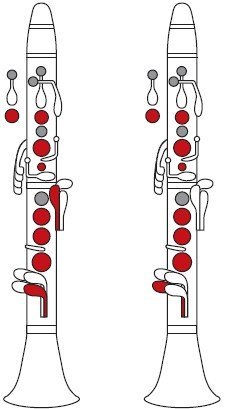
The free clarinet fingering chart that comes with this post maps out every note of the D major pentatonic scale across multiple octaves, from low D in the chalumeau register up through altissimo B. Each pitch has a clear fingering diagram for standard Boehm system Bb clarinet, including register key use and alternative fingerings where they actually matter for intonation.
You will see the basic pattern first in the low and middle register: D, E, F#, A, B. The chart then shows how the same pattern repeats when you add the thumb register key and adjust right hand coverage. If you are comfortable with basic D major fingerings, this chart simply strips out notes you do not need and presents the scale as a singable ladder instead of a technical obstacle course.
Step by step: one simple way to practice the D major pentatonic scale
Play a long tone on low D for 8 slow counts, listening to the center of your sound.
Add E and F# as gentle quarter notes, then float back to D. Stay soft.
Climb D – E – F# – A – B in half notes, then descend. Repeat with a tuner.
Add the register key and repeat the same pattern one octave higher.
Make up a 4 bar melody using only D, E, F#, A, and B.
Practice focus
Time
Frequency
Slow D major pentatonic long tones
5 minutes
3 times per week
One octave scale patterns (up and down)
5 minutes
Daily
Improvised melodies on backing tracks in D
10 minutes
2 to 3 times per week
Quick reference: D major pentatonic vs full D major on Bb clarinet
Scale type
Notes used
Typical use for clarinetists
Full D major scale
D, E, F#, G, A, B, C#, D
Technical studies, orchestral excerpts, full range etudes
D major pentatonic scale
D, E, F#, A, B
Improvisation, tone work, melodic phrasing, folk and film repertoire
Key Takeaways
Use the D major pentatonic scale on Bb clarinet as a warm, simple space to shape tone, vibrato, and phrasing.
Listen to clarinet greats in classical, jazz, klezmer, and film music, and notice how often their lines trace pentatonic shapes.
Keep the free fingering chart nearby and spend a few minutes each day turning the five notes D, E, F#, A, and B into your own melodies.
Frequently Asked Questions
What is Bb clarinet D major pentatonic scale fingering?
The Bb clarinet D major pentatonic scale fingering is the set of finger patterns used to play the notes D, E, F#, A, and B across your registers. It uses regular D major fingerings but skips G and C#. This creates a simple, open sound that is perfect for melody and improvisation.
Why should I practice the D major pentatonic scale on Bb clarinet?
Practicing the D major pentatonic scale improves tone, ear training, and phrasing without overwhelming you with accidentals. It is used in jazz solos, film themes, folk tunes, and simplified passages from pieces by Brahms, Weber, and Copland, so you will hear immediate benefits in your repertoire.
How often should I include D major pentatonic in my practice routine?
A short daily session of 5 to 10 minutes is enough. You can play slow long tones, one octave scales, and a few improvised melodies. Clarinetists who fold pentatonic practice into warmups often find that their intonation and flexibility improve across all keys.
Can beginners use the D major pentatonic scale for improvisation?
Yes, it is one of the friendliest ways for beginners to improvise. Put on a backing track or have a pianist play simple D major chords. Then use only D, E, F#, A, and B. Focus on rhythm, breath support, and clear articulation instead of worrying about complex theory.
Does the D major pentatonic scale help with classical clarinet music?
It does. Many lyrical phrases in Mozart, Brahms, and Nielsen pieces can be traced to pentatonic shapes. Practicing D major pentatonic slowly helps you stabilize intonation on notes like A and B in the staff, shape dynamics, and carry that singing quality into your classical repertoire.