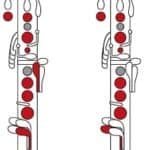
If the major scale is bright daylight on your Bb clarinet, the C Phrygian scale is twilight: that moment when colors deepen, streetlights flicker on, and the air starts to buzz with mystery. One pass through a slow C Phrygian scale and the clarinet stops sounding polite and starts sounding like it has stories to tell.
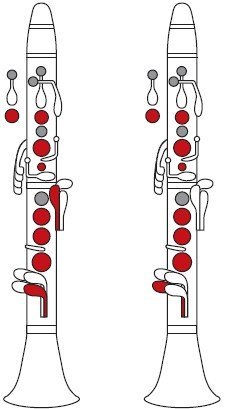
Receive a free PDF of the chart with clarinet fingering diagrams for every note!
The C Phrygian scale on Bb clarinet is an eight note minor mode built on C with a flattened 2nd, 3rd, 6th, and 7th degrees, sounding a whole step lower as Bb concert. It gives clarinetists a dark, Spanish flavored color that enriches improvisation and expressive phrasing.
The C Phrygian scale and its unforgettable mood
The C Phrygian scale on Bb clarinet is pure atmosphere: C, Db, Eb, F, G, Ab, Bb, C. On a Bb clarinet this sounds as Bb Phrygian in concert pitch, so your fingers shape C while the room hears a low, smoky Bb. That flattened 2nd, Db against C, is where the magic lives.
Think of it as the cousin of C natural minor that secretly listens to flamenco, film scores, and late night jazz. Lean into C, then brush against Db, and suddenly the clarinet feels like a human voice catching its breath before confessing something important.
The 2nd, 3rd, 6th, and 7th scale degrees are flattened, giving the C Phrygian scale its dark, Iberian flavor and gripping melodic pull for clarinetists.
From ancient modes to clarinet bell: a short history of Phrygian color
The Phrygian mode long predates the modern clarinet. Its roots go back to early modal music sung in churches and courts, evolving from ancient modal systems into the modes that composers like Palestrina and Monteverdi shaped in their choral lines. When the clarinet finally arrived in the 18th century, players suddenly had a reed voice that could bend those modes like a singer.
Early clarinet pioneers such as Johann Christoph Denner were not yet thinking in terms of C Phrygian on a Bb clarinet. But as the instrument grew, clarinetists like Anton Stadler, Mozart's friend and muse, started to bring modal flavors into Classical lines. Even in Mozart's Clarinet Concerto in A major, K. 622, you can hear shadowy turns that hint at Phrygian leaning appoggiaturas, especially in lyrical passages where the clarinet brushes against flattened notes.
In the 19th century, composers such as Carl Maria von Weber and Louis Spohr took the clarinet into darker, more dramatic corners. The slow movements of Weber's Clarinet Concerto No. 1 in F minor and his Concertino often slide over Phrygian inflections, even when they are not strictly C Phrygian. Those expressive dips to a flattened 2 or 6 feel right at home under the clarinet's keys.
How great clarinetists lean into the Phrygian sound
Even if you never see the label “C Phrygian” in a part, famous clarinetists have been flirting with its color for decades. Listen with your ear tuned to that half-step tension from the root to the 2nd, and you will start to recognize C Phrygian all over the clarinet universe.
In classical circles, Sabine Meyer has a special way of shading Phrygian touches. In her recordings of Claude Debussy's Première Rhapsodie and Olivier Messiaen's “Abîme des oiseaux” from Quatuor pour la fin du temps, there are phrases in the low register where a flattened 2nd or 6th sneaks in. That fragile, almost whispered half-step is the very soul of the Phrygian mood.
Martin Frost, famous for his dramatic stage presence, often leans into modal scales in contemporary works. In his performances of Anders Hillborg's “Peacock Tales” and Jesper Nordin's pieces for clarinet and electronics, you can hear C Phrygian style runs used for tension building sections, especially when he grows from a soft chalumeau C up to bright clarion notes with biting dissonances.
Richard Stoltzman, known for crossing borders between classical, jazz, and new music, uses Phrygian-like passages in improvisations on pieces by George Gershwin and Leonard Bernstein. Listen to his take on “Rhapsody in Blue” or his live improvisations on “Summertime” and you will catch the Phrygian color in those sliding lines that dance between minor and something even darker.
Jazz clarinet legends have always loved modal color. Benny Goodman, while often associated with swing and bright major keys, played arrangements that touched Phrygian sounds, especially in minor blues and Latin-tinged charts with his orchestra. Buddy DeFranco, moving into bebop, would twist through altered scales that pass directly through C Phrygian on the way to more complex patterns.
Then there is David Krakauer and Giora Feidman, both giants of klezmer clarinet. Klezmer is packed with Phrygian and Phrygian-dominant turns. That classic sound of a clarinet wailing over a Freylekhs or a Hora often comes from lines that sit just a breath away from C Phrygian: C, Db, E, F, G, Ab, Bb, C with slides, trills, and sob-like bends. Listen to Krakauer's work with Klezmer Madness! or Feidman's solo albums and you can almost trace the scale patterns with your Bb clarinet in hand.
Pieces and passages where the C Phrygian flavor shines
You will not often see a piece titled “C Phrygian Clarinet Study,” but you will run into its sound in scores from every era. The key is your ear. Once you hear that haunting minor with a flattened 2nd, you start to recognize it hiding in corners of familiar works.
In orchestral literature, listen to Maurice Ravel's “Rapsodie espagnole” and “Boléro.” The clarinet parts in those pieces often land on lines shaped by Phrygian and Phrygian-dominant intervals. When the clarinet glides from a root to a flattened 2 over Spanish rhythms, you are hearing the same color that practicing C Phrygian will give you under your fingers.
In Manuel de Falla's “El amor brujo” and “Nights in the Gardens of Spain,” clarinetists often highlight Phrygian phrases over guitar-like orchestral textures. Practicing C Phrygian on your Bb clarinet tunes your ear and fingers for exactly that dark-Spanish color, even if the printed key is transposed.
Film music is full of this sound. Think of the mysterious clarinet melodies in scores by Ennio Morricone, Alexandre Desplat, or John Williams. The clarinet solo at the start of Williams's “Schindler's List” may lean more toward D minor, but many of his suspense passages, especially for clarinet and low strings, brush against Phrygian intervals. That same tight half-step tension that you learn in a slow C Phrygian scale can become a movie's emotional knife edge.
On the jazz side, modal tunes like John Coltrane's “Impressions” or Miles Davis's “So What” are based on Dorian rather than Phrygian, but clarinetists who improvise on them often pass through Phrygian shapes to create extra tension. A Bb clarinetist reworking these tunes might focus on C Phrygian patterns as a way of deepening the color before resolving into more familiar minor or dominant sounds.
Klezmer classics such as “Der Heyser Bulgar” or “Donna Donna” feature phrases that can be analyzed as moving in and out of Phrygian territory. If you transcribe popular recordings by Giora Feidman or Naftule Brandwein and put the clarinet lines in C, you will see C Phrygian-like shapes appear again and again.
| Phrygian Flavor | Typical Use | Clarinet Example |
|---|---|---|
| C Phrygian | Dark Spanish or folk color | Ravel style passages, klezmer lines in C |
| C natural minor | Standard sad or dramatic minor | Weber slow movements, romantic solos |
| C Phrygian-dominant | Klezmer, Middle Eastern color | Krakauer and Feidman improvisations |
For more modal color ideas on clarinet, you might enjoy connecting this to the Bb clarinet Dorian scale fingering, or balancing it with the brighter Bb major scale chart. If you are exploring darker sounds, pairing C Phrygian with the Bb harmonic minor scale fingering creates a powerful practice trio.
Why the C Phrygian scale feels so human on clarinet
On a Bb clarinet, the C Phrygian scale feels like a confession whispered through the mouthpiece. The clarinet speaks so much like a voice that the half step from C to Db can sound like a sigh, a protest, or a question, depending on how you use your air and embouchure.
That flattened 2nd has a way of suspending time. Hold a long C in the chalumeau register, then slowly move to Db with warm air and very little finger noise. Suddenly, your living room turns into a small stone chapel or a backstreet in Seville. Add vibrato with a gentle jaw motion, and the scale stops feeling like an exercise and starts feeling like a story.
Clarinetists love C Phrygian because it gives access to a color that is sad without sounding defeated, intense without sounding angry. It sits right on the edge of tension and release. You can end a phrase on G or C to find stability, or land on Db or Ab for that delicious unresolved pull that makes people lean in.
Why this scale matters for you as a Bb clarinetist
Working with the C Phrygian scale on Bb clarinet does more than add another pattern to your fingers. It trains your ears to hear color, not just key signatures. Once you recognize the sound of that flattened 2nd, you will hear it in symphonies, chamber music, klezmer bands, and film scores, and your playing will start to respond instinctively.
Improvisers gain a powerful tool for solos over Spanish progressions, minor grooves, and modal vamps. Orchestral players deepen their phrasing in Debussy, Ravel, and Falla. Klezmer and folk clarinetists sharpen the cry, the laughter, and the lament in traditional tunes. Even classical students find that their long tones in C Phrygian teach a new kind of control over intonation and tone color in the chalumeau, clarion, and altissimo registers.
Just 5 focused minutes daily on the C Phrygian scale can sharpen your ear for minor color, improve half-step tuning, and give you instant material for expressive improvisation.
A quick word on fingerings, registers, and the free chart
The free clarinet fingering chart for the C Phrygian scale gives you the practical roadmap: standard Boehm system fingerings from low C up through at least two octaves, with register key changes clearly marked. Start with low C in the chalumeau near the bottom joint, then move smoothly through Db and Eb using relaxed left-hand fingers and a steady airstream.
As you cross the break to clarion C, keep your fingers close to the tone holes of the upper joint. The chart shows where to add the register key and how to balance ring finger and pinky positions for clean F, G, and Ab in both registers. Think of the chart as the map and your ear as the compass that points toward that unmistakable Phrygian color.
- Play C Phrygian slowly in the chalumeau register, one octave up and down.
- Add the second octave, focusing on smooth register key transitions.
- Use a tuner to match Db and Ab carefully, adjusting embouchure and voicing.
- Improvise simple 2 bar phrases using only notes from the scale.
- Finish with a long, expressive low C, then Db, shaping each like a sung note.
| Practice Focus | Duration | Frequency |
|---|---|---|
| Slow C Phrygian long tones | 5 minutes | Daily |
| Two octave scale patterns | 5 minutes | 3 times per week |
| Free improvisation in C Phrygian | 5 minutes | 3 times per week |
Troubleshooting C Phrygian on Bb clarinet
The C Phrygian scale is not technically the hardest pattern, but a few common issues show up for many players. Here are some quick fixes that keep the focus on sound and expression rather than pure mechanics.
| Issue | Likely Cause | Simple Fix |
|---|---|---|
| Db sounds sharp or pinched | Too much jaw pressure, high tongue position | Relax the embouchure slightly and think of saying “oo” for a rounder tone |
| Bumpy crossing the break | Fingers lifting too far while adding the register key | Keep fingers close to the keys and practice slow slurs from B to C to Db |
| Scale sounds like an exercise | Even dynamics, no shaping | Crescendo to Db and Ab, then decrescendo away to create phrases |
Key Takeaways
- Use the C Phrygian scale to give your Bb clarinet a darker, Spanish and klezmer flavored voice.
- Listen to masters like Sabine Meyer, Martin Frost, Giora Feidman, and David Krakauer to hear Phrygian color in action.
- Spend a few minutes daily with the free fingering chart, focusing on tone color and expressive half steps.
Frequently Asked Questions
What is Bb clarinet C Phrygian scale fingering?
The Bb clarinet C Phrygian scale fingering is the pattern of keys you use to play C, Db, Eb, F, G, Ab, Bb, and C across one or two octaves. It uses standard Boehm system fingerings with careful register key use, giving you a dark, expressive minor mode for classical, jazz, and folk music.
Why does the C Phrygian scale sound so dark on clarinet?
The C Phrygian scale sounds dark because it has a flattened 2nd, 3rd, 6th, and 7th. On clarinet, the half step from C to Db is especially intense. Combined with the chalumeau register's woody tone, this scale creates a Spanish or Eastern European color that feels intense and emotionally charged.
How often should I practice the C Phrygian scale on Bb clarinet?
Short, regular sessions work best. Try 5 minutes a day, focusing on long tones, slow scale patterns, and simple improvisations. This keeps the color in your ear and under your fingers without feeling repetitive. Over a few weeks, you will notice better pitch control and more expressive phrasing in minor keys.
Which pieces help me hear C Phrygian color clearly?
Listen to Ravel's “Rapsodie espagnole,” de Falla's “El amor brujo,” and klezmer recordings by Giora Feidman or David Krakauer. While not always labeled C Phrygian, many clarinet lines pass through that sound. Film scores with Spanish or Middle Eastern flavor also highlight the same intervals your C Phrygian practice uses.
How does C Phrygian relate to other minor scales on clarinet?
C Phrygian is a variation of minor with extra tension from the flattened 2nd. Compared with C natural minor, it has Db instead of D, which changes the mood dramatically. Practicing C Phrygian alongside natural minor, harmonic minor, and Dorian gives you a complete palette of minor colors for solos and expressive passages.