If you have ever fallen in love with that smoky, ancient sound in Spanish folk melodies or those tense, drifting lines in film scores, you have already felt the pull of the D Phrygian scale on clarinet. It is the sound of a question that never quite resolves, and on a Bb clarinet that color can feel almost vocal, like a low mezzo whispering through the reed.
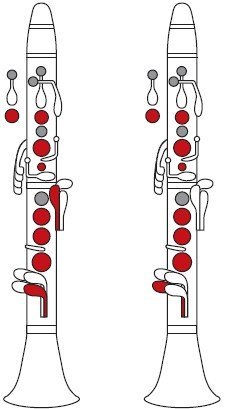
Receive a free PDF of the chart with clarinet fingering diagrams for every note!
The D Phrygian scale on Bb clarinet is a dark, Spanish-flavored minor scale that starts on written E and uses the notes E, F, G, A, B, C, D, E. It strengthens ear training, flexible finger technique, and expressive phrasing for classical, jazz, and world music players.
The D Phrygian scale: origin, shadow, and color
The D Phrygian scale is one of the old church modes, but it feels older than the stone walls that once carried it. In modal language it is the Phrygian mode built on D. On a Bb clarinet, that gives you a written E as the starting note, instantly shifting your fingers into a familiar space while the ear steps into a very different room.
Historically, Phrygian color shows up in Gregorian chant, in early Spanish processional tunes, and later in the raw cry of cante jondo in flamenco. Composers such as Manuel de Falla and Isaac Albeniz leaned on this sound to paint Spain in harmony. When you move that same flavor to the clarinet, you get a singing, breath-driven version of that old modal voice.
Clarinet voices who lived inside this sound
Clarinetists have been chasing the color of Phrygian, often without naming it. Anton Stadler, Mozart's legendary clarinetist, moved through modal turns in slow passages of the Clarinet Concerto in A major, K. 622. When you isolate some of his ornamented lines from early editions, you can hear him leaning into lowered seconds and dark neighbor tones that feel very close to D Phrygian shapes.
Heinrich Baermann, muse to Carl Maria von Weber, brought a more theatrical approach. Listen to the lyrical moments in Weber's Clarinet Concerto No. 2 in E flat and the Concertino. In some cadenzas, modern performers like Sabine Meyer slip in modal turns and Phrygian-inflected runs, especially in live performances where the clarinet almost imitates a dramatic operatic mezzo or a folk singer.
Jump ahead and you find Richard Stoltzman using Phrygian flavored lines in his recording of Leonard Bernstein's Prelude, Fugue and Riffs, especially where the harmony leans into edgy, jazz-inflected chords. The scale itself is never announced, but you can hear fragments that match that D Phrygian color: half-step tension, brooding minor, and sudden sparks of energy.
Martin Frost, in works like Anders Hillborg's Peacock Tales, takes the clarinet into wild, almost theatrical storytelling. Many of those acrobatic lines use modal touches, and you can practice them by isolating runs that sound Phrygian and matching them to a simple D Phrygian scale on your Bb clarinet. When you do, those wild contemporary lines suddenly feel much more playable.
Jazz clarinetists go straight to this sound whenever harmony stays on a dominant chord or on a static vamp. Benny Goodman, on darker choruses of “Stompin' at the Savoy” and “Sing, Sing, Sing,” sometimes brushes against Phrygian twists when he leans into b9 and b13 ideas. Artie Shaw, especially in “Nightmare” and some moody arrangements of “Summit Ridge Drive,” follows chromatic lines that pass right through the Phrygian colors.
Buddy DeFranco, who loved bebop language, occasionally used Phrygian ideas over minor 7b5 chords and altered dominants. Listen to his phrasing over standards like “Autumn Leaves” and focus on spots where he lands on a flattened second. Those are exactly the sort of gestures that studying D Phrygian on clarinet prepares your fingers and ears to handle.
Then there is the radiant world of klezmer. Giora Feidman and David Krakauer both use scales that feel very close to D Phrygian, especially when they stretch into Middle Eastern or Sephardic flavors. In tunes like Feidman's “Mother's Prayer” or Krakauer's projects with Klezmer Madness, the clarinet cries, bends, and sighs around that lowered second, often sliding from E to F on the clarinet in a way that sounds almost vocal.
Pieces, stages, and recordings that breathe Phrygian
The D Phrygian scale is hidden in a lot of clarinet repertoire, even when composers never name it. In Brahms' Clarinet Quintet in B minor, Op. 115, the slow movement contains modal turns and chromatic sighs that come alive when you have practiced your D and E Phrygian shapes in the chalumeau and clarion registers. Those ornamented lines feel more natural once your fingers know that half-step pull.
Ravel's Rapsodie espagnole and Debussy's Iberia both use Phrygian color in the orchestra. Clarinetists in the Orchestre de Paris or the Berlin Philharmonic bring that Spanish heat to life in solos that often sit right on Phrygian-flavored chords. Practicing the D Phrygian scale with a focused embouchure and steady air means those exposed lines feel like natural speech instead of technical traps.
Film composers have turned to the Phrygian flavor whenever they want mystery with an edge. In several scores by Hans Zimmer and James Newton Howard, sustained pads and string clusters sit under clarinet lines that outline a Phrygian-type minor. Think of those scenes where a lone reed instrument floats above a desert or an ancient city. If you map some of those cues onto your instrument, you will often find yourself playing exactly the notes of a D or E Phrygian scale.
In jazz and fusion, clarinet sometimes trades lines with soprano sax or electric guitar over modal vamps. Modern players like Anat Cohen use Phrygian colors in Mediterranean-influenced pieces and in her work with the Anzic Orchestra. Listen closely to clarinet solos over tunes with Spanish titles or Middle Eastern grooves and you will hear that half-step from the root to the second again and again.
World and folk music give perhaps the clearest window into this sound. Bulgarian clarinetists in wedding bands, Turkish clarinet masters like Hüsnü Senlendirici, and Greek folk players all rely on Phrygian-like scales, often with microtonal bends between notes that on the staff look like the D Phrygian scale. Practicing it slowly on your Bb clarinet prepares you to imitate those ornaments, trills, and slides with much more intention.
A full two-octave D Phrygian scale on Bb clarinet uses only 8 pitch names but dozens of standard fingerings. Once you are fluent in this small set, you can reuse them in classical cadenzas, jazz solos, and folk-style ornaments without stopping to rethink every interval.
From stone chapels to jazz clubs: the journey of Phrygian color
The Phrygian mode started in early Western chant, where voices outlined its half-step start for centuries before anyone wrote the word “Phrygian” in a theory book. Imagine a single-voice chant echoing in a monastery, then place a modern clarinetist in that same space, playing a long soft D Phrygian line. The architecture has changed, but the contour is the same.
By the baroque period, composers like J.S. Bach and Dieterich Buxtehude showed their love for Phrygian cadences and modal quirks. Clarinet was just coming to life, but those harmonic habits later filtered into the early clarinet repertoire. When classical composers such as Mozart, Weber, and Crusell wrote arias without words for clarinet, they occasionally brushed that Phrygian flavor as a way to color a slow movement or a cadenza.
The romantic era pushed emotion forward. Composers like Brahms, Schumann, and later Reger did not write “D Phrygian” over their scores, but their fondness for lowered seconds and modal sidesteps shows up in clarinet sonatas and trios. Players such as Baermann and later Reginald Kell brought those lines to life with tone control and breath phrasing that feels just like singing a modal folk tune.
The 20th century opened the door to everything. Igor Stravinsky, Bela Bartok, and Zoltan Kodaly folded folk modes straight into their concert music. Clarinet parts in works like Stravinsky's Three Pieces for Clarinet Solo and Bartok's Contrasts brush against Phrygian territory in their quick shifts and sharp half steps. Jazz, klezmer, and flamenco-influenced art music made the mode sound suddenly modern again.
Today, contemporary clarinetists like Kari Kriikku, Martin Frost, and David Krakauer commission works that move freely between classical clarity and folk-inspired rage or lament. Knowing something as simple as your D Phrygian scale gives you a flexible language to carry through all those styles without changing instruments, mouthpiece, or reeds.
How the D Phrygian scale feels under your fingers and in your chest
Emotionally, the D Phrygian scale sits somewhere between minor-key sadness and flamenco fire. That flattened second, on clarinet from E to F, feels like a guarded step forward. It is cautious, questioning, sometimes menacing, but never bland. When you lean into it with a rich chalumeau tone, it can sound like a dark folk song. In the clarion, it becomes a kind of urgent call.
For phrasing, Phrygian invites slides, half-hole bends, and fat vibrato on long tones. Players like Giora Feidman often slide between notes that outline a Phrygian contour, turning simple intervals into a human cry. On Bb clarinet you can imitate this by gently shading fingerings, slightly rolling the left-hand index finger, or using the side keys to smear between written E and F before settling into the pure note.
Because the harmony below the D Phrygian scale is often a static chord or drone, you can take your time. Long notes, slowly rising lines, and repeated riffs all feel natural. The mode supports storytelling, letting you stretch a phrase the way a singer stretches breath in flamenco or improvisation in an old synagogue.
Why this scale matters for your playing, today
Practicing the D Phrygian scale on Bb clarinet is not just a theory exercise. It gives you a shortcut into Spanish, Middle Eastern, klezmer, and modern film colors without changing your basic technique. You learn to hear and feel the tension of that half step, which makes your phrasing in Brahms or Debussy more expressive, and your jazz solos more daring.
For students, this scale helps train ear and fingers to move confidently between diatonic and chromatic notes. For professionals, it opens fresh improvisation ideas on static minor chords, vamps, and modal tunes. It can also unlock alternate readings of written solos. Suddenly a Weber cadenza or a Hillborg passage feels less like a series of notes and more like a story in a particular dialect.
| Scale | Characteristic Interval | Typical Mood |
|---|---|---|
| D natural minor (on Bb clarinet: E natural minor) | Whole step from root to 2nd | Sad, lyrical, familiar |
| D Phrygian (on Bb clarinet: E Phrygian) | Half step from root to 2nd | Dark, tense, Spanish or Middle Eastern flavor |
| D major (on Bb clarinet: E major) | Major 3rd, bright 2nd | Joyful, open, brilliant |
If you enjoy scale journeys like this, you might also enjoy connecting it with the G minor scale fingering chart for Bb clarinet, or exploring brighter colors in the C major scale fingering chart. Many clarinetists like to pair dark modes like Phrygian with more radiant scales from the full clarinet fingering chart collection.
A short fingering story, not a manual
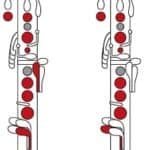
The fingering chart for the D Phrygian scale on Bb clarinet shows notes from low D up through at least high D, which on the page appear as E to E for you. The comforting thing is that almost every note uses standard fingerings you already know from E natural minor or C major. The difference is in how often you land on that written F and how you voice it.
Think of three little “stations” on your instrument:
- Chalumeau: low E to G, rich and woody, perfect for slow, chantlike lines
- Clarion: B to high D, singing and intense, ideal for passionate phrases
- Bridge notes: A, B flat, and B natural, where your left-hand thumb and register key help you cross registers smoothly
As you move through the chart, stay aware of air support and embouchure, not just fingers. A steady column of air and a relaxed but focused lower lip will keep your tone stable, especially on the half-step from E to F, which loves to crack if the air is timid.
- Play the written E to E D Phrygian scale slowly in quarter notes, two octaves if possible.
- Repeat with a gentle crescendo up and decrescendo down.
- Add a small slide between written E and F in both directions, to feel the “pull” of that interval.
| Practice Focus | Time | Frequency |
|---|---|---|
| Slow D Phrygian scale (written E to E) with tuner | 5 minutes | 3 times per week |
| Simple Phrygian motifs (E-F-E, E-F-G, G-F-E) | 5 minutes | Daily |
| Improv over a D minor or Spanish-style backing track | 10 minutes | 2 times per week |
Key Takeaways
- Use the D Phrygian scale on Bb clarinet to tap into Spanish, klezmer, and film-score color with familiar fingerings.
- Listen to clarinetists like Sabine Meyer, Giora Feidman, and Anat Cohen to hear Phrygian flavors in real music.
- Practice the scale slowly, then turn it into short motifs and improvisations so it becomes a living musical voice, not just an exercise.
Frequently Asked Questions
What is D Phrygian scale on Bb clarinet?
The D Phrygian scale on Bb clarinet is a mode that sounds like D Phrygian on concert instruments but is written as E Phrygian for you. Its notes are E, F, G, A, B, C, D, E. It creates a dark, Spanish-style minor sound thanks to the half step between the first and second notes.
Why should I practice the D Phrygian scale on clarinet?
Practicing the D Phrygian scale trains your ear to hear modal colors and your fingers to handle fast half steps cleanly. It prepares you for Spanish-influenced classical pieces, klezmer, jazz solos over minor vamps, and modern film-score lines. It also adds variety to your warmups beyond major and natural minor scales.
How is the D Phrygian scale different from D natural minor?
D natural minor has a whole step from the root to the second degree, while D Phrygian has a half step. On Bb clarinet that means your written E to F is a tight, tense interval. This single change shifts the mood from familiar sadness to a more exotic, urgent sound that suits flamenco, folk, and modal jazz.
Which famous clarinetists use Phrygian sounds?
Sabine Meyer and Martin Frost touch Phrygian colors in Weber and contemporary works. Jazz legend Buddy DeFranco used similar ideas over altered chords. Klezmer artists Giora Feidman and David Krakauer often improvise with Phrygian-like scales, and Anat Cohen explores related colors in Mediterranean-influenced jazz pieces.
How can I apply D Phrygian in my daily clarinet practice?
Use the D Phrygian scale as a warmup, then build small motifs like E-F-E or E-F-G and move them through different registers. Improvise over a steady D minor or Spanish-style backing track. Finally, look for spots in your existing clarinet pieces where a lowered second or modal flavor could shape your phrasing.