If you have ever played a low G on your Bb clarinet and wished it could sound darker, smokier, almost like a whispered story from an old street in Seville, then the G Phrygian scale is already living somewhere in your imagination. This scale feels like dusk: familiar light, but with longer shadows and secret corners waiting under your fingers.
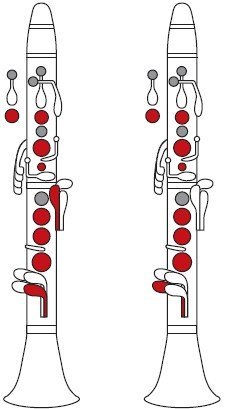
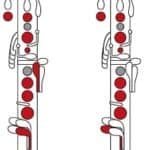
Receive a free PDF of the chart with clarinet fingering diagrams for every note!
The G Phrygian scale on Bb clarinet is a dark, Spanish-flavored minor mode built from G to G with a flattened 2nd, 3rd, 6th, and 7th degrees. It shapes expressive melodies, deepens your ear for color, and expands your improvisation and interpretation options.
The sound and story of the G Phrygian scale
Play G, then A flat, and just hold that interval for a moment. On clarinet, that tiny half step feels like a raised eyebrow. It is the sound of Phrygian. The G Phrygian scale gives you:
- A dark minor color (G, Ab, Bb, C, D, Eb, F, G)
- A spicy, almost flamenco edge from the Ab and Bb
- A chant-like gravity that pulls phrases downward
While the fingering chart maps the notes, the real magic starts when you lean into that half step between G and Ab with a warm throat-tone, supported air, and a little vibrato. Suddenly the clarinet sounds less like a polite salon instrument and more like a human voice remembering something important.
The G Phrygian scale flattens the 2nd, 3rd, 6th, and 7th notes compared with G major. That simple shift transforms a bright clarinet line into something brooding and atmospheric.
From ancient chant to clarinet: a brief history of Phrygian color
Long before the modern Bb clarinet had a register key or a Boehm mechanism, the Phrygian mode was already haunting cathedrals and city streets. Medieval singers used Phrygian-inflected melodies in plainchant. That half-step above the tonic felt like a sigh, and singers leaned on it the way we might bend a note with the reed today.
By the time baroque clarinetists like Johann Simon Hermstedt were playing early chalumeau and clarinet parts, Phrygian flavors were showing up in modal cadences and expressive slow movements. While you may not see the words “G Phrygian” printed on a score by Telemann or Handel, you will hear the Phrygian pull in cadences that move from A flat-like tensions into G-centered resolutions in minor-key sonatas.
In Spanish and Middle Eastern folk traditions, Phrygian-like scales became part of daily musical speech. Oud players, flamenco guitarists, and singers developed ornaments that line up beautifully with the clarinet's ability to slide between throat tones and clarion notes. When clarinet eventually joined these traditions, the G Phrygian scale felt instantly at home.
Clarinetists who lived in the shadows of G Phrygian
The G Phrygian scale may sound exotic, but many clarinet legends used this color constantly, sometimes without naming it. Once you hear it, you start spotting it everywhere.
Classical and romantic storytellers
Anton Stadler, Mozart's favorite clarinetist, played an extended-range instrument whose low notes gave extra weight to dark modes. Listen to the slow movement of the Mozart Clarinet Concerto in A major. Even though it is not in G Phrygian, Stadler's phrasing hints at modal colors that later composers would push further. If you shift some of those melodic turns into G Phrygian on your own clarinet, you will hear the kinship immediately.
Heinrich Baermann, who inspired Weber's Clarinet Concerto No. 1 and the Concertino, had a reputation for a smoky, vocal chalumeau. In cadenzas and ornamented passages, he could twist a simple minor line into something that brushes past Phrygian color, especially around the second scale degree. Try taking the famous opening of Weber's Concertino and reharmonizing it against a G drone using G Phrygian fingering; the expressive pull feels suddenly more urgent.
20th-century classical voices
Sabine Meyer, in her recordings of Spanish-influenced works like Debussy's “Premiere Rhapsodie” and various arrangements of de Falla pieces, often shapes half-step tensions on the clarinet exactly the way Phrygian demands. While she may nominally be in other keys, the expressive treatment of the lowered 2nd can be studied directly when practicing your G Phrygian scale.
Martin Frost, known for his daring interpretations of contemporary works, often emphasizes modal shifts in music by composers like Anders Hillborg and Kalevi Aho. In passages where the clarinet hovers around a tonic with tight half-step neighbors, you can almost hear a modern cousin of G Phrygian. Practice your G Phrygian scale, then listen to Frost's handling of slow lyrical lines; the phrasing ideas transfer easily.
Richard Stoltzman, with his fluid legato in pieces like Copland's Clarinet Concerto, often stretches notes that function like Phrygian neighbors in the harmony. Transpose short Copland motifs into G Phrygian on your Bb clarinet, and you will feel his influence on how to shape the scale with air, embouchure, and subtle dynamic shifts.
Jazz legends and the darker side of swing
Jazz clarinetists practically live in mode-rich environments, and G Phrygian is a natural tool when the harmony turns toward Spanish or minor dominant grooves.
- Benny Goodman: In Latin-tinged arrangements with his orchestra, especially on tunes that flirt with minor keys, his improvisations sometimes color a dominant chord with Phrygian-like spice. Try improvising on a D7 chord using G Phrygian; you will hear how easily it could have slipped into his vocabulary.
- Artie Shaw: In “Frenesi” and other Latin-influenced works, certain turns of phrase suggest the same half-step tension that defines Phrygian flavor, especially when the clarinet hovers on the flat 2nd degree.
- Buddy DeFranco: His bebop lines over minor II-V progressions often pass through Phrygian territory. If you slow down his solos and transpose fragments to start on G, you will find several shapes that map right onto the G Phrygian scale.
Klezmer, folk, and the Phrygian soul
For klezmer clarinetists, G Phrygian is almost like a home base, especially when you think of it alongside Freygish, a scale often described as a Phrygian mode with a major 3rd.
- Giora Feidman: Listen to his interpretations of traditional nigunim. Many melodies center around a tonic with a tight, crying half step above it. Practice your G Phrygian, then mimic his slides and wails between G and Ab on the clarinet; it is the same emotional territory.
- David Krakauer: In projects like “Klezmer Madness!”, he often bends notes that imply Phrygian degrees on G-based tunes. The expressive scoop from Ab up to G, or down to F, is pure clarinet drama drawn right from the scale.
In folk and world music, clarinetists from the Balkans, Turkey, and North Africa regularly use Phrygian variants. G-based tunes using G, Ab, Bb, C, D, Eb, and F can be heard on traditional recordings from players whose instruments may be in C, A, or Bb, but the flavor is unmistakable.
Pieces, film scores, and songs that echo G Phrygian
You may not often see “G Phrygian” printed at the top of a clarinet part, but you will hear its shadow in many pieces you already love.
Classical and concert works
- Manuel de Falla – “El Amor Brujo”: Clarinet lines and orchestrations often lean on Phrygian inflections over G-centered harmonies. Playing these passages on Bb clarinet with G Phrygian in mind makes the Spanish fire easier to control.
- Isaac Albeniz – “Asturias” (in arrangements): When arranged for clarinet and piano or clarinet ensemble, the characteristic Spanish Phrygian sound sits beautifully under the fingers in G Phrygian, especially in the chalumeau and throat tones.
- Olivier Messiaen – “Quartet for the End of Time”: Messiaen loved modes. While not strictly labeled as Phrygian, parts of the “Abyss of the Birds” movement feel like expressive cousins. Practicing G Phrygian enhances your control of slow, weighty intervals similar to those in the piece.
Jazz standards and Latin charts
- “Spain” (Chick Corea): Often played by clarinet in modern jazz ensembles, soloists frequently slip in Phrygian runs. On Bb clarinet, using G Phrygian over certain vamp sections can create that unmistakable Iberian bite.
- “Caravan” (Juan Tizol / Duke Ellington): The exotic sound of this tune, when taken in a key that allows G Phrygian fingerings, shows how that flat 2nd can color whole sections of an improvisation.
Klezmer and folk favorites
- “Der Heyser Bulgar”: In G-centered versions, melodic turns often brush past Phrygian notes. Practicing G Phrygian on your clarinet gives you the confidence to stretch and bend into the characteristic ornaments.
- “Misirlou” (in G-based transcriptions): This well-known melody, used in surf music and film, can be adapted for Bb clarinet using G Phrygian-like material that feels edgy and bright yet dark at its core.
Film and game scores
Modern composers for film and games frequently reach for Phrygian colors when they want mystery and tension.
- Many soundtracks with desert, ancient, or mystical settings contain G-based Phrygian motifs in the clarinet or oboe parts.
- Adventure game scores often feature clarinet doubling strings or voice on G Phrygian-style lines, especially in cutscenes that need quiet intensity rather than full dissonance.
When you know the shape of G Phrygian on your Bb clarinet, you start to hear it in all these places and can recreate those moods on your own.
Why the G Phrygian scale matters for your musical voice
G Phrygian is more than a pattern of notes. On clarinet it has a very specific emotional pull.
- It sounds like memory. The half step from G to Ab can feel like a catch in the throat, perfect for nostalgic or mournful phrases.
- It feels grounded yet dangerous. The solid tonic G in the chalumeau register anchors you, while the flattened scale degrees tilt the floor just enough to keep every phrase alive.
- It invites ornamentation. The distance between Ab, Bb, and C is rich territory for trills, mordents, and klezmer-style bends.
On a Bb clarinet, where the chalumeau register already has a human, almost vocal color, the G Phrygian scale makes the instrument sound like it is speaking in a different dialect of the same language. Soft subtone Gs, whispered As, and careful throat-tone Ab notes feel like characters in a story rather than just notes in an exercise.
G Phrygian vs G natural minor on Bb clarinet
To appreciate G Phrygian, it helps to compare it to a more familiar friend: G natural minor (G, A, Bb, C, D, Eb, F, G). The only difference is that Phrygian lowers the 2nd degree from A to Ab.
| Scale | Note pattern from G | Emotional color on clarinet |
|---|---|---|
| G natural minor | G, A, Bb, C, D, Eb, F, G | Sad, lyrical, familiar, good for traditional minor melodies and classical etudes. |
| G Phrygian | G, Ab, Bb, C, D, Eb, F, G | Darker, exotic, Spanish or klezmer flavored, perfect for tension and storytelling. |
That one-note shift from A to Ab is a small change in fingering but a huge change in emotional impact. When improvising or shaping a written line, deciding whether to use A or Ab can be the difference between “sad” and “haunting.”
A brief word on G Phrygian fingerings for Bb clarinet
The free fingering chart linked above walks through every note of G Phrygian across the clarinet's chalumeau, throat, and clarion registers. You will see familiar patterns from G natural minor, with just that critical Ab to remember instead of A.
On Bb clarinet, two areas deserve extra attention:
- G to Ab in the chalumeau: Moving from the low G fingering to the Ab (using the first finger of the left hand and the appropriate side or front key, depending on your setup) can feel a bit exposed. Practice it slowly with full air support.
- Throat-tone Ab and Bb: Smoothly connecting throat tones to clarion C and D is important for expressive Phrygian lines. Use long tones and slurred arpeggios to stabilize pitch and tone color.
- Play a long low G with a full breath.
- Slide gently to Ab, keeping the air steady.
- Climb the scale to high G using the chart.
- Come back down, listening for even tone through every register.
If you want a broader fingering context beyond this scale, the main Martin Freres clarinet fingering chart is a solid companion.
Practice ideas: making G Phrygian part of your playing
Instead of running the scale up and down like a treadmill, treat G Phrygian as material for little songs. Here is a simple practice routine that fits into 15 minutes and still leaves you time for etudes and repertoire.
| Exercise | Time | Focus |
|---|---|---|
| Slow G Phrygian scale (2 octaves if possible) | 5 minutes | Tone, air support, equal color on G, Ab, and throat tones. |
| Short melodies using only G, Ab, Bb, C | 4 minutes | Expressive phrasing, dynamics from piano to forte. |
| Improvise over a G drone (piano or app) | 6 minutes | Creating mood, ending phrases on G, Bb, and F for different effects. |
For more structured scale work to pair with this, you might enjoy the Bb clarinet scales guide or the G minor clarinet scale article, which make a nice contrast to the Phrygian color.
Common challenges with G Phrygian and how to fix them
Every interesting scale has a few pressure points. G Phrygian is no exception, especially on Bb clarinet where register shifts and throat tones can be touchy.
| Problem | Likely cause | Quick fix |
|---|---|---|
| Ab sounds sharp or thin | Tight embouchure, not enough air support, uneven throat-tone voicing | Loosen the jaw slightly, support with steady warm air, and practice long tones between G and Ab. |
| Scale breaks between throat tones and clarion | Abrupt tongue motion, inconsistent voicing when using the register key | Slur slowly from Bb to clarion C and D, keeping the tongue relaxed and the air constant. |
| Phrases sound like exercises, not music | Straight up-and-down patterns, no dynamic shape | Create 4-bar melodies using G Phrygian only, with clear crescendos and decrescendos. |
Pair this with the broader advice in the clarinet tone improvement guide on Martin Freres to keep your Phrygian practice sounding rich and controlled.
Key Takeaways
- The G Phrygian scale on Bb clarinet turns simple minor lines into dark, expressive stories through its flattened 2nd degree.
- Many classical, jazz, klezmer, and film clarinetists use Phrygian colors, even when the score does not label them by name.
- A few minutes of focused G Phrygian practice each day will expand your tonal palette and make your improvisation and phrasing more expressive.
Frequently Asked Questions
What is Bb clarinet G Phrygian scale fingering?
The Bb clarinet G Phrygian scale uses the notes G, Ab, Bb, C, D, Eb, F, and G, with standard fingerings you already know from G minor and related scales. The key difference is using Ab instead of A. A free fingering chart PDF helps you see the exact finger combinations across registers.
How is G Phrygian different from G minor on clarinet?
G natural minor uses G, A, Bb, C, D, Eb, F, G. G Phrygian replaces A with Ab, creating a half step between G and Ab. On clarinet that small change makes the scale sound darker and more exotic, ideal for Spanish, klezmer, and dramatic film-style melodies.
Which styles use the G Phrygian scale most on Bb clarinet?
You will hear G Phrygian color in flamenco-inspired classical works, klezmer tunes, Balkan and Middle Eastern folk music, and jazz or Latin charts that need a tense minor sound. Clarinetists in film and game scores also use it to suggest mystery, desert landscapes, and ancient atmospheres.
How should I practice the G Phrygian scale without sounding mechanical?
Start slowly with long tones, especially on G and Ab, then create short, song-like phrases instead of just playing the scale up and down. Add dynamics, small ritardandos, and gentle vibrato. Practicing over a sustained G drone or piano chord helps you treat the scale as a mood, not just a pattern.
Is G Phrygian useful for beginner clarinet players?
Yes. Once a beginner is comfortable with G major and G minor fingerings, G Phrygian is a natural next color. It uses mostly familiar notes, introduces expressive half-step tension, and makes simple exercises sound like real music, which keeps practice more engaging and imaginative.