Martin Freres, LaMonte, Coudet, Jean Martin Brand Clarinets and Other Woodwinds
Free Clarinet Fingering Chart: G Bebop Major Scale
If you have ever listened to a Benny Goodman solo and thought, “How does he land every note like it was meant to be there all along?”, you have already heard the spirit of the G Bebop major scale at work. On Bb clarinet, this scale feels like a musical tightrope that somehow always catches you when you leap.
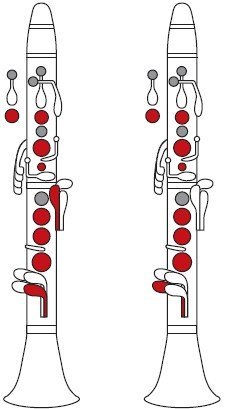
Receive a free PDF of the chart with clarinet fingering diagrams for every note!
The G Bebop major scale on Bb clarinet is where cool jazz logic meets clarinet lyricism. It is the sound of late-night sessions, smoky ballrooms, and that perfect eighth-note line that somehow swings even when you play it straight.
Quick Answer: What is the G Bebop major scale on clarinet?
The G Bebop major scale on Bb clarinet is an 8-note major scale with an added chromatic passing tone between the 5th and 6th degrees. It keeps chord tones on strong beats, making jazz lines feel grounded and swinging while giving clarinet players clear melodic targets.
Where the G Bebop Major Scale Came From and Why Clarinetists Fell in Love With It
The G Bebop major scale did not arrive as a theory concept first. It grew out of the ears and fingers of players like Charlie Parker, Dizzy Gillespie, and Bud Powell, who wanted their lines to sit perfectly on the chords. Clarinetists listened, borrowed, and reshaped those ideas for the cylindrical bore and flexible voice of the Bb clarinet.
For clarinetists, especially in big band and small combo settings, this scale became a quiet secret. Benny Goodman, Artie Shaw, and Buddy DeFranco were constantly finding ways to land their lines on chord tones over G6, Gmaj7, and E minor 7 chords. If you slow down DeFranco's playing on tunes like “I Got Rhythm” or “Opus Half” and sing the lines, you can almost feel that extra passing tone tucked inside. On clarinet, that one added note gives your fingers a satisfying little slide between D and E.
Sabine Meyer and Martin Frost may not be labeled as bebop specialists, but listen to their rhythmic articulation in classical concertos by Carl Nielsen or Jean Francaix. The same kind of clarity and placement of important notes on strong beats shows up there too. The G Bebop major scale is one of those rare bridges that connect Goodman at Carnegie Hall with Frost in front of the Gothenburg Symphony Orchestra.
How Great Clarinetists Have Used G Bebop Major Sounds
Benny Goodman, the so-called “King of Swing,” lived just before bebop fully exploded, but his later recordings like “Seven Come Eleven” and “Air Mail Special” are packed with lines that anticipate bebop thinking. When the band hits a G major or G6 sound, his clarinet dances around G, B, D, and E, with chromatic flourishes that feel almost like a textbook on the G Bebop major scale written by ear.
Buddy DeFranco took it further. On albums like “Cooking the Books” and “Buddy DeFranco and Oscar Peterson Play George Gershwin,” DeFranco uses bebop major lines so naturally that it is easy to forget they are built from scales at all. Over a G major II-V-I progression, his clarinet often threads through G, A, B, C, D, D#, E, F#, giving that classic bebop contour that keeps chord tones on the beat. You can pick out G Bebop major colors in his treatment of tunes like “What Is This Thing Called Love” and “Just One Of Those Things.”
On the Klezmer side, Giora Feidman and David Krakauer spin similar patterns, even when they are not strictly using jazz harmony. In a tune that settles around a G major or G-dominant center, they lean into fast lines where that chromatic passing note between D and E appears almost instinctively. Listen to Feidman's recordings of traditional freylekhs in G and you will hear that same sliding effect, even if the style is more clarinet wail than bop phrasing.
Modern clarinetists like Anat Cohen and Paquito D'Rivera move fluidly between straight major scales and bebop variants. On Cohen's versions of tunes like “Beija Flor” or standards played in G major-based keys, she stitches in G Bebop major flavors whenever the harmony invites it. Paquito's Latin jazz solos over G major or E minor grooves often drop in that characteristic D-D#-E motion on clarinet and soprano sax, giving you a live lesson in bebop vocabulary.
Field Note: In the Martin Freres archives, there is a mid-20th century Bb clarinet whose case still holds a small handwritten card labeled “G Bebop” with fingerings penciled in. The card is worn where the thumb would rest, suggesting that its owner practiced that pattern often enough to stain the paper with years of reed dust and valve oil.
Iconic Pieces Where G Bebop Major Colors Shine
The G Bebop major scale is not usually named in scores by Mozart or Brahms, but its sound shows up in how clarinetists choose to phrase, ornament, and improvise cadenzas. When players like Richard Stoltzman or Sabine Meyer approach the Mozart Clarinet Concerto in A major, their cadenzas and lead-ins sometimes borrow bebop-style lines when they perform with jazz-influenced ensembles or crossover groups.
Think of jazz standards and film scores in G major or related keys:
“All of Me” often sits in a key center that lets G major and G6 colors shine. Clarinetists in swing bands use G Bebop major fingerings to craft smooth 8th-note lines through the bridge.
“There Will Never Be Another You” regularly lands on passages where Gmaj7 or E minor 7 chords invite G Bebop major vocabulary on clarinet.
Film scores by composers like John Williams and Michael Giacchino sometimes center scenes in G major with a jazz hue, especially when clarinet solos appear over brushed drums and walking bass.
Listen to Artie Shaw's work on “Begin the Beguine” and later studio takes where the clarinet snakes through G major-inflected harmony. While the tunes are not labeled “bebop,” Shaw's chromatic approach to strong beats matches exactly the reason bebop major scales exist in the first place.
In modern chamber music, composers like Paquito D'Rivera and Igor Stravinsky (think of the “Ebony Concerto”) give clarinetists passages that lean heavily on G major with passing tones. Players often choose bebop-style finger patterns in practice to make those lines fall under the fingers with more rhythmical certainty.
8 notes instead of 7
The G Bebop major scale adds a chromatic passing tone to the regular 7-note G major scale. For clarinetists, that single added note makes even, flowing 8th-note lines easier to shape over 4-beat measures and gives chord tones stronger rhythmic placement.
From Baroque Lines To Bebop Fire: The Long Journey To G Bebop Major
Long before anyone said “bebop,” clarinet players were already bending major scales with extra notes. In baroque music, early chalumeau and clarinet parts by composers like Johann Melchior Molter and Antonio Vivaldi used chromatic passing tones all through G major and D major passages. The idea was simple: connect chord tones smoothly, even if the notated scale did not mention those extra notes by name.
Classical-era clarinetists like Anton Stadler and Heinrich Baermann took that idea into their concertos and chamber music. Stadler worked closely with Mozart on the Clarinet Quintet and Clarinet Concerto, and both parts include chromatic neighbor tones around scale degrees that feel very close to a proto-bebop logic. When you ornament a G major passage from that era, adding a D# between D and E is not far from the G Bebop major concept, even if the style is different.
By the Romantic period, Brahms was writing sweeping clarinet lines in his Clarinet Sonatas and Quintet, often in keys neighboring G major. Chromatic lines, approach tones, and neighbor notes appear everywhere. Players like Richard Muhlfeld, Brahms's muse, would shape these lines with a vocal style that later jazz players would echo using the G Bebop major scale as a tool.
Once bebop took hold in the 1940s, the theory caught up with what musicians were already hearing. G major chords needed a scale that put G, B, D, and F# on strong beats in fast lines. The solution was simple: keep the notes of G major, add a passing note between D and E, and you have the G Bebop major scale. Clarinetists, already used to rich chromatic playing from Brahms and Weber, slipped this new pattern into their jazz solos with surprising ease.
How the G Bebop Major Scale Feels Under The Fingers And In The Heart
On Bb clarinet, G Bebop major feels a bit like gliding down a staircase where each step is in exactly the right spot. There is a gentle brightness in G major itself, but the added D# adds a tiny bite, like a ray of light catching a metal key on your instrument.
Emotionally, this scale gives you confidence. Because chord tones land on the beat so naturally, you can take more risks. The clarinet's chalumeau register can sound warm and smoky on lower G-based lines, while the clarion register above the break lets G Bebop major leap out with almost vocal intensity. When you hit a long held G or B after a cascade of 8th notes, the line feels resolved in a very human way, almost like taking a breath after a quick laugh.
Players like David Krakauer use similar patterns to charge klezmer improvisations around G major with electricity. In a wedding tune that circles a G tonic, even one D# slipped between D and E turns a simple run into something that sounds alive, breathing, and full of personality.
Why The G Bebop Major Scale Matters For You As A Clarinetist
Whether you are practicing Weber Concertino, leading an amateur big band, or playing in a klezmer ensemble, the G Bebop major scale gives you a map. It shows you which notes feel like home base on G chords and which notes can act like stepping stones. On Bb clarinet, where register shifts and throat tones can break the line, having such a clear pattern keeps your sound smooth.
This scale is also a gateway into improvisation. Many classical clarinetists are nervous about their first jazz chorus. G Bebop major offers a safe starting point: you can improvise over tunes with G major or E minor harmony using this shape and know that your important notes will land in the right spots. It turns improvisation from a mystery into a conversation.
Pattern
Notes (concert pitch)
Best Use For Clarinetists
G major scale
G A B C D E F#
Classical technique, basic melody building, tone and articulation practice
G Bebop major scale
G A B C D D# E F#
Jazz lines, swing phrasing, improvisation over G6 or Gmaj7 chords
G major with approach tones
G A Bb B C C# D E F#
Advanced bebop, chromatic embellishment, fast clarinet runs
A Short, Practical Look At G Bebop Major Fingering On Bb Clarinet
Your fingering chart shows every note of the G Bebop major scale clearly, but here is a compact way to think about it. In practical clarinet terms, you take your standard G major scale pattern, then add one chromatic step between D and E.
Play a regular G major scale on clarinet in the register you want.
On the way up, after D, insert the D# fingering shown on the chart, then continue to E and F#.
On the way down, you can either include the D# again for symmetrical practice or skip it for a more traditional sound.
In the throat and clarion registers, be patient with the half-hole feeling of D# and the coordination of right-hand fingers. The chart will guide you, and the sound of the line will tell you when it locks into that bebop groove.
Practice Focus
Time
Frequency
Slow G Bebop major, 1 octave, quarter notes
5 minutes
Daily
Swing 8th-note patterns using G Bebop major
10 minutes
3 times per week
Improvising over a G6 or Gmaj7 backing track
10 minutes
2 times per week
Common G Bebop Major Scale Challenges On Clarinet
Issue
Likely Cause
Quick Fix
D# sounds unstable or squeaky
Inconsistent finger coverage or shifting embouchure
Practice D-D#-E slowly with a tuner, keeping the same air support and relaxed jaw
Line loses swing feel
Even 8th notes with no emphasis on chord tones
Accent G, B, D, and F# slightly on strong beats while using lighter tongue on passing notes
Break between A and B feels awkward
Hand position tension and rushed fingers
Isolate A-B-C runs from the chart and practice slurred first, then lightly tongued
Key Takeaways
Use the G Bebop major scale to keep important chord tones on strong beats and make your clarinet lines swing naturally.
Listen to clarinetists like Buddy DeFranco, Anat Cohen, and David Krakauer to hear G-based bebop colors in real music.
Practice slowly with the fingering chart, then apply the scale over G6 or Gmaj7 progressions to build improvisation confidence.
Frequently Asked Questions
What is G Bebop major scale clarinet fingering chart?
The G Bebop major scale clarinet fingering chart shows you how to play G, A, B, C, D, D#, E, and F# on Bb clarinet across different registers. It illustrates each key, including the added D# passing tone, so you can build smooth, swinging lines over G major chords with confident finger placement.
Why do jazz clarinetists use the G Bebop major scale?
Jazz clarinetists use the G Bebop major scale because it lines up chord tones like G, B, D, and F# with strong beats in 8th-note lines. That structure makes phrases feel grounded and swinging, especially over G6, Gmaj7, and E minor 7 chords, while still allowing expressive chromatic motion.
How is the G Bebop major scale different from G major on clarinet?
The regular G major scale has 7 notes, while the G Bebop major scale adds one note, D#, between D and E. On clarinet, that single added fingering turns straight G major runs into even 8-note patterns that fit comfortably in 4-beat measures and help your improvisation feel more rhythmically stable.
Can classical clarinet players benefit from G Bebop major practice?
Yes. Classical clarinet players gain better finger coordination, chromatic control, and rhythmic awareness by practicing G Bebop major. The scale helps with passages in composers like Brahms or Nielsen that use chromatic approach tones, and it prepares players for cadenzas or cross-style projects involving jazz or film music.
How often should I practice the G Bebop major scale on Bb clarinet?
A practical approach is to spend 5 to 10 minutes per day on G Bebop major patterns. Start slowly with long tones and clear finger transitions, then add swing articulation and short improvisations over G-based backing tracks. Regular, short sessions are more helpful than occasional long practice blocks.