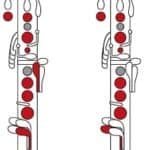
If there is one scale that feels like candlelight on a rainy night, it is the D Minor Scale (Natural) on Bb clarinet. It sits in that gentle shadowy space where joy and sorrow shake hands, the place composers from Bach to John Williams visit when they want the clarinet to speak with honest, unvarnished emotion.
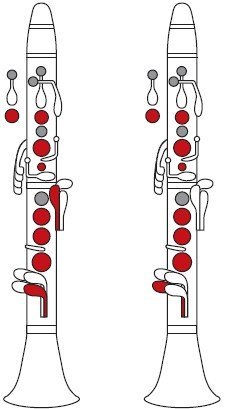
Receive a free PDF of the chart with clarinet fingering diagrams for every note!
Play a slow D Minor scale on your Bb clarinet and you will feel it right away: this is not just another pattern of notes. It is the voice of opera arias, smoky jazz clubs, late-romantic chamber music, and those unforgettable film-score moments where the clarinet sounds like a storyteller who has seen a lot and still believes in beauty.
The D Minor Scale (Natural) on Bb clarinet is an 8-note scale built on D with a key signature of 1 flat (B b) and no raised 6th or 7th degrees. It uses simple, mostly standard fingerings and trains a dark, singing tone that is perfect for expressive melodies and lyrical solos.
The sound of D Minor: echoes from stage and studio
Long before we practiced the D Minor Scale (Natural) in practice rooms, audiences heard its color in the hands of clarinet pioneers. Think of Anton Stadler, Mozart's clarinet muse. While Mozart's famous Clarinet Concerto shines mainly in A and C, the darker corners of his wind serenades and the “Gran Partita” K. 361 lean into minor colors that clarinetists shaped using patterns rooted in D Minor and its relatives.
Move forward to Heinrich Baermann, the virtuoso who inspired Carl Maria von Weber. In Weber's “Clarinet Concerto No. 1” and the Concertino Op. 26, passages slip in and out of minor harmonies that feel closely related to the D Minor world. Those low-register phrases, voiced through chalumeau notes like F, G and A on the Bb clarinet, draw on the same emotional palette you train when you run your D Minor scale in long tones.
Fast forward again to Sabine Meyer. Listen to how she phrases the slow movement of the Brahms Clarinet Quintet in B Minor with the Berlin Philharmonic. When the harmony touches D Minor, her tone narrows to a fine, focused thread. The way she leans into the clarinet's throat tones and chalumeau register is exactly what your hands and ears learn by lingering on each note of the D Minor Scale (Natural), from low D up to high D and back.
Or take Martin Frost and his performances of Anders Hillborg's “Peacock Tales”. Though the piece is wildly modern, full of multiphonics and flutter tonguing, you can hear how often Frost returns to simple minor-scale shapes. That familiar stepwise path of D, E, F, G, A, B b, C, D becomes a kind of emotional home base amid all the fireworks.
From baroque shadows to film scores: how D Minor followed the clarinet
The story of the D Minor Scale (Natural) starts before the modern Bb clarinet even existed. Baroque composers like Johann Sebastian Bach and Georg Philipp Telemann loved D Minor for its intensity, especially in oboe and recorder sonatas. When early clarinets appeared, makers like those behind the first Martin Freres instruments watched players adapt those same D Minor lines to a new, darker reed voice.
By the classical era, D Minor had become a signal for drama. Think of Beethoven's “Symphony No. 9” opening in D Minor. The clarinets in the orchestra, often in Bb or A, sit inside that stormy harmony, doubling violas and cellos with long D Minor lines. That orchestral tradition shaped how clarinetists practiced: they did not just play D Major and G Major scales, they worked in D Minor to match the color of string sections and horns.
In the romantic period, composers like Johannes Brahms and Richard Strauss gave the clarinet long, sighing phrases brushed with D Minor shading. The slow movement of the Brahms Clarinet Sonata in F Minor Op. 120 No. 1 often hovers around D Minor-related shapes, and you can hear that same natural scale contour on classic recordings by Richard Stoltzman and Karl Leister. Their playing turns a simple 8-note pattern into a long, human breath.
By the early 20th century, D Minor had slipped into jazz. Benny Goodman might be famous for explosive big band charts in Bb and F, but listen to his small-group recordings where tunes shift into minor keys. Lines that outline D Minor or its modes suddenly sound bluesy. Buddy DeFranco used similar shapes when moving through ii-V progressions in standards like “Stella By Starlight,” touching D Minor on the way to C Minor and F Minor, all on his Bb clarinet.
In klezmer, D Minor is practically a hometown. Giora Feidman, with his rich, vocal tone, often ornaments melodies that sit right inside the D Minor natural and harmonic shapes. Listen to his versions of “Oyfn Pripetshik” or “Shalom Aleichem” and notice how often he leans on the notes D, F, A and C in the chalumeau register. David Krakauer pushes that same palette into wild, modern territory, bending notes and using growls while still returning to that familiar D Minor staircase.
Film composers picked up on this color too. In John Williams scores like “Schindler's List” and “Memoirs of a Geisha,” the clarinet often threads through passages that outline natural minor scales, including D Minor, to paint sorrow without melodrama. Alexandre Desplat and Howard Shore write similar lines for clarinet in scores for “The Imitation Game” and “The Lord of the Rings,” where a single D Minor phrase can feel like a memory surfacing.
The D Minor Scale (Natural) has 7 unique pitches and just 1 flat (B b), shared with F Major. For clarinetists, that shared key signature makes it an ideal bridge between bright major scales and darker minor colors in etudes and orchestral excerpts.
Where you can hear D Minor breathing through the clarinet
Even when the score does not say “D Minor” at the top, clarinet parts are full of moments where this scale shows its face. Here are some places your ears will recognize it:
- In Weber's “Concertino” Op. 26, the lyrical opening section includes lines that move through D Minor-related harmonies before touching brighter keys. Clarinetists like Sabine Meyer and Emma Johnson shape these measures with the exact finger patterns you feel in the D Minor Scale (Natural).
- Brahms's Clarinet Quintet in B Minor has long phrases where the inner voices lean on D, F and A. Listen to recordings by Martin Frost or the Hagen Quartet with clarinet and you will hear D Minor contours linking phrases together.
- In Debussy's “Premiere Rhapsodie,” there are passages in the middle section where winding, modal lines sit a half-step away from pure D Minor, borrowing its color and shadow.
- Jazz standards like “Autumn Leaves” often move through ii chords like E Minor 7 flat 5 resolving to A7, then into D Minor. Clarinetists such as Artie Shaw and Buddy DeFranco weave D Minor scale fragments into their solos, turning classical finger habits into swinging phrases.
- Klezmer tunes like “Der Heyser Bulgar” or “Doina” in minor keys invite clarinetists to use the D Minor natural, harmonic, and Dorian shapes almost interchangeably, often starting in D Minor before ornamenting into other colors.
- Contemporary solo works, such as Magnus Lindberg's “Clarinet Concerto” or John Corigliano's “Concerto for Clarinet and Orchestra,” use fast passagework that moves in and out of D Minor fragments at high speed. Those patterns feel surprisingly familiar if your D Minor Scale (Natural) is steady and relaxed.
| Scale Type | Note Pattern (ascending) | Common Musical Use |
|---|---|---|
| D Minor (Natural) | D E F G A B b C D | Lyrical melodies, classical lines, film-score themes |
| D Minor (Harmonic) | D E F G A B b C# D | Klezmer ornaments, virtuosic runs, exotic color |
| D Dorian | D E F G A B C D | Jazz solos, modal improvisation, fusion and folk |
Why the D Minor Scale (Natural) feels so personal
The D Minor Scale (Natural) is sometimes called “melancholy” in theory books, but that is far too small a word. On Bb clarinet, it can be gentle, dignified, almost hopeful. The combination of low D, F and A in the chalumeau register gives the instrument a speaking, almost vocal quality, especially when you use long, warm air and a relaxed embouchure.
Listen to Richard Stoltzman playing the slow movements of the Mozart Clarinet Concerto or the Finzi Clarinet Concerto. Even when the key is not pure D Minor, he shapes phrases using the same motion: stepwise, careful, leaning into the 3rd and 6th degrees like they are thoughts he is not quite ready to say out loud. Practicing the D Minor Scale (Natural) with that same intention turns a technical drill into a quiet conversation.
For many players, especially those exploring improvisation, D Minor is the first place where the clarinet starts to sound like their own voice instead of a study piece. A simple pattern like D – F – G – A – C – D, played slowly with vibrato, can feel like a complete story. That is why so many practice books, from Klose to Baermann, linger on minor scales in the middle chapters: they know that this is where tone, breath, and phrasing begin to matter more than speed.
What mastering D Minor on Bb clarinet does for you
Spending real time with the D Minor Scale (Natural) does far more than check a box on a lesson plan. It teaches your ear how to balance tension and release. It trains your fingers to glide between registers, especially crossing the break from A to B and C. It sharpens your intonation on B b and F, notes that love to drift if your embouchure and air are not steady.
In ensemble playing, a comfortable D Minor scale means you can slide into dark harmonies with the violas and bassoons without fear. In jazz, it gives you a reliable base for soloing on standards that move through ii-V-I progressions. In klezmer and folk styles, it becomes the home key for heartfelt, ornamented melodies that drift between speaking and singing.
Most importantly, practicing D Minor daily, even for 3 minutes, is a small ritual of listening. You hear your own sound change, day by day. You notice which notes bloom, which ones feel tight, and how a tiny adjustment of tongue position or left-hand pinky changes the color. That sort of quiet listening is what connects you to the long line of clarinetists who have used this scale as a daily warm up and a lifelong companion.
Just 3 to 5 minutes of slow D Minor Scale (Natural) practice on Bb clarinet can noticeably improve tone, intonation, and breath control, especially across the register break.
A brief look at D Minor fingerings on Bb clarinet
This is not a technical manual, so treat these notes as a friendly nudge while you use the full fingering chart. On Bb clarinet, your written D Minor Scale (Natural) usually runs from low E to high E when you are thinking in concert pitch, but in standard clarinet notation for D Minor patterns you will often work from written D to high D. The key signature uses B b, so your left-hand index and right-hand index fingers share a lot of the work.
The trickiest spots are often the crossings around A, B and C. Practicing the D Minor Scale (Natural) slowly forces you to clean up those transitions: left-hand thumb on the register key, careful movement of the right-hand first finger on B b, and a relaxed jaw so the sound does not pinch. The chart will show you exact fingerings for each D Minor note, from low D with both pinkies to high D with the register key and vented holes. Let your eyes check the positions, but let your ears judge if the scale sounds even and singing.
- Play the D Minor Scale (Natural) ascending in whole notes with a tuner, focusing on B b and F.
- Descend in quarter notes, connecting low D, C and B b as smoothly as possible.
- Add a dynamic swell from piano on low D to forte on high D, then relax back down.
- Improvise a 4-bar melody using only D Minor scale notes in the chalumeau register.
| Practice Element | Time | Frequency |
|---|---|---|
| Slow D Minor scale, whole notes | 2 minutes | Daily warm up |
| Register-crossing patterns (A-B-C-D) | 2 minutes | 3 times per week |
| Free melody in D Minor | 1 minute | Every practice session |
Connecting D Minor to your wider clarinet journey
Once the D Minor Scale (Natural) feels friendly under your fingers, you will notice how it links to other musical paths. The shared B b with F Major means that melodic studies in F suddenly feel more comfortable. Long tone practice in G Minor and C Minor will benefit from the same embouchure stability you learned in D Minor.
On Martin Freres historical instruments with fewer keys, players had to shade tone holes and adjust fingers more creatively to voice D Minor cleanly. That history still whispers through modern practice: even with full Boehm or standard 17-key systems, clarinetists learn to use subtle finger shading and breath support to make D Minor phrases sound smooth and even.
As you shape your own path, you might explore related guides on Bb major scales, chromatic exercises, and long tone routines on sites like MartinFreres.net, all of which circle back to one idea: your scales are not separate from your music. When you meet a D Minor solo line in a Brahms piece, a klezmer improv, or a film-score arrangement for clarinet and piano, your daily D Minor practice will already know how to speak.
| Challenge | Possible Cause | Quick Fix |
|---|---|---|
| Rough shift between A and B | Late register key, tense throat | Practice A-B-A slowly with soft dynamic and steady air |
| Sharp high D | Tight embouchure, high tongue position | Relax jaw slightly and match pitch with a tuner or piano |
| Flat low D | Weak air support, dropped soft palate | Blow as if reaching the back wall of the room on every low note |
Key Takeaways
- Use the D Minor Scale (Natural) on Bb clarinet as a daily tone and phrasing study, not just a pattern to memorize.
- Listen to masters like Sabine Meyer, Martin Frost, Benny Goodman, and Giora Feidman to hear D Minor's color in real music.
- Rely on the fingering chart for accuracy, then let your ears and breath turn D Minor into your own musical voice.
Frequently Asked Questions
What is the D Minor Scale (Natural) on Bb clarinet?
The D Minor Scale (Natural) on Bb clarinet is an 8-note minor scale using the notes D, E, F, G, A, B b, C, and D, with a key signature of one flat. It keeps the 6th and 7th scale degrees natural, creating a smooth, lyrical color that is ideal for expressive melodies and tone practice.
Why should I practice the D Minor Scale (Natural) regularly?
Regular practice of the D Minor Scale (Natural) improves tone, intonation, and control across the break between A and B. It also prepares you for orchestral excerpts, jazz solos, and klezmer melodies that rely on minor-scale patterns. Just a few focused minutes a day can make your sound more flexible and expressive.
How is D Minor (Natural) different from D Minor (Harmonic) on clarinet?
The D Minor (Natural) scale uses B b and C, while the D Minor (Harmonic) scale raises the 7th degree to C#. On clarinet, that one note change creates a more exotic, intense sound. Natural minor is smoother and more vocal, while harmonic minor is used for sharper drama, klezmer ornaments, and virtuosic passages.
Which famous clarinet pieces use D Minor colors?
Many clarinet works use D Minor-related colors, including Brahms's Clarinet Quintet, Weber's Concertino, and passages in Debussy's “Premiere Rhapsodie.” Jazz solos by Buddy DeFranco and klezmer performances by Giora Feidman and David Krakauer also feature lines built from D Minor and its modes.
How can I make my D Minor scale sound more expressive?
Use slow practice with varied dynamics, focusing on breath support and smooth finger motion. Add gentle vibrato on long notes, especially on F, A and C. Listen to recordings by players like Sabine Meyer or Richard Stoltzman, then imitate their phrasing while you play the D Minor Scale (Natural) up and down.