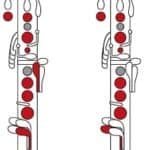
If you have ever felt that strange pull toward darker, mysterious sounds on the clarinet, the A Phrygian scale is probably already whispering to you. On a Bb clarinet it blooms with a smoky, ancient color, the kind of sound that feels like walking through a narrow stone street just after midnight, bell keys glinting softly under the lights.
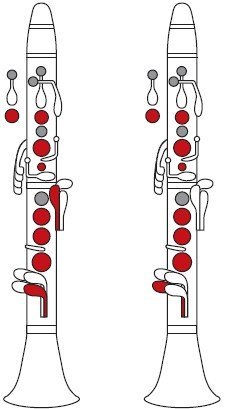
Receive a free PDF of the chart with clarinet fingering diagrams for every note!
The A Phrygian scale on Bb clarinet is a minor-sounding mode built from A to A using notes of the F major scale. It creates a dark, Spanish-flavored color that helps clarinetists shape expressive solos, atmospheric film lines, and characterful orchestral passages with confidence.
The sound-story of the A Phrygian scale on clarinet
The A Phrygian scale is like the moody cousin of A minor. It shares that shadowy minor feel, but the lowered second step gives it a twist of tension that clarinetists adore. On a Bb clarinet, where written B sounds as concert A, this mode sits beautifully under the fingers and pours out of the bell with a voice that feels part flamenco, part film score, part whispered prayer.
Think of a slow solo over an ostinato in the low strings, or a clarinet line curling above muted trumpets. That half step from A up to Bb is where the magic of A Phrygian lives. The clarinet reed vibrates just a little more tightly there, and the resonance in the upper joint feels like a question that never quite gets answered.
From ancient chant to modern screen: a brief history of A Phrygian
Phrygian as a mode predates the Boehm-system clarinet by many centuries. Medieval singers used Phrygian melodies in plainchant, and you can still hear that haunting flavor in old church music, even without clarinets or reeds. When baroque composers like Johann Sebastian Bach and Georg Philipp Telemann began experimenting with modal colors, that Phrygian half step started to appear in violin and oboe lines, and later in clarinet parts as the instrument evolved.
By the time early clarinet pioneers like Anton Stadler and Heinrich Baermann were working with composers such as Mozart and Weber, the language of modes had already soaked into tonal harmony. You will not always see “A Phrygian” written on the page, but that characteristic A-to-Bb tension shows up in chromatic bass lines and sighing phrases in the chalumeau register. Listen to the slow movement of Weber's Clarinet Concerto No. 1 with a modal ear; some of those dark twists sit right next to Phrygian color.
In the 19th century, nationalism and folk influence crept into clarinet writing. Spanish composers drew from flamenco melodies that often lean into Phrygian colors. Later, when Isaac Albéniz and Manuel de Falla inspired arrangements for clarinet and piano, many players used an A Phrygian scale as a practice tool for those guitar-like, Spanish-sounding clarinet phrases.
This tiny intervalic detail is what gives solos that instantly recognizable dark-Spanish color on Bb clarinet.
In the 20th century, modal jazz and film scores gave this sound a new life. Composers like Maurice Jarre, Nino Rota, and Ennio Morricone wrote clarinet and saxophone lines that flirt with Phrygian. Think of those lonely, wandering clarinet phrases up in the clarion register over static harmony; often the underlying sound is a Phrygian or Phrygian-dominant world.
Clarinet legends and the Phrygian shadow
No one books a recital with a piece titled “Etude in A Phrygian Scale,” yet many great clarinetists have leaned on this exact color in their playing.
In classical playing, listen to Sabine Meyer in works by Claude Debussy and Olivier Messiaen. In Debussy's “Premiere Rhapsodie,” moments of chromatic descent hint at Phrygian space, especially when she shapes the semitone tension with a soft, supported air stream. It is not written as A Phrygian, but the mental palette she draws from absolutely includes that scale.
Martin Frost brings a very similar modal tension to contemporary works like Anders Hillborg's “Peacock Tales.” Those sudden dark turns in the upper clarion register often land on the kind of half step that lives inside A Phrygian fingerings. He has spoken in interviews about using modes as emotional palettes rather than just theory exercises, and you can hear that in every slide and bend he shapes with his embouchure.
On the jazz side, Benny Goodman and Artie Shaw both flirted with Phrygian colors without naming them. Listen to Goodman's solos on “Caravan” or Shaw on “Frenesi.” Even if the chart centers around other keys, their lines often tag that half step above the root to give a hint of exotic, almost Spanish color. Buddy DeFranco, who thrived in bebop, used Phrygian and Phrygian-dominant shapes as part of his approach to altered dominant chords; transcribe a chorus and you will spot those A Phrygian fingerings flashing by.
In klezmer, Giora Feidman and David Krakauer regularly lean on Phrygian-style patterns. Tunes in Ahava Rabbah and Freygish scales are cousins to Phrygian, and when a melody focuses on an A center, the clarinetist's fingers often trace the same geography you see on an A Phrygian scale chart. The heavy use of the ring keys, the sliding from Bb to C, the cry of the clarion A, all echo through that modal family.
Modern artists like Shankar Tucker, Kinan Azmeh, and Anat Cohen bring this color into world music and contemporary jazz. Kinan Azmeh, for instance, often mixes Arabic maqam with Western modes; when he hovers near a note that feels like A and nudges the Bb around it, the sensation on the clarinet feels just like practicing A Phrygian, but translated into living, breathing improvisation.
Where you have already heard A Phrygian without knowing it
Even if you are just meeting the name A Phrygian today, your ears probably know it from dozens of pieces and recordings.
In the classical and romantic world:
- Listen to Johannes Brahms' “Clarinet Sonata in F minor, Op. 120 No. 1” with Richard Stoltzman or Karl Leister. Some inner lines in the slow movement briefly color an A center with neighboring Bb and C in a way that mirrors A Phrygian.
- Weber's “Concertino in E b major” as recorded by Sabine Meyer includes cadential turns that, if you isolate them, align with Phrygian-inflected patterns built over different tonics, including A in practice routines.
In jazz and big band settings:
- Artie Shaw's recording of “Nightmare” carries that dark, modal flavor; transposing some of his lines to A on the Bb clarinet reveals fingerings right out of an A Phrygian exercise.
- Modern players like Eddie Daniels in his more modal explorations often shift into patterns that, when centered on A, are exact A Phrygian shapes, especially over minor 7 b9 chords.
In klezmer and folk music:
- Giora Feidman's performances of traditional tunes like “Shlof Mayn Feygele” weave through modes related to Phrygian. If you sit with your clarinet and match his ornaments on an A drone, you will find your fingers landing on the notes of A Phrygian and its close relatives.
- David Krakauer's “Klezmer Madness” tracks often circle around half steps that feel strikingly Phrygian when re-centered on A.
In film and contemporary music:
- Think of the opening clarinet line in some modern scores by Alexandre Desplat or Nicholas Britell. Many of those quiet, atmospheric solos use Phrygian-like shapes to paint tension without going fully dissonant.
- Video game soundtracks and TV series with Middle Eastern or Mediterranean flavor often include clarinet or duduk lines that, if shifted to concert A, give you the exact step pattern of A Phrygian.
| Scale Color | Typical Mood On Clarinet | Where You Hear It |
|---|---|---|
| A natural minor | Sad, familiar, lyrical | Brahms sonatas, somber chamber music |
| A harmonic minor | Dramatic, classical, “old world” | Virtuosic runs in Weber and Spohr |
| A Phrygian | Dark, Spanish, mysterious | Flamenco-inspired pieces, klezmer, film cues |
How A Phrygian feels under your fingers and in your heart
On Bb clarinet, the A Phrygian scale feels amazingly vocal. That low written B (sounding concert A) in the chalumeau register has a human, speaking quality, especially when you use a relaxed embouchure and warm air from the diaphragm. As you creep up to written C and D, the throat tones act like whispered consonants in a sentence.
The emotional character is different from a plain A minor scale. A minor sighs; A Phrygian broods. There is more tension in each phrase, as if the clarinet is holding back a secret. That close B b above the tonic pushes against the bore, and when you add a gentle vibrato with your support muscles and embouchure, it can sound almost like a voice breaking slightly.
Play it slowly, long tones from B up to the next B, and you may notice that your mind starts imagining stories: dusty streets, old rituals, smoky jazz clubs, or a klezmer band sending melodies out into the night. That is the power of this mode. It hangs in the air longer, even after the sound from the bell has faded.
Why this scale matters for your playing, whatever your level
For a beginner, the A Phrygian scale is a gentle way to leave the safety of major and minor and start tasting color. It uses familiar fingerings from F major and D minor practice, but rearranged into a new mood. The fingering chart gives you a visual map; your ears fill in the story.
For an intermediate player working on orchestral excerpts or jazz standards, this scale is a shortcut to more expressive phrasing. Practicing A Phrygian makes it easier to shape those nearly-chromatic lines in pieces by Ravel, Debussy, and Stravinsky. It also gives you vocabulary for minor blues and modal tunes, where a line that leans on that flattened second can suddenly sound sophisticated and intentional.
For advanced clarinetists and professionals, having A Phrygian as a reflex in the fingers frees you to improvise and color phrases on the fly. You can move from a plain A minor passage into a Phrygian-inflected embellishment without breaking your airflow or thinking about theory terms. This is where scales stop being homework and start becoming language.
| Player Level | A Phrygian Goal | Benefit On Bb Clarinet |
|---|---|---|
| Beginner | Play the scale evenly, slurred | Improves throat-tone control and ear for minor color |
| Intermediate | Use it in simple improvisations | Adds modal flavor to jazz, klezmer and film themes |
| Advanced | Integrate into repertoire and cadenzas | Enriches phrasing in Weber, Debussy, contemporary pieces |
A short, friendly word about fingerings
The free fingering chart gives you the full written A Phrygian layout for Bb clarinet from low B up through the clarion register. Technically, you are walking through notes that belong to the written F major scale, but starting on B. That means many fingerings will already feel familiar from your long tones and scale drills.
Focus on two areas: the throat tones (B, C, C#) and the bridge between the upper joint and lower joint around written E and F. Keep your left-hand first finger relaxed over the A key, watch the right-hand ring keys so they stay close to the tone holes, and let the register key do its job without squeezing. The chart will guide your fingers; your job is simply to keep the air smooth and the sound singing.
- Start with long tones on B, C, and D.
- Slur the full A Phrygian scale up and down, very slowly.
- Add a gentle crescendo to the top note, then decrescendo back down.
- Try small 3-note patterns: B-C-D, C-D-E, and so on.
- Finally, improvise a 4-bar melody using only A Phrygian notes.
A Phrygian practice mini-routine for your next session
Here is a simple routine you can print or copy into your practice notebook. It links the free fingering chart to real musical habits on your Bb clarinet.
| Exercise | Time | Focus |
|---|---|---|
| Slow scale, full range (slurred) | 3 minutes | Tone quality on throat tones and clarion A |
| Three-note groups (B-C-D, C-D-E, etc.) | 4 minutes | Finger connection across the register key |
| Short improvisation over an A drone | 5 minutes | Phrasing and emotional expression |
If you already use other Martin Freres fingering charts for Bb clarinet scales, you can easily weave this routine alongside your F major and D minor work so that A Phrygian becomes part of your regular sound palette instead of a one-time curiosity.
Key Takeaways
- Use the A Phrygian scale on Bb clarinet to add dark, Spanish and klezmer-flavored color to your phrasing and improvisation.
- Practice slowly with the fingering chart, paying special attention to throat tones and the semitone from A to Bb.
- Listen to classical, jazz and klezmer clarinetists who lean on Phrygian-like colors, then imitate their phrasing using this scale.
Frequently Asked Questions
What is Bb clarinet A Phrygian scale fingering?
The Bb clarinet A Phrygian scale fingering is the pattern of written notes from B to B that uses the pitches of F major, starting on B instead of F. On the clarinet this creates a dark, minor-flavored mode that feels expressive and slightly exotic, ideal for Spanish, klezmer and film-style lines.
How is A Phrygian different from A natural minor on clarinet?
A natural minor has the notes A, B, C, D, E, F and G. A Phrygian lowers the second note, so the sequence becomes A, Bb, C, D, E, F and G. On Bb clarinet, this small change feels like extra tension between A and Bb, giving solos a darker, more mysterious color.
Why should clarinet students practice the A Phrygian scale?
Practicing A Phrygian helps students strengthen throat tones, refine half-step finger transitions, and expand their ear beyond major and minor. It also prepares them for modal passages in jazz, klezmer and contemporary classical music, making improvisation and expressive phrasing feel more natural and less tied to plain major scales.
Which famous clarinetists use Phrygian-like sounds?
Classical players such as Sabine Meyer, Martin Frost and Richard Stoltzman often color phrases with Phrygian-style half steps in Debussy, Messiaen and contemporary works. Jazz greats like Benny Goodman, Artie Shaw and Buddy DeFranco, and klezmer artists Giora Feidman and David Krakauer, also use similar modal patterns in solos and ornaments.
How can I apply A Phrygian to real music on Bb clarinet?
Once the scale feels comfortable, try using A Phrygian over any piece or backing track centered on A minor or A5 power chords. Improvise short phrases, echoing lines you hear in Spanish guitar pieces, klezmer tunes or modal jazz recordings, and let that A-to-Bb half step become a expressive focus point in your melodies.