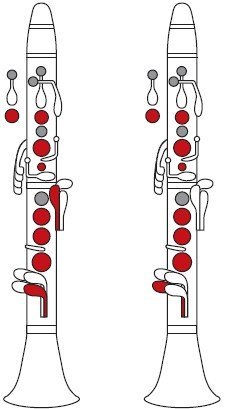
If you grew up singing folk songs in school or around a kitchen table, you probably met “Alouette” long before you ever picked up a clarinet. Hearing it on a Bb clarinet for the first time feels like seeing an old friend in a new outfit: bright, clear, and just a little bit mischievous. This free Alouette clarinet fingering chart lets you turn that childhood melody into a real musical moment.
Receive a free PDF of the chart with clarinet fingering diagrams for every note!
Quick Answer: What is the Alouette clarinet fingering chart?
The Alouette clarinet fingering chart is a visual guide showing every note and Bb clarinet fingering used in the song “Alouette.” It helps beginners and returning players learn the melody quickly, build confidence in the upper and lower registers, and enjoy a familiar folk tune with clear, simple finger patterns.
Alouette on clarinet: a folk song with a concert hall passport
“Alouette” began as a French-Canadian folk song, passed from voice to voice long before anyone thought to write a clarinet part. Sailors sang it on ships leaving Quebec, children sang it in playgrounds in Montreal and Paris, and teachers used it to teach French vocabulary in classrooms from Toronto to New York.
Then the clarinet joined the conversation. That light, teasing melody suddenly had a new color when played through a grenadilla body, past a vibrating reed and a silver-plated ligature. The clarinet could imitate a singing voice, but with more range, more agility, and that special shimmer that only a good Bb clarinet can give to a simple tune.
Imagine a young student in a French conservatory, playing a Martin Freres clarinet in a stone-walled practice room. “Alouette” would often be one of the first real melodies after simple long tones: a chance to feel how the throat tones connect to the clarion register, how the left-hand index finger moves between A, G, and F, and how a playful line can still demand real control from the embouchure and air.
Field Note: In the Martin Freres archives, there are handwritten teaching notes from the early 1900s where Parisian clarinet teachers marked “Alouette” as the first piece to be played entirely from memory. The comment in one margin simply reads: “If they can sing it, they can breathe it.”
How great clarinetists would shape Alouette
No one became famous because of “Alouette,” but almost every great clarinetist has used short, folk-style melodies like it as a private laboratory. The magic is hearing how their sound and style could change even the simplest tune.
Take Sabine Meyer. Her recording of the Mozart Clarinet Concerto with the Berlin Philharmonic shows a tone that is endlessly singing, especially in the second movement. If you use that same relaxed jaw, that same center of air, and play “Alouette” slowly in the chalumeau register, it suddenly feels like a miniature aria instead of a schoolyard song.
Martin Frost often blends classical phrasing with a storyteller's sense of drama. Listen to his performances of Nielsen's Clarinet Concerto or his work with the Swedish Chamber Orchestra. Then imagine him treating “Alouette” as a character: the bird could be shy in the first phrase, then bold in the repeat, with tiny crescendos on each repetition of the words “Alouette, gentille Alouette.” On clarinet, that means sculpting every note with slight changes in tongue pressure and right-hand support.
In the jazz corner, Benny Goodman and Artie Shaw both loved to quote little snatches of folk tunes when they improvised. On live radio broadcasts, Goodman would slip a fragment of a nursery rhyme between phrases of “Sing, Sing, Sing.” You can easily imagine him tossing the first four notes of “Alouette” into a solo for a laugh, squeaking them out in the altissimo register with his trademark bright tone and agile right-hand fingers.
Richard Stoltzman, with his fusion of classical and jazz, would probably turn “Alouette” into a meditation. Listen to his album “Begin Sweet World” or his Brahms Sonatas with Rudolf Serkin. He often stretches time and leans on color. On “Alouette,” that might mean holding the top notes just a fraction longer, adding a warm vibrato in the clarion register, and treating the simple G-A-Bb pattern like a tiny phrase from Brahms or Schumann.
Klezmer legends such as Giora Feidman and David Krakauer are masters at transforming folk material. Feidman can take a two-note motif and make it sound like a life story. If he played “Alouette” on a vintage German-system clarinet, there might be wide portamento between notes, laughing grace notes around the melody, and a raw, speaking tone that turns each repetition into a different joke.
Then think about earlier classical voices like Anton Stadler, for whom Mozart wrote his celebrated Clarinet Concerto, or Heinrich Baermann, a favorite of Carl Maria von Weber. Their instruments had fewer keys and a more direct chalumeau sound. Played on their kind of clarinet, “Alouette” would sound earthier, more like a rustic song in a village square than a polished conservatory study.
Approx. 12 to 16 notes
Most student versions of “Alouette” use only about 12 to 16 distinct notes on Bb clarinet. That compact range lets players focus on tone, phrasing, and breathing instead of worrying about wide jumps into the altissimo register.
From folk kitchens to clarinet studios: the journey of Alouette
“Alouette” is often associated with Quebec and French-Canadian culture, but it probably has roots in older French song traditions that traveled across the Atlantic. While composers like Jean-Philippe Rameau and François Couperin were writing elegant harpsichord pieces in the baroque era, families were passing this melody by ear around wooden tables, sometimes accompanied only by voice and hand claps.
As the clarinet evolved in the late 18th century with makers like Denner and later French builders, the instrument slowly found its way into popular and folk contexts. Military bands in France and Canada often featured Bb clarinet as a central voice. Players might practice Weber or Mozart in the rehearsal room, then step outside and improvise on “Alouette” during breaks, using the same reed and barrel that had just sung a concerto line.
By the romantic era, while Johannes Brahms was writing his clarinet sonatas for Richard Mühlfeld, folk melodies like “Alouette” were appearing in children's songbooks and early method books. Clarinet tutors from the late 19th century often ended each technical section with a short, recognizable song. That made “Alouette” an ideal candidate: stepwise motion, clear phrases, and text that students already knew.
In the 20th century, as jazz and dance bands rose in popularity, short tunes like “Alouette” became material for arrangements and variations. Imagine Artie Shaw taking the melody and turning it into a clarinet feature over a swing rhythm section, or a village band in rural France adding clarinet obbligato lines on top of a brass arrangement of the tune.
Film composers have also played with this melody. In some French films and animated features, you can hear sneaky references to “Alouette” woven into underscore, sometimes in a clarinet line doubled by oboe or flute. A single clarinet playing the tune in a high, pure register can instantly place a scene in a French-speaking setting, just like an accordion or a musette pipe.
By the time “Alouette” arrives in your clarinet case, it carries all of that history: baroque singers, village choirs, early band players, Parisian students working on long tones, and jazz musicians smiling over a throwaway quote in the middle of a solo.
Iconic pieces that rhyme with Alouette
“Alouette” itself is usually taught in simple arrangements, but its melodic shape and spirit show up everywhere in the clarinet repertoire. When you practice this tune, you are quietly training for much bigger moments.
Listen to the opening of the Mozart Clarinet Concerto in A major, K. 622. The second movement has a gentle, rocking line that moves stepwise just like “Alouette.” The clarinet floats over the orchestra the way a child's voice floats over a group. The same kind of legato and air support that makes a beautiful “Alouette” phrase also makes that Mozart solo sing.
In Weber's Clarinet Concertino in E b major, there are playful passages where the clarinet dances with the orchestra in a light, skipping rhythm. Those figures often use the same G-A-Bb and F-G-A shapes that appear in many arrangements of “Alouette” for Bb clarinet. The fingers do not know the difference between folk song and concert piece. They just know patterns.
Brahms's Clarinet Sonata in F minor, Op. 120 No. 1 might seem far away from a French-Canadian tune, but the slow movement includes phrases that rise and fall in simple steps, then repeat with new colors. That is exactly what happens when you vary “Alouette” with dynamics, articulation, or small rhythmic tweaks.
On jazz recordings, patterns reminiscent of “Alouette” appear constantly. In Benny Goodman's solos on pieces like “Stompin' at the Savoy” or “Moonglow,” you will hear little cells of 3 or 4 notes moving stepwise, then repeated at different pitch levels. The habit of making a simple melody speak clearly on clarinet is the same whether you are playing folk tunes or big band swing.
Klezmer repertoire is full of cousins of “Alouette.” Tunes like “Freylekhs” or “Bulgar” often begin with a small, singable hook that repeats with embellishments. Giora Feidman and David Krakauer both show, in concerts and recordings, how a few notes can become a whole story. Practicing “Alouette” with slides, trills, and grace notes is a bridge into that expressive style.
Contemporary clarinet soloists, from Sharon Kam to Andreas Ottensamer, often record arrangements of folk songs and film tunes along with the standard concertos. On albums that pair pieces like the Copland Clarinet Concerto with lighter tracks, you hear how the same embouchure, the same Yamaha or Buffet Bb clarinet, the same Vandoren mouthpiece and reed can move freely between deep orchestral works and simple song arrangements.
Tune or Piece
Connection to “Alouette”
What it teaches your fingers
Mozart Clarinet Concerto (2nd movement)
Stepwise, singing melodic lines
Smooth connection across throat tones and clarion notes
Weber Concertino in E b major
Playful skipping figures and repeats
Light finger action and agile tongue in simple keys
Klezmer tunes like “Freylekhs”
Short recurring motifs, varied each time
Ornamentation, slides, and characterful accents
Why Alouette matters emotionally for clarinetists
“Alouette” is not about showing off range or speed. It is about honesty. You cannot hide behind complex harmony or dense orchestration. It is just you, your reed, and a line everyone already knows. That is a beautiful kind of pressure.
Played softly in the chalumeau register, the tune can sound nostalgic, almost like a memory of a childhood choir or a grandparent humming in the kitchen. Move it into the clarion register with a light staccato and it becomes cheeky and bright, like a bird teasing from a rooftop. Use full, supported breath, and each repetition can carry a different shade: sometimes joyful, sometimes wistful, sometimes quietly proud.
Because the melody is so familiar, your brain is free to listen deeply to tone color. Is your throat open as you play G and A? Are the long notes in the phrase supported all the way to the end, like a singer in an opera house? Are you shaping each note with the same care you would give to a line in Debussy's “Premiere Rhapsodie” or Copland's Clarinet Concerto?
For many students, the first time they play “Alouette” with piano or guitar accompaniment is the first time they feel like a real musician instead of a person doing exercises. The melody fits so comfortably under the fingers that you can look up from the clarinet fingering chart and start listening to the harmony around you, breathing with other players, and letting the phrase lead you instead of clinging to the stand.
What Alouette gives you as a player
Working with an Alouette clarinet fingering chart is like having a tiny training ground for almost every musical quality that matters: timing, breath, tone, creativity, and confidence. It is short enough that you can repeat it dozens of times in one practice session, each time with a different goal.
Once the finger patterns are secure, you can play with articulation the way Benny Goodman did in his big band features: one time all legato, one time light staccato, one time with a clear accent on the first note of each bar. You can experiment with dynamics the way Sabine Meyer shapes the slow movement of the Brahms Clarinet Trio, building a gentle crescendo into the top of the phrase, then relaxing on the descent.
The biggest gift, though, is connection. This tune is known in schools, camps, choirs, and living rooms across continents. When you pull out your clarinet and play “Alouette” at a family gathering, even relatives who have never heard of Martin Frost or Weber's Concertino will stop and smile. You become the bridge between formal practice room work and spontaneous music-making.
Practice focus
How to use “Alouette”
Benefit for your playing
Tone quality
Play very slowly, all legato, listening for even color on every note
More consistent sound across chalumeau and clarion registers
Articulation
Repeat the tune with staccato, then marcato, then mixed styles
Cleaner tongue strokes and better rhythmic control
Phrasing
Shape each 2-bar phrase with clear breathing points
More musical lines in pieces by Mozart, Weber, and Brahms
A quick word on Alouette clarinet fingerings
The free Alouette clarinet fingering chart lays out each note clearly, so you do not need a long explanation. Most versions sit comfortably in the staff, centered around the left-hand notes G, A, and B natural, with occasional steps down to low E and F or up to C in the clarion register. That means you are mostly using basic finger combinations with standard Boehm-system keywork.
The melody usually moves step by step, which is perfect for checking hand position. Keep the fingers curved over the tone holes, especially the right-hand ring finger on low F and the left-hand index finger between A and G. Let the thumb rest naturally on the thumb rest while freeing the left thumb for the register key when needed. The chart will guide you note by note, so you can focus on sound and style rather than guessing where to put each finger.
Study the chart away from the clarinet and sing “Alouette” once through.
Play the melody slowly with a tuner, watching that pitch stays centered on notes like G and A.
Repeat using only legato tonguing, then only light staccato.
Increase the tempo slightly and add dynamic contrast, such as soft questions and louder answers.
Finish by playing the tune from memory without looking at the fingering chart.
Suggested Alouette practice routine
To turn “Alouette” from a simple tune into a real clarinet study, treat it like a short etude alongside your scales, long tones, and orchestral excerpts.
Session part
Time (minutes)
How to use “Alouette”
Warm-up
5
Play “Alouette” very softly, focusing on steady air and relaxed embouchure.
Technique
5
Use short repeated phrases from the tune for articulation patterns and rhythmic variations.
Musical play
5
Improvise simple variations on “Alouette” in different registers and dynamics.
Key Takeaways
Use the Alouette clarinet fingering chart to free your mind from guessing fingerings so you can focus on tone and phrasing.
Treat “Alouette” like a miniature study in sound, articulation, and character, just as great clarinetists shape simple motifs in concertos.
Return to this tune regularly as a quick musical check-up for breath, hand position, and expressive playing.
Frequently Asked Questions
What is Alouette clarinet fingering chart?
The Alouette clarinet fingering chart is a visual guide showing each note of the song “Alouette” with the correct Bb clarinet fingerings. It helps beginners, band students, and returning players learn the melody quickly, avoid guessing on throat tones, and focus on musical expression instead of finger confusion.
Is Alouette suitable for complete beginner clarinet players?
Yes. “Alouette” sits mostly in the staff and uses comfortable notes like G, A, B, and low E. With a fingering chart and a simple rhythm, it is often one of the first real songs learned after basic long tones and open G. It builds confidence while still feeling playful and familiar.
Which register of the Bb clarinet is best for playing Alouette?
Most beginner arrangements keep “Alouette” in the chalumeau and lower clarion registers, roughly from low E up to C above the staff. That range allows a warm, singing tone without forcing the embouchure into altissimo work. More advanced players sometimes transpose it higher for color and variation.
How can I make Alouette sound more expressive on clarinet?
Focus on phrasing and breath. Shape each 2-bar phrase with a gentle rise and fall, keep your air stream steady, and experiment with light vibrato on longer notes. Try different articulations, from legato to light staccato, and use dynamic contrast to make repeated sections feel like a conversation instead of a loop.
Can practicing Alouette help with harder pieces like Mozart or Weber?
Yes. The same stepwise motion and simple patterns in “Alouette” appear in the Mozart Clarinet Concerto and Weber's Concertino. By refining tone, hand position, and articulation on this short tune, you prepare your fingers and air support for longer, more demanding classical passages that use similar shapes.
For more on shaping your sound and learning beautiful clarinet melodies, explore the other fingering resources and historical notes available on MartinFreres.net, including guides on long tones, classical solos, and clarinet care for vintage and modern instruments.