If you listen closely to a great jazz clarinet solo, there is a moment where everything seems to click into place. The line suddenly sounds both free and perfectly balanced, like a trapeze artist landing on the bar at the last possible second. That little extra note that makes the harmony sparkle is the heartbeat of the B bebop major scale on Bb clarinet.
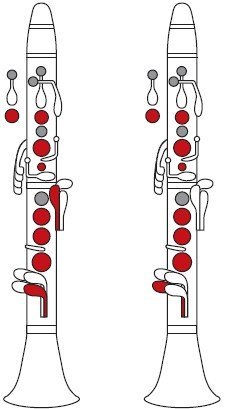
Receive a free PDF of the chart with clarinet fingering diagrams for every note!
The B bebop major scale on Bb clarinet is a B major scale with one added chromatic note between the 5th and 6th degrees. It gives improvised lines smooth, flowing eighth notes over jazz chords and helps clarinetists play swinging, harmonically clear melodies.
The sound of the B bebop major scale: why it feels like swing in slow motion
The B bebop major scale on Bb clarinet is built from the bright B major scale you already know, but with one tiny twist: an added chromatic note between the 5th and 6th degrees. That extra step is the reason bebop lines can race by at 220 bpm and still land chord tones on the beat like clockwork.
On a Bb clarinet, fingered carefully from low written C sharp up through the throat tones and into the clarion register, this scale sounds like a tightrope walk over a B major chord and its dominant friends. There is a kind of smiling tension in it: not the storm of harmonic minor, not the cool distance of Dorian, but a confident, sunlit brightness that still leaves room for grit and growl.
The B bebop major scale has 9 notes instead of the usual 8. That extra pitch lets clarinetists keep strong chord tones (like B, D sharp and F sharp) on the beat while playing straight eighth notes in fast tempos.
From Anton Stadler to Charlie Parker: how we arrived at bebop on clarinet
Long before anyone called it the B bebop major scale, clarinetists were already chasing smooth stepwise lines around a B major center. Anton Stadler, Mozart's beloved clarinetist for the Clarinet Concerto in A major K. 622 and the Clarinet Quintet K. 581, did not play bebop, but his sense of line is where this story quietly starts.
Listen to the way the second movement of the Mozart Clarinet Concerto glides through A major with small chromatic turns. Those little passing notes are the spiritual grandparents of the bebop scales we practice today. The same is true for Heinrich Baermann in Weber's Clarinet Concerto No. 1 in F minor: rapid arpeggios in the clarion register are often connected by sly chromatic steps that anticipate later jazz vocabulary.
Jump to the Romantic era and Brahms handing his Clarinet Quintet in B minor to Richard Mühlfeld. B minor and B major are neighbors. The way Brahms writes long lines that lean through B, D sharp, and F sharp gives you the skeleton of what will later become bebop motion, especially when modern players like Sabine Meyer or Martin Frost phrase those lines with a bit of jazz-like flexibility in the air stream.
The real explosion, though, comes in the 1940s. While the saxophone players and trumpeters were codifying the bebop language, clarinetists were listening closely. Charlie Parker's use of bebop major material over dominant and tonic chords, especially in tunes like “Confirmation” and “Donna Lee,” inspired clarinet improvisers to adapt the same note choices to the clarinet's unique timbre. The added chromatic note in the bebop major scale is partly a response to Parker-like lines that needed a tidy rhythmic structure without losing the bite of chromaticism.
Clarinet legends who lived inside the B bebop major scale
If you want to hear the spirit of the B bebop major scale on Bb clarinet, start with Benny Goodman. On recordings like “Air Mail Special” and “Seven Come Eleven,” Goodman's lines in B major and neighboring keys are full of passing tones that sound exactly like bebop scale fragments, even before theory teachers started naming them. His altissimo register work on the Buffet and Selmer clarinets of his era treats B major as a playground, especially when his bell tones punch out the roots and fifths of the chord.
Artie Shaw takes it in a slightly different direction. In his “Concerto for Clarinet,” the cadenza moves through long chains of chromatic and diatonic lines that feel like proto-bebop. When he races across the break between throat A and clarion B, you can hear him surfing the same slippery chromatic charm we now formalize as bebop scales in keys like B and E.
Then there is Buddy DeFranco, the clarinetist who arguably brought pure bebop clarinet into sharp focus. On albums such as “Cooking the Blues” and his work with the Oscar Peterson Trio, you can hear clean, textbook uses of bebop major material over B major and E major chords. DeFranco's fingerwork through the upper joint, especially over crossings from left-hand F sharp to right-hand B, is like a living fingering chart for the B bebop major scale.
In the modern era, Eddie Daniels and Ken Peplowski both show how to fold bebop major colors into a more lyrical clarinet voice. Daniels, on his album “Breakthrough,” threads bebop-flavored lines with stunning legato, moving through B major and G sharp minor centers with throat tones and register key work as smooth as a singer's breath. Peplowski brings a slightly more old-school sound but still sprinkles bebop major material into standards in B flat, E flat and B, especially in his small group recordings.
Outside straight-ahead jazz, listen to klezmer icons like Giora Feidman and David Krakauer. While klezmer scales lean heavily on modal and augmented intervals, the idea of weaving chromatic passing notes into a diatonic framework is the same. On Krakauer's projects that mix klezmer with jazz and rock, you will hear lines in B and E that clearly lean on bebop major logic, even as the embouchure and vibrato come straight out of the klezmer tradition.
Iconic pieces and recordings where the B bebop major idea shines
Even if a score never says “B bebop major scale” in ink, your ears will pick it out. In big band charts featuring clarinet lead, the scale often hides in fast shout chorus lines or soli sections over B major or E major harmonies.
Listen for it in arrangements of “Sing, Sing, Sing” that modulate up into brighter keys. When the clarinet comes roaring back after a trumpet solo, the runs often trace B major plus that extra passing note. Those piercing cries from the upper register, supported by a tight ligature and well-balanced mouthpiece, are living examples of bebop major vocabulary in action.
In small group swing and bebop, you can hear the same flavor in Goodman and DeFranco's takes on standards like “All the Things You Are” and “Body and Soul” when they move through sections in B or E. The way they climb through the clarion register, touching B, C sharp, D sharp and then sneaking in an extra in-between step before E, is the scale in motion without ever being labeled on the page.
Film composers picked up on this sound too. In certain arrangements of classic themes for clarinet and orchestra, such as re-orchestrations of Gershwin's “Rhapsody in Blue” in brighter keys, the soloist may use bebop-inspired embellishments in cadenzas. When a clarinetist like Richard Stoltzman performs jazz-infused versions of these scores, he often colors the cadenzas with bebop major runs that briefly pass through B and E major, especially when improvising over a rhythm section instead of a traditional orchestra.
Even contemporary clarinetists like Martin Frost occasionally dip a toe into this sound. In crossover albums where he plays works by Anders Hillborg or arrangements of Piazzolla tangos, moments of quasi-improvisation often involve chromaticized major scales. When those phrases sit over B major chords in a chamber ensemble or string orchestra texture, you are hearing the same logic that drives the B bebop major scale.
| Context | Scale Flavor | Where you might hear B bebop major |
|---|---|---|
| Big band shout chorus | Bright, brassy, rhythmic | Clarinet lead runs over B or E major chords |
| Bebop combo | Fast, chromatic, agile | Clarinet solos over dominant cycles in B |
| Crossover classical | Lyrical with swing accents | Improvised codas and cadenzas near B major |
How the B bebop major scale grew out of earlier clarinet traditions
The bebop major scale concept really comes from the practical needs of improvisers. In fast jazz tempos, clarinetists wanted straight eighth notes that still landed neatly on chord tones. Theory-minded players began inserting an extra chromatic step in major scales, and suddenly the rhythmic and harmonic problems both solved themselves.
On Bb clarinet, the B bebop major scale sits at the crossroads of several traditions. Classical players had already developed secure fingerings for B major in orchestral excerpts, like passages from Rimsky Korsakov's “Scheherazade” or Tchaikovsky's symphonies, where chromatic runs through B and C sharp appear in clarion and altissimo registers.
By the time jazz clarinetists in big bands were pushing the instrument with microphones and brighter reeds, the mechanical groundwork was already in place. The same pinky keys, throat tone adjustments, and register shifts that made Marcel Moyse-style etudes in B major possible suddenly served bebop lines as well. Teachers started adding bebop versions of major scales to their scale routines, especially for advanced students working on improvisation.
In folk and klezmer circles, clarinetists were used to bending scales with chromatic passing notes and expressive ornaments. When those players encountered jazz harmony, it was natural to adapt patterns like the B bebop major scale to their own phrasing, using fast grace notes and slides between written B, C sharp and D sharp with a slightly looser embouchure and more vocal throat shaping.
Why the B bebop major scale feels so good under your fingers and in your heart
Emotionally, the B bebop major scale feels like walking into a room full of light where one curtain is still slightly drawn. It is mostly bright B major, yet that extra chromatic note adds a tiny shadow that gives your phrases character. On clarinet, that flavor is amplified by the way the wooden body resonates around B and F sharp, especially in the chalumeau and lower clarion registers.
Play a simple line that climbs up the B bebop major scale, then gently resolves to a long B over a piano or guitar playing a B major 7 chord. The added note creates this satisfying sense of having taken the scenic route, not just the direct stairway. It invites you to linger on passing tones, shape your vibrato, and use subtle dynamics from pianissimo to fortissimo as you move through the register key and throat tones.
Artistically, the scale offers you permission to be both precise and wild. Because the chord tones line up so neatly with the beats, your lines sound grounded even when you add scoops, smears, and growls with your embouchure and tongue. That balance of structure and freedom is what turned so many classical clarinetists into part time jazzers once they discovered bebop scales.
What mastering the B bebop major scale does for you as a clarinetist
Working with the B bebop major scale on Bb clarinet is like tuning your ear, fingers, and imagination all at once. Your fingers learn to trust the B major fingerings across the break: the move from throat A and A sharp to clarion B becomes less scary when you run it daily inside this scale pattern.
Your ear starts to recognize the sound of strong chord tones in motion: B, D sharp and F sharp keep arriving on strong beats while the added passing tone glides by in between. That makes it easier to improvise over jazz standards, to ornament classical cadenzas, and even to shape more expressive lines in pieces like the Weber Concertino or the Brahms Clarinet Sonatas in F minor and E flat major.
Technically, you also gain comfort with chromatic finger movement. The extra note encourages you to refine how your right hand pinky moves between low F sharp and C sharp, how your left hand ring finger handles the B key, and how your throat tones connect to clarion notes without bump or crack. Those skills carry over to orchestral excerpts, chamber music and contemporary solo pieces.
| Goal | How B bebop major helps | Practice focus |
|---|---|---|
| Improve jazz improvisation | Lines stay in time and hit chord tones | Straight eighth note patterns in B over play alongs |
| Strengthen the break | Frequent movement across throat B flat and clarion B | Slow scale slurs with tuner and long tones |
| Refine chromatic technique | One extra note makes you tidy every motion | Isolated finger groups and rhythmic variations |
B bebop major scale fingering on Bb clarinet at a glance
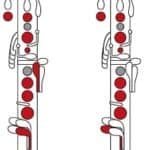
You have the full fingering chart in front of you, so think of this as a friendly whisper from another clarinet nerd rather than a full lesson. The B bebop major scale on Bb clarinet is essentially your standard B major scale with an extra chromatic passing note added between the 5th and 6th scale degrees.
Starting from low written C sharp and moving up, you will pass through familiar B major territory. Watch the usual trouble spots: the leap across the break from throat A and A sharp to clarion B, the pinky work for low F sharp and C sharp on the lower joint, and the slight hand angle adjustments needed as you move toward clarion E and F sharp. The chart shows each note clearly: focus on smooth finger motion and air support rather than overthinking the theory while you play.
- Play the B major scale slowly, two octaves, slurred.
- Add the extra passing note shown on the chart, keeping the rhythm as even eighth notes.
- Reverse it: descend using the same bebop pattern, always listening for even tone color.
A simple practice routine for living inside the B bebop major scale
| Exercise | Time | Focus |
|---|---|---|
| Slow bebop scale, 2 octaves slurred | 5 minutes | Even tone, stable embouchure, clean break |
| Articulated eighth notes at medium tempo | 5 minutes | Light tongue on the reed, steady air |
| Short improvisations over B major backing | 10 minutes | Hitting B, D sharp, F sharp on strong beats |
Use this routine alongside other scale work like the Bb clarinet G major scale fingering pattern, your standard chromatic scale, and any blues scales you practice. The contrast helps your fingers and ears learn how bebop major feels different from simple diatonic runs.
Key Takeaways
- The B bebop major scale on Bb clarinet adds one chromatic note that keeps chord tones landing on the beat at fast tempos.
- Listening to players like Benny Goodman, Buddy DeFranco and Eddie Daniels will show you how this sound lives in real music.
- Use the free fingering chart and a short daily routine to make B bebop major feel as natural as your basic B major scale.
Frequently Asked Questions
What is Bb clarinet B bebop major scale fingering?
The Bb clarinet B bebop major scale fingering is the set of finger patterns used to play a B major scale with one added chromatic note between the 5th and 6th degrees. It follows standard B major fingerings across two octaves, with one extra note shown on the fingering chart to keep chord tones on strong beats.
Why do jazz clarinetists practice the B bebop major scale?
Jazz clarinetists practice the B bebop major scale because it keeps chord tones like B, D sharp and F sharp on strong beats while using straight eighth notes. This helps improvised lines sound both rhythmically clear and harmonically connected, especially over B major and E major chords in fast tempos.
How often should I practice the B bebop major scale on Bb clarinet?
Short, regular sessions are best. Five to ten minutes a day on the B bebop major scale, combined with other major and minor scales, will build comfort without tiring your embouchure. Focus on tone and smooth finger motion rather than speed, then slowly increase tempo once the pattern feels settled in your hands.
Does the B bebop major scale help with classical clarinet playing?
Yes. Practicing the B bebop major scale strengthens your B major fingerings, improves control across the break, and refines chromatic motion. Those skills apply directly to orchestral excerpts, chamber music and solo works that pass through B major or related keys, such as some passages in Brahms and Weber clarinet pieces.
Can beginners use the B bebop major scale fingering chart?
Early intermediate players can benefit from the chart once they are comfortable with basic B major and the full Bb clarinet chromatic scale. Beginners should first master simpler scales and stable embouchure. After that foundation is set, adding the B bebop major scale introduces jazz color without overwhelming technique.