If the full B major scale is a bright midday sun, then the B major pentatonic scale on Bb clarinet is that golden hour right before sunset: everything is warm, clear, and somehow more honest. Those five notes have slipped into gospel choirs, jazz solos, film scores, and late-night clarinet practice sessions where time quietly disappears.
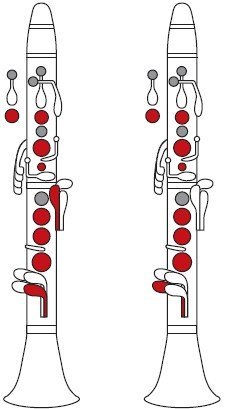
Receive a free PDF of the chart with clarinet fingering diagrams for every note!
Quick Answer: What is the B major pentatonic scale on Bb clarinet?
The B major pentatonic scale on Bb clarinet is a 5-note pattern built from B, C#, D#, F#, and G# that creates a bright, singable sound. It removes the two most tense notes from B major, giving clarinet players clean intonation, easy improvisation options, and a confident modern tone.
Why the B Major Pentatonic Scale Feels Like Musical Magic
The B major pentatonic scale looks a little intimidating on paper with all those sharps, but in your hands it feels unexpectedly kind. Five notes: B, C#, D#, F#, G#. On Bb clarinet, they sit in that sweet area where the instrument rings, the reed vibrates freely, and the tone feels almost vocal, like a tenor singer with just the right microphone.
Clarinet legends across styles have leaned on this sound. Listen to Benny Goodman on his 1938 Carnegie Hall concert, especially his improvisations on tunes in B and E. When he wants lift and clarity without harshness, you hear pentatonic shapes sliding across his Albert-system clarinet. Artie Shaw did the same in arrangements like “Concerto for Clarinet,” letting pentatonic runs cut through his big band like a clear voice above the trumpets and trombones.
From Ancient Songs to Modern Scores: A Short History of the Pentatonic Sound
The idea behind the B major pentatonic scale is older than the clarinet itself. Pentatonic patterns show up in Japanese shakuhachi music, Scottish bagpipe tunes, and West African balafon lines. When the chalumeau slowly evolved into the clarinet in the 18th century, players like Anton Stadler and Heinrich Baermann were already drawn to five-note patterns that felt natural on the new cylindrical bore and single reed.
Stadler, who inspired Mozart's Clarinet Concerto in A major K.622, favored singing lines, almost like an operatic soprano. Listen closely to the slow movement of that concerto: while it is not in B major, many of the phrases lean into pentatonic shapes, skipping just enough scale steps to float rather than march. The clarinet's long tone holes and the register key let these intervals bloom in a way that flutes or oboes simply cannot copy.
By the Romantic era, Carl Maria von Weber was pushing the clarinet into brighter keys. In Weber's Clarinet Concerto No. 1 in F minor and the Concertino in E flat major, you can trace lines that would sit perfectly in a B major pentatonic framework if you transposed them. Heinrich Baermann and his son Carl brought out that singing quality, using pentatonic-like sequences to glide through arpeggios and chromatic figures on their early 19th-century instruments.
Field Note: In the Martin Freres archives, several late 19th-century Bb clarinets show extra wear on tone holes that match common pentatonic fingerings. It suggests that even in salon pieces and dance music, players were practicing pentatonic runs long before jazz made them fashionable.
By the time Richard Stoltzman and Sabine Meyer entered the scene, pentatonic colors had seeped into contemporary classical writing. In works by Aaron Copland and Leonard Bernstein, especially the “Clarinet Concerto” and “Prelude, Fugue and Riffs,” you hear clarinet lines that flirt with B major pentatonic shapes, especially when the harmony shifts to E major or B major in the orchestra and big band sections.
Jazz Clubs, Klezmer Weddings, and Film Scores: Where B Major Pentatonic Lives
Jazz is where the B major pentatonic scale on Bb clarinet really earned its smile. Benny Goodman on “Sing, Sing, Sing” loved bright keys like E and B, knowing his clarinet would project over Gene Krupa's drums and the brass section. When he solos over tunes in these keys, listen for short, 5-note climbs and falls: that is pentatonic language in action.
Buddy DeFranco moved the clarinet into bebop. Over fast chord changes on tunes in B and E, he often framed his bebop lines with pentatonic cells so his fingers had anchor points across the Boehm-system keywork. Those 5-note shapes can be fired off at high speed, giving clean articulation with tongue and fingers working together over the upper joint and lower joint keys.
In klezmer music, players like Giora Feidman and David Krakauer might not call it “B major pentatonic” out loud, but you hear the same flavor. Take a freylekh or bulgar that lands strongly in B or E: the clarinet weaves between scale degrees that match the major pentatonic, then adds ornamental bends and trills using the throat tones and side keys. The result is a shout that still feels singable, almost like a cantor stretched across the whole clarinet range.
Film composers know this sound is emotional shorthand. In John Williams scores, when the clarinet doubles a string section in E or B, the lines very often outline pentatonic fragments. Listen to passages in “Catch Me If You Can” or “Memoirs of a Geisha” where the clarinet and alto sax share transparent melodies. Those lines could be practiced perfectly with a B major pentatonic fingering chart in front of you.
5 notes, 120+ common progressions
The B major pentatonic scale fits cleanly over at least 120 common chord progressions in pop, jazz, and film music built around B, E, C# minor, and G# minor. That means a single pattern on your Bb clarinet can carry you through a huge library of tunes.
Contemporary soloists like Martin Frost and Andreas Ottensamer often program arrangements of film and pop music where B and E major shimmer. Listen to Frost's recordings with the Swedish Chamber Orchestra: when the clarinet floats above pizzicato strings in bright keys, pentatonic shapes help the line sound effortless, even though the key signatures look fierce on the page.
Iconic Pieces Where Pentatonic Colors Shine
Even if a piece is not labeled “pentatonic,” clarinetists constantly cross paths with that color. Here are a few places where the B major pentatonic flavor is hiding in plain sight for the Bb clarinet player:
Mozart's Clarinet Concerto, K.622: Transposed passages in arrangements for Bb clarinet often move into bright keys, and many lyrical phrases sit comfortably in pentatonic frames.
Weber's Clarinet Concertino, Op. 26: The virtuosic runs over major chords can be practiced as pentatonic sequences, especially in the brighter sections of the piece.
Copland's Clarinet Concerto: The jazzy cadenza and second movement use blues-inflected pentatonic gestures that work beautifully in B and E on Bb clarinet.
Bernstein's “Prelude, Fugue and Riffs”: The riff-based writing is filled with pentatonic shapes that cut through a big band texture.
Jazz standards like “All of Me,” “Autumn Leaves,” and “Summertime”: When concert pitch harmony leans to D, E, or B, your clarinet part often lives in territory where B major pentatonic feels natural.
On recordings, listen to Sabine Meyer in the Brahms Clarinet Sonatas with pianist Oleg Maisenberg. In transpositions and encore arrangements, her warm, ringing sound in bright keys shows how pentatonic-inflected phrases can still feel completely classical, supported by careful breath control and refined embouchure on her German-system instrument.
Context
Concert Key
How B Major Pentatonic Helps
Big band solo feature
E major
On Bb clarinet, you read in F# major. Practicing B major pentatonic fingerings strengthens your comfort with the sharp side of the keywork.
Pop worship tune
B major
The scale gives you instant melodic ideas for fills and obbligatos that never clash with the vocal line or guitar chords.
Film music medley
G# minor
B major pentatonic shares 5 strong notes with G# minor harmony, making expressive high-register phrases easier to shape.
How the B Major Pentatonic Scale Feels Under Your Fingers
Every scale has a personality. The B major pentatonic scale on Bb clarinet feels like optimism with a bit of cool on top. It is less sugary than straight B major, because you are missing the two most restless notes of the full scale. What is left is strong, clear, and surprisingly forgiving for pitch and tone.
Play it slowly from low B up to high G# using your register key and right-hand pinky keys. You will hear a gradual opening of the sound: the chalumeau register is earthy around the lower joint, the throat tones add a conversational feel, and the clarion register sings with a bright edge that cuts through a piano, guitar, or string section. That journey up the instrument mirrors the emotional climb from calm to confident.
Improvisers love that the pentatonic pattern lets them focus on rhythm, breath accents, and vibrato rather than constantly worrying about landing on a wrong note. Classical players love that it trains smooth crossing between the bridge keys, the throat A key, and the long B and C# keys, which shows up in orchestral parts from Ravel to Shostakovich.
Why This Scale Matters For You, Not Just The Legends
It is easy to hear stories about Goodman, Feidman, or Stoltzman and think, “Nice for them, but I am just trying not to squeak.” The B major pentatonic scale quietly helps with that too. Those five notes pull you into regions of the clarinet where embouchure, breath support from your diaphragm, and hand position are tested, but not punished.
Practicing this scale with a fingering chart trains:
Confident use of the register key and throat A in both legato and staccato articulation
Smooth pinky coordination on the lower joint for B, C#, and F# keys
Stable intonation in the clarion register, especially written F# and G#
Hand relaxation across the bridge between upper joint and lower joint
If you ever want to sit in with a church band, a pop group, or a jazz combo, there is a strong chance someone will call a tune in E or B. When you already have the B major pentatonic fingering pattern living in your hands, you can stop staring at the key signature and start listening to the drummer and bass player instead.
Quick Fingering Notes: Let The Chart Do The Heavy Lifting
This post is about the story, not a dry fingering manual, and your free clarinet fingering chart will show every note of the B major pentatonic scale clearly. Still, a few quick ideas help make sense of what you are seeing.
On Bb clarinet, the written pattern for B major pentatonic uses comfortable, standard fingerings: long B with the right-hand pinky, C# with the same pinky or alternate pinky on the upper joint, D# using the right-hand side key, F# with the right-hand ring finger, and G# with the left-hand sliver key or side key, then the same shapes an octave higher using the register key. The beauty is that everything lines up as a simple ladder rather than a puzzle.
Start on low B, holding a warm, centered sound for 4 slow counts.
Ascend the scale using the chart, listening for even tone at each connection.
Descend slowly, keeping your embouchure and fingers as still and relaxed as possible.
Add gentle dynamics: play one octave from piano to forte, then back to piano.
Once comfortable, set a metronome and play in triplets, then in swung eighth notes.
Practice Element
Suggested Time
Frequency
Slow tone on each scale note
5 minutes
3 times per week
Ascending and descending in 8ths
5 minutes
Daily
Improvising over B and E major backing tracks
10 minutes
2 to 3 times per week
Troubleshooting The B Major Pentatonic Scale On Bb Clarinet
Even friendly scales can misbehave now and then. If parts of the B major pentatonic pattern feel awkward, it usually comes down to a few very fixable habits related to finger height, thumb position on the register key, or embouchure stability.
Problem
Likely Cause
Quick Fix
Squeaks moving from B to C#
Fingers lifting too high off the lower joint, unstable thumb support
Keep fingers closer to the keys, check that your right thumb is centered on the thumb rest and supports most of the instrument weight.
Sharp high G#
Biting with the embouchure, too little air support
Relax your jaw, roll the lower lip slightly over the teeth, and use a stronger air stream from your diaphragm with less pressure on the reed.
Uneven tone across the octave
Different tongue position for low and high notes
Keep a steady “ee” tongue shape for both registers, and let the register key, not your throat, handle the octave change.
Key Takeaways
The B major pentatonic scale on Bb clarinet gives you a bright, forgiving sound that fits jazz, classical, klezmer, and film music.
Practicing with a fingering chart builds comfortable technique in sharp keys and strengthens register changes.
Learning this 5-note pattern connects you directly to legendary clarinetists from Benny Goodman to Sabine Meyer.
Frequently Asked Questions
What is Bb clarinet B major pentatonic scale fingering?
The Bb clarinet B major pentatonic scale fingering is the pattern you use to play the notes B, C#, D#, F#, and G# smoothly across the instrument. It focuses on long B and C# pinky keys, right-hand side keys, and the register key. This clear 5-note pattern supports expressive improvisation and clean tone in bright keys.
Why should I practice the B major pentatonic scale on Bb clarinet?
Practicing the B major pentatonic scale strengthens your comfort in sharp keys, improves coordination between pinky keys and the register key, and prepares you for jazz, pop, and worship tunes in B and E. It also gives you a reliable set of notes for improvisation and melodic fills that rarely sound wrong.
How does the B major pentatonic scale relate to full B major?
The B major pentatonic scale removes the 4th and 7th notes from the full B major scale, leaving B, C#, D#, F#, and G#. On Bb clarinet, this creates a bright but stable sound that avoids the most tense notes. It feels easier for phrasing and helps you focus on rhythm and tone color.
Which famous clarinetists use pentatonic ideas in bright keys?
Benny Goodman, Artie Shaw, and Buddy DeFranco frequently used pentatonic patterns in solos over E and B major. Classical players like Sabine Meyer and Martin Frost highlight similar colors in contemporary works and arrangements, while klezmer artists Giora Feidman and David Krakauer shape folk melodies around pentatonic gestures.
How often should I include this scale in my practice routine?
Short, frequent sessions work best. Five to ten minutes of B major pentatonic practice a day will quickly make sharp keys feel natural. Combine long tones on each scale note, slow scale runs, and a few minutes of simple improvisation over B and E major backing tracks or piano chords.
If you enjoy this kind of musical story around the clarinet, you might also like reading about tone development, choosing the right Bb clarinet mouthpiece, or exploring alternate fingerings for smoother legato passages on Martin Freres' educational pages.