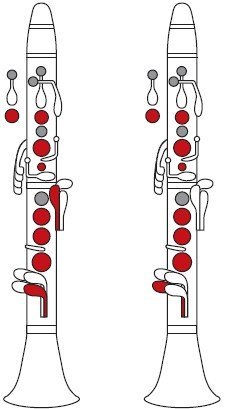
If you close your eyes and play the first few notes of “Baa Baa Black Sheep” on your Bb clarinet, you are stepping into something much bigger than a children's song. Our “Baa Baa Black Sheep” clarinet fingering chart is a tiny map into centuries of melody, memory, and the way simple tunes turned young players into artists.
Receive a free PDF of the chart with clarinet fingering diagrams for every note!
Quick Answer: What is the Baa Baa Black Sheep clarinet fingering chart?
The Baa Baa Black Sheep clarinet fingering chart is a visual guide for Bb clarinet showing each note of the melody with clear finger positions. It helps beginners play the song accurately, build confident tone on basic notes, and enjoy a familiar tune while learning real musical control.
The quiet power behind Baa Baa Black Sheep
“Baa Baa Black Sheep” did not start its life in a band room. It began as an English nursery rhyme in the 1700s, sung in small rooms and at kitchen tables long before a clarinet key ring ever clicked over low E. Yet this tiny tune has become one of the first melodies many Bb clarinet players ever shape with air, reed, and keys.
The scale patterns inside the song are simple, built mostly on the notes of a major scale, but simplicity is exactly why great artists treat melodies like this with respect. They know that if you can make three or four notes sing, you can later make Mozart, Brahms, and Gershwin breathe the same way.
About 80% of Baa Baa Black Sheep uses just 5 notes
That small set of notes is perfect for building a stable embouchure, consistent breath support, and smooth finger motion on the Bb clarinet, without overwhelming early players.
How great clarinetists treat simple tunes
No, you will not find Anton Stadler or Heinrich Baermann listed next to “Baa Baa Black Sheep” in a catalog, but listen to how they handle lyrical lines in Mozart's Clarinet Concerto in A major, K. 622 and Weber's Clarinet Concerto No. 1 in F minor. Their long tones on throat tones like A, B? (A#), and B, their even fingers on middle-register C and D, are built on years of singing short melodies just like this one.
Sabine Meyer, for instance, often speaks about the vocal quality of the clarinet. If you listen to her recording of the Mozart Concerto with the Berlin Philharmonic, the way she caresses a simple descending phrase is exactly how you can treat the line “Baa baa black sheep” using only a handful of notes. Martin Frost does the same thing in his interpretations of Nielsen's Clarinet Concerto, turning small note groups into clear, human gestures.
Jazz legends lean on the same idea. Benny Goodman worked over easy tunes and children's melodies to refine his tone and articulation on his Selmer clarinet. Buddy DeFranco talked about practicing slow, uncomplicated lines to get his fingers and tongue perfectly aligned before attacking bebop runs. Artie Shaw, in his famous recording of “Begin the Beguine,” shapes the simplest notes like speech. If you can play “Baa Baa Black Sheep” with that kind of care, you are following the same path.
In klezmer traditions, players such as Giora Feidman and David Krakauer often start with basic folk tunes, then twist them with ornaments, bends, and slides. Imagine taking your steady version of “Baa Baa Black Sheep” and later adding small scoops on repeated notes, or singing it with a warm vibrato in the upper chalumeau register, like Feidman in his “Love” and “Dance” recordings.
Field Note: In the Martin Freres archives, there are letters from 19th century teachers describing how they used simple folk melodies on Martin Freres clarinets to test the evenness of new keywork. If a student could play a children's tune in tune and in time across the break, the instrument was considered ready for serious literature.
From nursery rhyme to concerto hall
Although “Baa Baa Black Sheep” itself is a nursery rhyme, its melodic DNA shows up everywhere in clarinet literature. The tune shares its broad outline and pitch motion with cousins like “Twinkle, Twinkle, Little Star” and the alphabet song, which in turn echo the shapes of 18th century song forms and simple folk airs used by composers such as Haydn, Mozart, and early Beethoven.
Think of the opening phrase of Mozart's Clarinet Quintet in A major, K. 581. That gentle rise and fall in the chalumeau and clarion registers feels like an older, more sophisticated relative of a nursery tune. Carl Maria von Weber does something similar in the slow movement of his Clarinet Concerto No. 2, where the clarinet sings on long, stepwise lines that any beginner melody could fit inside.
As we move into the romantic era, Johannes Brahms uses folk-like simplicity in his Clarinet Sonata in F minor, Op. 120 No. 1. In the slow movement, the clarinet line in the right hand of the piano score could easily be transformed into a child's song if you stripped away the harmony. The shape is still there: a few notes, repeated, turned gently around a central tone.
Jazz standards do the same trick. Listen to Benny Goodman on “Body and Soul” or Artie Shaw on “Moon Ray.” Those melodies are not far from the contour of “Baa Baa Black Sheep” in their early bars: a small range, stepwise motion, and repetition. Players like Buddy DeFranco built their bebop language on top of this kind of plain, singable line.
In film scores, nursery-rhyme-style motifs appear again and again. Composers like John Williams and Howard Shore often give the clarinet soft, almost childlike lines in soundtracks. Williams's writing for clarinet in “E.T.” and “Harry Potter” uses just a few close-together notes in the chalumeau and clarion registers to suggest innocence and wonder, the same emotional territory where a tune like “Baa Baa Black Sheep” lives.
Iconic clarinet pieces with the same melodic DNA
Once you hear the shape of “Baa Baa Black Sheep” on your Bb clarinet, you start recognizing its cousins everywhere. Here are some pieces where that simple, stepwise language shows up, carried by famous clarinetists and ensembles:
Mozart: Clarinet Concerto in A major, K. 622 – played by Sabine Meyer, Martin Frost, and Richard Stoltzman with orchestras like the Berlin Philharmonic and the London Symphony Orchestra. The lyrical second movement grows out of the same kind of gently rocking intervals you meet in children's songs.
Weber: Concertino in E? major, Op. 26 – a favorite for students, recorded by Heinrich Baermann in early editions and by modern players like Sharon Kam. The opening cantabile sections use a tiny melodic range in the chalumeau and clarion registers, just like a nursery melody.
Brahms: Clarinet Trio in A minor, Op. 114 – often recorded by Karl Leister and Sabine Meyer. The clarinet line in the Adagio moves in small steps and repeated patterns that feel as familiar as any folk song.
Gershwin: “Summertime” in arrangements for clarinet and piano, performed by Richard Stoltzman. The tune is a lullaby at its core, built on short, memorable patterns very close to the simplicity of “Baa Baa Black Sheep.”
Klezmer tunes like “Der Heyser Bulgar” and “Ale Brider” – often played by Giora Feidman and David Krakauer. Their clarinet lines spin around a narrow pitch center, with repetition and ornamentation growing from a child-simple core.
The next time you listen to a recording of Sabine Meyer playing the Mozart Quintet, notice how many phrases could be simplified down to a five-note children's tune. Those phrases are the grown-up relatives of the line you are about to play with the help of your Baa Baa Black Sheep clarinet fingering chart.
Melody Type
Typical Note Range
Clarinet Example
Nursery rhyme (Baa Baa Black Sheep)
About 5 notes in the chalumeau/low clarion
Beginner Bb clarinet song using basic notes like G, A, B, C, D
Classical concerto phrase
About 8 notes, often stepwise
Mozart K. 622 slow movement clarinet line
Jazz standard theme
5 to 10 notes, repeated patterns
Benny Goodman's intro to “Body and Soul”
Why Baa Baa Black Sheep matters emotionally on clarinet
On paper, “Baa Baa Black Sheep” is short, repetitive, and easy to memorize. On a Bb clarinet, though, it turns into a small emotional laboratory. Those repeated notes ask you to control your embouchure and air so that each note speaks with the same warmth. The gentle stepwise motion invites you to phrase, to breathe like a singer, to decide where the musical sentence ends.
For a young player, this might be the first time a melody feels “real” under the fingers, not just a long tone or an exercise from a method book like the Klose method or the Rubank series. For an advanced player, it can be a reset button: a way to reconnect with the pure joy of sound on a simple line, the kind of thing Richard Stoltzman might hum backstage before walking out to play the Copland Clarinet Concerto.
Parents hear childhood; teachers hear potential; clarinetists hear the start of lyric playing. That is the quiet magic of this little tune.
What this simple tune opens up for your clarinet playing
Working with a Baa Baa Black Sheep clarinet fingering chart is not just about getting the right keys down. It is about building skills that show up everywhere else. The song usually stays in one comfortable key, often C major or G major concert (so D major on Bb clarinet), which means you can focus on sound and phrasing while your fingers memorize a handful of basic patterns.
Once those notes feel easy, you can start to:
Experiment with dynamics, playing the line as a lullaby pianissimo or as a bright marching tune forte.
Change articulation, trying legato slurs like Sabine Meyer or light swing-style tonguing as Benny Goodman might.
Transpose the melody to different starting notes, testing your comfort in other clarinet registers, from low chalumeau E and F to middle clarion A and B.
The same control will serve you in scales, in the Weber Concertino, in jazz combos, in klezmer bands, and in school wind ensembles playing Holst or Vaughan Williams, where the clarinet section often carries simple, songlike lines.
Skill
How Baa Baa Black Sheep helps
Where it shows up later
Tone control
Repeated notes reveal embouchure and air issues quickly.
Long phrases in Mozart and Brahms sonatas.
Finger coordination
Short shifts among 5 notes train left and right hand balance.
Crossing the break in Weber concertos and orchestral solos.
Phrasing
Clear, short phrases make breath planning obvious.
Jazz standards, klezmer doinas, lyrical band solos.
Reading the Baa Baa Black Sheep clarinet fingering chart
The fingering chart for Baa Baa Black Sheep lays out each note of the melody with a clear diagram of which holes and keys to cover on your Bb clarinet. Most versions of the song use just a small group of pitches, often centered on notes like G, A, B, C, and D in the staff, which means you stay in the comfortable chalumeau and low clarion registers.
Use your left-hand index finger on the first tone hole, middle finger on the second, and ring finger on the third, with your right hand resting on the next three tone holes. Thumb position on the register key will stay relaxed, and the chart will show you exactly where the break between lower and upper register appears, if your arrangement crosses it at all. Think of the chart as your visual reference while your ears guide each phrase.
Look at the first note in the chart and match the fingering diagram on your clarinet.
Play that note as a long tone, listening for a rich, centered sound.
Move to the next note and feel which fingers change, keeping your air steady.
Add rhythm only after you can move between each pair of notes smoothly.
Finally, play through the whole tune in time, imagining you are singing it.
Simple practice plan for Baa Baa Black Sheep on Bb clarinet
To make the most of your Baa Baa Black Sheep clarinet fingering chart, keep your practice short, focused, and musical. A few minutes a day is enough to turn this into a beautiful little ritual with your instrument, whether you are just starting or warming up for Brahms or Copland.
Practice Block
Time
Focus
1. Long tones on song notes
5 minutes
Hold each note from the tune, one by one, shaping clear tone and even breath.
2. Slow melody with the chart
5 minutes
Use the fingering chart, play very slowly, listening for smooth fingers.
3. Musical version
5 minutes
Add dynamics and phrasing, like Sabine Meyer or Benny Goodman might.
For more melodic ideas beyond this tune, you might enjoy reading about classical scales and melodic patterns in other articles on MartinFreres.net, such as features on Bb clarinet scales, stories behind famous clarinet concertos, and historical perspectives on early clarinet pedagogy.
Key Takeaways
Treat Baa Baa Black Sheep like a tiny concerto: focus on tone, phrasing, and expression, not just getting the notes right.
Use the Baa Baa Black Sheep clarinet fingering chart as a visual guide while your ears and breath shape the melody.
Remember that simple tunes train the same musical skills you will need for Mozart, Brahms, jazz standards, and klezmer solos.
Frequently Asked Questions
What is Baa Baa Black Sheep clarinet fingering chart?
The Baa Baa Black Sheep clarinet fingering chart is a note-by-note visual guide for playing this nursery rhyme on Bb clarinet. It shows which keys and holes to press for each pitch in the melody, helping beginners build confident fingers and tone while learning a familiar, singable tune.
What notes are used in Baa Baa Black Sheep on Bb clarinet?
Most arrangements of Baa Baa Black Sheep on Bb clarinet use about 5 to 7 notes in a comfortable range, often centered on G, A, B, C, and D in the staff. Some versions may start on different pitches, but they usually stay in one simple key that is friendly to new players.
Is Baa Baa Black Sheep good for beginner clarinetists?
Yes, it is ideal for beginners. The melody is short, repetitive, and mostly stepwise, so students can focus on embouchure, breathing, and basic finger coordination. Because the tune is already familiar, the player can listen for tone and phrasing instead of worrying about remembering the notes.
How often should I practice Baa Baa Black Sheep on clarinet?
Even 10 to 15 minutes a day for a week can make a big difference. Start with slow practice using the fingering chart, then gradually add rhythm and musical expression. Many players keep it in their warm-up for longer, using it as a quick tone and phrasing check before harder music.
Can I use Baa Baa Black Sheep to learn different clarinet registers?
Yes. Once the tune feels easy in its original position, you can move it higher or lower by starting on different notes. This lets you practice similar finger patterns in the chalumeau, clarion, and even altissimo registers, while still working with a melody your ear already knows by heart.