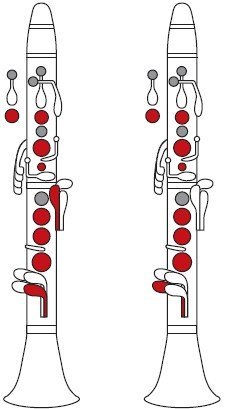
If there was ever a song that felt like a quiet porch swing at twilight, it is “Beautiful Dreamer.” On Bb clarinet, this melody sings in a way that feels almost like conversation: gentle, human, a little nostalgic. That is why this free Beautiful Dreamer clarinet fingering chart is more than a set of dots and keys. It is an invitation to join a long line of players who have used this tune to tell their own story.
Receive a free PDF of the chart with clarinet fingering diagrams for every note!
Written in the 1860s by Stephen Foster, “Beautiful Dreamer” started as a parlor song, carried by fragile upright pianos and soft singing voices. On clarinet, it feels like the melody finally found the instrument it had been waiting for: something that can whisper, sigh, and glow on a single long breath.
Quick Answer: What is the Beautiful Dreamer clarinet fingering chart?
The Beautiful Dreamer clarinet fingering chart is a visual guide for Bb clarinet that shows the exact fingerings for every note in the melody. It helps players of all levels read, play, and phrase the song more confidently, so the focus stays on expression and a warm clarinet sound.
The story of Beautiful Dreamer on clarinet
Stephen Foster never wrote this melody with a Bb clarinet specifically in mind, yet the line sits in such a natural range for the instrument that it almost feels like a lost clarinet solo. Most arrangements place the tune comfortably in the clarion register, right where the chalumeau depth begins to bloom into singing brightness. It is the same register Mozart gave to Anton Stadler in the Clarinet Concerto, where the instrument sounds closest to the human voice.
In old photographs of early 20th century bands, you can sometimes spot clarinetists on simple-system instruments holding sheet music labeled “Foster medley” or “Parlor songs.” Pieces like “Beautiful Dreamer,” “Jeanie With the Light Brown Hair,” and “Old Folks at Home” were regular fare for clarinetists in park concerts, riverboat ensembles, and small-town wind bands from New Orleans to Paris.
Field Note: In the Martin Freres archives, there are handwritten parts for “Beautiful Dreamer” arranged for 2 clarinets and cornet, dated around 1905. The clarinet staves are covered with penciled breath marks and small dynamic curves, proof that even casual players treated this simple song as a miniature aria.
Playing “Beautiful Dreamer” with a focused clarinet embouchure and a relaxed right hand creates exactly that feeling: an aria without the opera house. With the free clarinet fingering chart in front of you, the mechanics recede and the melody can finally float.
Clarinetists who would have loved Beautiful Dreamer
There is no famous clarinet concerto titled “Beautiful Dreamer,” but listen to how great players shape similar melodies and you will hear the same spirit. Imagine Anton Stadler, Mozart's clarinet muse, using a tune like this as a warmup to test intonation between throat tones and clarion notes on his extended basset clarinet. The melody glides across F, G, A, and middle C in a way that would have shown off the smoothness of his old boxwood instrument.
Heinrich Baermann, the romantic-era virtuoso adored by Carl Maria von Weber, was known for his singing legato and elegant use of register key on early 19th century clarinets. If you listen to Weber's “Concertino” or the slow movement of the First Clarinet Concerto, you can almost superimpose the shape of “Beautiful Dreamer” over those long, arching phrases. The same wide intervals, the same need for a steady diaphragm and controlled tongue position.
Fast forward to the 20th century. Richard Stoltzman recorded entire albums of lyrical American songs and spirituals, using his Buffet clarinet and usually a Vandoren mouthpiece to create a tone that feels like velvet. While he might not have programmed “Beautiful Dreamer” specifically, his approach to Gershwin's “Someone To Watch Over Me” or Copland's clarinet pieces shares the same DNA: simple, beautiful lines sung with intense care.
Sabine Meyer and Martin Frost live more in the classical and contemporary arenas, but listen to their phrasing in the slow movements of the Brahms Clarinet Sonatas or Magnus Lindberg's “Clarinet Concerto.” They both treat every long note as if it were the last note in “Beautiful Dreamer” before sleep finally arrives. That same approach works wonders when a student takes this song from the page to the air in front of the bell.
On the jazz side, Benny Goodman and Artie Shaw were surrounded by these sentimental American songs from childhood. Goodman's warm chalumeau tone on pieces like “Memories of You” or “Moonglow” feels like a cousin of “Beautiful Dreamer.” Artie Shaw's liquid legato in “Begin the Beguine” shows how a clarinetist can take a song-like melody and turn it into something hypnotic simply with breath control and right-hand balance on the lower joint.
Klezmer greats like Giora Feidman and David Krakauer might prefer modal freygish scales and dancing ornaments, but listen to their quieter moments. Feidman's recording of “Yiddishe Mame” and Krakauer's tender playing in slow doina sections show the same heart that suits a tune like “Beautiful Dreamer.” The instrument parts are different, the reeds are sometimes harder, but the artistic goal is the same: one note that says more than a paragraph.
Where the spirit of Beautiful Dreamer shows up in clarinet music
Even if the exact melody of “Beautiful Dreamer” does not appear in standard clarinet repertoire, its character is all over the instrument's greatest pieces. Think of the slow movement of Mozart's Clarinet Concerto in A major, K. 622. The way the line hovers on the dominant, then gently resolves, feels like the same bedtime story energy as Foster's tune.
Brahms wrote for Richard Muhlfeld with a dark, autumnal sound in mind. In the Clarinet Quintet and the Two Sonatas, the clarinet often sings in the same range you will use for “Beautiful Dreamer” on Bb clarinet: A, B, C, and D above the staff, supported by a warm throat B flat and G. Those pieces ask for the same patient breath, the same soft left-hand finger motion you practice in a simple song.
In American band literature, many early 20th century pieces quote or reference Foster songs. Arrangements of “American Patrol” or “Foster Favorites” often gave the melody to the first clarinet, asking young players with simple Albert-system clarinets to sing out over cornets and trombones. That tradition continues in school band arrangements today, where clarinetists often carry similar lyrical melodies from composers like Clare Grundman and Frank Erickson.
Film scores echo this sound too. Listen to the clarinet lines in the score for “To Kill a Mockingbird” by Elmer Bernstein or the gentle woodwind writing in “Cinema Paradiso” by Ennio Morricone. Those clarinet parts feel like modern descendants of songs such as “Beautiful Dreamer” and “Wayfaring Stranger” not because they quote them directly, but because they carry the same sighing, rocking motion.
8 to 16 measures of pure melody
Most clarinet arrangements of “Beautiful Dreamer” fit on a single page, usually 8 to 16 bars long. That short length makes it perfect for tone practice, phrasing exercises, and quick warmups without tiring the embouchure or right-hand fingers.
Jazz clarinetists like Buddy DeFranco and Eddie Daniels often used similar lyrical standards as palate cleansers between blistering bebop lines. Listen to Daniels on ballads like “Body and Soul” with clarinet and piano. The way he leans into throat tone A and long clarion F sharp could be a masterclass for anyone playing “Beautiful Dreamer” out of a simple fingering chart.
From parlor song to clarinet stand: a brief history
“Beautiful Dreamer” was published after Stephen Foster's death in 1864, at a time when parlors, not concert halls, were the center of musical life in many homes. The melody was built for singing, usually in the key of C or E flat for comfortable vocal range. As wind bands spread across Europe and America, arrangers began to hand these songs to clarinets, cornets, and flutes.
Early clarinets in C and B flat, often built of boxwood or grenadilla with simple keywork, took on these melodies for outdoor concerts in city squares. Players balanced their reed strength against damp evening air, trying to keep the tone focused while still sounding gentle. The register key and throat A key were already present, and the shape of “Beautiful Dreamer” encouraged smooth register transitions that made these new instruments feel more lyrical than their baroque ancestors.
By the late romantic era, the clarinet had become a standard voice for anything tender or nostalgic. Composers such as Mahler, Tchaikovsky, and Rachmaninoff wrote slow clarinet solos in their symphonies that carried the same emotional weight as Foster's song: a distant memory, a private lullaby, a dream that might be slipping away.
In the early 1900s, clarinet parts for salon ensembles and cinema orchestras frequently included arrangements of American songs. Beautiful Dreamer rode along with them, sometimes under different titles, sometimes hidden inside medleys printed on fragile paper that now lives only in archives like those preserved by Martin Freres. Even as clarinet design evolved with the Boehm system, modern pads, and adjustable barrels, the melody stayed the same: simple, floating, forgiving.
Today, you might find “Beautiful Dreamer” in a beginner clarinet method book, a jazz fake book, or an online sheet music download. The Bb clarinet fingering chart you hold now is part of that continuum: a fresh way to approach a very old song with modern keywork, precision-made mouthpieces, and carefully cut reeds.
Why Beautiful Dreamer matters emotionally on Bb clarinet
On clarinet, “Beautiful Dreamer” is not flashy. There are no rapid arpeggios like in Weber's concertos and no crazy leaps up to high C like in Nielsen's Concerto. Instead, it stays mostly in the middle of the instrument, where the chalumeau meets the clarion, right around the register break. That neighborhood is where clarinetists build their sound identity.
Playing this song well demands courage of a different kind: the courage to hold a long note with a stable embouchure, to keep fingers relaxed on the upper and lower joints, and to trust that your air column will carry the phrase. A simple G tied across two measures can feel more exposed than a run of 16th notes across the break.
Emotionally, the song sits somewhere between lullaby and farewell. The clarinet, with its cylindrical bore and single reed, has a built-in melancholy that suits this mood. When you pulse a gentle vibrato with your jaw or use a slight swell in the middle of a phrase, you are doing the same expressive work that great singers like Ella Fitzgerald or Julie Andrews brought to their simplest songs.
This is why teachers often reach for pieces like “Beautiful Dreamer” after a tough articulation etude. One page of long, floating clarinet lines reminds the student that the instrument is not just for scales and orchestra excerpts. It is for singing to someone who matters, even if that someone is just you in a quiet practice room.
What learning Beautiful Dreamer does for you as a clarinetist
Working through a Beautiful Dreamer clarinet fingering chart is less about memorizing note names and more about building habits you will use in Weber, Brahms, and Debussy. The slow tempo forces you to listen to the sound coming out of the bell and through the tone holes, not just whether you hit the note correctly.
Every time you move between throat A, B flat, and clarion B with clean finger motion, you are quietly training the same mechanics needed for solos in band pieces like Alfred Reed's “Armenian Dances” or Percy Grainger's “Lincolnshire Posy.” The fingering chart is a simple map, but the trip you take with it touches everything from breath support to left-hand ring finger control.
For advancing players, using this melody as a canvas for phrasing practice can be powerful. Try adding subtle dynamics, portamento-style finger slides that stay in tune, and varied articulation. These same skills later color the opening of the Debussy Rhapsodie or the soft interjections in Gershwin's “Rhapsody in Blue.”
Practice Focus
How Beautiful Dreamer Helps
Future Pieces Supported
Tone and breath control
Long notes in the middle register reveal embouchure and air issues quickly.
Mozart Concerto, Brahms Sonatas, lyrical band solos
Register transitions
Smooth moves across the register break in slow motion.
Simple melody lets you focus on dynamics, vibrato, and shaping.
Jazz ballads, klezmer doinas, film score solos
A quick, gentle word on the fingerings
The free Beautiful Dreamer clarinet fingering chart lays everything out visually, so you do not have to overthink the mechanics. Most arrangements for Bb clarinet sit in a friendly key like F major or E flat major, using open G, long B flat, first finger E, and simple clarion notes such as A and B.
Focus on three things as you follow the chart: keep the left-hand thumb steady on the register key, let the right-hand fingers stay curved and relaxed on the lower joint, and use even air so the tone does not thin out at phrase endings. The rest is just you, your reed, and a very old melody that still feels new in the right hands.
Finger the notes slowly using the chart until each combination feels effortless.
Add a metronome at a soft tempo, around 60 beats per minute, to steady your breath.
Once the notes are secure, ignore the chart and play from memory, focusing only on sound.
Level
Session Length
Weekly Frequency
Beginner
5 minutes on melody after scales
3 times per week
Intermediate
10 minutes with dynamics and phrasing
2 to 3 times per week
Advanced
5 minutes as a tone meditation
As a warmup before repertoire
Troubleshooting Beautiful Dreamer on clarinet
Issue
Likely Cause
Quick Fix
Squeaks on register changes
Thumb and register key not moving together, loose embouchure
Practice the shift alone, tighten corners of the mouth, use steady air.
Thin tone on long notes
Air support fading, jaw biting the reed
Think warm air into the bell, relax jaw, keep diaphragm engaged.
Uneven slurs
Fingers lifting too high, inconsistent tongue position
Keep fingers close to keys, silent left-hand practice on the body only.
Key Takeaways
Use the Beautiful Dreamer clarinet fingering chart to free your mind from note worries so you can focus on sound and expression.
Treat this short song like a mini aria to practice breath, register control, and lyrical phrasing for larger clarinet works.
Listen to great clarinetists in lyrical pieces, then apply their phrasing ideas to your own Beautiful Dreamer performance.
Frequently Asked Questions
What is Beautiful Dreamer clarinet fingering chart?
The Beautiful Dreamer clarinet fingering chart is a visual guide for Bb clarinet that shows which keys to press for every note in the song. It removes guesswork about finger placement so you can focus on breath, tone, and phrasing while playing this classic Stephen Foster melody.
Is Beautiful Dreamer suitable for beginner clarinet players?
Yes. Beautiful Dreamer is ideal for beginners who know basic fingerings up to about high C. The moderate tempo, simple rhythms, and mostly stepwise motion let new players practice long tones, legato articulation, and steady air without overwhelming finger technique.
What key is Beautiful Dreamer usually played in on Bb clarinet?
Most Bb clarinet arrangements of Beautiful Dreamer are in F major or E flat major. These keys use comfortable fingerings like open G, first finger A, and long B flat. They also allow smooth transitions over the register break, which helps develop reliable left-hand thumb and register key coordination.
How can I make Beautiful Dreamer sound more expressive on clarinet?
Shape each phrase with a gentle swell in the middle and a soft taper at the ends. Use connected legato tonguing, steady breath from the diaphragm, and a relaxed embouchure. Listen to recordings of lyrical clarinet solos in Mozart or Brahms, then copy that same style of line shaping in this shorter melody.
How often should I practice Beautiful Dreamer with the fingering chart?
Short, regular sessions work best. Try adding 5 to 10 minutes of Beautiful Dreamer after your scales, two or three times a week. Use the fingering chart at first, then gradually look away and play from memory so you can focus on tone color, intonation, and musical storytelling.