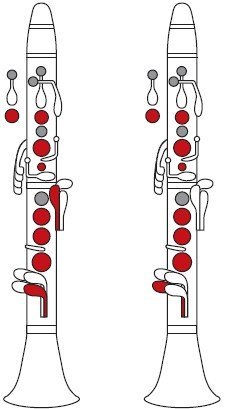
If the full C major scale is a whole city of sounds, the C Major Pentatonic scale is the quiet neighborhood where every house has its porch light on. On Bb clarinet it feels warm, open, and honest, and it shows up in more music than most players ever realize.
Receive a free PDF of the chart with clarinet fingering diagrams for every note!
Quick Answer: What is the C Major Pentatonic scale on Bb clarinet?
The C Major Pentatonic scale on Bb clarinet is a 5 note pattern built from C, D, E, G, and A that removes the half steps of full C major. It gives a clear, singable sound that works in classical, jazz, folk, and film music and makes improvising feel easier and more melodic.
The sound and story of the C Major Pentatonic scale
Play these notes on your Bb clarinet: C, D, E, G, A. No F, no B. Suddenly the clarinet speaks in a different accent. The tone feels like sunlight on the mouthpiece, especially if you lean on that low chalumeau C and then float up to G in the clarion register.
Clarinetists have whispered and shouted with this sound for more than 200 years. From Anton Stadler breathing life into Mozart phrases, to Benny Goodman filling the Carnegie Hall air with bluesy pentatonic riffs, those same five notes kept returning, like an old friend hidden inside every melody.
5 core notes, infinite phrases
With only 5 notes, the C Major Pentatonic scale covers over 2 full octaves on Bb clarinet, from low chalumeau C up through clarion and into the altissimo. That limited pitch set frees players to focus on tone, timing, and expression instead of finger panic.
From Mozart to Brahms: early echoes of pentatonic color
Classical composers did not write “C Major Pentatonic” above the staff, but they loved the color. Listen to Mozart's “Clarinet Concerto in A major, K. 622” and focus on the slow movement. When the clarinet line circles around simple notes of the tonic triad and adds just a couple of steps, you can almost hear a pentatonic skeleton underneath.
Anton Stadler, the Viennese clarinetist who inspired Mozart, was known for a singing tone on chalumeau notes like written C and D, using the thumb and first two fingers of the left hand. Those notes sit right at the heart of the C Major Pentatonic scale on Bb clarinet, and his lyrical approach gave later players a model for how simple note sets can still carry huge emotion.
Later, Carl Maria von Weber took that same idea and gave it more drama in his “Clarinet Concerto No. 1 in F minor” and the “Concertino in E b”. Even in stormy keys, he often lets the clarinet fall back on five note shapes that behave like pentatonic patterns: step, skip, skip, step. Heinrich Baermann, his clarinet muse, shaped these phrases with a warm legato that modern players still chase in rehearsals with orchestras from Berlin to Chicago.
Brahms pushed the clarinet even further in his “Clarinet Sonata in F minor, Op. 120 No. 1” and the “Clarinet Quintet in B minor”. In the slow movements, listen for those gentle, hymn like lines. They often rest on five stable scale tones, gliding across the register break between throat tones and clarion E and F. That same idea, stripped to C Major Pentatonic, becomes a perfect training ground for singing Brahms style lines with a relaxed embouchure and steady air.
Jazz legends and the five note magic
Now picture Benny Goodman in front of his big band, clutching his Selmer or Buffet clarinet, calling a blues in C. When he riffs over a simple swing groove, he often leans on exactly those C Major Pentatonic notes. They fall perfectly under the fingers, especially around throat tone A, clarion C, and high E, where the clarinet can really cut through trumpets and saxophones.
Artie Shaw used the same five note language but with a more fluid, almost vocal glide. In recordings like “Begin the Beguine” and “Stardust”, you can hear him slide between clarion G and A, then dip to a soft chalumeau E. Those are classic pentatonic moves, even when the harmony underneath is richer than plain C major.
Buddy DeFranco, stepping into bebop, turned pentatonic shapes into launch pads for more chromatic lines. Listen carefully to his solos on standards like “How High the Moon”. When the harmony hits a bright, open chord, you will catch short, sparkling fragments that sound just like C Major Pentatonic before he fans out into full chromatic runs.
Jazz Player
How they use pentatonics
Listen for on Bb clarinet
Benny Goodman
Bluesy riffs built from 5 notes over big band grooves
Short licks around C, D, E, G, A in mid clarion
Artie Shaw
Smooth, vocal style pentatonic lines in ballads
Slides between G and A, then down to E and C
Buddy DeFranco
Pentatonic fragments inside fast bebop solos
Short 5 note bursts before chromatic runs
For students learning jazz improvisation on Bb clarinet, teachers often start with the C Major Pentatonic scale because it keeps the clarinet speaking clearly through the register break and encourages rhythmic creativity without the fear of “wrong” notes.
Klezmer, folk melodies, and film scores
If you shift your ear from swing to klezmer, the C Major Pentatonic scale suddenly sounds like a cousin of old village tunes. Giora Feidman, who grew up surrounded by Jewish melodies, often transitions from minor modes into major pentatonic colors to create a sense of uplift in pieces like “Avinu Malkeinu” and arrangements of Hasidic dances. His chalumeau C and D have a vocal cry, helped by careful voicing and a flexible lower lip.
David Krakauer takes that same heritage and twists it with modern harmony and groove. In his interpretations of traditional freylekhs and bulgars, you can hear him strip a phrase to just five bright notes, then bend them with pitch slides and fast mordents. The throat A and clarion C are especially expressive in this style, thanks to controlled finger slides and subtle embouchure adjustments.
Outside klezmer, folk clarinetists from Irish to Appalachian influenced bands often use C Major Pentatonic shapes to echo fiddle tunes. The scale matches well with open string drones on violin or guitar, and the clarinet can float above with simple patterns that stay close to C, E, and G in the clarion register. That blend shows up in film scores too, where composers want a feeling of innocence or wide open countryside.
Think of soundtracks by John Williams or James Horner, where clarinet lines often trace five note patterns over lush strings. Even when the written key is different, the concept is the same: a pentatonic spine, voiced through clarinet tone, to suggest purity or nostalgia.
Field Note: In the Martin Freres archives, there are early 20th century clarinets with handwritten practice sheets tucked into the cases. Several show simple 5 note scales, including C, D, E, G, A, repeated up the instrument. No label, no theory, just patterns. It is a reminder that many players learned pentatonics by ear long before they had a name for them.
Why the C Major Pentatonic scale feels so good to play
On Bb clarinet, the C Major Pentatonic scale avoids the two half steps of full C major: no F, no B. That means fewer spots where your ear expects tension. Everything feels open. When you improvise or shape a classical style phrase using just those five notes, you can relax your embouchure and push more air without worrying about harsh clashes.
Emotionally, this scale tends to sound:
Comforting, like a hymn or lullaby
Hopeful, especially when centering on clarion E and G
Reflective, when you linger on low chalumeau C and D with soft dynamics
For players at any level, that emotional clarity is a gift. You can focus on breath support, tongue position, and the feel of keys under the fingers, while the harmony stays friendly. It also makes it easier to match intonation with piano or string players, since the notes fit neatly over common chords like C major, A minor, and F major.
Your clarinet journey with C Major Pentatonic
Whether you are working through early etudes by Cyrille Rose or polishing the Mozart Concerto for an audition, the C Major Pentatonic scale can become a sort of musical home base. Practicing it slowly over two octaves trains several core skills:
Crossing the register break smoothly between throat tones and clarion
Balancing tone between chalumeau C and clarion C
Landing on stable notes like E and G when you shape phrases
For improvisers, it opens the door to creating your own lines over pop songs, blues in C, and simple folk progressions. For classical players, it gives you a clear way to practice shaping arcs in Brahms, Debussy, or even chamber music like the Poulenc Clarinet Sonata, by thinking in small, singable note groups.
10 focused minutes per day
Many clarinet teachers recommend about 10 minutes of pentatonic practice daily. That is long enough to cover two or three octaves with tone work, articulations, and simple patterns, without stealing time from etudes, études, or orchestral excerpts.
Practice focus
Time
How to use C Major Pentatonic
Tone and long tones
4 minutes
Sustain C, D, E, G, A in chalumeau and clarion with steady air
Articulation
3 minutes
Play the scale tongued, slurred, and mixed, up and down two octaves
Creativity
3 minutes
Improvise simple melodies using only C, D, E, G, A over a metronome
Brief fingering notes: seeing the chart with fresh ears
The fingering chart for the C Major Pentatonic scale on Bb clarinet will show you exactly which keys to press, from low chalumeau C with the left thumb and three main fingers, up through clarion A using the register key and standard left hand positions. Most of these notes use basic, comfortable fingerings without awkward side keys.
As you follow the chart, listen for how even small changes in finger combinations shift the color of the scale. Moving from throat A to clarion C with the register key, for example, feels like stepping into a brighter room. That change is perfect for practicing air support and voicing, whether you play a Martin Freres vintage clarinet or a modern Buffet or Yamaha model.
Start on written low C and play slowly up the five notes.
Repeat in the clarion register, starting on clarion C.
Connect the two octaves, focusing on smooth air through the register break.
Key Takeaways
Use the C Major Pentatonic scale on Bb clarinet to build a warm, open sound that fits classical, jazz, folk, and film music.
Listen to players like Benny Goodman, Artie Shaw, Giora Feidman, and David Krakauer to hear pentatonic ideas in real music.
Practice the scale daily over two octaves with the fingering chart, focusing on tone, register changes, and simple creative phrases.
Frequently Asked Questions
What is Bb clarinet C major pentatonic scale fingering?
The Bb clarinet C Major Pentatonic scale fingering is the set of finger patterns used to play the notes C, D, E, G, and A over your full range. You follow the usual C major fingerings but skip F and B. This creates a simple, friendly sound that is ideal for improvisation and lyrical practice.
Why is the C Major Pentatonic scale important for clarinetists?
This scale matters because it lets clarinetists practice tone, timing, and phrasing without worrying about clashing notes. It appears in classical melodies, jazz solos, folk tunes, and film scores. Using just five notes, you can work on smooth register shifts, clean articulation, and musical creativity at any level.
Which famous clarinet players use pentatonic scales?
Many great clarinetists use pentatonic shapes, including Benny Goodman, Artie Shaw, and Buddy DeFranco in jazz, and Giora Feidman and David Krakauer in klezmer and world music. Even classical icons like Sabine Meyer and Martin Frost shape phrases that often rest on pentatonic note groups, especially in lyrical slow movements.
How should I practice the C Major Pentatonic scale on Bb clarinet?
Start by playing the scale slowly over two octaves with a tuner and metronome, focusing on steady air and consistent tone. Then add different articulations, such as all slurred or all tongued. Finally, improvise short melodies using only C, D, E, G, and A over a simple pulse or backing track in C major.
Can the C Major Pentatonic scale help with improvisation?
Yes, it is one of the easiest ways to start improvising on Bb clarinet. Because all five notes sound consonant over common chords in C major and A minor, you can experiment freely with rhythm and phrasing. Many teachers use this scale as a starting point before adding blues notes and full major and minor scales.
To go deeper into clarinet color and expression, you might also enjoy reading about alternate fingerings and sound concepts in other articles on MartinFreres.net, such as detailed pieces on tone development, historical clarinet models, and register transition practice for Bb clarinet players.