If the clarinet had a twilight mood, it would live inside the F Dorian scale. On Bb clarinet this shadowy, soulful color has whispered through jazz clubs, floated through film scores, and haunted concert halls for more than a century. It is minor, but not hopeless. Dark, but quietly brave. That is why clarinetists keep coming back to F Dorian.
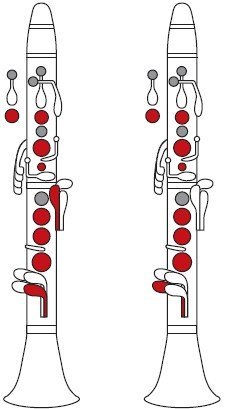
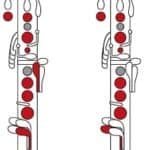
Receive a free PDF of the chart with clarinet fingering diagrams for every note!
The F Dorian scale on Bb clarinet is an 8-note minor-mode pattern using F, G, Ab, Bb, C, D, and Eb that blends sadness and strength. It helps clarinetists shape jazz, film, and classical lines with a smoky, lyrical sound and richer emotional control.
The sound-story of the F Dorian scale
On Bb clarinet, the F Dorian scale feels like a late conversation after a concert, when the lights are low and the reed is just starting to fray. It is built from F to F, with that raised 6th (D natural) giving it a quiet, hopeful glow inside a minor shell. Your throat tones, your long-tube notes, your register key shifts: they all conspire to turn simple fingerings into something human and fragile.
Play a slow F up to the high F with a soft vibrato, and the clarinet seems to remember Benny Goodman ballads, Giora Feidman whispers, and the dusky corners of film scores by John Williams and Alexandre Desplat. That is the emotional pull of F Dorian: it sounds like memory, but it never quite gives up.
F, G, Ab, Bb, C, D, and Eb on Bb clarinet give F Dorian its distinctive color. Change just one note (D to Db) and you leave Dorian behind, losing that subtle inner light many jazz and film composers love.
From modes and monasteries to smoky clubs: a brief history
Long before the modern Bb clarinet existed, the Dorian mode was sung in medieval chant and early church music. It was a modal color on voices and wooden flutes, not yet on grenadilla and silver keys. When baroque clarinet ancestors like the chalumeau appeared, players began to taste those modal flavors on reed instruments too, even if they did not use the term “F Dorian” yet.
By the time of Anton Stadler, Mozart's clarinet muse, the clarinet was still mostly living in major and traditional minor keys. But the Dorian sound creeps into Mozart's Clarinet Quintet and Clarinet Concerto in passing modal turns and folk-like lines. Stadler's early basset clarinet, with its extended low notes, would have colored Dorian phrases with a soft, vocal quality similar to what modern players feel when they shape low F and G in long, singing lines.
In the 19th century, players like Heinrich Baermann and Carl Baermann helped clarify the clarinet's role in Romantic music through the concertos of Weber and the chamber works of composers like Mendelssohn and Schumann. While their repertoire sat mostly in major and harmonic or melodic minor, the Dorian shade quietly appeared in modal themes and folk-inspired inner lines, especially in slow movements. The feeling of minor-with-hope that we now associate with F Dorian on clarinet has deep roots in these expressive 19th-century phrases.
Clarinet legends and the F Dorian flavor
The F Dorian scale might not appear on a concert program, but it hides in the fingers and ears of nearly every great clarinetist. It shapes their phrasing, their solo lines, and the way they turn a simple F into a story.
Classical voices: from Sabine Meyer to Martin Frost
Sabine Meyer often leans into Dorian colors in slow movements of the Brahms Clarinet Sonatas, Op. 120. When she moves through phrases that outline F minor with a bright sixth in her Deutsche Grammophon recordings, your ear catches hints of Dorian tension and release. Her use of air, embouchure, and right-hand resonance keys on notes like D and Eb gives F Dorian patterns a warm, vocal edge.
Martin Frost, known for his dramatic stage presence and flawless control, brings modal flavors to life in works such as Anders Hillborg's “Peacock Tales” and in his interpretations of Messiaen's “Quartet for the End of Time”. Passages where the clarinet floats over static harmony often lean on Dorian-type scales. On Bb clarinet, that often means long arcs built from F Dorian fingerings, with a clean, almost glassy upper register using the register key on A and B while keeping the line breathing and human.
Jazz legends: Benny, Artie, Buddy and beyond
In jazz, the F Dorian scale is practically home base. For a Bb clarinet, F Dorian fits beautifully over tunes in Eb major and Bb major with modal sections, but most directly over tunes where the band sits on a concert Eb minor or c minor vamp. Players shape solos that slide between blues and Dorian flavors, and the clarinet's color makes those notes cry and smile at once.
Benny Goodman, the “King of Swing”, may not have talked much about modes in theory terms, but listen to his ballad choruses in tunes like “Body and Soul” or “Moonglow”. In many live recordings, his choruses lean heavily on Dorian-inflected minor lines, especially over longer ii7 chords. His fingerings on F, Ab, and D in the clarion register shape that exact F Dorian sound, with a light tongue and a floating, singing tone.
Artie Shaw used Dorian flavor as a way to bend the harmony without losing swing. In “Begin the Beguine”, his soloing style often skirts the border between straight minor and Dorian, particularly in inner phrases where F Dorian-type lines carve a different mood than standard blues patterns. His fast, liquid technique around throat tones and altissimo notes made that color particularly sharp and clear.
Buddy DeFranco, one of the great bebop clarinet voices, was more explicit about modal language. Over ii-V-I progressions in live recordings, you can hear him slip into Dorian scales over the ii chord again and again. For a Bb clarinet, that often means rapid patterns that feel like F Dorian under the fingers, even if the concert key shifts. His mastery of pinky keys, side keys, and alternate fingerings kept F Dorian passages crisp at bebop speed.
Klezmer, folk and modern voices: the Dorian cry
Klezmer clarinetists like Giora Feidman and David Krakauer live in a world of modes: Freygish, Misheberach, and Dorian colors flow through their phrasing. In tunes that lean toward minor but keep a brighter sixth degree, the clarinet cries in a Dorian way. On Bb clarinet in F, players use the F Dorian scale as a skeleton and then twist it with ornaments: krekhts, bends, and slides between notes like Ab and Bb or D and Eb.
Listen to Feidman's recording of “The Lonely Shepherd” or his live improvisations with violinist ensembles, and you will hear passages that outline F Dorian in the chalumeau register with heavy vibrato and flexible intonation. Krakauer's work with the Klezmatics and his solo albums goes even further, mixing Dorian modal riffs with jazz phrasing, slap tonguing, and fast grace notes around F and G.
Contemporary clarinetists in folk and world groups, from Balkan brass bands to Celtic fusion projects, lean on Dorian often. The F Dorian scale mirrors traditional pipe tunes, fiddle reels, and modal songs. On Bb clarinet, players often sit in that range around written F above middle C and up to the high D, letting the natural resonance of the instrument give those Dorian runs a plaintive, singing quality.
Where you hear F Dorian on clarinet: pieces and recordings
Composers love the Dorian mood for scenes of quiet struggle, noble sadness, or mysterious calm. The F Dorian scale on Bb clarinet hides inside many scores, even if it is never labeled that way.
Classical and chamber hints
In Brahms's Clarinet Quintet in B minor, Op. 115, modal flavors appear constantly. Certain passages where the harmony softens over sustained strings invite the clarinet to spin Dorian-like lines. When clarinetists like Richard Stoltzman or Karl Leister shape slow phrases with a bright minor 6th, their fingers often outline patterns that feel exactly like F Dorian in relation to the underlying chords.
In Messiaen's “Quartet for the End of Time”, the movement “Abyss of the Birds” gives the solo clarinet enormous freedom. Players such as Martin Frost and Jorg Widmann often color their improvisatory-feeling lines with modal motion. You can hear sequences that match F Dorian shapes when transposed, especially in long climbs through the altissimo register using the register key, side keys, and the left-hand C and G keys.
Jazz standards and modal clarinet moments
While the classic modal tune “So What” is famously in D Dorian for horns in C, Bb instruments end up using fingerings that echo F Dorian patterns when similar structures are used in other tunes. In small-group sessions, clarinetists often call tunes with static minor chords and then slip into Dorian language by instinct. Recordings by Don Byron, for instance on his album “Bug Music”, show the clarinet dancing inside Dorian modes with a mix of period swing and modern attitude.
In more modern settings, clarinet solos over tunes like Herbie Hancock's “Maiden Voyage” or Wayne Shorter's “Footprints” often lean on Dorian fingerings. When those tunes are called in keys that place the clarinet's pattern on F, your F Dorian scale chart becomes a roadmap for smoky, suspended solos that hang above the harmony.
Film scores and atmosphere
Film composers love the clarinet's ability to sound like a half-remembered song, and F Dorian is perfect for that. In many scores, the written key centers around F minor but keeps a raised sixth degree, which means the clarinet part effectively lives in F Dorian for long stretches.
In the music of Alexandre Desplat for films like “The Grand Budapest Hotel”, the clarinet often floats above strings in restrained, modal lines. While a specific track might not be labeled “F Dorian”, the pattern of F, G, Ab, Bb, C, D, and Eb shows up in melodic fragments that feel like F Dorian etudes. Similarly, in some of John Williams's more intimate scores, especially in quiet, introspective scenes, the clarinet sings modal lines that mirror Dorian shapes transposed through different tonal centers.
| Context | How F Dorian Appears | Listening Idea |
|---|---|---|
| Classical chamber music | Modal shadings in slow movements, minor themes with bright 6th | Brahms Clarinet Sonatas (Sabine Meyer, Richard Stoltzman) |
| Jazz ballads and modal tunes | Solos over ii7 chords and static minor vamps | Benny Goodman live ballads, Buddy DeFranco bebop sets |
| Klezmer and folk bands | Minor melodies with brighter inner color, lots of ornaments | Giora Feidman solos, David Krakauer with the Klezmatics |
Why F Dorian matters emotionally for clarinetists
Most clarinet students learn F major, F natural minor, and F harmonic minor early on. F Dorian sits between them like a secret third path. Use the same clarinet, the same mouthpiece, the same reed, and suddenly the mood tilts. The F Dorian scale lets you say: “I am not fine, but I am still standing.”
On Bb clarinet, that feeling lives especially in the middle register: throat-tone A and Bb, the chalumeau F and G, the clarion C and D. Long tones on these notes with a gentle crescendo tell a story that straight minor cannot. Jazz players bend into F Dorian to sound more lyrical. Classical players lean on it to color a phrase that would be too heavy in pure minor. Klezmer and folk clarinetists ride Dorian to bring tears and smiles in the same breath.
What mastering the F Dorian scale opens for you
Once the F Dorian finger pattern feels natural, your improvisation vocabulary jumps forward. Over an F minor 7 chord or a ii7 chord in Eb major, your hands know where to go. Over modern worship tunes, indie songs, or film-score-style backing tracks, F Dorian on Bb clarinet gives you reliable shapes that sound thoughtful instead of random.
It also deepens your ear. Practicing F Dorian slowly against a drone or piano helps you hear the difference between flat 6 and natural 6, between sad and quietly resilient. That sensitivity flows back into how you interpret Brahms, Debussy, or even simple etudes by Rose and Baermann. Suddenly, you are not just pushing fingers; you are shading harmonies like a painter with extra colors on the palette.
Spend just 5 minutes daily on F Dorian: long tones, slow scales, simple patterns, and one tiny improvisation. Over a month, many players report easier jazz solos and more expressive phrasing in classical pieces.
| Day | Practice Focus | Time (minutes) |
|---|---|---|
| 1 | Long tones on F, Ab, Bb, D | 5 |
| 2 | Slow F Dorian scale, 2 octaves | 5 |
| 3 | Simple 3-note patterns (F-G-Ab, G-Ab-Bb, etc.) | 5 |
| 4 | Free improvisation on F Dorian over a drone | 5 |
A quick fingering glance: where F Dorian lives under your fingers
The full clarinet fingering chart does the heavy lifting, but it helps to picture the line in words. On Bb clarinet, start on low F with the left-hand first finger plus the right-hand fingers, then climb:
- F: low chalumeau, left-hand index, middle, ring, and right-hand fingers, thumb on the register tube (no register key engaged).
- G: lift the right-hand fingers, leave left-hand index and middle down.
- Ab: add the left-hand ring finger for the written Ab.
- Bb: throat Bb using the A key plus the side key or register key combination you prefer.
- C, D, Eb, and F: move into the clarion register with the register key, using standard first-position fingerings.
Above that, in the upper clarion and early altissimo, the chart walks you through which right-hand pinky and side keys to favor so that lines stay smooth. Many players use alternate fingerings for Bb, C, and D when playing F Dorian fast, just as jazz clarinetists do in bebop runs.
| Register | F Note | F Dorian Character |
|---|---|---|
| Chalumeau (low) | Low F below staff | Smoky, intimate, perfect for quiet openings |
| Clarion (middle) | F on top line of staff | Lyrical, vocal, central to jazz and classical solos |
| Altissimo (high) | High F above staff | Intense, shining, great for emotional climaxes |
Simple practice steps to make F Dorian feel natural
Use the free clarinet fingering chart as your visual anchor, then turn practice into a small daily ritual. Think more about color and breath than about perfection.
- Play the F Dorian scale very slowly, 2 octaves, two times with a tuner. Listen to the D natural and Eb carefully.
- Play it again, but add a gentle swell on each note: soft to medium, then back to soft.
- Pick any melody you know in F minor and swap the Db for D natural wherever it works. Feel the mood change.
- Finish with 1 minute of free improvisation using only F, G, Ab, Bb, C, D, and Eb.
| Issue | Likely Cause | Quick Fix |
|---|---|---|
| Ab and Bb sound stuffy | Tense throat, weak air support | Relax jaw, use warm air, keep tongue low like saying “ah” |
| Break between Bb and C is rough | Fingers and register key not coordinated | Practice those 2 notes slowly with legato tongue and firm fingers |
| High D and Eb are sharp | Too much lower-lip pressure, thin air stream | Add more air, slightly relax embouchure, think “warm” on top notes |
Key Takeaways
- Use the F Dorian scale on Bb clarinet to add a bittersweet, hopeful color to jazz, film, classical, and folk phrases.
- Listen to clarinetists like Benny Goodman, Sabine Meyer, Giora Feidman, and Buddy DeFranco to hear F Dorian-style lines in action.
- Practice F Dorian slowly with the fingering chart, focusing on tone and emotion more than speed or technical fireworks.
Frequently Asked Questions
What is F Dorian scale on Bb clarinet?
The F Dorian scale on Bb clarinet is a minor-mode pattern using the notes F, G, Ab, Bb, C, D, and Eb. It sounds darker than F major but lighter than F natural minor. Clarinetists use it to color jazz solos, lyrical classical passages, and folk-inspired melodies with a gentle, bittersweet mood.
How is F Dorian different from F natural minor on clarinet?
The only difference is the sixth note. F natural minor uses Db, while F Dorian uses D natural. On Bb clarinet, that one change brightens the mood and gives a more hopeful, modal sound. Your fingers hardly change, but the emotional impact shifts from heavy sadness to a more reflective, singing tone.
Why should I practice the F Dorian scale on Bb clarinet?
Practicing F Dorian improves your ear for modal color, helps you solo more confidently over minor 7 chords, and deepens your expressive control in classical and film music. It also connects you to phrasing styles used by clarinetists from Benny Goodman to Giora Feidman, giving your playing a more mature, story-like quality.
How often should I include F Dorian in my practice routine?
Even 5 minutes a day can make a difference. Try one day of slow scales, one of patterns, one of long tones, and one of improvisation. Rotate these approaches through the week along with your other scales like F major and F harmonic minor. The scale will soon feel natural under your fingers.
Can beginners learn the F Dorian scale, or is it for advanced players?
Beginners can absolutely learn F Dorian. The fingerings are almost the same as F natural minor, so once basic scales feel comfortable, you can add F Dorian easily. Start slowly, use a fingering chart, and listen to recordings to connect the new pattern to a clear musical mood and sound.
For more clarinet stories, you may also enjoy articles on other expressive scale colors, vintage Martin Freres clarinets in chamber music, and lyrical phrasing ideas drawn from classic clarinet etudes.