If you learned clarinet with school chairs scraping, music stands rattling, and a slightly-out-of-tune piano, there is a good chance “Here We Go Round The Mulberry Bush” was one of your first victories. This simple little song has walked beside generations of Bb clarinet players, from tiny hands wrestling with a plastic student clarinet to seasoned artists warming up before a concerto.
Receive a free PDF of the chart with clarinet fingering diagrams for every note!
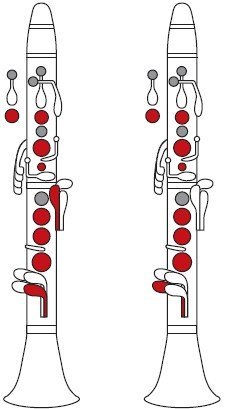
The “Here We Go Round The Mulberry Bush” clarinet fingering chart is a visual guide for Bb clarinet that shows every note used in the song and how to finger it. It helps beginners learn the melody faster, build steady tone, and enjoy playing a complete song with confidence.
The nursery rhyme that quietly trained generations of clarinetists
“Here We Go Round The Mulberry Bush” started life as a simple English nursery rhyme, sung in circles by children on grey winter mornings. When this melody moved onto clarinet, it became something else: a tiny training ground for air support, finger coordination, and that first real feeling of “I can actually play a song.”
Clarinet teachers across the globe have used it in the earliest pages of method books from Paul Jeanjean in Paris to British tutors inspired by Frederick Thurston, and American school band programs that trace their lineage through players like Robert Marcellus of the Cleveland Orchestra. The tune is short, endlessly repeatable, and it sits comfortably in the clarinet's sweet, singing chalumeau register.
Field Note: In the Martin Freres archives, there are early 20th century handwritten teaching notebooks where instructors marked the words “Mulberry Bush” next to fingerings for notes like C, D, E, and G in the staff. It was used not just as a song, but as a memory anchor for young players learning their first note combinations.
From playground song to practice-room ritual: who played it
Of course, you will not find Benny Goodman recording a jazz arrangement of “Here We Go Round The Mulberry Bush” on a Columbia album. But you can be sure that tunes exactly like it lived in his first wooden clarinet before “Sing, Sing, Sing” ever blasted across a ballroom.
Think of the players we admire:
Anton Stadler, who inspired Mozart's Clarinet Concerto in A major, would have grown up on simple folk tunes not far in spirit from “Mulberry Bush” as he learned to tame the early classical clarinet.
Heinrich Baermann, the virtuoso behind Weber's Concertos in F minor and E flat major, learned to connect gentle folk lines long before he tackled Weber's leaping arpeggios. Teachers of his time borrowed from dances and children's songs to build breath control.
Sabine Meyer, with her luminous clarinet tone in Mozart and Nielsen, often speaks about the musicality of the simplest melodies and how she still uses short, songlike phrases in daily warmups.
Martin Frost, known for his almost theatrical interpretation of Copland's Clarinet Concerto, works with very basic musical cells when shaping articulation, the same kind of cells that live in tunes like “Mulberry Bush.”
Classical giants did not skip over this phase. They just passed through it quietly, then carried its lessons into Weber, Brahms, and beyond. The ability to shape a four-note phrase in “Here We Go Round The Mulberry Bush” is the same skill you need to voice the opening of the Mozart Clarinet Quintet or the soft lines in Brahms's Clarinet Sonata in F minor.
Jazz legends also remember this territory, even if they rarely mention it by name. Benny Goodman, Artie Shaw, and Buddy DeFranco all played endless simple songs in C major and G major while building embouchure strength and tongue control. Their blazing runs in standards like “Body and Soul” or “Stardust” grew from a foundation of tiny phrases and regular note patterns that feel exactly like this nursery rhyme under the fingers.
How a nursery tune connects to Mozart, jazz standards, and film scores
So where does “Here We Go Round The Mulberry Bush” actually show up in the wider clarinet universe? Not always directly, but its DNA is everywhere.
Listen to the first movement of Mozart's Clarinet Concerto in A major. The opening theme is graceful, stepwise, and on the clarinet it feels as friendly as a children's song, even though the harmony is more sophisticated. The same is true in Weber's Concertino in E flat major, where the clarinet line often walks by step in the clarion register, just like “Mulberry Bush” walks within a narrow range in the chalumeau register.
In chamber music, the Scherzo of Brahms's Clarinet Quintet in B minor has light, skipping figures that could be traced back to children's games and dances. The clarinet line steps and skips in short, memorable patterns, the same kind of patterns you practice with this nursery tune.
Range of “Mulberry Bush” on Bb clarinet: usually 6 to 8 notes
This compact range mirrors many clarinet orchestral lines, where a player must shape melody within just a few notes of the staff. Mastering phrasing in a narrow range prepares you for exposed solos in works by Ravel, Stravinsky, and Copland.
In jazz, the stepwise motion of “Mulberry Bush” echoes through standards like “All of Me” and “Autumn Leaves” in the way phrases climb and fall by small intervals. Benny Goodman's clarinet solos often start with simple cells before breaking into more elaborate lines. Teachers sometimes sneak “Mulberry Bush” into early improvisation lessons, using its chord movement as a teaching tool in beginner-friendly keys.
Film composers also love childlike tunes on clarinet. Think of John Williams writing gentle clarinet lines in scores like “Harry Potter and the Sorcerer's Stone” or the subtle chalumeau melodies in Thomas Newman's soundtracks. The idea is the same: a clear, singable line that could almost be a nursery rhyme, floating over strings and harp. When you play “Here We Go Round The Mulberry Bush” with a soft, supported tone, you are closer than you think to that kind of cinematic sound.
From Victorian playgrounds to clarinet studios worldwide
The melody of “Here We Go Round The Mulberry Bush” is usually traced back to the 19th century, sung in English workhouse schools and playgrounds. Children would walk in a ring, circling a pretend mulberry bush, often before lessons began. As clarinet took root in brass and woodwind bands, teachers began adapting the songs children already knew for Bb instruments.
By the late 1800s, as clarinet manufacturing improved, makers like Martin Freres in France were sending sturdy student instruments to schools and bands across Europe. Instructors copied out simple songs like “Mulberry Bush” on staff paper for young players learning basic fingerings and breath control. The same melody that echoed in chilly schoolyards started resonating in small teaching rooms alongside long tones and scales.
Through the 20th century, as method books spread across Britain, North America, and beyond, the tune showed up in early pages next to basic pieces like “Hot Cross Buns” and “Mary Had a Little Lamb.” It was easy to transpose, short enough to memorize, and comfortable on the clarinet's cylindrical bore in common beginner keys like C major or G major for concert pitch bands.
Today, the song survives in digital learning apps, beginner band arrangements, and teacher-made worksheets. Some instructors reharmonize it in jazzy styles, others turn it into a round for clarinet choir, and some turn the melody into a call-and-response between clarinet and piano. A simple Victorian circle game has become a modern clarinet study, quietly living in practice rooms from Tokyo to Toronto.
Why “Here We Go Round The Mulberry Bush” matters for musical expression
There is something surprisingly emotional about playing a childhood tune on a grown-up instrument. “Here We Go Round The Mulberry Bush” is simple enough to remember after one listen, which means your brain stops worrying about what note comes next and can focus on how it sounds.
On clarinet, that is gold. You can shape the first three or four notes with a gentle crescendo or a small rubato. You can experiment with vibrato on a long note, or with a whisper-soft attack using just reed and air. You can explore how the register key changes the color if you take a phrase up an octave into the clarion register. The song becomes a laboratory for emotion, without the stress of tricky finger crossings.
For many players, there is also nostalgia. Teaching a younger sibling or student “Mulberry Bush” on a Bb clarinet feels like passing along a family recipe. Your left-hand index finger moves from A to B as it has done a thousand times, but the memory attached is powerful: first concerts, proud parents, a conductor tapping a baton and saying, “Let's start from the top.”
How mastering this melody opens musical doors
It might look like just one more nursery rhyme in a beginner book, but if you treat “Here We Go Round The Mulberry Bush” seriously on clarinet, it gives you several long-term gifts.
Skill
How the song helps
Where it shows up later
Breath support
Short repeating phrases encourage continuous air on each repeat.
Long lines in Brahms Sonatas and Debussy Rhapsodie.
Finger coordination
Stepwise notes train left hand ring fingers and pinkies in slow motion.
Smooth passages in Weber concertos and orchestral excerpts.
Phrasing
Clear 2-bar and 4-bar phrases teach natural breathing spots.
Shaping melodies in jazz ballads like “Misty” and “My Funny Valentine”.
Once you can play this song on autopilot, you can apply the same phrasing to other melodies like “Scarborough Fair” and “Amazing Grace” arranged for clarinet. You will also notice that many beginner band pieces and clarinet choir arrangements at Grade 1 or Grade 2 level recycle the same stepwise patterns and rhythms.
Mastering “Mulberry Bush” with a musical mindset turns you into the kind of player who treats every melody with respect. That mindset pays off later in everything from Copland's Clarinet Concerto to klezmer tunes like “Der Heyser Bulgar” where the clarinet leads with a strong, dance-like phrase.
A quick word on the fingering chart and mechanics
The “Here We Go Round The Mulberry Bush” clarinet fingering chart for Bb clarinet usually lives within a comfortable starting range around low G, A, B, C, D, and sometimes up to E or F in the staff. That means your left-hand index, middle, and ring fingers do most of the work, with the right hand gradually joining in.
Use the free fingering chart to check each note visually, but then close your eyes and feel the keywork: the curved register key under your left thumb, the two main trill keys near your left index finger, and the smooth rings for A and G. Even in a simple tune, this is your chance to feel how the instrument's Boehm system flows from note to note.
A gentle practice plan for “Mulberry Bush” on Bb clarinet
If you want a simple structure for working with the fingering chart, here is a short routine that fits into 10 to 15 minutes and still leaves time for scales and long tones.
Step
What to do
Time
1. Slow notes
Play each note from the chart as a whole note, listening for steady tone and checking each fingering.
3 minutes
2. Phrase practice
Play the first line of the song very slowly, without the words, shaping a smooth legato.
4 minutes
3. Repeat and vary
Repeat the whole song several times, changing volume or articulation each time.
5 minutes
Look at the fingering chart and speak the note names out loud.
Finger the notes silently without blowing, checking each key on your clarinet body.
Play with a tuner or keyboard so your ear connects the sound with the pitch.
End by playing the song once as if it were a melody in a Mozart Serenade.
More melodies and stories for your next steps
Once “Here We Go Round The Mulberry Bush” feels natural, you can branch out into other tunes that share its gentle clarity. Many clarinetists move next to traditional songs and early band pieces that keep the same note range but add more expressive opportunities.
On Martin Freres you will find guides that connect nicely to this song, such as articles on building a singing chalumeau register, stories behind famous clarinet melodies in Mozart's Clarinet Concerto, and practice ideas for bringing life to simple long tones. Treat “Mulberry Bush” as your gateway: if you can make this little melody sing, you are ready to bring the same care to everything else you play.
Key Takeaways
Treat “Here We Go Round The Mulberry Bush” as a real melody, not just a children's tune, and use it to practice phrasing and tone.
Use the clarinet fingering chart to build muscle memory for low and middle notes that appear in major concertos and orchestral parts.
Carry the musical lessons from this short song into larger works by Mozart, Weber, Brahms, and your favorite jazz and film themes.
Frequently Asked Questions
What is Here We Go Round The Mulberry Bush clarinet fingering chart?
The “Here We Go Round The Mulberry Bush” clarinet fingering chart is a visual map of every note in the song for Bb clarinet. It shows exactly which keys and rings to press for each pitch so beginners can focus on breath, rhythm, and musicality while feeling secure about finger placement.
What range of notes does “Mulberry Bush” use on Bb clarinet?
Most arrangements stay between low G and E or F in the staff, all in the chalumeau register. That narrow range is perfect for early embouchure development, consistent air support, and left-hand coordination. It keeps the focus on sound quality instead of register changes or difficult leaps.
Is “Here We Go Round The Mulberry Bush” good for adult beginners on clarinet?
Yes. Adult beginners benefit from its short, memorable phrases and comfortable range. Because the melody is familiar, you can focus on reed response, tongue position, and hand relaxation. Many adult learners use it as a warmup piece alongside scales and long tones for several months.
How fast should I play “Mulberry Bush” on clarinet at first?
Start very slowly, around 60 to 70 beats per minute, with each note feeling steady and relaxed. Once the fingerings feel automatic, gradually increase the tempo until you can play the melody confidently at a comfortable walking speed, still with clean articulation and an even tone.
What should I practice after I learn this song on clarinet?
After “Mulberry Bush,” move to other short melodies with similar note ranges, such as folk songs and simple hymn tunes. Then explore pieces that introduce the clarion register, small leaps, and dynamic contrasts. Use the same attention to phrasing you developed with this tune in every new piece.