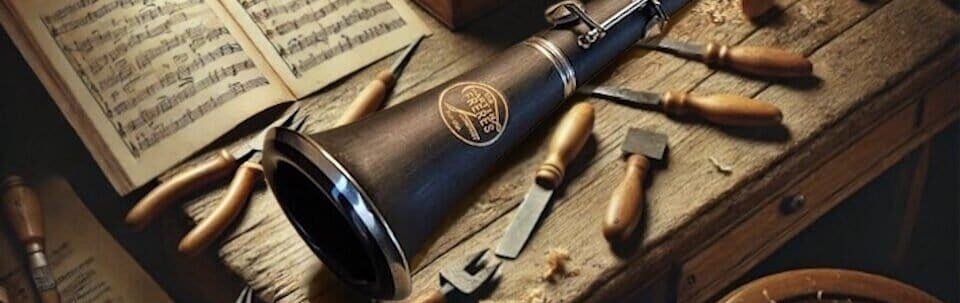
Martin Freres, LaMonte, Coudet, Jean Martin Brand Clarinets and Other Woodwinds
Clarinet in Free Jazz: History, Techniques, and Practical Guidance
The clarinet in free jazz is an adaptable woodwind voice that combines traditional timbre with extended techniques and improvisation, creating sounds from lyrical to explosive. It became especially prominent in European free jazz from the 1960s through players like Peter Brötzmann, Jimmy Giuffre, and Pee Wee Russell, who expanded both technique and musical language.
Why the Clarinet Fits Free Jazz – tonal range, flexibility, expressive possibilities
The clarinet fits free jazz because it covers a huge pitch and color range, from dark chalumeau lows to piercing altissimo cries. Its flexible embouchure and bore allow microtones, multiphonics, and sudden timbre shifts. In free improvisation, this means one instrument can move from whispering textures to raw, vocal-like shouts within a single phrase.
Compared with saxophones or trumpet, the clarinet responds quickly to subtle air and finger changes. This sensitivity suits the spontaneous interactions of free jazz. Players like Jimmy Giuffre and Eric Dolphy used this responsiveness to shape phrases that bend time, pitch, and tone, matching the fluid structures of free ensembles and small-group improvisations.
Free jazz often abandons fixed chord progressions, so color and texture become structural elements. The clarinet can smear between notes, split tones into multiphonics, or create breathy, noise-based sounds. These options give improvisers a wide palette for building tension, contrast, and dialogue with drums, bass, and other winds in open forms.
Approximate clarinet range in free jazz practice: 3.5 to 4 octaves, from written E3 to C7, including extended altissimo and subtones.
Because the clarinet has a long history in classical and early jazz, free-jazz clarinetists can reference those traditions while breaking them apart. A single solo might quote Benny Goodman-style swing articulation, then dissolve into Peter Brötzmann-style overblown screams. This tension between memory and rupture is central to the instrument's role in free jazz.
A Brief Timeline: From Early 1900s Jazz to 1960s European Free Jazz
In early 1900s New Orleans jazz, clarinetists like Johnny Dodds and Sidney Bechet used the instrument for agile countermelodies above trumpet and trombone. By the 1930s, Benny Goodman brought the clarinet to the center of swing, showcasing virtuosic solos and tight big-band arrangements that defined American popular jazz for a decade.
After World War II, bebop and cool jazz shifted focus toward saxophones and trumpets. Clarinet remained present through players such as Buddy DeFranco, but its mainstream visibility declined. At the same time, classical and contemporary composers in Europe and the United States began exploring extended clarinet techniques, which later fed into free improvisation practices.
In the 1950s and early 1960s, musicians like Jimmy Giuffre and Ornette Coleman started loosening harmonic and rhythmic structures. Giuffre's chamber-like trios blurred jazz, folk, and modern classical influences. Coleman, primarily an alto saxophonist, occasionally used clarinet to push his harmolodic ideas into even more raw and flexible territory.
By the mid-1960s, European free jazz and free improvisation emerged in cities like Berlin, Amsterdam, and London. Social and political unrest, student movements, and a desire to break from American models all shaped this scene. Peter Brötzmann, Willem Breuker, and others used clarinet and related reeds to create dense, often confrontational sound masses.
Key period: 1965-1975 saw over 50 notable European free-jazz recordings featuring clarinet or related reeds, including Brötzmann's work and ICP-associated projects.
From the 1970s onward, European free improvisation diversified. Clarinetists like Evan Parker (on soprano and clarinet), Rolf Kühn, and later Louis Sclavis and John Carter developed highly personal vocabularies. Archives, radio recordings, and small labels across Germany, the Netherlands, and the UK now document this evolution, offering rich material for players and researchers.
Pioneers and Key Players (Ornette Coleman, Jimmy Giuffre, Pee Wee Russell, Benny Goodman, Peter Brötzmann) and Landmark Recordings
Benny Goodman represents the clarinet's mainstream jazz apex. While not a free-jazz player, his technical control and projection influenced later improvisers. Listening to his 1938 Carnegie Hall Concert shows how a clarinet can lead a large ensemble, cut through dense textures, and maintain clarity at fast tempos, skills still important in free contexts.
Pee Wee Russell bridged traditional jazz and freer expression. On late recordings such as “Ask Me Now” (1963), his tone fractures, bends, and smears pitches in ways that anticipate free jazz. Russell's playing shows how a swing-era musician could stretch harmony and timbre while still sounding deeply rooted in early jazz language.
Jimmy Giuffre's early 1960s trios with Paul Bley and Steve Swallow, especially the albums “Fusion” (1961) and “Thesis” (1961), are important for clarinet in free jazz. Giuffre uses soft dynamics, breathy attacks, and flexible time to create open forms. His clarinet lines drift in and out of tonality, suggesting free improvisation without abandoning lyricism.
Ornette Coleman, though better known as an alto saxophonist, brought clarinet into his harmolodic universe on recordings like “The Empty Foxhole” (1966) and later works. His clarinet sound is raw, vocal, and unconcerned with classical smoothness. For students, these solos demonstrate how emotional intent can override conventional tone ideals.
Peter Brötzmann is central to European free jazz. On albums like “Machine Gun” (1968), he primarily plays saxophones, but his work with clarinet and tarogato shows a similar intensity. Brötzmann's approach emphasizes overblowing, dense multiphonics, and high-volume interaction. His recordings illustrate how clarinet can function as a noise generator as well as a melodic instrument.
Suggested starting discography: 8 to 10 core albums spanning 1938 to 1980 will cover Goodman, Russell, Giuffre, Coleman, and Brötzmann's most relevant clarinet-related work.
Later figures such as John Carter, Louis Sclavis, and Don Byron expanded clarinet roles in free and avant-garde jazz. Carter's “Roots and Folklore: Episodes in the Development of American Folk Music” (1982-1990) uses clarinet within large-scale, historically informed compositions. Sclavis blends European folk, contemporary classical, and free improvisation, showing how the clarinet can anchor hybrid styles.
Distinctive Techniques Used in Free-Jazz Clarinet Playing
Free-jazz clarinetists rely on extended techniques to expand their sound vocabulary. Multiphonics, where more than one pitch sounds at once, are central. By adjusting embouchure pressure, air speed, and alternate fingerings, players can produce complex, unstable chords that add tension or create drone-like textures under more conventional lines.
Microtones and pitch bends help break away from equal-tempered scales. Half-holing, sliding fingers, and subtle embouchure adjustments allow pitches between standard notes. In European free improvisation, these inflections often mirror speech or non-Western music, giving clarinet lines a flexible, vocal quality that fits open harmonic contexts.
Overblowing and controlled squeals extend the altissimo register. Instead of treating squeaks as mistakes, free-jazz players harness them as expressive tools. By practicing overblown harmonics on low fingerings, clarinetists learn how to trigger and shape these high partials, turning them into deliberate cries, siren-like glissandi, or percussive accents.
Air sounds, key clicks, and slap tonguing add rhythmic and noise elements. Soft air-only tones can create atmospheric backdrops, while amplified key noise can function as a drum-like layer. Slap tongue, both pitched and unpitched, provides sharp attacks that cut through dense ensembles, a technique heard in many European free-jazz recordings.
Circular breathing, used by players such as Evan Parker on related reeds, allows long, uninterrupted phrases or drones. On clarinet, this can support extended textures or continuous multiphonics. Even if a player never fully masters circular breathing, practicing its components improves breath control and endurance for intense free-jazz performances.
Practical Workshop: Exercises, Improvisation Routines, and Transcription Targets
This workshop section translates historical and technical ideas into daily practice. The goal is to build a flexible sound palette and improvisational fluency that can function in both American-style free jazz and European free improvisation. Each exercise can be adapted for B-flat or A clarinet and for different experience levels.
Foundational sound and register control
Spend 10 to 15 minutes on long tones across chalumeau, clarion, and altissimo registers. Start with comfortable notes, then add crescendos, decrescendos, and subtle vibrato. Focus on keeping the tone stable as you change dynamics. This prepares your embouchure for the extreme contrasts common in free jazz.
Next, practice register leaps: low E to clarion B, then to altissimo E or F. Use a metronome at a slow tempo and aim for clean attacks. Once the leaps are secure, vary the rhythm freely without the metronome, simulating the flexible timing of free improvisation while maintaining technical control.
Microtone and pitch-bend studies
Choose a simple scale, such as D Dorian, and play it slowly. Between each pair of notes, slide using half-holing or embouchure bends to explore the space between pitches. Record yourself and listen for smoothness and control. This practice builds the vocabulary needed for non-tonal or modal free-jazz lines.
Then, improvise short phrases using only three or four neighboring notes, focusing on microtonal inflections rather than wide intervals. This limited range encourages attention to color and nuance, a key feature of Jimmy Giuffre's softer, chamber-like free improvisations.
Multiphonics and noise textures
Set aside 10 minutes to explore multiphonics. Start with known fingerings from a multiphonic chart for B-flat clarinet, then experiment by slightly altering fingers or embouchure. Note which combinations are repeatable. Keep a practice journal of effective fingerings and their approximate pitch content for later use.
Alternate multiphonics with pure tones, creating call-and-response phrases. For example, play a clear chalumeau G, then answer with a rough multiphonic based on that fingering. This contrast mirrors the way Peter Brötzmann and other European players shift between recognizable pitches and dense noise.
Improvisation routines and form concepts
Practice short free improvisations with self-imposed constraints. For 3 minutes, use only staccato attacks and wide intervals. For the next 3 minutes, use only legato lines and microtones. These constraints help you discover new ideas and avoid defaulting to bebop or modal habits when playing in open forms.
Work with a drummer or percussionist, if possible. Set a 5-minute timer and agree that neither of you will maintain a steady pulse. Instead, respond to density, register, and dynamics. This exercise reflects the interactive, non-metric approach heard on many European free-jazz recordings from the 1960s and 1970s.
Transcription targets and listening-based practice
Transcribe short clarinet passages rather than full solos at first. For Benny Goodman, choose a 12 to 16 bar segment from the 1938 Carnegie Hall Concert and focus on articulation and swing feel. For Pee Wee Russell, transcribe a chorus from his 1960s recordings to study pitch bends and timbral distortions.
For Jimmy Giuffre, target a quiet, rubato passage from “Thesis” and notate rhythm approximately, then focus on contour and dynamics. For Ornette Coleman's clarinet, pick a brief, intense phrase and capture its shape and register, even if exact pitches are hard to pin down. Use these transcriptions as seeds for your own improvisations.
Field note: The Martin Freres archives include period advertisements and method-book excerpts showing how early 20th-century clarinet pedagogy framed tone and articulation. Comparing those materials with free-jazz recordings highlights just how far players have stretched the instrument's expected sound and role.
Instrument Anatomy for Free-Jazz Techniques – registers, embouchure, mouthpiece and reed choices
The clarinet's cylindrical bore and single reed create a strong fundamental with rich overtones, which free-jazz players exploit through overblowing and multiphonics. The chalumeau register (low E to written B-flat) offers dark, woody tones ideal for drones and growls. Clarion (B to high C) provides a singing quality suited to melodic lines.
The altissimo register, above written C, becomes a primary expressive zone in free jazz. Its natural instability allows cries, wails, and spectral sounds. Understanding how the register key vents the air column helps you adjust voicing and fingerings to access high harmonics reliably, even when using non-standard fingerings or half-holes.
Embouchure in free jazz must be both stable and flexible. A firm but not rigid embouchure lets you shift quickly between pure tones and distorted sounds. Many players adopt a slightly more relaxed jaw and varied reed pressure than in classical playing, which facilitates bends, microtones, and multiphonics without constant embouchure resets.
Mouthpiece choice strongly affects your ability to use extended techniques. A moderately open tip with a medium-long facing often balances control and flexibility. Extremely closed classical mouthpieces can make multiphonics and overblowing more difficult, while very open jazz pieces may sacrifice stability for players still developing embouchure strength.
Reed strength and cut also matter. Many free-jazz clarinetists prefer slightly softer reeds than in classical setups, such as 2.5 to 3 on common brands, to allow easier pitch bending and overblowing. Unfiled reeds may produce a darker, more resistant tone, while filed reeds can respond more quickly, useful for fast articulation and slap tongue.
Maintenance Steps for Players Using Extended/Crashing Techniques
Aggressive free-jazz playing exposes the clarinet to more moisture, vibration, and mechanical stress than typical practice. Daily swabbing after every session is important. Run a soft, lint-free swab through the instrument several times, separating upper and lower joints if needed, to prevent moisture buildup that can warp pads and encourage mold.
Reeds wear out faster under heavy overblowing, slap tongue, and multiphonics. Rotate at least 4 reeds in active use, marking them and cycling daily. Lightly sand or clip reeds that feel waterlogged or dull, but retire any that develop cracks or chips, since they can cause unpredictable squeaks and uneven response during demanding improvisations.
Clean the mouthpiece weekly with lukewarm water and a soft brush, avoiding hot water that can warp hard rubber. Remove reed and ligature, then gently scrub the interior and wipe the exterior. Regular cleaning maintains consistent response, which is important when exploring subtle embouchure changes and microtones.
Apply cork grease sparingly to tenon corks every few days if you assemble and disassemble the clarinet frequently for rehearsals and gigs. Excessive force when assembling after intense sessions can compress or tear corks. Smooth assembly helps keep the bore alignment stable, which indirectly affects intonation and multiphonic reliability.
Schedule professional inspections at least once a year, or every 6 to 9 months if you perform free jazz heavily. Ask the technician to check for loose posts, worn key bushings, and pad seating, especially under keys that you slap or hit hard for percussive effects. Tight, well-regulated mechanisms respond better to the fast shifts common in free improvisation.
Troubleshooting Common Problems When Playing Free Jazz on Clarinet
Squeaks and unwanted overtones often appear when experimenting with microtones or alternate fingerings. To troubleshoot, isolate the problem note at a soft dynamic using standard fingering. Once stable, gradually add the alternate fingering or half-hole. If squeaks return, adjust air support before changing embouchure, since unsteady air is a frequent culprit.
Altissimo instability is another common issue. Practice harmonic overtones on low fingerings, such as low E and F, to learn how voicing affects higher partials. Use a tuner to match these harmonics to written notes in the altissimo range. This approach builds internal models of voicing that transfer to free-jazz contexts where fingerings may be unconventional.
Choking or edge-tone problems can arise with soft reeds or very open mouthpieces. If notes cut out during loud multiphonics, try slightly stronger reeds or adjust reed placement so the tip aligns precisely with the mouthpiece tip. Small ligature position changes can also alter response; experiment with moving the ligature up or down a few millimeters.
Embouchure fatigue is common when practicing extended techniques for long periods. Introduce new techniques gradually, limiting intense multiphonic or overblowing work to 5 to 10 minute blocks separated by rest or conventional playing. Persistent jaw or lip pain signals that you should reassess mouthpiece opening, reed strength, or overall tension.
Intonation drift in free contexts can be hard to notice without harmonic references. Use drones or sustained piano tones during practice to check pitch while exploring microtones and bends. Learning to return to a stable reference pitch after wild gestures helps you interact more clearly with other musicians, even in non-tonal settings.
Player Outcomes: What Skills and Musical Perspectives Clarinetists Can Expect to Gain
Clarinetists who commit to free-jazz practice gain a broader tonal vocabulary, including microtones, multiphonics, and controlled noise. This expanded palette carries over into more traditional settings, where subtle bends, color shifts, and dynamic contrasts can make standard repertoire more expressive and personal.
Improvisational fluency improves as players learn to navigate music without fixed chord changes. Working in open forms sharpens listening skills, since structure emerges from interaction rather than pre-written harmony. Clarinetists become more responsive to texture, density, and register choices made by bandmates in real time.
Dynamic control across registers also develops. Free jazz often demands extreme contrasts, from barely audible air sounds to full-volume overblown cries. Practicing these extremes, while maintaining tone and pitch awareness, strengthens breath support and embouchure flexibility that benefit any style, from chamber music to big band lead parts.
Understanding differences between American and European free-jazz approaches gives clarinetists stylistic fluency. American scenes often retain blues inflections and rhythmic drive, even in open forms, while European free improvisation may emphasize timbre, extended techniques, and non-jazz influences. Studying both perspectives helps players choose language appropriate to each musical context.
Concrete benchmarks might include: reliably playing into the altissimo up to written C7, producing at least 10 usable multiphonics, improvising solo for 5 minutes without repeating obvious patterns, and transcribing several short passages from Giuffre, Russell, or Brötzmann. Meeting these goals signals a solid foundation for deeper free-jazz exploration.
Further Listening, Archives, and Research Resources
For early context, listen to Benny Goodman's 1938 Carnegie Hall Concert and Pee Wee Russell's 1960s recordings on labels associated with the New York scene. These albums show how clarinet phrasing, articulation, and tone evolved from traditional jazz toward more fragmented, expressive approaches that anticipate free playing.
Jimmy Giuffre's “Fusion” and “Thesis” offer important examples of quiet, spacious free improvisation. Focus on how clarinet interacts with bass and piano without fixed chord progressions. Ornette Coleman's occasional clarinet work, particularly in the mid-1960s, illustrates a raw, emotionally charged approach that prioritizes expression over conventional tone.
For European free jazz, Peter Brötzmann's “Machine Gun” and subsequent projects document the clarinet's role within high-energy, collective improvisation. Later recordings from musicians such as Louis Sclavis, Rolf Kühn, and John Carter expand the instrument's role into compositionally rich, cross-genre territories that combine free improvisation with folk and contemporary classical influences.
Archives, radio collections, and university libraries often hold rare live recordings and interviews with free-jazz clarinetists. Researching festival programs from the 1960s and 1970s in cities like Berlin, Amsterdam, and London can uncover lesser-known clarinet voices. These primary sources help players understand how performance practice evolved outside major commercial labels.
Scholarly books and articles on free jazz, European improvisation, and clarinet technique provide analytical frameworks. Combining this research with active listening, transcription, and practical experimentation gives clarinetists a well-rounded understanding of how the instrument functions in free jazz, from historical roots to present-day practice.
Key Takeaways
The clarinet's wide range and flexible tone make it ideal for free jazz, from early American experiments to European free improvisation.
Extended techniques such as multiphonics, microtones, and overblowing expand the instrument's role beyond traditional melody into texture and noise.
Focused exercises, careful maintenance, and targeted listening help clarinetists build a sustainable, expressive free-jazz practice.
FAQ
What is Clarinet in Free Jazz?
Clarinet in free jazz refers to using the instrument in improvisational settings that loosen or abandon fixed chord progressions and regular song forms. Players rely on extended techniques, wide dynamic contrasts, and interactive listening to shape music in real time, often blending jazz, contemporary classical, and folk influences.
Which musicians pioneered clarinet use in free jazz?
Key pioneers include Jimmy Giuffre, whose early 1960s trios explored quiet, open forms, and Pee Wee Russell, who stretched swing language toward abstraction. Ornette Coleman occasionally used clarinet in his harmolodic groups, while Peter Brötzmann and later European improvisers brought the instrument into high-energy free-jazz and free-improv contexts.
What extended techniques do clarinetists use in free-jazz settings?
Common extended techniques include multiphonics, microtones, pitch bends, overblowing into altissimo, air sounds, key clicks, slap tonguing, and sometimes circular breathing. These methods expand the clarinet's sound palette from pure, single-note lines to complex textures and noise-based gestures that fit open, experimental music.
How does European free-jazz clarinet differ from American approaches?
American free-jazz clarinet often retains blues inflections, swing feel, and references to standard forms, even in open settings. European free-jazz and free improvisation typically emphasize timbre, extended techniques, and influences from contemporary classical and folk music, with less reliance on traditional jazz harmony or groove.
How should I care for my clarinet when practicing aggressive or extended techniques?
Swab the instrument thoroughly after each session, rotate several reeds to prevent rapid wear, and clean the mouthpiece weekly. Use cork grease regularly to avoid forcing joints, and schedule professional checkups at least annually. These steps help your clarinet withstand the extra moisture, vibration, and mechanical stress of intense free-jazz practice.