Martin Freres, LaMonte, Coudet, Jean Martin Brand Clarinets and Other Woodwinds
Free Clarinet Fingering Chart: B Minor Scale (Natural)
If the clarinet had a secret diary, the B Minor Scale (Natural) would be written across the pages where things get honest, a little dark, and unexpectedly beautiful. This is the scale that sounds like late-night practice rooms, candlelit Brahms, and jazz solos that hang in the air just a second too long.
Receive a free PDF of the chart with clarinet fingering diagrams for every note!
On Bb clarinet, the natural B minor scale feels like stepping through a quiet side door into music's more private conversations. It is not the loud fanfare key. It is the key of letters never sent, of slow movements, of the kind of expressive playing that keeps you in the practice chair long after you meant to stop.
Quick Answer: What is the B Minor Scale (Natural) on Bb clarinet?
The B Minor Scale (Natural) on Bb clarinet is a seven-note scale built from B to B with two sharps in the key signature. It uses the notes B, C#, D, E, F#, G, and A, and it gives clarinet players a dark, lyrical sound that is perfect for expressive phrases.
Why the B Minor Scale (Natural) Feels Like the Clarinet's Private Voice
Play a B natural on your Bb clarinet, then slide gently up through C#, D, and E. The color is not bright like D major, not stormy like C minor, but quietly intense. Composers from Johann Sebastian Bach to Dmitri Shostakovich loved this family of sounds because B minor sits in that beautiful space between hope and confession.
The clarinet, with its chalumeau register whispering low B and C#, and its singing clarion register on F# and A, carries this scale especially well. A single slur from low F# up to high B can feel like a sigh. That emotional pull is why mastering the B Minor Scale (Natural) is so rewarding for any Bb clarinet player.
2 sharps: F# and C#
This simple pattern anchors the natural B minor scale and appears constantly in orchestral clarinet parts, chamber works, and jazz lines. Seeing two sharps on the staff should instantly light up your B minor reflex.
From Baroque Shadows to Modern Stages: A Short History of B Minor
Long before the modern Bb clarinet existed, composers were already obsessed with B minor. Bach wrote his famous “Mass in B minor” and several sonatas and cantatas in the key, using baroque oboes, chalumeaux, and early clarinets to color its special darkness. Those early single-key instruments in the workshops of Nuremberg and Paris were already chasing that slightly bitter, slightly sweet tension of B minor.
As clarinets developed with more keys and better pad seals, the key of B minor became more accessible. By the time of Carl Maria von Weber and Heinrich Baermann in the early 19th century, virtuoso clarinetists could move more freely across the break between A and B, making the scale sing smoothly. Their performances, particularly of Weber's Clarinet Concertos, pushed composers to write more ambitiously in sharp keys, including B minor and its relatives.
Later, Romantic composers like Johannes Brahms and Max Reger fell in love with the clarinet's ability to shade a phrase in B minor with endless colors. Brahms did not write a clarinet concerto in this key, but listen to the B minor hues in his Clarinet Trio in A minor, Op. 114, or the Clarinet Quintet in B minor's cousin key of B minor's relative D major, where B minor lines ache inside the harmonic fabric.
Field Note: In the Martin Freres archives, several 19th century clarinets show extra wear around the B and C# tone holes. Workshop notes mention players requesting special voicing in this area, hinting at how often clarinetists were exploring B minor passages in orchestras and salons.
How Great Clarinetists Colored B Minor
Listen to a great clarinetist linger on a B minor line and you can almost hear the hours they spent with this scale. It is woven into their fingers.
Anton Stadler, Mozart's clarinet muse, played on earlier instruments that made keys like B minor more challenging. Yet his legendary flexibility encouraged composers to push him into darker tonal territory. The agility he showed in the Clarinet Concerto in A major, K. 622, especially in the more shadowed modulations, set the stage for later players exploring the nearby world of B minor.
Heinrich Baermann, Weber's superstar clarinetist, helped make the clarinet feel at home in dramatic, almost operatic keys. In Weber's “Concertino for Clarinet and Orchestra,” listen to passages where the clarinet dips into minor colors around B and C#. Those smoky runs are essentially B minor scale fragments dressed for the stage.
Fast forward to the 20th century and you hear the B Minor Scale (Natural) flowering in wildly different styles. Sabine Meyer draws astonishing control from it in orchestral recordings of Tchaikovsky's Symphony No. 6 and Shostakovich symphonies, where inner clarinet lines often revolve around B minor shapes. Her sound on low B, F#, and G is like velvet with a little steel at the center.
Martin Frost uses the natural B minor color as a dramatic tool in pieces like Anders Hillborg's “Peacock Tales” and his performances of Nielsen's Clarinet Concerto. Listen closely to his phrasing when the harmony leans toward B minor: each scale fragment feels like a carefully sculpted sentence.
Richard Stoltzman, with his unmistakable vibrato and jazz-inflected phrasing, has used B minor in both classical and crossover recordings. In his interpretations of Brahms and in improvisatory cadenzas, you will hear blazing runs that trace straight up and down the natural B minor scale before dissolving into bluesy twists.
On the jazz side, Benny Goodman, Artie Shaw, and Buddy DeFranco all leaned on B minor vocabulary. On clarinet features such as “Body and Soul” or “Sing, Sing, Sing” arrangements, lines often pivot around B minor or its nearby modes. Those rapid arpeggios from B up to F# and A are built on the very same fingering patterns you practice in your B Minor Scale (Natural).
Klezmer legends like Giora Feidman and David Krakauer take the scale further, bending the B minor sound into something raw and vocal. In tunes that hover around B minor, like traditional freylekhs and bulgars, they treat the notes B, D, F#, and A almost like characters in a story, teasing and sliding between them with ornamentation that every clarinetist secretly wishes they could steal.
Iconic Pieces Where B Minor Sneaks Into Your Clarinet Part
You might not always see “B minor” printed at the start of your clarinet part, but its fingerprint is everywhere. Many clarinet parts in orchestral and chamber works pass through sections built on the natural B minor scale.
In orchestral music, listen for B minor flavors in:
Tchaikovsky's Symphony No. 6 “Pathetique” where clarinet lines brush B minor while the cellos brood underneath
Shostakovich's Symphony No. 5, especially in the softer inner movements where clarinets shape phrases around B, C#, D, and F# with haunting simplicity
Mahler's symphonies, where clarinet solos often slide between relative keys, briefly bathing in B minor colors before resolving elsewhere
In chamber music, the B Minor Scale (Natural) shows up as running figures, sighing motives, and inner-line countermelodies:
Brahms Clarinet Trio, Op. 114: the clarinet part often passes through B minor lines inside A minor harmonies
Brahms Clarinet Quintet, Op. 115: middle movements contain passages where B minor fragments float through the texture
Max Bruch's “Eight Pieces” for clarinet, viola, and piano, where dark minor scales, including B minor shapes, give the clarinet its vocal quality
Film and contemporary music also love this sound. Composers writing for clarinet in modern scores often reach for B minor when they want something introspective. Think about scenes with solitary streets, distant city lights, or quiet endings. Many studio clarinetists report sight-reading B minor based cues for dramas, indie films, and streaming series sessions.
Even in jazz and pop arrangements for clarinet choir or clarinet and rhythm section, B minor shows up in charts for standards like “Autumn Leaves” (in transposed keys), “All of Me,” and modal tunes that lean on B Dorian or B Aeolian. The natural B minor scale becomes your anchor when the harmony circles around B minor 7 or related chords.
How B Minor Feels Under Your Fingers and In Your Chest
The natural B Minor Scale on Bb clarinet is not just a pattern of keys. It is a physical sensation. Your left hand wraps around that low B, C#, and D. Your right hand stabilizes as you climb through E and F#. By the time you reach high A and B, the resonance in the clarinet body has changed, and so has the feeling in your chest.
B minor carries a mood somewhere between sorrow and courage. It is the sound of walking home alone after a big day, replaying everything in your head. If D major feels like bright afternoon, B minor feels like midnight with one streetlight still on.
For expressive players, this key is a gift. With just a tiny change of air speed or embouchure, you can bend the color from resigned to hopeful. Add a little vibrato on a long F# or A, and suddenly the phrase feels human, like a voice trying to say something difficult.
Why The B Minor Scale (Natural) Matters For You
No matter where you are in your clarinet journey, getting comfortable with B minor unlocks music you might not expect. For students, it opens orchestral excerpts, band parts, and solo repertoire that used to look scary just because of the key signature. For professionals, it sharpens intonation and control right where many instruments can feel unstable: around B, C#, and F#.
If you dream of playing Brahms, Shostakovich, or Mahler in an orchestra, you will meet B minor in quiet clarinet solos and subtle inner lines. If jazz or klezmer calls to you, B minor is part of your daily vocabulary, living right next to blues scales and modal patterns. Even for those who just love playing hymns, folk songs, or film themes, transpositions will frequently drop you in or near B minor.
Practicing the B Minor Scale (Natural) until it feels like a favorite song gives you freedom. Your fingers stop worrying about “hard keys” and start listening for phrases. That is where music really starts.
A Quick Fingering Glance: Let The Chart Do The Heavy Lifting
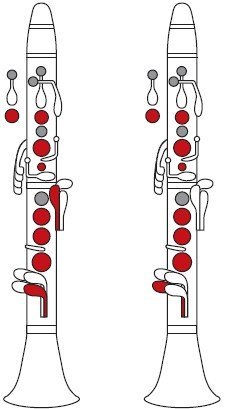
On Bb clarinet, the natural B minor scale uses the notes B, C#, D, E, F#, G, and A. You will cross the break right at B and C#, which is why this scale is such a good teacher. The free clarinet fingering chart for B Minor (Natural) lays out each note clearly, from low B in the chalumeau to high B in the clarion register.
Instead of overthinking the mechanics, let the chart guide your fingers while your ears guide your sound. Focus on smooth slurs through the break, especially between A and B, and between B and C#. Use steady air, light fingers on the right-hand rings, and keep your thumb relaxed over the register key to avoid tension.
Start slowly with one octave of B minor (low B to middle B) using the chart.
Add a second octave (up to high B) once the lower octave feels steady.
Practice in slurs first, then add gentle articulation on every note.
Finish by playing simple tunes in B minor to connect the scale to real music.
Practice Block
Time
Focus
Slow scale (1 octave)
5 minutes
Smooth slurs, even tone from low B to middle B
Full range scale (2 octaves)
5 minutes
Crossing the break cleanly at B and C#
Musical fragments
5 minutes
Short phrases from pieces or improvisations in B minor
Troubleshooting B Minor: Common Clarinet Hiccups
Even advanced clarinetists still negotiate with B minor from time to time. The break, the right-hand position, and tuning around C# can all cause small headaches. The good news: those same spots are where your playing can grow fastest.
Issue
Likely Cause
Simple Fix
Crack between A and B
Thumb or register key moving late
Practice slow A-B slurs, moving thumb a split second ahead of fingers
Sharp C# in the staff
Too much embouchure pressure, low air support
Relax embouchure slightly, use warm, fast air and listen for pitch
Uneven tone across F# and G
Right-hand fingers lifting too high
Keep fingers close to the keys, practice with mirror or slow motion
Connecting B Minor To Your Wider Clarinet Journey
B minor does not live alone. It sits in a family of keys that share similar fingerings and musical moods. Once your B Minor Scale (Natural) feels comfortable, scales like D major, G major, and E minor suddenly feel less intimidating, because many of the same notes and fingerings repeat.
As you explore other scales on Bb clarinet, such as the G major scale or the D major scale, you will notice how patterns of F# and C# reappear. This shared DNA helps your hands learn faster. B minor becomes a central reference point rather than an outlier.
For those curious about extending their practice, pairing B minor with its harmonic and melodic forms offers even richer colors. But the natural form remains the emotional backbone. It is the version that appears in so many clarinet lines, from simple etudes to advanced orchestral passages.
Key Takeaways
Treat the B Minor Scale (Natural) on Bb clarinet as a mood and a color, not just a pattern of notes.
Listen to great clarinetists in orchestral, jazz, and klezmer settings to hear how B minor comes alive in real music.
Use the free fingering chart and short daily practice blocks to make B minor feel effortless under your fingers.
Frequently Asked Questions
What is Bb clarinet B minor scale (natural) fingering?
The Bb clarinet B Minor Scale (Natural) fingering covers the notes B, C#, D, E, F#, G, and A in order, usually over one or two octaves. It crosses the break between A and B, so it is perfect for learning smooth thumb and register key coordination while developing a dark, lyrical sound.
Why does the B Minor Scale (Natural) sound so dark on clarinet?
The natural B minor scale uses intervals that emphasize B, D, and F#, which create a somber, introspective color. On Bb clarinet, these notes sit in rich parts of the chalumeau and clarion registers, so the instrument's natural resonance amplifies that shadowy, emotional character.
How often does B minor appear in clarinet music?
B minor appears regularly in orchestral solos, inner-line passages, chamber music, jazz standards, and klezmer tunes. Even when the piece is in a related key like D major or G major, clarinet lines frequently pass through phrases built on the natural B minor scale, especially in lyrical sections.
Is B minor a difficult scale for beginner clarinetists?
B minor can feel tricky at first because it crosses the break and uses notes like C# and F#, but that challenge makes it very rewarding. With a clear fingering chart, slow practice, and relaxed air, beginners quickly turn it into one of their most expressive and comfortable scales.
How should I practice the B Minor Scale (Natural) musically?
Start by playing the scale slowly with a beautiful tone, then add dynamics like crescendos and decrescendos across the full range. Turn small parts of the scale into short melodies, imitate phrases from Brahms or jazz solos, and always listen for smooth connection between notes and expressive phrasing.