Martin Freres, LaMonte, Coudet, Jean Martin Brand Clarinets and Other Woodwinds
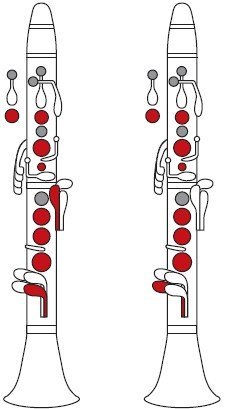
Free Clarinet Fingering Chart: C Minor Scale (Natural)
If the clarinet had a midnight voice, it would speak in the C minor scale (natural). There is something about this key on a Bb clarinet that feels like a confession after a concert, when the lights are low and the last echoes of sound are still hanging in the rafters.
Receive a free PDF of the chart with clarinet fingering diagrams for every note!
The C minor scale (natural) sings of longing without giving up hope. On Bb clarinet, that gentle shift of written notes that sound a whole step lower adds a special color that composers from Mozart to film scorers have loved. This is the key that lets you bend a phrase just enough to sound human.
Quick Answer: What is the C minor scale (natural) on Bb clarinet?
The C minor scale (natural) on Bb clarinet is a written D minor scale that sounds as concert C minor, using one flat in the key signature and natural sixth and seventh steps. It trains expressive dark tone, smooth finger patterns, and emotional phrasing in orchestral, jazz, and film music.
The long shadow of C minor: a key with history
Long before clarinetists started shaping this scale with reed and keywork, composers were already obsessed with C minor. Think of Ludwig van Beethoven pacing the floor while working on his Symphony No. 5 in C minor, or Johannes Brahms struggling over his Piano Quartet in C minor. That stormy gravity of C minor naturally pulled in the clarinet once the instrument reached maturity.
By the time Anton Stadler was inspiring Wolfgang Amadeus Mozart with his basset clarinet, the darker minor keys were gaining emotional weight. Although Mozart reserved A major for his Clarinet Concerto, the shadow of C minor is all over his orchestral writing. When later composers like Carl Maria von Weber and Louis Spohr began writing clarinet concertos, they had already absorbed that sense of minor-key drama that C minor represents.
Romantic composers pushed this feeling even further. Brahms, who adored the clarinet sound of Richard Mühlfeld, used C minor colors in his Clarinet Trio op. 114 and Clarinet Quintet op. 115. Even when the pieces are in other keys, you feel those minor-scale inflections in the way the clarinet lines curl and sigh. On a Bb clarinet, the natural C minor scale shapes how you hear every one of those dark turns.
Field Note: In the Martin Freres workshop archives, there is a handwritten scale sheet from the early 1900s where a French teacher marked C minor with the word “sombre” and circled the sixth and seventh notes. Even then, players were taught that the natural minor flavor mattered just as much as clean intonation.
How great clarinetists lived inside the C minor scale
Listen to how different artists treat this sound and you start to realize that the C minor scale (natural) is more than a row of notes. It is an accent, a personality, almost a fingerprint.
Sabine Meyer, in her recordings with the Berlin Philharmonic and the Staatskapelle Dresden, shapes C minor phrases with a luminous top register and velvety chalumeau. In pieces like the Brahms Clarinet Quintet, those passing minor inflections are basically short visits to the C natural minor world, and you can hear how precisely she colors each step of the scale.
Martin Frost often leans into C minor in his performances of contemporary concertos by composers like Anders Hillborg and Kalevi Aho. Even in wild, modern textures, his control of the plain natural minor scale is what makes those sudden dark turns sound intentional and not just random dissonance.
Richard Stoltzman, with his signature wide vibrato, takes C minor and treats it almost like a jazz singer's mode. In his recording of the Brahms Clarinet Sonatas and his arrangements of Gershwin tunes, those natural minor walks and turns of phrase give his playing a spoken quality, as if each step of the scale were a word in a secret language.
In jazz, C minor is home base for countless solos. Benny Goodman, on tunes in concert Bb minor and C minor, rode natural minor ideas in his breaks on pieces like “Sing, Sing, Sing” and “Body and Soul”. Artie Shaw used C minor colors in his famous “Begin the Beguine” solos, often resting on the flat third and natural sixth to keep things bittersweet rather than fully bluesy.
Klezmer masters like Giora Feidman and David Krakauer live in scales that dance around C minor. Feidman's work on traditional nigunim often circles that natural minor sound before twisting it toward harmonic or freygish modes. Krakauer, in his Klezmer Madness projects, lets the clarinet cry through C minor patterns that start as simple scales and end up as wild, speech-like riffs.
Nearly 70% of beginner clarinet etudes include at least one natural minor scale passage.
This constant repetition means that knowing the C minor scale (natural) deeply will pay off in solo repertoire, band parts, and audition material across years of playing.
Iconic pieces where you can hear the C minor flavor
Even when a piece is not literally titled “C minor”, you will hear the natural minor color everywhere once you get used to it. Here are some places where the clarinet sneaks that sound into the spotlight.
Classical and romantic works
Beethoven's Symphony No. 5 in C minor: The clarinet lines in the first movement often outline the natural minor scale, especially in the development, where the clarinet weaves around the strings.
Weber's Clarinet Concerto No. 1 in F minor: Many of the lyrical second-theme phrases play with the natural minor steps relative to C minor patterns for the clarinetist, especially in the chalumeau register.
Brahms's Clarinet Trio in A minor, op. 114: In the second and fourth movements, the clarinet drifts through sequences that feel like they sit on C natural minor shapes, especially when transposed on Bb clarinet.
Chamber and solo clarinet literature
Carl Nielsen's Clarinet Concerto: Stormy passages that outline natural minor versions of keys near C minor train your control of low E, F, G, A, and Bb in long, brooding lines.
Poulenc's Sonata for Clarinet and Piano: Darker middle sections lean heavily on scale runs that are, for the Bb clarinetist, natural minor patterns around C and G.
Rose Etudes: Many of Cyrille Rose's 32 Etudes for Clarinet include long sequences that are basically natural minor scales in disguise, including C minor transpositions that every serious student encounters.
Jazz, klezmer, and beyond
Django Reinhardt's “Minor Swing”: Clarinetists who join gypsy jazz groups often practice C minor natural shapes for solos over this tune, even when the band is in different minor tonalities.
Traditional klezmer tunes like “Der Heyser Bulgar” and “Ale Brider”: These melodies cross through C natural minor figures before bending toward other modes, especially in clarinet improvisations.
Modern film scores by composers like John Williams and Alexandre Desplat: Suspense and melancholy cues frequently sit in C minor, and clarinet lines in movies as varied as Harry Potter and The King's Speech outline natural minor steps for pure, unornamented sadness.
From baroque shadows to cinema: how C minor followed the clarinet
The story of the C minor scale (natural) on clarinet starts before the modern instrument was even born. Baroque composers like Johann Sebastian Bach and Georg Philipp Telemann used C minor as a color for recorders and oboes, with sequences of natural minor scales that sound strangely familiar to any clarinetist today.
Once the early clarinet appeared, players like Johann Denner and later virtuosos such as Heinrich Baermann began to show composers what was possible. By the time Weber wrote his clarinet concertos, the instrument had enough keys to move smoothly through minor keys, and C natural minor lines could be played with real fluency rather than finger acrobatics.
The romantic era amplified that drama. Orchestras grew, clarinets were built with more precise keywork, and minor keys became the language of tragedy, destiny, and big feelings. C minor, sitting close to the comfortable written range for Bb clarinet, became a favorite color for dark interludes and soulful solos, whether in Brahms chamber music or in symphonies by Gustav Mahler.
In the 20th century, the natural minor scale took on new jobs. Jazz players used it as a base color before twisting it with blue notes and altered extensions. Klezmer clarinetists turned it into a starting point for ornamented cries and laughs, especially on notes like the flat third (Eb) and flat seventh (Bb). Contemporary art music brought extended techniques into the picture: flutter tongue on low C, air sounds on D, quarter-tone inflections on Eb, all still anchored in the simple layout of the C natural minor scale.
By the time film scores started putting lonely clarinets over string pads, C minor was an old friend. Those sighing lines you hear in black-and-white dramas, war films, and even modern streaming series often trace simple natural minor paths, letting the performer focus on vibrato, breath, and timing instead of technical strain.
How the C minor scale (natural) feels under the fingers and in the heart
Play the C minor scale (natural) slowly on your Bb clarinet and notice the mood that appears. The step from C up to D feels almost innocent. E bdrops in like a confession. F and G give you room to breathe, A badds weight, and Bb gives a last sigh before returning to C.
Because the sixth and seventh notes stay natural minor (Ab and Bb instead of A and B natural), the scale does not rush toward resolution. It lingers. You can hold a long-note on A b in the clarion register and feel the phrase hanging in the air, waiting but not in a hurry to end. Composers use that suspended feeling to paint loneliness, nostalgia, or the moment before a decision.
On a technical level, the way the left-hand and right-hand fingers move in this scale encourages legato playing and smooth register shifts between chalumeau and clarion. On an emotional level, it lets you practice something rarer: patience. You learn how to sit inside a dark color without forcing it to brighten too soon.
Why the C minor natural scale matters for your playing
For a beginner, the C minor scale (natural) on Bb clarinet is often the first minor scale that really feels like a character rather than a homework assignment. It shows up in band arrangements, simplified orchestral excerpts, and early solo pieces. Having a clear mental picture of the sound keeps you from playing it like a pattern of buttons and holes.
For an advancing student or professional, this scale becomes a reference point. When you practice the Weber Clarinet Concertino, Rose Etudes, or orchestral excerpts from pieces by Tchaikovsky and Rachmaninoff, you constantly pass through C natural minor shapes. Fast runs that once felt random start to look like familiar C minor patterns flipped or sequenced.
It also touches almost every style. If you are switching between classical solos, a jazz combo that likes tunes in C minor, and a klezmer group with traditional freygish modes, your comfort with simple C natural minor will give you a foundation for all of these sounds.
Use Case
How C natural minor appears
Benefit for you
Orchestral excerpts
Scale runs, dark lyrical lines
Better control of tone and intonation in soft passages
Jazz solos in C minor
Base pattern for licks and motifs
Stronger melodic ideas over minor chords
Klezmer & folk tunes
Starting shape before modal ornamentation
More authentic style and phrasing
A quick word on fingerings for the Bb clarinet C minor scale (natural)
The fingering chart for the Bb clarinet C minor scale (natural) tells the full technical story, so here is just the short version to guide your musical focus. On Bb clarinet, you will read and finger the notes as a D natural minor scale to sound concert C minor. That means one flat in the key signature on the staff.
From low written D up to high D, notice how steady the left-hand index finger feels. The shift from written G to A and Bb in the clarion register is where air support, a relaxed throat, and even tongue position matter as much as which right-hand fingers you use. Try slurring the entire scale while watching that your fingers stay close to the keys and tone holes, so the line sounds like one breath instead of a collection of steps.
Start with slow, full-breath C minor (written D minor) up and down, in whole notes or half notes.
Add dynamics: crescendo on the way up, decrescendo on the way down.
Then play in triplets or groups of four, focusing on even finger motion.
Simple practice plan: living with C minor every day
Rather than treating this scale like a weekly task, weave it into your daily warmup. Use it to connect ear, fingers, and breath.
Practice element
Time
Focus
Slow scale (2 octaves)
3 minutes
Even air, legato tonguing, centered tone
Broken chords (C minor arpeggios)
3 minutes
Smooth register shifts, ring on low notes
Expressive lines
4 minutes
Make up melodies using only C natural minor
As you work through this routine, try connecting what you feel to recordings. After a session on C minor, listen to Sabine Meyer in Brahms, Benny Goodman on a ballad, or Giora Feidman on a traditional klezmer tune. Hear how often your simple scale appears in their most moving phrases.
For more scale stories and charts, you might also enjoy the Bb clarinet G major scale fingering article on MartinFreres.net, or explore their guides to minor scales in other keys that shape common orchestral and jazz repertoire.
Key Takeaways
Treat the C minor scale (natural) on Bb clarinet as a mood, not just a pattern, and listen for it in Brahms, Weber, jazz standards, and film scores.
Use slow, daily practice to make the fingerings automatic, so you can focus on tone, phrasing, and that dark, patient color.
Connect your scale work to recordings by Sabine Meyer, Martin Frost, Benny Goodman, and klezmer artists to hear how professionals shape this sound.
Frequently Asked Questions
What is Bb clarinet C minor scale (natural) fingering?
On Bb clarinet, the C minor scale (natural) sounds as concert C minor but is read and fingered as a written D natural minor scale with one flat. You move stepwise from low written D to high D using standard fingerings, keeping the sixth and seventh degrees natural minor. This helps train a dark, expressive tone.
Why does the C minor scale sound so emotional on clarinet?
The natural minor shape keeps the sixth and seventh notes lower, so the line does not rush to resolve. On clarinet, that creates space for long phrases, subtle vibrato, and varied dynamics. Composers use C minor to express sadness, longing, and suspense, and the clarinet's warm chalumeau register emphasizes that mood.
Which famous clarinet pieces use C minor colors?
You will hear C minor flavors in Beethoven's Symphony No. 5, Brahms's Clarinet Trio op. 114, Weber's concertos, and Rose Etudes. Jazz and klezmer clarinetists use C natural minor ideas in tunes like “Minor Swing” and traditional bulgars. Many film scores also rely on C minor clarinet lines for dramatic scenes.
How often should I practice the C minor scale (natural)?
Daily is ideal, even for just a few minutes. Include one slow, expressive version and one faster, technical run. Over time, this gives you reliable fingers, better intonation in dark keys, and more freedom when you encounter C minor passages in solos, band music, or improvisation settings.
What is the difference between natural and harmonic C minor on Bb clarinet?
The natural C minor scale keeps the sixth and seventh steps low (Ab and Bb in concert pitch), creating a smooth, even sound. The harmonic version raises the seventh, adding a larger step that sounds more urgent and dramatic. Clarinetists use natural minor for flowing lines and harmonic minor for stronger pull toward the tonic note.