If you have ever played a smoky jazz ballad or a film melody that felt both hopeful and blue at the same time, you have heard the color of the C Dorian scale. On Bb clarinet it sits right under the fingers, inviting you to bend time, shade notes, and tell stories that feel ancient and modern at once.
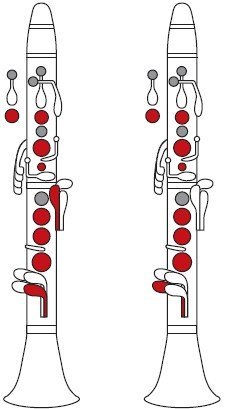
Receive a free PDF of the chart with clarinet fingering diagrams for every note!
The C Dorian scale on Bb clarinet is an 8 note minor jazz mode built from C to C using the notes of Bb major. It creates a soulful, flexible minor sound that fits blues, modal jazz, film scores, and lyrical solos, giving clarinetists a rich expressive palette.
The sound and story of the C Dorian scale
The C Dorian scale is like a dim streetlight over a late-night trio: warm, a little lonely, but strangely comforting. On Bb clarinet, its slight brightness compared to pure natural minor lets the sound lean forward, as if the melody is curious about where it might go next.
Pianists talk about C Dorian as a home base for modal jazz, but clarinetists quietly adore it too. That raised sixth gives your throat tones and clarion register a bittersweet glimmer, perfect for bending notes with a soft embouchure, exploring chalumeau whispers, and letting phrases float above a walking bass or a string pad.
This pattern turns a minor sound into something more open and lyrical, which is why clarinetists reach for Dorian in jazz solos, modal etudes, and film-style improvisations.
Clarinet heroes who lived inside C Dorian
Even if no one put “C Dorian” in bold letters on a chart, legendary clarinetists have poured this sound into their playing for decades. Listen to Benny Goodman trade choruses on tunes like “Soft Winds” and “Stompin' at the Savoy”. In medium-tempo blues sections and modal vamps, you can hear Dorian gestures in his chalumeau runs and clarion scoops, especially when the harmony stays on one chord for a while.
Artie Shaw's famous recording of “Summit Ridge Drive” has stretches that sit on minor flavors where Dorian licks slip in almost casually. His use of the throat A, long B, and clarion C as launchpads for modal lines is pure clarinet poetry. Buddy DeFranco, in his bop-heavy playing on tunes like “Cherokee” and “Out of Nowhere”, would glide through ii chords using Dorian vocabulary, letting the clarinet cut through big band brass in the upper clarion and early altissimo.
Move forward in time and you find Eddie Daniels using Dorian shades in tunes like “That Waltz” and his clarinet features with the GRP Big Band. His controlled altissimo, smooth throat tones, and legato over a static harmony show exactly what happens when a clarinetist really trusts the mode. On the classical side, you can hear modal hints from Dorian language in Martin Frost's interpretation of contemporary works by Anders Hillborg and Magnus Lindberg, where orchestral clarinet solos float over clusters instead of traditional chord progressions.
Klezmer players love something very close to C Dorian when they slide between scales in freygish and Misheberakh modes. Giora Feidman often hovers near a Dorian flavor in slower meditations, shaping the sound with wide vibrato and throat-tone bends. David Krakauer, especially in his work with Klezmer Madness and his collaborations with John Zorn, throws in Dorian-based runs that ride over electric bass and drums, creating a bridge between Old World dance music and New York jazz clubs.
Iconic pieces and recordings where C Dorian lives
You might not see “C Dorian” printed at the top of many clarinet parts, but you hear its spirit in famous music across genres. In jazz, think about tunes built on minor vamps or ii chords: “So What” by Miles Davis sits on D Dorian, but transposed for clarinetists and practice purposes, C Dorian becomes a friendly cousin. When you work C Dorian fingering patterns, you are preparing for every modal solo where the band just sits on a minor 7 chord and lets you float.
In big band arrangements of “Autumn Leaves” or “Blue Bossa”, clarinetists covering sax parts often treat the ii chords as Dorian playgrounds. For example, over a Dm7 in concert, a Bb clarinet reading a transposed chart might run lines that feel exactly like C Dorian finger patterns under the hands. That tiny physical memory in your fingers makes riffs smoother, especially in the chalumeau and clarion crossover around throat A and B.
In classical and modern orchestral writing, C Dorian colors show up in slow, modal sections. Consider the opening movement of Aaron Copland's “Clarinet Concerto”. Although it moves through several tonal centers, the solo clarinet often hints at Dorian-style mixtures: minor lines with a bright sixth peeking out. Sabine Meyer has recorded this concerto with a liquid tone that almost shines a spotlight on those modal moments, using her throat tones and lower clarion like a jazz singer shading syllables.
Film composers love Dorian for clarinet solos because it feels ancient and new at the same time. In scores by John Williams, Alexandre Desplat, and Patrick Doyle, clarinet lines often sit on minor chords where the sixth is left ambiguous. Recordings of “Harry Potter and the Prisoner of Azkaban” and “The Curious Case of Benjamin Button” feature clarinet phrases that flirt with Dorian, especially when the music needs to be sad but not hopeless. When you practice the C Dorian scale, you are secretly learning the flavor of a hundred haunting soundtrack moments.
Chamber works also lean toward modal colors. In contemporary clarinet trios and quartets, composers like Jorg Widmann and Jukka Tiensuu use Dorian inflections across the ensemble. One clarinet might sit on a C Dorian figure in chalumeau while another climbs through alternate fingerings in the altissimo, creating an echo of folk song over modern harmony.
| Context | How C Dorian appears | Suggested listening |
|---|---|---|
| Jazz minor vamp | Long stretches on one minor 7 chord | Benny Goodman small group recordings |
| Modern concerto | Modal melodies with bright sixth | Copland Clarinet Concerto, Sabine Meyer |
| Klezmer ballad | Mix of minor and modal turns | Giora Feidman slow improvisations |
For related stories about iconic repertoire and clarinet color, you might enjoy reading about the Mozart Clarinet Concerto, the history behind Brahms clarinet sonatas, or the expressive challenges of the Weber clarinet concertos.
From chant to jazz club: a short journey of Dorian
Dorian as a mode is older than the modern clarinet, older than the Boehm system, older than the idea of keys as we think of them. Medieval chant teachers used it as one of their core modes. By the time the Chalumeau and early clarinet arrived, composers like Johann Stamitz and Anton Stadler were already playing in keys and modes that felt similar to what we now call Dorian, even if the theory vocabulary had shifted.
In the classical era, Heinrich Baermann and Carl Baermann championed the Weber concertos and concertino. While not labelled Dorian, these works hint at modal shifts inside minor passages that feel like glimpses of Dorian color. The clarinet's agility in both chalumeau and clarion registers made it a natural storyteller for these flexible minor sounds.
By the romantic era, Brahms opened harmonic space where modes sat side by side with traditional major and minor. In the slow movements of the Clarinet Sonatas Op. 120, careful listeners will catch passing fragments where a raised sixth over a minor base note gives a Dorian-like ache. Players such as Richard Muhlfeld, and in our time artists like Richard Stoltzman and Sharon Kam, bring that color to life with nuanced breath control and smooth register shifts.
The real explosion of C Dorian as a practical scale for clarinetists arrived with early jazz and swing. Dance band arrangers loved simple minor vamps where a clarinet in Bb could soar above trombones and trumpets. Artie Shaw and Benny Goodman learned these colors on the bandstand long before theory books codified them as “Dorian”. Later, Buddy DeFranco and Eddie Daniels studied and taught this language systematically, turning it into something every serious jazz clarinetist practices in all twelve keys.
Today, whether you are playing a modal tune in a small combo, improvising for a video game soundtrack, or adding a hint of folk flavor to a clarinet and guitar duo, the C Dorian scale is one of those quiet tools that keeps reappearing. It connects Gregorian chant, swing era solos, klezmer meditations, and modern film scores, all through a simple pattern of whole and half steps that your fingers can memorize on a single Bb clarinet.
Why the C Dorian scale feels so special on Bb clarinet
Emotionally, C Dorian feels like a minor scale that decided not to give up. The flattened third and seventh carry the weight of sadness, while the natural sixth holds onto a thread of hope. On Bb clarinet, that sixth falls in a range where the tone is velvety and warm, especially when you shape it with subtle vibrato or a slightly looser embouchure.
Compared to a plain natural minor, Dorian encourages smoother legato across the break. When you move from the lower clarion to the first notes of the upper register, the scale pattern guides your fingers in a way that can clean up your register transitions just by repeating it slowly. Many players notice that spending time with C Dorian helps emergency register crossings in repertoire feel more stable.
Artistically, Dorian lets you sit comfortably on one harmony for a long time without sounding stuck. That is why so many jazz and fusion clarinetists lean on Dorian scales: a single Bb clarinet and a single chord on piano or guitar can sustain a whole improvisation. You can build small motifs in the chalumeau, answer them in the clarion, and gradually climb into altissimo without ever leaving the same modal neighborhood.
By practicing just 8 notes of C Dorian in at least 5 rhythmic patterns, clarinetists often report more confident improvisation and smoother phrasing in under 10 minutes a day.
Why mastering C Dorian matters for you
If you are a beginner, the C Dorian scale is a friendly introduction to the idea that not all minor is the same. It helps your ear learn the difference between sad and soulful, between dark and warmly shaded. As you climb from chalumeau E and F up through clarion G, A, and C, you start to feel how one small note, the sixth, can change the mood of the entire line.
For intermediate and advanced players, C Dorian is a gateway to improvisation. Instead of thinking “What chord is this?” every measure, you can think “What story do I want to tell over this minor groove?” Jazz clarinetists practicing ii-V-I progressions in Bb or F major use Dorian on the ii chord constantly. Classical players working on phrasing in Debussy, Ravel, or contemporary works find that Dorian exercises sharpen their sense of color and tension.
Even if your main focus is orchestral playing, the freedom that comes from being comfortable improvising with C Dorian pays off when you face cadenzas, rubato solos, or flexible melodic lines. You start to hear each note of the scale as a character, not just a number, which changes the way you shape Brahms, Strauss, or Copland.
To connect this with other coloristic studies, you might also explore scale and tone work used in articles like Bb clarinet fingering chart basics or historical discussions such as the history of the clarinet and its evolving sound.
A quick word on C Dorian fingerings (and how to use the chart)
The free Bb clarinet fingering chart for the C Dorian scale lays everything out visually, from low C up through the clarion and into early altissimo. You will see the basic Boehm system fingerings for each note, with clear diagrams for left-hand register key, right-hand pinky options, and alternate fingerings where they matter for intonation or smoothness.
Think of the chart as a canvas rather than a rule book. Start by playing C Dorian slowly, two octaves if your embouchure and air support allow it. Keep your fingers relaxed over the tone holes, especially in the left-hand ring finger and right-hand pinkies, which often tense up around the break. After that, use the scale as raw material for melodies instead of just running it up and down like a technical etude.
- Play the C Dorian scale in whole notes, listening for even tone from chalumeau to clarion.
- Add a simple rhythm, such as quarter note, eighth note, eighth note, repeated up and down.
- Create a short 4 bar melody using only C Dorian notes, starting and ending on different tones.
- Change the dynamics each time: soft, medium, then bold, without changing finger pressure.
| Practice focus | Time | Frequency |
|---|---|---|
| Slow C Dorian scale, 2 octaves | 5 minutes | Daily |
| Simple Dorian melody creation | 5 minutes | 3 times per week |
| Play along with a minor backing track | 10 minutes | 1 to 2 times per week |
Troubleshooting common C Dorian issues
Even with a lyrical scale like C Dorian, Bb clarinet players tend to bump into the same spots: messy crosses over the break, uneven tone between throat tones and clarion, and pitch wobbles near the top of the scale.
| Problem | Likely cause | Quick fix |
|---|---|---|
| Cracks crossing from A to B | Moving fingers before adding register key | Practice slow A-B shifts with steady air and early register key |
| Flat throat tones | Loose embouchure and weak air | Support with faster air and slightly firmer lower lip |
| Uneven scale rhythm | Fingers lifting too high | Keep fingers close to keys, practice with a metronome |
Key Takeaways
- The C Dorian scale on Bb clarinet gives you a soulful minor color used in jazz, film, klezmer, and modern classical music.
- Famous clarinetists from Benny Goodman to Sabine Meyer have drawn on Dorian flavors in iconic recordings and performances.
- Use the free C Dorian fingering chart not just for drills, but as a starting point for melodies, improvisation, and expressive phrasing.
Frequently Asked Questions
What is Bb clarinet C Dorian scale fingering?
Bb clarinet C Dorian scale fingering is the pattern of finger positions that produces the notes C, D, Eb, F, G, A, Bb, C on a Bb clarinet. It follows the Dorian formula 1, 2, b3, 4, 5, 6, b7 and is used for jazz solos, modal etudes, and expressive minor melodies.
How is the C Dorian scale different from C natural minor on clarinet?
The C Dorian scale has a natural A instead of Ab, which is the sixth degree. On clarinet, this gives the scale a brighter, more flexible color than C natural minor. It feels less dark and more open, which is why players favor Dorian for jazz improvisation and lyrical modal lines.
Why should clarinetists practice the C Dorian scale?
Practicing the C Dorian scale helps clarinetists develop a strong minor sound that works over ii chords, modal tunes, and static minor vamps. It improves ear training, phrasing, and comfort across the break. Regular practice also prepares you for jazz standards, film music, and contemporary pieces that use modal harmony.
Which famous clarinetists use Dorian sounds in their playing?
Jazz clarinetists like Benny Goodman, Artie Shaw, Buddy DeFranco, and Eddie Daniels often use Dorian in solos. Classical and contemporary artists such as Sabine Meyer, Martin Frost, and Richard Stoltzman highlight Dorian-like colors in modern concertos and chamber music. Klezmer players Giora Feidman and David Krakauer also lean into similar modal flavors.
How can I use the C Dorian scale to start improvising?
Put on a simple C minor backing track or have a pianist play a C minor 7 chord, then play only notes from C Dorian: C, D, Eb, F, G, A, Bb. Start with short rhythmic patterns, repeat simple motifs, and focus on smooth transitions across the break. Let your ear guide which notes feel most expressive.