If the major scale is daylight for the clarinet, then the D Dorian scale is that blue hour just before sunrise: quiet, hopeful, and full of stories. On Bb clarinet it sits under the fingers in a way that practically invites improvisation, from medieval tunes to smoky jazz solos and film scores that never quite resolve the way you expect.
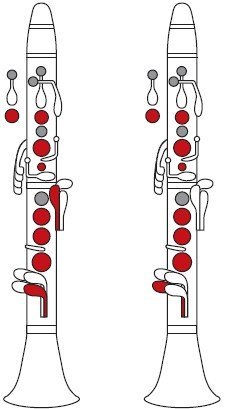
Receive a free PDF of the chart with clarinet fingering diagrams for every note!
The D Dorian scale on Bb clarinet is a minor-flavored mode built from D to D using the notes of C major, giving you D, E, F, G, A, B, C, D. It blends minor warmth with major brightness and is a favorite for improvisation, expressive solos, and modal pieces.
The D Dorian scale and its unmistakable mood
Play a simple D Dorian scale on your Bb clarinet, and you feel it immediately: not as dark as natural minor, not as bright as D major, but something in between. The raised 6th (B instead of Bb) is the secret ingredient. It gives your sound a gentle inner light, the way a bass clarinet can glow inside a Mahler symphony or a Bb clarinet can whisper in a small jazz combo.
Clarinetists talk about colors all the time: throat tones like soft charcoal, clarion register like bright watercolor, altissimo like a spotlight. D Dorian lets all of those colors sit in a single eight-note span. Your low D feels grounded, almost like a small drum. By the time you climb to the upper D with a steady embouchure and focused air, the scale has shifted from introspection to quiet courage.
D, E, F, G, A, B, C, D on Bb clarinet form the D Dorian sonority that shows up in jazz, folk, film music, and contemporary classical pieces, all with the same distinctive mix of hope and melancholy.
From church modes to jazz clubs: the journey of D Dorian
Long before the modern Bb clarinet existed, singers and early instrumentalists were already living inside the D Dorian sound. Medieval chant and Renaissance dances often used D Dorian as their playground. If you listen to old English tunes for recorder or shawm, that slightly haunting, slightly hopeful flavor comes from this mode.
By the baroque era, when early clarinets began showing up in courts and small orchestras, modes quietly fed into the way composers wrote melodies. Johann Stamitz and his Mannheim colleagues loved sequences and modal touches in their orchestral writing. Even though they might not always mark “D Dorian” on the page, you hear D Dorian shapes in inner lines for oboes, chalumeaux, and early clarinets weaving through the harmony.
In the classical and romantic eras, the story shifts. Tonal major and minor took center stage, but modal colors stayed in the cracks. Clarinet heroes like Anton Stadler, who inspired Mozart's Clarinet Concerto, and Heinrich Baermann, who worked closely with Carl Maria von Weber, both lived in a time where “church modes” and folk tunes met polished classical harmony. Listen to the slow movement of Mozart's Clarinet Concerto or Weber's Clarinet Concerto No. 2. You will hear little turns and phrases that lean toward Dorian shapes, including D Dorian runs in the inner voices and clarinet lines that toy with a raised 6th inside minor passages.
By the time we reach the late romantic period, composers like Brahms and Dvorak were openly drawing from folk music. Their clarinet writing, often performed by Richard Muhlfeld and other great players, sometimes brushes against D Dorian in rustic dances and wistful clarinet phrases. That modal color is like a folk violin tucked inside the clarinet section of the orchestra.
Clarinet legends who lived inside the D Dorian sound
If you want to feel why D Dorian matters, listen to the players who used it as their personal canvas. On the classical side, Sabine Meyer shapes modal phrases in works by contemporary composers like Peteris Vasks, where D Dorian shadows hide inside long, singing lines. Her focused throat tone and perfectly centered clarion register show how this mode can feel both ancient and new.
Martin Frost often bends into Dorian color in pieces like Anders Hillborg's “Peacock Tales”. In live recordings with the Swedish Radio Symphony Orchestra, you can hear the clarinet slip from pure D minor toward D Dorian as the harmonies shift underneath, especially when the strings sustain open fifths and the clarinet nudges that raised 6th into the texture.
In American classical music, Richard Stoltzman brought a jazz-infused sense of phrasing to works by Leonard Bernstein and Aaron Copland. Listen closely to his performance of Bernstein's “Sonata for Clarinet and Piano”. In the more improvisatory sections, he leans on modal fragments that could easily sit inside a D Dorian framework, shaping the phrases with a slightly brushed articulation and gentle vibrato.
Then there is the jazz lineage, where D Dorian practically has its own barstool. Benny Goodman, in his small group recordings with Teddy Wilson and Lionel Hampton, loved minor blues and modal turns. Even though many tunes sit in different keys, the language he built would fit perfectly into a D Dorian vamp: clear tonguing, fast clarion-register runs, and piercing altissimo notes sitting over simple piano voicings.
Artie Shaw took that same vocabulary and gave it a more vocal spin. Listen to “Summit Ridge Drive” or his choruses on “Begin the Beguine” and imagine the rhythm section sitting on a D Dorian groove. His wide intervals and fluid slurs are exactly what makes this scale such a joy for modern clarinet improvisation.
Buddy DeFranco brought bebop language to the clarinet. His solo on “Deep Purple” uses patterns that feel at home over ii chords (like Dm7) in a C major context. Those ii chords are where D Dorian lives. When you practice your D Dorian scale with the free fingering chart, you are touching the same harmonic territory Buddy flew over with lightning-fast articulation and airy altissimo notes.
In klezmer, Giora Feidman and David Krakauer often slip into modal flavors around D Dorian in freygish and other related modes. They twist the notes with glissandi, pitch bends, and ornamental trills. On recordings like Krakauer's work with the Klezmatics or Feidman's solo albums, you can hear how one raised 6th can shift a melody from pure lament into something more hopeful and dance-like.
Iconic pieces and recordings where D Dorian shines
While you might not always see “D Dorian” printed at the top of a clarinet part, the sound is everywhere. Composers and bandleaders lean on it whenever they want a minor feel that still has lift.
In jazz, think of tunes that hover around a ii chord in C major. Dm7 backed by a simple piano voicing practically begs for D Dorian from the clarinet player. Imagine:
- “So What” by Miles Davis reimagined for clarinet, with the horn section replaced by a clarinet choir.
- Modal choruses on standards like “Autumn Leaves” where the Dm7-G7 section becomes your playground.
- Clarinet lead voices in small combos putting D Dorian licks over Dm7 in a C blues context.
Benny Goodman's later live performances often stretched tunes longer, and you can hear him play scalar runs that match D Dorian finger patterns even if the tune sits in another key. Artie Shaw's clarinet tone on recordings with his Gramercy Five suggests the same language: arpeggios and scale fragments that any clarinet student could practice using a simple D Dorian fingering chart.
On the classical side, D Dorian sometimes hides inside outer sections written in D minor or C major. Contemporary works are especially rich here. In pieces by John Adams, such as “Gnarly Buttons”, the clarinet line brushes past Dorian moods in its more reflective sections. The way the solo clarinet floats above marimba and banjo textures feels like a 21st-century reimagining of modal chant, with D Dorian phrases slipping in and out of focus.
Film composers love D Dorian too. Think about soundtracks where the clarinet carries a lonely tune over a sustained string drone, like in the music of Howard Shore, John Williams, or Alexandre Desplat. In certain cues from fantasy and historical films, the underlying harmony sits on something like Dm7 while the melody spins around D, F, G, A, and B. That is pure D Dorian storytelling, whether the line is played on Bb clarinet, cor anglais, or solo cello.
Even traditional music finds its way to the clarinet section. Irish and Scottish tunes like “Scarborough Fair” or Dorian-style jigs translate beautifully to Bb clarinet. When bands or clarinet choirs arrange those melodies, D Dorian becomes a natural mode, especially for players comfortable in the chalumeau and clarion registers.
| Use of D Dorian | Typical Setting | Clarinet Example |
|---|---|---|
| Dorian chant color | Medieval/Renaissance inspired works | Soft Bb clarinet solo over organ or string drone |
| Modal jazz ii chord | Dm7 groove in C major | Improvised D Dorian solos in small combo |
| Folk-inspired film theme | Quiet scene, pastoral or nostalgic | Clarinet melody using D, F, G, A, B over drones |
Why the D Dorian scale feels so personal on clarinet
There is something about D Dorian that sits perfectly in the clarinet's emotional range. Start on low D in the chalumeau register with a relaxed left-hand position. The sound is dark but not heavy. As you move up through E and F, you can lean into soft dynamics, letting the reed vibrate with just enough support from your diaphragm and tongue position.
Hit the B, that raised 6th, and you feel the entire emotional temperature rise. In natural minor, the 6th would be Bb, which pulls you deeper into sadness. With B instead, the clarinet line feels like it just remembered something hopeful. Jazz players will often let that note ring a little longer, maybe with a small scoop or a touch of vibrato, because it changes the entire story of the solo.
Klezmer clarinetists like David Krakauer exaggerate this effect by bending into the B, almost crying and laughing in the same note. Classical players like Sabine Meyer tend to keep it pure and centered, using the raised 6th to give lift to a phrase in a slow movement or a contemporary modal passage. Either way, D Dorian lets you speak in sentences that do not fit simple major vs minor categories.
What mastering D Dorian does for your playing
Working the D Dorian scale into your daily warmup does more than add another scale to the list. Because it lives so naturally over Dm7 in C major, it trains your ear to hear ii-V-I progressions, modal vamps, and film-style drones. You start recognizing that sound in band music, clarinet choir writing, and jazz lead sheets.
For improvisers, D Dorian is often the first true “modal” space that feels comfortable. It lets you leave the idea of strict chord changes and simply live in a sound for a few bars. For classical players, it sharpens your intonation and color choices in slow movements that flirt with modality, such as sections of Copland's Clarinet Concerto or modern clarinet sonatas that use folk-inspired themes.
For students, the D Dorian fingering pattern is gentle on the hands and very close to familiar C major and D natural minor scales. The free fingering chart is not just a technical reference, it is a map to a musical neighborhood you will keep visiting in pieces, etudes, and your own improvisations.
Key Takeaways
- Practice the D Dorian scale on Bb clarinet to feel a minor mood with extra brightness, perfect for jazz, folk, and film-style solos.
- Listen to clarinetists like Benny Goodman, Sabine Meyer, and David Krakauer to hear how Dorian colors shape their phrasing.
- Use the free fingering chart and short routines below to build D Dorian into your warmups and improvisations every day.
A quick word on D Dorian fingerings for Bb clarinet
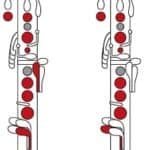
On Bb clarinet, D Dorian uses the same key signature as C major: no sharps, no flats on the staff, but your tonal center is D. From low D up to the next D, your left-hand position feels almost identical to a D natural minor scale, except for that B instead of Bb. The free clarinet fingering chart shows each note with a clear diagram, from chalumeau low D through throat tones and into clarion D.
Most players learn this pattern very quickly because it sits neatly across both left-hand and right-hand keys without awkward side-key jumps. That makes it perfect for speed work, articulation practice with single tongue and light double tongue, and slur exercises focusing on smooth crossing of the break between A and B.
| Scale | 6th Degree | Emotional Color on Clarinet |
|---|---|---|
| D natural minor | Bb | Darker, heavier, more tragic |
| D Dorian | B | Melancholy with a gentle, hopeful lift |
| D major | B | Bright, celebratory, extroverted |
Simple D Dorian practice ideas with the fingering chart
Once you have the Bb clarinet D Dorian fingering chart in front of you, treat it like a musical sketchbook rather than a technical checklist. The goal is to make the mode feel like a familiar friend under your fingers and in your ear.
- Play the scale slowly, two octaves if you can, listening to the color of each note.
- Repeat just the notes D, F, G, A, and B, creating small motifs.
- Improvise over a long, held low D from a piano, tuner, or backing track.
- Switch between D natural minor and D Dorian to hear the effect of Bb vs B.
| Routine | Time | Focus |
|---|---|---|
| Slow D Dorian scale, slurred | 3 minutes | Tone and intonation from low D to high D |
| Articulated 8th-note patterns | 4 minutes | Light tongue on reed, even finger motion |
| Free improvisation in D Dorian | 5 minutes | Phrasing, dynamics, and musical storytelling |
For extra inspiration, pair your practice with listening. Put on a Benny Goodman trio track, a Sabine Meyer recording of a contemporary work, and a Giora Feidman klezmer track. Then try short D Dorian sketches that borrow their articulations, breaths, and dynamic shapes.
Frequently Asked Questions
What is Bb clarinet D Dorian scale fingering?
The Bb clarinet D Dorian scale fingering covers the notes D, E, F, G, A, B, C, D using standard fingerings similar to C major, but centered on D. You start on low D, pass through familiar throat tones and clarion register fingerings, and return to D. It supports expressive modal playing and jazz solos.
Why does the D Dorian scale sound different from D minor on clarinet?
D Dorian uses B instead of Bb as its 6th note. That single change brightens the color while keeping the minor-style 3rd (F). On clarinet, this makes phrases feel less tragic and more contemplative. The result is a mix of sadness and hope that suits jazz, folk tunes, and atmospheric film music.
How should I practice the D Dorian scale on Bb clarinet?
Start by playing the scale slowly with a tuner, listening especially to the intonation of F and B. Then add simple rhythmic patterns, such as triplets or 8th notes, across one or two octaves. Spend a few minutes each day improvising short phrases in D Dorian to connect the fingerings with musical ideas.
Which clarinet pieces use D Dorian colors?
You will hear D Dorian style lines in modern works like John Adams pieces, folk-inspired arrangements, and jazz solos over Dm7 sections in C major. Clarinetists such as Martin Frost and Richard Stoltzman often touch Dorian sounds in contemporary concertos and sonatas, especially in lyrical slow movements.
Is D Dorian useful if I only play classical clarinet?
Yes. Even if you never improvise, D Dorian practice sharpens your ear for modal phrases in orchestral and chamber music. It helps you shape lines in pieces by Copland, Bernstein, or modern composers who blend folk and classical styles. It also strengthens scale fluency in a register that appears constantly in etudes and auditions.