If the clarinet had a twilight color, it would sound like the E Dorian scale. On Bb clarinet, this scale feels like a minor key that lifted its chin and decided not to give up. That gentle brightness inside the shadows is exactly why so many clarinetists fall in love with E Dorian and keep coming back to it in jazz solos, film music, folk tunes, and darkly glowing orchestral lines.
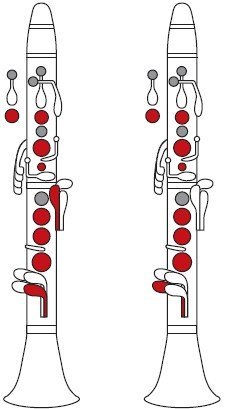
Receive a free PDF of the chart with clarinet fingering diagrams for every note!
The E Dorian scale on Bb clarinet is a bright minor-mode scale built on E that uses the notes E, F#, G, A, B, C#, D, E. It blends minor warmth with major color, giving clarinetists expressive options for jazz, folk, and film-style improvisation.
The sound story of the E Dorian scale
The E Dorian scale is the musical equivalent of a streetlamp in light rain: not fully sad, not quite happy, just quietly alive. On Bb clarinet, that first note E in the staff settles under your fingers, then the F# and C# slip in like shafts of light through a cloudy window. It is the same family of color you hear in D Dorian on piano, but shifted for our clarinet world.
Listen to a long, held E, then climb to G and A, letting the clarinet's chalumeau register bloom. You get that smoky, modal flavor so many players chase: the sound you hear in Irish reels, in Miles Davis ballads, and in whispered Klezmer intros. The E Dorian scale is where minor mood meets quiet hope.
E Dorian for Bb clarinet uses 8 scale tones with F# and C#. That small change from natural minor gives you a lift on the 6th degree and opens up a more lyrical, improvisation-friendly sound.
From ancient modes to clarinet bell tones: a short journey
Dorian mode is older than the clarinet itself. Medieval singers used it in Gregorian chant, centuries before a single grenadilla barrel was turned on a lathe. That same pattern of whole and half steps eventually found its way into Renaissance dances, then into Baroque violin gigues by composers like Arcangelo Corelli and later into woodwind parts that would eventually inspire clarinet writing.
By the time Anton Stadler was playing the basset clarinet for Mozart in the late 18th century, modal colors like Dorian had already seeped into folk tunes that floated through Vienna, Prague, and Paris taverns. Those rustic melodies, often built on Dorian shapes, influenced how composers wrote for clarinet in chamber music and serenades. While Mozart's famous Clarinet Concerto in A major lives in a luminous major key, its lyricism owes much to the same modal thinking that makes E Dorian so haunting.
In the Romantic era, Heinrich Baermann and Carl Baermann dazzled audiences with Weber's concertos. Though Weber did not label his themes as “Dorian,” you can hear modal turns and raised sixths that give his melodies an edge of Dorian brightness inside minor passages. Those subtle colors are cousins of the E Dorian scale you are about to practice.
Famous clarinet voices who live in Dorian colors
Even when players do not say “E Dorian” out loud, you can hear this color in their phrasing. It sits quietly in the toolkit of so many giants.
In classical playing, Sabine Meyer often shapes modal-sounding lines in pieces like Bela Bartok's “Contrasts” and Jean Francaix's “Theme and Variations.” Those works love raised sixths, folk patterns, and modal twists. When you shift those same patterns onto E Dorian on Bb clarinet, the kinship is obvious: smooth chalumeau lines, then rising into the clarion register with a hint of folk dance.
Martin Frost brings a similar flavor to his recordings of Anders Hillborg and Kalevi Aho. In those contemporary concertos, phrases sometimes outline scales that match Dorian shapes. Hearing Frost swell a single D against an E pedal tone feels exactly like the emotional pull you get from the E Dorian 7th degree leaning home.
On the jazz side, Benny Goodman and Artie Shaw lived in Dorian territory constantly, especially when shifting blues vocabulary into more modal tunes. Put on Goodman's recordings of “Memories of You” or his takes on ballads where he floats over minor harmonies. When you sing along on clarinet using E, F#, G, A, B, C#, D, you will feel how Dorian fits naturally into that swing language.
Buddy DeFranco, who moved the clarinet firmly into bebop, loved scales that could slide over ii chords. E Dorian is literally the sound of an A major scale starting on E, which clarinetists often use to solo over ii7 chords in D or G tonal centers. His rapid lines on recordings like “Cookin' the Books” are full of that sound, just shifted to different roots.
In klezmer, Giora Feidman and David Krakauer often ride the border between minor, Phrygian, and Dorian. In slow doinas, you will hear lines that suddenly brighten with a raised sixth, exactly the color that marks E Dorian. Feidman's singing tone on low E and F# is a model for anyone wanting to give this scale a human voice.
Pieces and recordings that echo the E Dorian feel
You will not always see “E Dorian” printed at the top of a clarinet part, but the flavor hides everywhere. The same step pattern of the E Dorian scale on Bb clarinet is built into countless melodies.
Listen for similar modal colors in:
- Claude Debussy's “Premiere Rhapsodie” for clarinet, where floating lines often lean on raised sixths and seventh scale degrees inside minor phrases.
- Igor Stravinsky's “Three Pieces for Clarinet Solo,” especially the first movement, which hovers between tonal centers with modal fragments, sounding very Dorian when transposed under the fingers.
- Bela Bartok's “Romanian Folk Dances” in clarinet arrangements, where Dorian and Mixolydian modes shape rustic dance tunes.
- Traditional Irish reels like “The Silver Spear” and “Cooley's Reel,” often played by clarinetists in folk bands, that outline Dorian modes very close in shape to E Dorian when shifted for Bb clarinet.
In film and game scores, E Dorian-type colors sneak in whenever the composer wants “mysterious but hopeful.” Think about woodwind textures in Howard Shore's “Lord of the Rings” scores or Alexandre Desplat's writing in “The King's Speech” and “The Shape of Water.” Though not all are in E Dorian, the clarinet parts often sit in modal space that feels exactly like the scale on your chart.
| Piece or Style | Modal Color | Connection to E Dorian |
|---|---|---|
| Bartok folk-inspired clarinet writing | Dorian & Mixolydian | Similar raised 6th gives that same bright-minor character as E Dorian. |
| Jazz ii7 chord soloing | Dorian mode | E Dorian works over ii7 in D or as a modal center in modern jazz tunes. |
| Irish reels on clarinet | Dorian | Same step pattern, just moved to a key that sits well on Bb clarinet. |
Why the E Dorian scale feels so special on Bb clarinet
E Dorian is a mood shifter. Start with a pure E natural minor scale, then raise the C to C#. Suddenly the music looks up. You keep the clarinet's dark chalumeau tone on E, G, and B, but the C# and D give you a beam of clarity that stops the sound from sinking into despair.
Emotionally, this scale sits perfectly between Klezmer yearning and jazz cool. It lets you slide, scoop, and bend with the same fingerings you use for classical articulation drills, but the feeling in your air changes. The throat tones E and F#, the open G, and the right-hand A and B all line up for smooth legato, making it easy to pour sound into each note without technical stress.
For improvisers, E Dorian can be a home base. On Bb clarinet, the pattern sits in a friendly register where your embouchure can stay relaxed, your left-hand position feels natural, and the pinky keys are not overworked. That comfort helps you forget about the keys and focus on story: a small fall from E to D, a sighing leap from G to B, a questioning slide from C# to B.
Modern clarinetists carrying the Dorian torch
Plenty of today's clarinetists use Dorian colors as a core part of their musical voice, often in contexts where classical, jazz, and folk touch each other.
Anat Cohen, known for her joyful blend of straight-ahead jazz, choro, and Klezmer, often hovers in Dorian territory during solos. Listen to her recordings on tunes like “Lilia” or “In the Spirit of Baden” and try singing E Dorian over some of her eighth-note lines. The fit is uncanny.
David Krakauer, especially in his work with Klezmer Madness, twists between minor and Dorian so fluidly that the scale almost feels like a character in the music. On passages where the accompaniment suggests an E minor type drone, he will suddenly use C#, giving that exact E Dorian lift.
In classical crossover, players like Andreas Ottensamer and Sharon Kam often record arrangements of traditional melodies, film themes, and new commissions that lean on modal scales. When you shift those melodies under your fingers, many of them trace out the same pattern as our E Dorian scale, just transposed to sit comfortably in the clarinet's best speaking range.
What mastering E Dorian opens up for you
Once E Dorian feels natural on your Bb clarinet, you get more than just one scale checked off your list. You gain a new emotional language. Suddenly, ii7 chords in jazz charts feel friendlier. Modal band music feels less like a puzzle and more like a conversation. Celtic-style tunes, film score excerpts, and contemporary etudes will stop surprising you with unexpected raised sixths.
Practically, this scale sharpens a lot of fundamental skills:
- Smooth transition between throat tones (E, F#) and open G.
- Right-hand stability on A and B, especially for legato phrasing.
- Clean intonation on C# and D, which often wobble if air support is weak.
Emotionally, it gives you a place to go when you do not feel purely happy or purely sad. Improvise a small melody staying inside E Dorian, and you will notice how easily you can sound thoughtful, nostalgic, or quietly confident.
The E Dorian fingering story in one glance
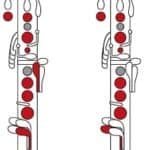
The free fingering chart does the detailed work for you, but here is the short version so your fingers have a mental picture. On Bb clarinet, E Dorian sits very naturally across the break. You begin with E in the staff, then pass through F#, G, A, B, C#, D, and back to E, using fingerings you probably know from your A major and E minor scales.
Think of it this way: take your A major scale fingerings and re-center them so that E feels like home. Your throat tone E and F# use standard fingerings, G is open, A and B use left-hand and right-hand basics, and C# and D will remind you of how you cross the break in your daily long tones. The chart will show exact diagrams for each register, but the magic lies not in the mechanics, rather in how you shape each note with breath and imagination.
| Degree | Note Name | Helpful Fingering Tip |
|---|---|---|
| 1 | E | Treat as your tonal “home” and aim for a centered chalumeau sound. |
| 2 | F# | Use firm air to keep this throat tone from sagging in pitch. |
| 3 | G | Open G should match tone color with E and F# through embouchure, not pressure. |
A simple, musical E Dorian practice routine
Instead of running the E Dorian scale like a treadmill exercise, treat it as a short story. Here is a light practice plan you can plug into your warm-up, whether you play a vintage Martin Freres clarinet or a modern student model.
| Exercise | Time | Focus |
|---|---|---|
| Slow E Dorian up & down (2 octaves if possible) | 3 minutes | Even tone and relaxed hand position crossing the break. |
| Dorian “questions” (4-note motifs) | 3 minutes | Improvise little phrases ending on D or C# to feel the modal pull. |
| Play a simple tune, then “Dorian-ize” it | 4 minutes | Raise the 6th where possible and notice the emotional shift. |
For related practice ideas, you might enjoy connecting this to other modal or expressive scales on clarinet, such as the A Dorian patterns often used in jazz, the G minor scale fingering shapes often covered in classical etudes, or our melodic minor clarinet scale resources that share similar expressive tension and release.
Key Takeaways
- E Dorian on Bb clarinet gives you a bright minor color perfect for jazz, folk, and film-style phrasing.
- Listening to players like Sabine Meyer, Benny Goodman, Giora Feidman, and Anat Cohen will help you hear this scale in action.
- Use the free fingering chart as a visual guide, then practice musically with slow scales, motifs, and short improvisations.
Frequently Asked Questions
What is Bb clarinet E Dorian scale fingering?
The Bb clarinet E Dorian scale fingering is the pattern of finger placements used to play the notes E, F#, G, A, B, C#, D, E smoothly across the clarinet. It combines familiar fingerings from A major and E minor scales, giving you a bright minor sound ideal for modal jazz, folk, and expressive classical passages.
How is E Dorian different from E natural minor on clarinet?
E Dorian and E natural minor share most notes, but E Dorian raises the sixth degree from C to C#. That one change brightens the mood and creates a more open, hopeful sound. On Bb clarinet, this also gives you a more flexible scale for improvising over ii7 chords and modal tunes.
Why should clarinetists practice the E Dorian scale?
Practicing the E Dorian scale builds comfort with modal sounds, improves movement between throat tones and the clarion register, and prepares you for jazz, folk, and contemporary classical pieces. It also strengthens your ear for raised sixths, which show up often in band music, film scores, and Klezmer-inspired writing.
How can I make E Dorian practice more musical?
Try singing each note before you play it, then improvise short four-note phrases that stay inside the scale. Play along with recordings that use modal harmony, such as certain jazz ballads or folk tunes, and treat the scale like a palette for creating small melodies instead of just running up and down.
Does E Dorian help with improvisation on clarinet?
Yes. E Dorian is one of the most useful modes for improvisation on Bb clarinet, especially over ii7 chords and modal vamps. Once the fingerings feel comfortable, you can focus on rhythm, articulation, and storytelling, shaping lines that sound both modern and rooted in folk and jazz traditions.