If you have ever played a moody jazz ballad or a smoky minor groove and thought, “What is that color I am hearing?”, there is a good chance the G Dorian scale was whispering through the clarinet section. On Bb clarinet it feels like a secret doorway: familiar enough to trust, strange enough to keep you leaning in.
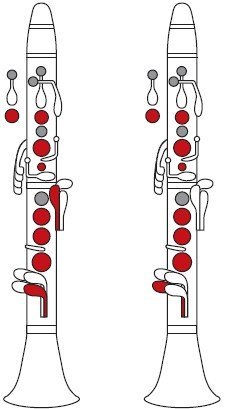
Receive a free PDF of the chart with clarinet fingering diagrams for every note!
The G Dorian scale on Bb clarinet is an eight note minor-mode scale built from concert F, sounding one whole step lower than written. It uses G, A, Bb, C, D, E, and F, and helps clarinetists shape soulful jazz lines, expressive folk melodies, and modal classical passages with added color and flexibility.
The sound of G Dorian: a minor key with a secret smile
Play a simple G Dorian scale on Bb clarinet: G, A, Bb, C, D, E, F, G. The ear hears “minor”, but the sixth degree, that bright E, slips in like a ray of light through stained glass. Compared to G natural minor (with Eb), the G Dorian scale feels less tragic and more curious, like a question hanging over a late-night club or a misty hillside.
On a Bb clarinet the chalumeau register carries G Dorian with a dark grain, thanks to the wide bore and soft reed response. Move into the clarion register and it starts to shine, especially on written D and E, right around the throat-tone and long-tube fingerings. The contrast between low G and high E in this mode is one of those textures that keeps players hooked for life.
You can feel G Dorian as “one flat” (concert F major) or as a minor color inside G. Clarinetists who practice both viewpoints switch faster between classical reading and improvising by ear.
From medieval modes to modern Bb clarinet: how G Dorian travelled
The Dorian mode was already old by the time the first chalumeau showed up in the 17th century. Medieval singers used it in plainchant, and later, folk fiddlers in Ireland, Scotland, and Brittany used Dorian tunes to give dance music that bittersweet lift. Transpose many of those melodies to Bb clarinet and you suddenly meet the G Dorian scale in reels, jigs, and laments.
As clarinet history moved through baroque and classical eras, players like Anton Stadler and Heinrich Baermann mostly lived in major keys and traditional minor. But the Dorian color still crept in. Early clarinet parts in church music and wind band music sometimes hover around Dorian cadences, especially in pieces built over long pedal tones in the bassoon or serpent.
By the 19th century, composers like Carl Maria von Weber and Johannes Brahms used modal touches in their clarinet works, even if they did not label them “Dorian”. In Weber's Clarinet Concerto No. 1, Op. 73 and the Concertino, Op. 26, you hear moments where the harmony brushes against Dorian-style raised sixths inside minor passages. Brahms, in the Clarinet Quintet Op. 115, threads modal colors into his late romantic language; a clarinetist who knows the feel of G Dorian and its cousins can phrase those lines with more intention instead of playing them as generic minor.
By the time jazz arrived in New Orleans and later New York, the mode had a second birth. The chromatic keywork of the Boehm-system Bb clarinet gave players new freedom to color minor harmony with raised sixths and ninths. The Dorian sound became a signature flavor, especially for soloists who loved long, singing lines over static chords.
Clarinet voices that lived inside the Dorian color
So who actually breathed life into the G Dorian scale on Bb clarinet? Across styles, many giants built their sound around this color, even if they never called it by name.
Benny Goodman, in recordings like “Body and Soul” and “Moonglow”, often leans on Dorian lines over minor progressions. When he floats a phrase that lands on the natural sixth above a minor chord, he is painting in Dorian. Try singing one of his bluesy licks and then map the notes: you will see G Dorian patterns all over his solos, especially in live performances with the Benny Goodman Orchestra.
Artie Shaw brought a more liquid legato to the same language. Listen to “Begin the Beguine” or “Stardust” with your clarinet in hand. Many of the tender, questioning lines that wrap around the melody sit right inside a Dorian palette. When you practice the G Dorian scale slowly with a singing tone, you are quietly practicing how Shaw glided across minor harmony.
Buddy DeFranco took it into bebop. His work with the Buddy DeFranco Quartet converts Dorian shapes into fast chromatic runs. If you slow these solos down, you can mark phrases where the skeleton is a simple G Dorian scale, then filled in with passing tones and chromatic approach notes.
On the classical and contemporary side, players like Sabine Meyer and Martin Frost have championed pieces that slip into modal language. In Magnus Lindberg's “Concerto for Clarinet and Orchestra” and works by Kalevi Aho, modal scales including Dorian appear as expressive building blocks. A clarinetist who has spent time with G Dorian will recognize the contour immediately and phrase those lines with more intention and less guesswork.
Klezmer icons Giora Feidman and David Krakauer show another side of the same coin. Traditional freygish modes get most of the attention, but many Hasidic tunes and nigunim wander into Dorian territory. When Feidman plays a soft, questioning doina backed only by accordion and double bass, you can often hum a G Dorian scale over it and feel right at home.
In folk and world music, clarinetists like Manu Dibango and Balkan-style players use Dorian colors to bridge African, Eastern European, and jazz idioms. On Bb clarinet these lines tend to sit perfectly under the fingers, especially in the lower joint where alternate fingerings give small shadings to repeated notes.
Iconic pieces and recordings where G Dorian shines
Even if the score does not shout “G Dorian” on the page, your ear will pick it out once you know the flavor. Here are some touchstones worth playing along with on Bb clarinet.
- “So What” by Miles Davis – Originally a D Dorian tune, but when you transpose lines for Bb clarinet practice, you often land in G Dorian fingerings. Many clarinetists, including Richard Stoltzman on crossover albums, have borrowed this modal language for their own improvisations.
- Jazz standards like “Summertime” and “Afro Blue” – Arrangements for clarinet trio or clarinet and rhythm section often use Dorian reharmonizations. Try taking a chorus purely in G Dorian over a minor vamp; the natural sixth instantly gives the Gershwin melody a fresh twist.
- Film scores by John Williams – In movies like “Schindler's List” and parts of the “Harry Potter” series, clarinet and oboe lines often hang over pedal harmonies with Dorian touches. Transcriptions for Bb clarinet frequently put your fingers right into G Dorian or its neighbors.
- Folk-inspired pieces – Works like Bela Bartok's “Romanian Folk Dances” arranged for clarinet, or Ralph Vaughan Williams's folk song settings, often shift between minor and Dorian. On Bb clarinet, G Dorian shows up regularly in these transcriptions.
- Contemporary clarinet works – Composers like John Adams, Arvo Part, and John Mackey use modal scales to blend choir, strings, and clarinet. Listen to how the clarinet in Adams's “Gnarly Buttons” outlines raised sixths in minor contexts. Practicing G Dorian prepares your ear for that sound world.
On MartinFreres.net you can hear this color inside discussions of classical tone and historical performance practice, especially where modal influences touch Romantic and 20th century clarinet writing. It also ties in beautifully with material on scales and arpeggios for clarinet and on choosing the right clarinet mouthpiece to carry those expressive inflections.
| Scale Color | Typical Mood | Where You Hear It |
|---|---|---|
| G Natural Minor | Darker, heavier, tragic | Classical etudes, orchestral excerpts, standard minor keys |
| G Dorian | Smoky, searching, hopeful | Jazz solos, folk tunes, film scores, modal contemporary works |
| G Major | Open, bright, straightforward | Marches, classical concertos, clarinet choir arrangements |
How G Dorian feels under your fingers and in your heart
G Dorian is the scale that lets you play “sad but not broken”. The low G on Bb clarinet, with a rich chalumeau tone, sets the scene. As you climb to A, Bb, and C, you feel the familiar weight of minor. Then D and E open the window. That E in particular is where many players instinctively hold a long note, add vibrato with the embouchure, and let the sound hang in the room.
Emotionally, this scale is perfect for:
- Ballads where you want sorrow mixed with resilience
- Improvised clarinet leads over a minor 7 groove
- Modal folk melodies in clarinet and guitar duos
- Contemplative clarinet choir textures around low G and C
On a mechanical level, the G Dorian scale also teaches control over throat tones (A and Bb) and across-the-break connections between B, C, and high D. Your left-hand index finger and thumb, plus the register key, learn to change roles without panic. This builds the kind of calm the clarinet needs for expressive phrasing.
Why the G Dorian scale matters for you as a clarinetist
Whether you are working through your first Baermann book or already playing concertos, G Dorian quietly trains several things at once.
- Ear training: It teaches your ear to hear minor with a natural sixth. That helps when you sight-read contemporary pieces or improvise over minor 7 chords.
- Style flexibility: Once you know G Dorian, relative modes like D Dorian or C Dorian feel less mysterious on Bb clarinet.
- Technical flow: The pattern glides naturally through chalumeau, throat tones, and clarion, making it a perfect warm-up that is more musical than a basic major scale.
On MartinFreres.net you will often see scales tied to artistic goals, not just exercises. G Dorian belongs in that camp: a bridge between straight classical work, expressive klezmer or folk tunes, and jazz vocabulary. It fits nicely alongside guides on clarinet intonation and on choosing reeds, because the mode rewards control of pitch and color in every register.
G Dorian practice mini-routine for Bb clarinet
| Exercise | Time | Focus |
|---|---|---|
| Slow G Dorian, 2 octaves legato | 3 minutes | Tone on low G and shape of E and F |
| Thirds in G Dorian | 3 minutes | Smooth break between B, C, D, E |
| Simple improvisation over a Gm7 drone | 4 minutes | Phrasing, breath, and dynamic shape |
A quick word on G Dorian fingerings for Bb clarinet
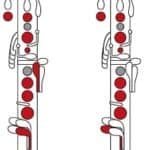
The fingering chart that comes with this guide is your visual map, so think of this section more as a friendly hint than a lecture. Written G below the staff uses standard chalumeau fingering, all left-hand fingers plus right-hand 1 and 2. From there, the Dorian pattern to the next G is:
- G, A, Bb, C in chalumeau and throat tones
- D, E, F, G in clarion using the register key and standard long-tube fingerings
The only real “surprise” is how often you will move across the break. G to A to Bb is easy, but Bb to C to D requires smooth coordination of left-hand index finger, thumb, and register key. The chart includes alternate fingerings for A and Bb so you can choose what feels best in context, especially in quick jazz lines or klezmer ornaments.
Key Takeaways
- Treat the G Dorian scale as a mood, not just a pattern: “sad with a soft light inside” on your Bb clarinet.
- Listen to clarinetists like Benny Goodman, Artie Shaw, Giora Feidman, and Martin Frost and notice where Dorian colors appear.
- Use the free fingering chart and a short daily routine to make G Dorian feel as natural as G major and G minor.
Frequently Asked Questions
What is Bb clarinet G Dorian scale fingering?
Bb clarinet G Dorian scale fingering covers written G, A, Bb, C in chalumeau and throat tones, then D, E, F, G in clarion with the register key. The notes are G, A, Bb, C, D, E, F, G. Practicing this pattern gives you a flexible minor color used in jazz, folk, and modern classical music.
How is G Dorian different from G natural minor on clarinet?
G natural minor has Eb, while G Dorian has E natural. On Bb clarinet that single change brightens the mood and suggests a Gm7 sound instead of a strict minor key. It lets you float between sadness and hope, especially in jazz solos and modal film themes that sit over long minor chords.
Why should classical clarinetists practice the G Dorian scale?
Classical clarinetists meet modal passages in Brahms, Bartok, John Adams, and many contemporary works. Practicing G Dorian trains your ear to hear a raised sixth in minor contexts and smooths finger transitions over the break. That makes phrasing more intentional and helps you respond quickly to modal turns in both orchestra and chamber music.
How can I use G Dorian when improvising on Bb clarinet?
Use G Dorian over Gm7 chords or any groove that feels like a minor vamp with a natural sixth. Start by playing the scale up and down with a metronome, then create short two bar phrases that land on G, Bb, D, or F. Gradually add bends, grace notes, and dynamics to echo players like Benny Goodman and Buddy DeFranco.
Which pieces are good for hearing G Dorian on clarinet?
Listen for Dorian color in jazz standards like “So What” or modal reharmonizations of “Summertime”, as well as in film music by John Williams and folk-based works by Bartok and Vaughan Williams. Clarinet recordings by Giora Feidman, David Krakauer, and Richard Stoltzman often include passages that sit right inside the G Dorian sound.