If you have ever played a solo in A minor and wished it had just a bit more lift in the air, the A Dorian scale is probably the sound your ear was reaching for. On the Bb clarinet it feels like a secret bluesy door you stumble into by accident, then never want to leave.
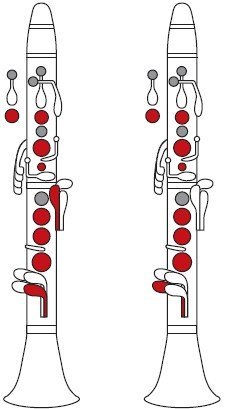
Receive a free PDF of the chart with clarinet fingering diagrams for every note!
The A Dorian scale on Bb clarinet is an 8 note minor-mode scale built on A with a raised 6th (F#) that uses clarinet fingerings from low A up to high A. It blends minor warmth with bright color and helps players sound expressive in jazz, classical, and folk music.
The sound story of the A Dorian scale
A Dorian is the minor scale that refuses to stay sad. You get the dark pull of A minor, but that F# sneaks in like a ray of light. On clarinet, especially a wooden Bb clarinet with a warm bell and responsive throat keys, that single F# can turn a plain phrase into something quietly hopeful.
Think about the way a slow clarinet solo can hover over a string section in an orchestra: low A speaking softly through the chalumeau register, C and D glowing, then that F# in the clarion register lifting the whole line. That is the A Dorian flavor. It is the sound of shadow with a skylight cut into it.
Those 8 notes, from A up to the next A, give clarinetists a flexible color that sits perfectly on the instrument's natural break between chalumeau and clarion registers.
From church modes to club stages: a short history of A Dorian
The Dorian mode is old enough to make your metronome feel young. Long before the modern clarinet, its ancestor the chalumeau was playing modal melodies in European churches and folk circles. The Dorian color, including what we now call A Dorian, shows up in early chant and in the modal lines that later influenced Baroque composers.
By the time Anton Stadler, Mozart's clarinet muse, walked on stage with his extended basset clarinet, the language of modes was already in the air. Listen to the slow movement of Mozart's Clarinet Concerto in A major: even though it is tonal, many of the turns and suspensions lean gently toward Dorian-like colors. Stadler's sound, with that deep chalumeau resonance, made those modal touches shimmer.
In the Romantic era, clarinetists like Heinrich Baermann and Carl Baermann played music by Weber and Spohr that often flirts with modal inflections. When you hear dimly lit phrases in Carl Maria von Weber's Clarinet Concerto No. 1, the line sometimes sidesteps through raised sixths that hint at Dorian thinking, especially around A and D tonal centers.
Then the 20th century arrived, and the Dorian mode took on new life in jazz and folk settings. As clarinetists stepped into big bands, klezmer groups, and film studios, A Dorian became one of those scales you might not name, but your ears lean toward it again and again.
Clarinet legends who lived inside A Dorian
Even if they did not always say “A Dorian” out loud, many clarinetists built signature moments around this sound. Part of the magic on Bb clarinet is how A Dorian lines feel under the left hand and around the break between A and B.
Classical and modern soloists
Sabine Meyer, in her recordings of Brahms's Clarinet Sonatas and the Clarinet Quintet, often shapes minor phrases with that gentle raised sixth color. In passages centered on A, you can hear her slide through F# as a leading voice, giving the impression of A Dorian before resolving back into more traditional harmonic minor patterns.
Martin Frost is another master of this color. In his performances of contemporary works like Anders Hillborg's “Peacock Tales” and pieces by Kalevi Aho, modal writing is everywhere. When an A-centered melody uses F# instead of F natural, his bell tones and altissimo notes let that Dorian shimmer speak clearly.
Richard Stoltzman, especially in his crossover albums with jazz rhythm sections and string quartets, often shapes improvisatory cadenzas with Dorian language. When the harmony lands around A minor but the line sings F#, you are hearing A Dorian at work.
Jazz clarinet voices
Benny Goodman brought Dorian colors into countless solos, especially when he stretched over modal tunes and blues in A. Listen to his live recordings where the band sits on a vamp: when he lifts a line with F# above an A minor feel, the air turns unmistakably Dorian.
Artie Shaw, in arrangements like “Nightmare” and darker swing numbers, often inserts Dorian licks to keep A minor phrases from sounding flat. Buddy DeFranco, bridging bebop and swing, made Dorian scales part of his daily jazz vocabulary; A Dorian and D Dorian sheets were core to his practice.
Klezmer, folk, and world clarinetists
Giora Feidman, known for his soulful work on soundtracks and traditional klezmer recordings, plays A-centered melodies that pass through F#. While klezmer often prefers altered scales with augmented seconds, Feidman sometimes softens a phrase with a Dorian contour, especially in quieter doinas and improvised intros.
David Krakauer pushes this even further. In his fusion projects that mix klezmer with jazz and rock, A Dorian grooves sit comfortably over electric bass riffs. His use of the chalumeau register on A, followed by bright clarion F# and G, makes the mode feel like a living, breathing voice.
In Celtic-inspired groups and Balkan brass bands where Bb clarinet joins fiddles and accordions, A Dorian is a staple flavor. Many Irish tunes notated in D mixolydian or E Dorian shift registers so the clarinetist ends up living in A Dorian shapes across the middle joint and upper joint of the instrument.
Iconic pieces and recordings where A Dorian shines
A Dorian likes to hide in plain sight. It is rarely advertised in the title, but it shows up in phrases, bridges, and improvisations across genres. Here are some places clarinetists can go hunting for it.
Classical and chamber hints
In Brahms's Clarinet Quintet in B minor, especially in the second and third movements, there are inner lines that stray toward Dorian flavors. When you play reductions or transcriptions that bring those inner lines to A on the Bb clarinet, the presence of F# above A feels just like A Dorian.
In Claude Debussy's “Premiere Rhapsodie” for clarinet and piano, some of the more improv-like passages use modal fragments centered around A. Accent an F# rather than F natural in those spots, and suddenly the phrase has a Dorian tilt. Many modern clarinetists, including Sabine Meyer and Paul Meyer, play these lines with a light, vocal color that brings out that mode.
Jazz standards and modal tunes
For jazz players, A Dorian is a best friend over tunes like “So What” and “Impressions” when the band shifts tonal centers. Even if the chart says D Dorian, clarinet transposition often brings your fingers into A Dorian territory on the instrument. Benny Goodman-inspired players use these shapes over minor blues in A with the piano hinting at A minor 7 chords.
On modern recordings by Anat Cohen or Eddie Daniels, listen to solos where the band holds an A minor 7 or A minor 9 sound for several bars. When F# appears more often than F natural in the clarinet line, that is the A Dorian mood taking the lead.
Klezmer tunes and folk melodies
Many traditional pieces sit between major and minor. A slower freylekhs in A might dip into a Dorian moment in its B section, with the clarinet highlighting F# against a drone-like A in the bass. Giora Feidman's intimate recordings of such tunes on older grenadilla clarinets capture that bittersweet color perfectly.
Celtic session players who double on clarinet know the feeling of sliding from an A natural minor run into a Dorian lick by simply lifting F natural to F#. It turns a lament into something more like a story of survival. Recorded collaborations between clarinetists and fiddlers often lean on that switch for emotional impact.
| Scale Type | A Minor Notes | Emotional Color |
|---|---|---|
| A natural minor | A B C D E F G A | Darker, more resigned |
| A harmonic minor | A B C D E F G# A | Dramatic, more tense |
| A Dorian | A B C D E F# G A | Hopeful, quietly bright |
Why the A Dorian scale feels so special on Bb clarinet
The real magic of A Dorian on clarinet is how it sits in the instrument's voice. Low A and B in the chalumeau register sound like a quiet narrator. Climb through C, D, and E and you are already close to the break into clarion. That F# arrives just as the horn opens up, so the raised sixth feels like a literal opening in the sound.
Hit G above that, and suddenly the instrument is singing with the resonance of the upper joint and barrel working together. Many players notice that A Dorian phrases almost build their own dynamics: the scale invites you to start low and hushed, arc up to F# and G with more air, then settle gently back to A.
Emotionally, A Dorian suits stories that are not finished yet. It feels right for film score passages where the clarinet comments on memory instead of tragedy. Composers writing for clarinet often reach for A Dorian over soft strings and harp because it suggests motion, not finality.
Why learning A Dorian matters for you
Whether you are learning your first modal tune or polishing an orchestral audition, A Dorian is a scale you will touch more often than you expect. On Bb clarinet it becomes a gateway: once your fingers and ears know it, other modes stop feeling like strangers.
Improvising over a simple A minor 7 vamp with a drummer and pianist? A Dorian will give you lines that sound lyrical, not stuck. Playing a piece by Brahms or Weber where the harmony leans toward A minor? Knowing how that F# option feels under your fingers can help you shape phrases more like Sabine Meyer or Martin Frost, with subtle color instead of plain scales.
Even for classical etudes by Rose or Baermann, teachers often encourage students to practice in Dorian, mixolydian, and other modes. A Dorian is usually one of the first, because it uses comfortable clarinet fingerings and sits well in both chalumeau and clarion.
Just 5 minutes of A Dorian patterns in your daily warm-up can improve your ear, embouchure flexibility, and comfort crossing the break on Bb clarinet.
A quick clarinet fingering story for A Dorian
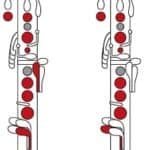
The free fingering chart gives you every note of the Bb clarinet A Dorian scale, from low A on the chalumeau register to high A above the staff. Think of it as a gentle tour of the instrument: the scale walks you from relaxed left-hand pinky work on low A, up through the break at B and C, into ringing clarion F# and G.
Fingerings themselves are familiar: standard left-hand A, open B, and side key F# are all part of your regular toolkit. The difference is how you connect them. Pay attention to throat A moving into long B, and to the feel of sliding from clarion E into that bright F#. Those two transitions are where A Dorian really begins to sing.
- Start on low A and play up one octave using the chart.
- Repeat starting on throat A, then clarion A.
- Accent only the F# each time to spotlight the Dorian color.
- Reverse the scale, holding G and F# a bit longer on the way down.
| Practice Element | Time | Focus |
|---|---|---|
| Slow A Dorian up and down | 2 minutes | Smooth fingers through the break |
| Accent F# and G | 2 minutes | Hearing the mode's color |
| Short A Dorian improvisation | 1 minute | Creating your own melody |
Common A Dorian troubles and quick fixes
A Dorian itself is simple, but the clarinet has a few favorite places to tease you. Here are quick reference ideas to keep your tone and intonation happy while you enjoy the scale. Use them alongside the chart and your normal long-tone routine.
| Issue | Likely Cause | Quick Fix |
|---|---|---|
| Crack on B or C near the break | Uneven air or late right-hand fingers | Tongue lighter and keep fingers close to the keys |
| Sharp F# in clarion | Too much lower lip pressure | Relax embouchure, add more warm air |
| Unclear low A and B | Leaky pinky keys or weak air start | Press pinky firmly and start notes with full air |
Key Takeaways
- A Dorian on Bb clarinet blends minor warmth with bright energy, perfect for jazz, classical, and folk styles.
- Listening to players like Sabine Meyer, Martin Frost, Benny Goodman, and Giora Feidman will help you recognize this mode by ear.
- Spend a few minutes each day with the A Dorian fingering chart to improve your tone, line shape, and comfort crossing the break.
Frequently Asked Questions
What is Bb clarinet A Dorian scale fingering?
Bb clarinet A Dorian scale fingering is the set of finger patterns used to play the notes A B C D E F# G A across the clarinet's registers. It uses standard fingerings from low A through clarion A and helps players practice smooth break crossings, clean intonation, and expressive modal phrasing.
How is A Dorian different from A natural minor on clarinet?
The only note that changes is the 6th degree: A natural minor uses F, while A Dorian uses F#. On clarinet this small shift has a big expressive impact, brightening phrases and making lines feel more open, especially in the clarion register where F# rings more clearly than F natural.
Why do jazz clarinetists use the A Dorian scale so often?
Jazz clarinetists use A Dorian because it fits naturally over A minor 7 chords and modal vamps. The raised sixth (F#) avoids the heavy drama of harmonic minor, so solos sound relaxed and lyrical. The fingerings sit well across the break, making fast lines, turns, and arpeggios comfortable on Bb clarinet.
How should I practice A Dorian with the fingering chart?
Start by playing the A Dorian scale slowly in whole notes with a tuner, then in quarters and eighths, always keeping your air steady. Use the chart to check each note, especially low A and clarion F#. Then create short two-bar melodies, focusing on F# and G, to train your ear to hear the mode clearly.
Does A Dorian help with orchestral clarinet music?
Yes. Many orchestral and chamber passages by Brahms, Debussy, and modern composers use modal colors around A minor. Being comfortable with A Dorian fingerings and sound makes it easier to shape those lines musically, match string phrasing, and color repeated figures without always relying on harmonic minor patterns.
For more clarinet stories, charts, and practice ideas, you can read about other scales, historical instruments, and performance tips on Martin Freres, including articles on Bb clarinet scales, historical clarinet designs, and modern clarinet artistry.