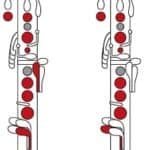
If you have ever listened to a clarinet solo that sounded like a dream sliding out of its frame, floating just slightly away from gravity, you have already felt the spell of the G Whole-Tone Scale. On Bb clarinet, this shimmering pattern turns your keys into a painter's palette filled with Debussy clouds, Stravinsky fire, and bold jazz colors in a single breath.
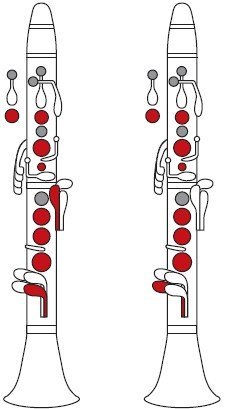
Receive a free PDF of the chart with clarinet fingering diagrams for every note!
The G Whole-Tone Scale on Bb clarinet is a six-note repeating pattern built entirely of whole steps starting on written G. It creates a bright, floating sound that helps clarinetists shape impressionistic colors, bold jazz runs, and mysterious film-score effects with confident, even finger motion.
The sound and story of the G Whole-Tone Scale
The G Whole-Tone Scale is what happens when the clarinet decides to stop walking in straight lines and starts levitating. Every step is the same size: whole-step, whole-step, whole-step. No half-steps to pull you back to earth. That simple pattern creates a sound that feels suspended, like you are standing in a room with no sharp corners.
On Bb clarinet, that written G whole-tone pattern connects beautifully across the break, so your left-hand thumb and register key become part of the color, not just a technical hurdle. You are no longer only playing notes. You are bending time, stretching harmony, and hinting at chords that never quite settle.
The G Whole-Tone Scale uses only 6 different notes before repeating. This limited set gives you a focused color for improvisation and makes patterns easy to memorize across the full clarinet range.
From Debussy to Ellington: how this scale found its voice
The roots of the whole-tone sound reach back into 19th-century harmony, but it burst into full color with composers like Claude Debussy and Alexander Scriabin at the end of the Romantic era. While they wrote mostly for piano and orchestra, the clarinet became a natural voice for this new harmony, thanks to its ability to slide between soft velvet and cutting brightness.
Listen to Debussy's “Prélude à l'après-midi d'un faune” or “La Mer” and you will hear whole-tone patterns rippling through the woodwinds. In many performances by the Berlin Philharmonic or Orchestre de Paris, the clarinet line hangs over the harmony like mist on water. The exact scale might not always be G Whole-Tone for clarinet, but the color is the same family: equal steps, blurred gravity, luminous tension.
Igor Stravinsky pushed that sound in a sharper, more rhythmic direction. In “The Firebird” and “Petrushka,” clarinetists like Sabine Meyer and Martin Frost have recorded passages that sit right on whole-tone fragments, using the clarinet's agility to spit out patterns that sound almost like otherworldly dance steps. Those lines may move through different transpositions of the whole-tone collection, but the sensation you feel under your fingers on Bb clarinet is exactly what you practice with the G Whole-Tone Scale.
Fast-forward to jazz in the 20th century and the same sound catches fire in a new way. Duke Ellington and Billy Strayhorn loved the color of whole-tone runs over dominant chords. When you hear a clarinetist rip up a whole-tone lick over a G7 chord, that often traces the same pattern as your G Whole-Tone Scale, just flipped into improvisation instead of written notes.
Clarinet legends who lived inside this sound
Whole-tone patterns became a secret playground for clarinetists across styles. Each player shaped it differently, but they all touched the same mysterious six-note ladder.
Benny Goodman used whole-tone ideas in his big band solos, especially over bright dominant chords in tunes like “Sing, Sing, Sing” and “King Porter Stomp.” Listen closely to some live recordings with the Benny Goodman Orchestra: between the blues phrases, you will catch smooth, almost slippery six-note runs that step only by whole steps. That is the essence of a whole-tone scale in action.
Artie Shaw took it further in pieces like “Concerto for Clarinet.” His cadenzas weave chromatic runs with sudden bursts of whole-tone color, especially as he climbs into the high register. The pattern might not be locked to G every time, but if you practice G Whole-Tone on Bb clarinet, you will recognize the feel of those smooth, evenly spaced leaps under his fingers.
In modern jazz, Buddy DeFranco and Eddie Daniels often touched that sound in bebop and post-bop lines. They spin whole-tone fragments over altered dominant chords, stacking the scale over G7#5 or G7b5 colors. For a clarinetist in a small combo, the G Whole-Tone Scale becomes a quick path to that more daring, modern tension you hear on classic recordings.
Classical virtuosos use the same colors in a different way. Sabine Meyer in the Nielsen Clarinet Concerto, or Martin Frost in pieces by Anders Hillborg, often shapes lines that flirt with whole-tone clusters. You may hear it in a swirling run or an ethereal high-register passage. Their fingers know that smooth, equal step motion; your G Whole-Tone practice simply gives that sensation a clear home base.
Klezmer clarinetists like David Krakauer and Giora Feidman sometimes hint at whole-tone ideas when they slide into wild, spiraling passages over dominant chords in freylekhs and bulgars. While klezmer language is rooted more in modes like Ahava Rabba, the occasional whole-step-only run gives a surreal twist right in the middle of a dance tune. That twist has the same DNA as your G Whole-Tone Scale on Bb clarinet.
Iconic pieces and where the G Whole-Tone color hides
You will not always see the label “G Whole-Tone Scale” printed in a clarinet part, but its fingerprint is everywhere. Once you know the sound, you start hearing it in scores, solos, and even film music.
In Maurice Ravel's “Daphnis et Chloé” and “Rhapsodie espagnole,” the clarinet winds through passages built from whole-tone and modal collections. Players like Richard Stoltzman, in his orchestral recordings, shape these lines with delicate, even fingers so that each whole-step feels like a step deeper into a dream.
In the saxophone and clarinet writing of Ravel's “Bolero,” many woodwind passages move around whole-tone centers over repeating snare drum rhythm. On Bb clarinet, practicing the G Whole-Tone Scale helps you internalize that kind of motion, even when the written key is different. The sensation of equal stepping prepares your embouchure and fingers for that hypnotic ease.
Film composers like John Williams and Alexandre Desplat also lean on whole-tone color for magic and mystery. In scores such as “Harry Potter” and “The Shape of Water,” clarinet and bass clarinet often trace patterns that sound slightly off-balance, gliding away from ordinary major and minor. Those are built from the same whole-tone collection, and a written G starting point is one of the most comfortable positions for a Bb clarinetist to first learn that language.
In the jazz world, pieces like Thelonious Monk's “Trinkle Tinkle” and “Four in One” are full of whole-tone flavor. Clarinetists who adapt Monk's lines, such as Anat Cohen, often use whole-tone runs over G7 or A7 chords. A solid G Whole-Tone Scale on Bb clarinet turns those angular Monk phrases into something your hands already recognize.
Even in standard clarinet repertoire, such as Paul Hindemith's Clarinet Sonata or the second movement of Carl Nielsen's Clarinet Concerto, you will find sudden flashes of whole-tone clusters. Spot them in a slow practice session, and you may realize you are basically playing slices of your G Whole-Tone Scale without even thinking about it.
| Piece / Style | Where the whole-tone color appears | How G Whole-Tone practice helps |
|---|---|---|
| Debussy orchestral works | Woodwind clouds, rising runs, dreamy transitions | Trains fingers to play even whole steps across the break |
| Jazz solos over G7 | Whole-tone licks on dominant chords, altered colors | Gives ready-made patterns for improvisation on G7 and G7#5 |
| Modern clarinet concertos | Blazing runs, mystical high-register phrases | Builds confident motion in upper register and altissimo |
How the G Whole-Tone Scale feels under the fingers and in the heart
Play a regular G major scale on clarinet, then play the G Whole-Tone Scale. The difference is not only about notes; it is about feeling. G major wants to go somewhere, to resolve and arrive. G Whole-Tone hangs in the air. It feels like standing at the top of a staircase that never ends, each step the same size, no final landing.
On Bb clarinet, that feeling is especially vivid in the chalumeau and clarion registers. From written G on the staff up through high D and E, your fingers follow a clean, even pattern. Your ear hears a sound that can be bright, eerie, playful, or utterly mystical, depending on how you shape your air and vibrato.
Emotionally, this scale is perfect for:
- Moments of uncertainty or mystery in solo improvisation
- Dreamy intros and outros on ballads or film arrangements
- Comic or off-kilter effects in pit orchestra or theater music
- Bold, modern tension in contemporary classical pieces
Clarinetists often talk about “colors” in their sound. The G Whole-Tone Scale gives you a ready-made color swatch: one that glows a little too brightly to be normal, just strange enough to be beautiful.
Why this scale matters for your own playing
You do not need to be Benny Goodman or Sabine Meyer to let this scale change how you play. For a student or hobbyist, the G Whole-Tone Scale on Bb clarinet does three powerful things at once:
- It trains even finger motion across the break between A and B.
- It sharpens your ear for modern harmony and altered dominant chords.
- It gives you an instant pattern for improvisation in jazz, fusion, and film-score style music.
If you regularly visit fingering charts for G major, D major, and chromatic scales on Bb clarinet, adding the G Whole-Tone Scale is like adding a new room to your musical house. It does not replace the fundamentals; it expands your sense of what your instrument can say.
On Martin Freres historical Bb clarinets, archival teaching materials often pair this scale with simple arpeggios, encouraging students to use it both as a technique builder and as a color study for French repertoire. That same approach still works today, whether you are preparing Mozart, Weber, or a fresh jazz chart for a small ensemble.
Quick fingering notes and practice ideas
The full fingering chart will show you every note, but here is the basic idea: starting on written G on the staff, the G Whole-Tone Scale climbs by whole steps. On Bb clarinet that means you move from G to A, then B, then C#, then D#, then F, and back to G. The pattern repeats in each register, including chalumeau, clarion, and altissimo.
Because every interval is the same, this is a wonderful test of even finger control. You cross the break smoothly, use the register key confidently, and learn to keep the sound centered as accidentals like C# and D# appear. The chart's diagrams will show you clear fingerings for each written pitch in the pattern.
A simple G Whole-Tone practice routine for Bb clarinet
| Exercise | Time | Focus |
|---|---|---|
| Slow G Whole-Tone, 2 octaves up and down | 5 minutes | Even fingers, steady air, smooth break crossing |
| Rhythmic patterns (triplets, swing eighths) | 5 minutes | Jazz feel, light articulation, tongue placement |
| Improv over a sustained G7 drone | 5 minutes | Hearing color, creating phrases, expressive dynamics |
Troubleshooting G Whole-Tone on Bb clarinet
| Problem | Likely cause | Quick fix |
|---|---|---|
| Break between A and B feels rough | Thumb or register key moving late | Practice G-A-B slowly, watching left thumb motion in a mirror |
| C# and D# sound sharp or thin | Tense embouchure or uneven air support | Play long tones on C# and D#, relaxing jaw and keeping warm air |
| Scale sounds mechanical | No phrasing or dynamic shape | Shape to a high point, then fade, like a mini Debussy phrase |
Key Takeaways
- Use the G Whole-Tone Scale to add bright, floating color to classical, jazz, and film-style playing on Bb clarinet.
- Practice it slowly across at least 2 octaves to smooth out the break and stabilize accidentals like C# and D#.
- Listen to Debussy, Stravinsky, Ellington, and modern clarinet soloists, and try to match their whole-tone color in your own phrases.
Frequently Asked Questions
What is Bb clarinet G whole-tone scale fingering?
The Bb clarinet G Whole-Tone Scale fingering is a pattern of notes starting on written G and moving only by whole steps: G, A, B, C#, D#, F, and back to G. You use standard fingerings for each pitch, crossing the break smoothly. It is a favorite pattern for modern classical passages and jazz improvisation.
Why should I practice the G Whole-Tone Scale on Bb clarinet?
Practicing the G Whole-Tone Scale improves finger evenness, break control, and ear training for altered dominant chords. It prepares you for passages in Debussy, Ravel, Stravinsky, and modern concertos, and it gives you ready-made licks for jazz solos over G7 or G7#5 harmonies.
How often should I include the G Whole-Tone Scale in my routine?
Many clarinetists practice the G Whole-Tone Scale 3 to 5 times per week for about 5 to 10 minutes. Rotate it with major, minor, and chromatic scales. Short, focused sessions are enough to build comfort while leaving time for etudes, orchestral excerpts, and improvisation practice.
Does the G Whole-Tone Scale help with crossing the break?
Yes. Because the scale moves in smooth whole steps, it is perfect for practicing the transition between A and B and between B and high C# on Bb clarinet. Playing it slowly with a tuner and mirror helps your left thumb and register key coordination become natural and reliable.
Can beginners use the G Whole-Tone Scale, or is it only for advanced players?
Beginners who can already play a few basic scales can start using a short one-octave G Whole-Tone pattern. Advanced players expand it through the full range, including altissimo. The pattern is simple to understand, and its unique sound keeps practice fresh at every level.