
The A major scale on Bb clarinet has a very particular glow to it. It is the sound of sunrise in an orchestra, of hopeful jazz solos, of film scores that promise that something good is about to happen. Any time you slide over those notes from low A to high A, you join a long line of clarinetists who have used this bright key to make audiences lean in and listen.
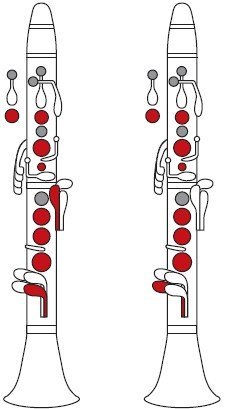
Receive a free PDF of the chart with clarinet fingering diagrams for every note!
The A major scale on Bb clarinet is an eight note pattern from low A to high A that uses three sharps (F#, C#, G#). Learning this scale strengthens finger coordination, intonation, and tone color, and it prepares clarinetists for orchestral, jazz, and solo repertoire in bright, expressive keys.
A major across the centuries: from Stadler to the soundstage
Long before your clarinet case ever snapped shut around your instrument, players like Anton Stadler were feeling out the shape of A major on early clarinets with fewer keys and far trickier intonation. Stadler, who inspired Mozart to write his Clarinet Concerto in A major, helped pull this key into the center of clarinet history.
Even though most modern clarinetists meet A major in scale sheets and method books, it was once a color that composers carefully saved for special moments. Franz Schubert used A major for the gentle lyricism in his chamber music. Carl Maria von Weber used it to spin long clarinet lines that seem to float over the orchestra. Later, Johannes Brahms, in his warm and autumnal Clarinet Trio in A minor and Clarinet Quintet in B minor, often leans into A major passages as places of relief, like sunlight coming through windows of darker harmony.
By the time the 20th century arrived, A major was no longer rare air for clarinetists. Composers like Paul Hindemith and Jean Francaix wrote passages that demand quick runs in A major and related keys, trusting that the modern Bb clarinet mechanism could dance comfortably in these bright harmonies.
How great clarinetists gave A major its voice
Think about the sound of Sabine Meyer in Mozart's Clarinet Concerto in A major with the Berliner Philharmoniker. The way she shapes the opening arpeggios through A major feels almost like speech, each note connected, the right-hand first and second fingers moving with such quiet precision that all you notice is the singing tone.
Martin Frost often uses A major in his own arrangements and encores, especially when he shifts from calm chalumeau register phrases up into the clarion register. Listen to his performances of the Copland Clarinet Concerto: when he slides through A major patterns in the lyrical first section, the sound on his Buffet Crampon clarinet feels glassy and clear, like light on water.
Richard Stoltzman, in jazz and crossover settings, treats A major as friendly ground for improvisation. On some recordings with vibes and piano, you can hear him lean into simple A major triads, then ornament them with turns, trills, and blues inflections. The scale itself becomes a canvas for style, not just a technical exercise.
In the jazz big band era, Benny Goodman and Artie Shaw both favored bright keys that let the clarinet project over brass sections. While many swing standards sit neatly in Bb or Eb, arrangements were often transposed or reharmonized, and A major frequently shows up in solo choruses on Bb clarinet. That means their fingers were dancing through F#, C#, and G# far more than the lead sheets suggest. Buddy DeFranco, with his bop-influenced lines, would spin long streams of eighth notes that traced A major arpeggios blended with chromatic passing tones.
Klezmer giants like Giora Feidman and David Krakauer use the flavor of A major in a different way. Traditional tunes might sit around A minor or D minor on the sheet, but clarinet lines often pivot to A major for sudden flashes of joy, wedding dances, or soaring doinas. The switch from a darker scale to A major can feel like a switch from memory to celebration, helped by fast ornaments in the upper clarion register with right-hand fingers fluttering over the G#, A, and B keys.
Pieces where the A major scale quietly steals the show
On paper, a scale is just eight notes. In real music, the A major scale is the quiet hero in a lot of clarinet writing. Once you start listening for it, you hear it everywhere.
- Mozart: Clarinet Concerto in A major, K. 622 – Bb clarinetists usually play a transposed edition in different notation, but the expressive center of the piece is still the sound world of A major: gentle brightness, clear intervals, elegant leaps from low E to high A.
- Weber: Clarinet Concerto No. 1, Op. 73 – Rapid A major patterns appear as passagework in both the clarion and altissimo registers, testing finger precision and embouchure stability.
- Jean Francaix: Tema con variazioni – Playful, almost sarcastic melodies hop through A major fragments, with swift clarion register shifts handled by the left-hand index and right-hand first fingers.
- Gershwin: Rhapsody in Blue (orchestral arrangement) – Some clarinet parts in arrangements pivot into A major around the jazzy solos, mixing classical tone with swing phrasing.
- Film and game scores – Modern composers often write clarinet cues in A concert (which sits as B on Bb clarinet) but then pivot into lines that feel like extended A major shapes in your fingers, especially in adventure or family movie cues.
The A major scale uses exactly 3 sharps. This limited set of accidentals lets clarinetists focus on even finger action between the left and right hands and builds accuracy for related keys like E major and D major.
Even in chamber music, you feel A major show up as a place of comfort. In Brahms clarinet sonatas, clarinet and piano sometimes arrive in A major after long stretches of stormy harmony, and everything suddenly rests. On Bb clarinet, the fingers settle into familiar patterns around the throat A key, the register key, and the lower joint right-hand group.
How A major feels under the fingers and in the heart
Every scale has a personality. A major tends to feel optimistic, direct, and open. On Bb clarinet, the transition from low A in the chalumeau register up to middle E and then high A in the clarion register gives you a full tour of the instrument's emotional range, all within one familiar pattern of finger motion.
The chalumeau notes in A major can sound like a mellow vocalist: soft throat tones shaped with a relaxed left hand. Move higher and the clarion register takes over, brilliant and clean, using the register key and a coordinated combination of left-hand index, middle, and ring fingers with right-hand first and second fingers. In expressive solos, that contrast between warm lower notes and luminous upper notes turns the A major scale into a kind of emotional staircase.
Jazz players like Eddie Daniels often speak about certain keys as feeling “homey” under the fingers. A major has that vibe for many clarinetists: there is enough sharpness in F#, C#, and G# to feel bright, but not so many accidentals that the hands tense up. That relaxed physical feeling often shows up as a more singing tone and freer phrasing.
From baroque courts to Spotify playlists: A major today
In early clarinet history, players in baroque and classical courts worked with fewer keys and more awkward cross fingerings. Heinrich Baermann, a crucial early virtuoso, helped make pieces in bright keys like A major more playable by collaborating on improved keywork. His performances influenced composers like Weber, who wrote long A major passages knowing Baermann could handle the finger patterns on his boxwood instruments.
Fast forward to today and A major lives in a lot of styles you might stream without even thinking about the key. Indie film scores often use clarinet in light, floating textures that trace A major and related modes. Contemporary clarinet soloists, such as Andreas Ottensamer, record arrangements of pop songs and folk tunes in A major because the clarinet's upper register cuts clearly through strings and guitar textures.
On world music stages, clarinetists playing Turkish, Greek, or Balkan music often move between modes that sit near A major, flavoring the basic seven notes with microtonal bends and ornaments. The fingers might follow the same buttons as your basic A major scale chart, but the ear hears an entirely different tradition, colored by slides and embouchure flexibility.
| Context | How A major feels | Typical clarinet use |
|---|---|---|
| Classical concerto | Noble, lyrical, shining | Long clarion lines, arpeggios, soft chalumeau phrases |
| Jazz solo | Bright, agile, playful | Scale runs, chord outlines, blue notes on A and E |
| Klezmer tune | Joyful, piercing, ecstatic | Fast ornaments on high A, trills between G# and A |
Reading the fingering chart without losing the magic
The fingering chart for the Bb clarinet A major scale is simple on paper: A, B, C#, D, E, F#, G#, A. On your instrument, that means both hands working as a team, especially around the right-hand keys for F# and G#. The chart shows you which tone holes to cover, how the register key shifts notes into the clarion register, and where alternate fingerings can help smooth tricky passages.
If you look closely at the chart, you will notice a few patterns. The lowest A blossoms out of full left-hand coverage with right-hand fingers placed comfortably. C# uses a more open feel with fewer covered holes, while F# and G# combine left-hand precision and right-hand stability. Those repeating shapes are the ones you will feel in orchestra auditions, jazz solos, and chamber music solos that use A major and its relative keys.
Making A major your most musical daily ritual
To give the A major scale a real voice, it helps to treat it as a short piece instead of a technical test. Start with a gentle breath, focus on the resistance of the reed on your Vandoren or Rico mouthpiece setup, and let each note ring long enough that you could imagine it sung by a human voice.
| Exercise | Duration | Focus |
|---|---|---|
| Slow A major scale (2 octaves) | 5 minutes | Even tone, relaxed fingers between chalumeau and clarion |
| Broken chords in A major | 5 minutes | Clean jumps between A, C#, E, and G# |
| A major in simple melodies | 5 minutes | Phrasing, breath control, dynamic contrast |
- Play the A major scale slowly with a tuner to settle the pitch of C# and G#.
- Use the fingering chart to double check right-hand positions when shifting into clarion F# and G#.
- Invent a short 4 bar melody in A major each day and play it as if it belonged in a concerto.
For more musical approaches to basic scales, you can connect this A major work to resources like the Martin Freres guides on long tones, clarinet warm-ups, and Bb clarinet articulation studies, which all encourage thinking of every exercise as music, not just mechanics.
Key Takeaways
- The A major scale on Bb clarinet connects you directly to Mozart, Weber, Brahms, and modern jazz and film music traditions.
- Focusing on tone, phrasing, and comfort between chalumeau and clarion registers turns a simple scale into a daily musical meditation.
- Using the fingering chart regularly builds confident technique for bright keys with F#, C#, and G#, opening doors to advanced repertoire.
Frequently Asked Questions
What is Bb clarinet A major scale fingering?
The Bb clarinet A major scale fingering is the pattern of finger positions used to play A, B, C#, D, E, F#, G#, and high A smoothly from chalumeau to clarion. It combines left-hand coverage with stable right-hand fingers, and mastering it supports clean technique and expressive playing in bright, singing keys.
Why is the A major scale important for clarinetists?
A major appears in clarinet concertos, chamber music, jazz solos, and film cues. Practicing it refines coordination on F#, C#, and G#, strengthens register changes, and prepares you for common orchestral and ensemble passages that rely on clear, confident playing in sharp keys.
How often should I practice the A major scale on Bb clarinet?
Playing the A major scale for 5 to 10 focused minutes each practice day is enough to build comfort. Rotate tempos, start on different notes, and include both slurred and tongued versions so your embouchure, tongue, and fingers all grow steadier in this bright key.
What are common problems with A major scale fingerings?
Many players struggle with squeaks on clarion E and F#, uneven fingers around G#, and flat C# intonation. Slow practice with a tuner, careful right-hand placement, and relaxed thumb support on the thumb rest help stabilize tone and prevent tension in the left-hand index finger and thumb.
How does the A major scale help with clarinet repertoire?
Once A major feels natural, passages in Mozart, Weber, Hindemith, and jazz standards become easier to phrase and memorize. Your hands recognize familiar patterns around the F# and G# keys, so you can focus on color, vibrato, and dynamics instead of struggling with basic finger coordination.