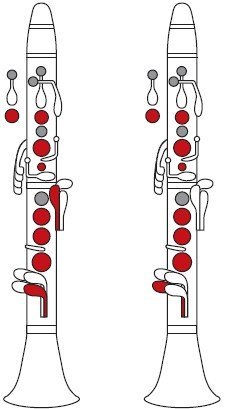
If you close your eyes and think “It's a Jazzy Day!”, you can almost hear a bright Bb clarinet skipping over a walking bass line, like something Benny Goodman might have tossed off between choruses at the Carnegie Hall Concert. That same playful, syncopated energy is exactly what this free “It's a Jazzy Day!” clarinet fingering chart is about: capturing the feeling of stepping into your own little swing era every time you open the case.
Receive a free PDF of the chart with clarinet fingering diagrams for every note!
This is not just another exercise line. “It's a Jazzy Day!” is a little invitation to join a tradition that stretches from Anton Stadler and Johannes Brahms all the way to Artie Shaw, Sabine Meyer, and David Krakauer. One short tune, a single page of fingerings, and suddenly you are part of a larger story.
Quick Answer: What is the It's a Jazzy Day clarinet fingering chart?
The It's a Jazzy Day clarinet fingering chart is a free Bb clarinet guide that shows every note needed for this upbeat jazz-style line, with clear diagrams and simple phrasing so players can feel swing, articulation, and groove with confidence.
The story behind “It's a Jazzy Day!” on Bb clarinet
Every clarinetist has that first moment when the instrument suddenly stops sounding like homework and starts sounding like music. For many players, it happens on a short, catchy jazz line that bounces around the break, slides through blue notes, and makes the reed feel alive. That is the spirit behind “It's a Jazzy Day!”
Think of the way Benny Goodman opens “Sing, Sing, Sing” with that swaggering riff, or how Artie Shaw in “Begin the Beguine” turns a simple scale fragment into something that feels like a smile. “It's a Jazzy Day!” lives in that same space: it takes familiar Bb clarinet fingerings and dresses them in swing rhythm, syncopation, and a little wink of blues color.
On a practical level, the line touches key clarinet landmarks: open G, the throat tones around A and Bb, that first brave leap over the break to clarion B and C, and often a playful twist into F# and C#. On an emotional level, it is the sound of walking out into bright sunlight with your clarinet in hand, ready to improvise along with a rhythm section that lives in your imagination.
Field Note: In the Martin Freres archives there is a handwritten practice sheet from the 1930s with a simple swing riff repeating on G, A, and B. A repairman had scribbled in the margin: “Same three notes, new rhythm, fresh life.” That is exactly the idea behind “It's a Jazzy Day!” You are not learning new notes as much as learning a new attitude.
From Mozart to Goodman: how a classical clarinet became a jazz storyteller
The Bb clarinet did not start out as a jazz instrument. When Anton Stadler worked with Wolfgang Amadeus Mozart on the Clarinet Concerto in A major, K. 622, there was no swing rhythm in sight. Yet the way Mozart writes for clarinet in that concerto, and in the Clarinet Quintet K. 581, already hints at a singing, flexible voice that could later slip into jazz phrasing with ease.
In the Romantic era, Heinrich Baermann inspired Carl Maria von Weber to write the Clarinet Concerto No. 1 in F minor, Op. 73. Listen to the first movement and you will hear wide leaps, rapid arpeggios, and singing legato lines that later jazz clarinetists would translate into their own vocabulary. The technical demands of Weber and Johannes Brahms prepared the instrument for the athletic work it would do in swing and bebop.
By the time Benny Goodman picked up a Selmer Bb clarinet and stepped into the band of Fletcher Henderson, the groundwork was already there. The same keys and holes that sang the slow movement of the Brahms Clarinet Sonata in F minor, Op. 120, could now snap out riffs in “King Porter Stomp” or glide across the famous clarinet break in “Sing, Sing, Sing”. The leap from low G to clarion C that once haunted students in etudes by C. Rose or Paul Jeanjean became the very leap that electrified dancers at the Palomar Ballroom.
“It's a Jazzy Day!” is like a compact history lesson hidden in a cheerful etude. In a few bars you feel the echo of these earlier composers: stepwise figures that could sit inside a Brahms Intermezzo, arpeggios that nod to Weber, and then a rhythmic twist that clearly belongs to Duke Ellington, Count Basie, and later, modern players like Buddy DeFranco.
Range spotlight: E3 to C6
Most “It's a Jazzy Day!” style riffs comfortably live between low E (on the lower joint) and high C above the staff. This 2 octave span is perfect for intermediate players and still expressive enough for advanced improvisers working on tone, altissimo preparation, and fluid register changes.
Famous clarinet voices who would love “It's a Jazzy Day!”
If you imagine who might pick up this little jazzy line and make it their own, a surprising crowd forms. On one side of the rehearsal room you have Benny Goodman, Artie Shaw, and Buddy DeFranco. On the other side you find Sabine Meyer, Martin Frost, and Richard Stoltzman, all of them smiling at the chance to bend the rules for a minute.
Benny Goodman, often called the “King of Swing”, built his sound on tight articulation, fast finger work on his Boehm-system clarinet, and a sense of line that came from hours of classical etudes. The quick triplets and upbeat accents that give “It's a Jazzy Day!” its energy are the same skills that let him spin out solos on “Avalon” and “Body and Soul”.
Artie Shaw, with his famous recording of “Stardust” and his band arrangements of Cole Porter standards, loved wide, swooping intervals and smooth legato. If you play “It's a Jazzy Day!” with slightly longer phrases, even with a bit of portamento between notes, you suddenly hear Shaw-like elegance hiding inside a simple practice riff.
Buddy DeFranco brought bebop to the clarinet, crossing the break at high speed and weaving chromatic lines with the same clarity you hear in Charlie Parker's saxophone solos. If you take the “It's a Jazzy Day!” pattern and speed it up, dropping it into ii-V-I progressions, you get the start of a bebop warmup that would have felt at home on a DeFranco recording with the Oscar Peterson Trio.
On the classical side, Sabine Meyer has often shown how clean articulation and controlled vibrato on a Buffet Crampon clarinet can make even a simple G major arpeggio sound special. Imagine her playing this line as a light encore between movements of the Mozart Concerto. The same is true of Martin Frost, whose recording of Anders Hillborg's “Peacock Tales” proves just how theatrical and rhythmic the clarinet can be, and of Richard Stoltzman, who has improvised freely on standards like “Over the Rainbow” and “Amazing Grace” with equal parts classical tone and jazz inflection.
Then there are the klezmer and folk players. Giora Feidman, known for his performances of traditional Jewish melodies and his work with the Berlin Philharmonic, often builds entire solos from a few notes around the clarinet's throat tones and upper register G, A, and B. David Krakauer, in pieces like “Klezmer Madness!”, does the same with high energy ornaments, bends, and scoops. They would look at the “It's a Jazzy Day!” chart and immediately see places to insert a krekhts, a slide, or a wail on clarion C.
Iconic pieces that share the “It's a Jazzy Day!” energy
Even if the exact title “It's a Jazzy Day!” is new to you, the sound is not. Little riffs like this are hidden everywhere in the clarinet repertoire, from orchestra parts to film scores.
Listen to George Gershwin's “Rhapsody in Blue” in the famous arrangement featuring Harold Wright or Ricardo Morales. That legendary opening clarinet glissando begins on a low concert Bb and climbs into a bright clarion register. The middle sections are full of short jazzy clarinet figures that could easily be cousins of our “It's a Jazzy Day!” motif.
In the big band library, charts like “One O'Clock Jump” and “Jumpin' at the Woodside” often give the clarinet section riffs that sit right where this piece lives: between open G and high C, with syncopated accents and simple chord tones. Any good band part from Count Basie's orchestra shows how those fingerings become the heartbeat of swing.
Film music loves this sound too. John Williams uses clarinet in “Catch Me If You Can” and “The Terminal” to paint a jazzy, slightly nostalgic tone. The clarinet lines in those scores often rely on exactly the kind of small, repeating patterns that an “It's a Jazzy Day!” chart prepares you to play by ear.
Even in straight classical symphonies you will hear echoes. In Sergei Rachmaninoff's Symphony No. 2, the clarinet solo in the Adagio moves with a vocal, almost improvisatory shape, while Igor Stravinsky's “L'Histoire du Soldat” uses clarinet lines that, if you changed the drum part underneath, would sound right at home in a jazz combo on a rainy afternoon.
Piece or Style
Shared “It's a Jazzy Day!” Element
Where to Listen for It
“Rhapsody in Blue” – Gershwin
Swing-like riffs around clarion G and A
Middle sections after the piano cadenza
Goodman small group recordings
Short repeated riffs on Bb clarinet
Intros and shout choruses in tunes like “China Boy”
Klezmer tunes (e.g. “Der Heyser Bulgar”)
Bouncy patterns near the break
Fast dance sections with clarinet lead
Why “It's a Jazzy Day!” feels so good to play
There is something about a short jazz line on clarinet that instantly changes your posture. Your right hand settles a little deeper on the lower joint, your left thumb finds a comfortable balance between the register key and tone hole, and suddenly you are not just “playing the clarinet” but speaking through it.
Musically, “It's a Jazzy Day!” leans on chord tones that feel stable under the fingers: low G, B, D, and high G on the Bb clarinet. It adds passing tones like A, C, and F# to keep the line moving and then sprinkles in rhythmic surprises. Straight quarter notes give way to swung eighths, accents land off the beat, and you start to feel the imaginary drummer on your right and the bassist on your left.
Players often say that this kind of line helps them find personality in their sound. A student who plays the long tones of a Trevor Wye flute book or the studies of Baermann with good technique might still feel shy. But once that same student bounces through a chorus of “It's a Jazzy Day!”, tonguing lightly and letting the bell of the clarinet point just a bit toward the floor, they suddenly hear their own voice in the instrument.
Why this small fingering chart matters for your playing
On paper, the “It's a Jazzy Day!” clarinet fingering chart looks simple. A handful of notes, clear diagrams for each pitch, maybe an alternate fingering for throat Bb or long B to smooth out a phrase. But those notes are a gateway.
Once you are comfortable with these fingerings in a jazzy rhythm, you can start to:
Improvise your own variations over a 12 bar blues or a simple I-IV-V progression.
Read big band charts and studio parts without fear of offbeat accents or syncopation.
Add tasteful embellishments to classical encores, just as Richard Stoltzman sometimes stretches a phrase or slides between notes in recital.
Join a klezmer, swing, or folk group and feel at home in their favorite keys and grooves.
For a professional, this little pattern is a reminder to keep the fingers relaxed and the air flowing. For a younger player, it is often the first step out of the method book and into music that feels like a conversation.
A quick word on the fingerings themselves
The chart that goes with “It's a Jazzy Day!” shows standard Boehm-system fingerings for Bb clarinet, starting around low G and stretching up to clarion C or D. You will see familiar shapes: left-hand index on A and B, the throat A key for smooth movement, and the right-hand F and E keys for those stepping figures on the lower joint.
There are likely a few alternate fingerings included, especially for throat Bb, long B, and perhaps high C. These alternates are not there to complicate your life, but to help you keep the line connected and in tune. For instance, using a long Bb (register key plus A and side key) can make the shift to clarion B smoother in a fast jazz riff. Try these alternates slowly at first, then slip them into tempo once they feel natural.
Note
Typical Use in “It's a Jazzy Day!”
Fingering Tip
Throat Bb
Short pickup notes and grace notes
Experiment with both thumb-Bb and long Bb for smoother leaps
Clarion A and B
High points of the riff
Keep the left thumb light on the register key to avoid tension
Low G and A
Groove foundation at phrase starts
Use firm right-hand support to keep tone centered
Simple practice ideas to make every day a jazzy day
You do not need a full practice overhaul to bring “It's a Jazzy Day!” into your routine. A few focused minutes can change the way your fingers and ears relate to these notes.
Exercise
Time
What to Focus On
Slow run-through of the fingering chart
5 minutes
Even finger motion, relaxed left-hand thumb on the register key
Play “It's a Jazzy Day!” in straight eighths, then swung
5 minutes
Feel how rhythm alone changes the character of the same notes
Improvise two new endings using chart notes only
5 minutes
Ear training, phrase shape, and confident articulation
Play through the written “It's a Jazzy Day!” line at a slow tempo, watching the fingering chart as you go.
Repeat it one step higher, using the same rhythm but new fingerings, like a short scale sequence.
Create a call-and-response: one bar of the written line, one bar of your own idea using the same chart notes.
Record yourself and listen back once a week to notice how your swing feel, tone, and pitch improve.
“It's a Jazzy Day!” uses familiar Bb clarinet fingerings in a swing style, connecting you to jazz legends and classical masters.
Short daily practice with this fingering chart builds comfort over the break, improves articulation, and strengthens rhythmic feel.
Treat this line as a musical playground: vary endings, change keys, and listen to classic recordings for phrasing ideas.
Frequently Asked Questions
What is It's a Jazzy Day clarinet fingering chart?
The It's a Jazzy Day clarinet fingering chart is a free Bb clarinet guide showing every note needed for a short, swing-style line. It highlights standard and helpful alternate fingerings so players can cross the break smoothly, feel a jazz groove, and start experimenting with simple improvisation.
What level of player is It's a Jazzy Day! best for?
It is ideal for late beginner to intermediate clarinetists who can comfortably play from low E to at least clarion C. Advanced players also benefit by using it as a warmup for swing articulation, finger relaxation, and quick register changes before tackling solos or big band parts.
Do I need jazz experience to use this fingering chart?
No prior jazz background is required. The chart simply presents clear Bb clarinet fingerings for a short melody. You can start by playing it with straight eighth notes, then gradually add swing, accents, and dynamic shape as you listen to jazz clarinet recordings for inspiration.
Can I transpose It's a Jazzy Day! to other keys?
Yes, and that is a great way to grow. Once the line feels comfortable in the original key, shift it up or down step by step. This trains your fingers to find similar shapes around the break and prepares you for playing in common jazz keys like F, Bb, and Eb.
How does this chart relate to classical clarinet practice?
Many classical etudes from Baermann, Rose, or Jeanjean use the same finger patterns without the swing rhythm. Practicing It's a Jazzy Day! gives you better control of those patterns, improves staccato and legato, and adds flexibility so you can approach Mozart, Weber, and Brahms with more ease and personality.