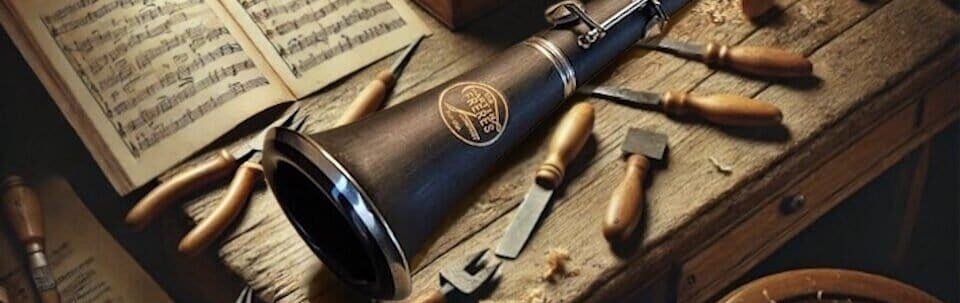
Where do I find the serial number on a Martin Freres clarinet?On most vintage Martin Freres clarinets (such as LaMonte, Versailles, and Coudet models), the serial number is stamped directly into the wood in two specific locations: the Left Hand (Upper) Joint on the bottom tenon (usually on the back), and the Right Hand (Lower) Joint on the top tenon.
Important Note: Do not rely on numbers found on the bell or mouthpiece. These are often patent numbers or mold numbers, not the unique serial number needed to date your instrument.
So much of the Martin Freres serial record has vanished into time’s silence.
What remains has been pieced together from fragments: surviving catalogs, archived documents, and the markings on instruments that outlasted their makers.
This crosswalk is drawn from those remnants. It does not claim perfection; it offers guidance. Within these ranges, you’ll find the most likely era your instrument was built, though not necessarily when it was sold. History moved slowly then. Wars interrupted, inventories lingered, and clarinets sometimes waited years before finding their first breath of music.
Chronological Crosswalk Table
| Date / Era | Representative Models | Observed or Inferred Serial-Number Range & Format | Notes / Highlights |
|---|---|---|---|
| c. 1740 – 1817 | Francois Martin (Simple System) | No serial numbers used | Hand-made boxwood clarinets by François Martin, founder of the Martin family lineage. Each was individually crafted without numbering. |
| c. 1840 – 1905 | Martin Freres Simple System (Paris) | None or very low 3-digit | Early Paris production in boxwood and grenadilla. First use of the “Martin Freres A Paris” stamp. A Bee emblem often engraved above the logo signified authenticity and industry. |
| c. 1906 – 1914 | Système Ordinaire Nos. 22–51, Grand Prix, Classic, Artist, Conservatoire | ? 500 – 2000 | Transition from the Bee emblem to the oval Martin Freres Paris logo. Engravings frequently include award references such as Bruxelles 1910 and Turin 1911. Representative example: Grand Prix SN 1219. |
| 1920s – 1930s | Arrow / LaMonte Arrow | ? 300 – 6000 | Numeric-only serials. Early export instruments stamped “Arrow A Paris.” Marks the beginning of consistent serial practice across Martin Freres models. |
| Late 1930s – 1940s | 1740 Arrow, 1740 Model 1, Concorde | ? 6000 – 9000 | Classic grenadilla Paris production. Professional instruments with oval logo and traditional keywork. Representative examples: 825, 8061. |
| 1943 (Prototype) | LaMonte Model 1 (Stencil) | 43 xxxx (e.g., 43 2526) | Six-digit wartime serials believed to originate from Malerne subcontract production for Martin Freres. These long numbers are rare and non-sequential. |
| Late 1940s – Early 1950s | LaMonte Model 1, 1740 DeLuxe | A 31055 – B 2122 and numeric 7000 – 12000 | First post-war production using both numeric and letter-prefixed serials. Letter prefixes begin appearing for separate model or market batches. |
| 1950 – 1954 | LaMonte Model 2 (Early) | E 5868 – F 8004 | Early 1950s transitional production introducing updated Boehm keywork. Still built in Paris workshops using grenadilla wood. |
| 1955 – 1958 | LaMonte Model 2, Jean Martin DeLuxe, 1740 DeLuxe II | F 10738 – G 14751 – H 22376 | Alphabetic progression through mid-1950s production. Represents the core output of postwar Martin Freres clarinets. |
| 1950s – Early 1960s | 1740 DeLuxe, Model 200, Supra, Vendome, Versailles, Victoire | Numeric 7000 – 90000 or Letter A – S + 4–5 digits | Primary manufacturing period for Martin Freres. Serial numbers were reused within each letter batch. Letter prefixes (A through S) likely identified sales regions or distribution contracts rather than chronological order. Dating requires reference to engraving, keywork, and material details. |
| 1970s (End of Paris Distribution) | Late 1740 DeLuxe, Concorde II, Symphony (stencil/export models) | ? 34000 – 44000 (variable) | Final European and contract production distributed through Buegeleisen & Jacobson (New York) until its closure in the early 1970s. Some instruments carried alternate trade names or stencil engravings for the export market. |
| 1980s – Early 2000s | Paris DeLuxe, Concorde Reissue | Short numeric or lettered (undocumented) | Limited contract or stencil manufacturing in Europe and Asia. Records are scarce; surviving examples show mixed serial styles. |
| 2012 – Present (Modern Revival) | 18 / 34 / 44 / 66 / 77 / 88 Series | mmxxxx (6–7 digits), e.g., 441467 (B44), 88156 (B88) | Structured model-coded system restoring serialization continuity. Model 18 and 34 are student ebonite clarinets; 44 is rosewood; 66 is intermediate/entry-professional; 77 is professional; 88 is student Bakelite (introduced 2012). |
Understanding the A–S Prefix System: Martin Freres reused serial numbers within separate letter batches between the 1940s and 1960s. Each letter likely corresponded to a specific production or distribution region. Because identical numbers can appear under different prefixes, the serial alone cannot confirm build year. Dating depends on logo style, engraving, and construction features. This approach paralleled systems used by other Paris makers such as Selmer, Leblanc, and Malerne.