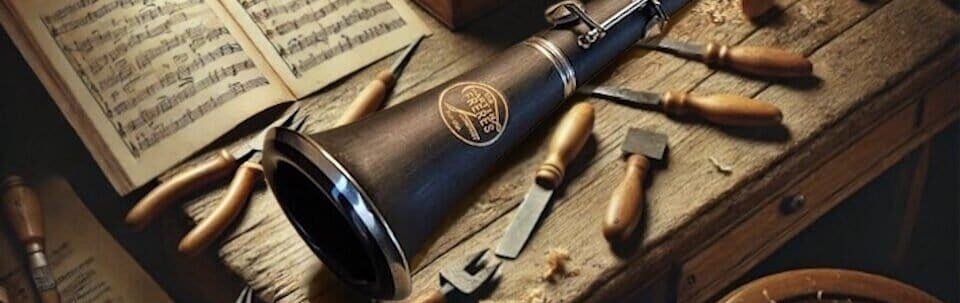
Martin Freres, LaMonte, Coudet, Jean Martin Brand Clarinets and Other Woodwinds
Johann Christoph Denner: Maker Who Turned the Chalumeau Into the Clarinet
Johann Christoph Denner was a late-17th/early-18th-century Nuremberg instrument maker credited with transforming the chalumeau into the clarinet by adding a register key and refining bore and fingering designs. These innovations expanded the instrument's range and tone and shaped modern clarinet construction for players and makers alike.
Brief biography: Johann Christoph Denner and his Nuremberg workshop
Johann Christoph Denner (often dated 1655-1707) worked in Nuremberg, a major German center for instrument making. Guild records and city tax lists place him among respected woodwind makers, active alongside families such as Haas and Oberlender. His reputation spread across German-speaking courts, where his woodwinds were prized for tuning stability and refined craftsmanship.
Denner was the son of Heinrich Denner, also an instrument maker, and belonged to a broader Denner family workshop that continued into the 18th century. Later instruments stamped with the Denner name may come from his sons, notably Jacob and Johann David. This family context complicates attribution but shows a sustained workshop tradition rather than a single isolated genius.
Musicological sources, including Grove Music Online and Nuremberg archival studies, suggest that Denner initially focused on recorders, oboes, and chalumeaux. Around the turn of the 18th century, he began experimenting with chalumeau design. These experiments, especially the addition of a functional register key, are what later writers identified as the birth of the clarinet.
Contemporary written accounts are sparse but telling. Court inventories from places such as Dresden and Darmstadt list “clarinetti” or similar terms soon after Denner's lifetime, often in contexts that suggest high-status, novel instruments. While not always naming Denner directly, these documents align with the timeline of his workshop's innovations.
Later 18th-century writers, including theorists like Johann Mattheson and Johann Gottfried Walther, credit the Denner name with significant improvements to reed instruments. Their comments, though written decades after Johann Christoph's death, helped cement his reputation as the key figure in the clarinet's early development.
1655-1707: Commonly cited lifespan for Johann Christoph Denner, placing his key innovations around 1690-1705 in Nuremberg.
From chalumeau to clarinet: the key innovations Denner introduced
The chalumeau was a simple, single-reed pipe with a cylindrical bore, limited range, and no true overblowing into a higher register. Denner's most famous innovation was the addition of a strategically placed register key near the top of the instrument. This key allowed controlled overblowing at the twelfth, effectively creating a new upper register.
By refining the bore and tone hole layout, Denner balanced the low chalumeau register with the new high register. The result was an instrument with roughly two usable octaves instead of the chalumeau's more restricted range. This expanded compass opened the door to melodic writing that moved across wide intervals and exploited contrasting tone colors.
Denner also appears to have modified the mouthpiece-reed relationship inherited from the chalumeau. Early clarinet-like instruments likely used a separate reed tied onto a beak-shaped mouthpiece, but the facing, tip opening, and reed thickness were adjusted to support stable overblowing and a more projecting tone.
Keywork was still minimal. Surviving early clarinets attributed to the Denner circle typically have two keys, sometimes three, compared with the keyless chalumeau. These keys improved chromatic notes and facilitated the new upper register. Although crude by modern standards, this was a radical step in woodwind evolution.
Importantly, Denner's innovations did not erase the chalumeau's character. The low register retained its dark, reedy quality, while the upper register gained a brighter, more trumpet-like voice. This dual personality shaped how 18th-century composers and players conceived the clarinet's expressive role in ensembles and solo writing.
2-3 keys: Typical key count on early Denner-style clarinets, compared with 0 keys on chalumeaux and 5-13 keys on later Classical and early Romantic clarinets.
Anatomy of a Denner-style clarinet: bore, register key, materials, and fingering
A Denner-style clarinet is usually a three- or four-part instrument with a cylindrical or slightly tapered bore. Surviving examples show bore diameters in the approximate range of 13.0-14.0 mm, narrower than many later Classical clarinets. This bore profile supports strong overblowing at the twelfth and a focused, penetrating tone.
The register key sits near the upper joint, close to the mouthpiece. Its vent hole is carefully sized and positioned to favor the twelfth over the octave, which distinguishes the clarinet from oboe or flute acoustics. The key mechanism is simple: a flat brass key with a leather or bladder pad, pivoted on a short rod or pin.
The mouthpiece on early Denner-type instruments is often integral with the top joint or only slightly differentiated. A separate reed, typically cane, is tied on with thread. The facing length is short, and the reed is relatively thick, producing a resistant but stable response. This setup contrasts with the more flexible, longer facings of modern clarinet mouthpieces.
Finger holes are relatively large and spaced for the hand of an 18th-century player, often slightly smaller than on later Classical clarinets. The basic fingering system is already recognizably clarinet-like, with cross-fingerings for some chromatic notes and a clear break between chalumeau and upper registers controlled by the register key.
Compared with the chalumeau, the Denner-style clarinet adds the register key and at least one additional key for low E or F. Compared with later Classical clarinets by makers such as Grenser or Lotz, Denner instruments have fewer keys, less refined key cups, and more reliance on half-holing and cross-fingering. These differences affect tuning tendencies and technical possibilities.
Materials are typically boxwood, sometimes stained or decorated, with mounts of horn, ivory, or bone. Keywork is brass or occasionally silver. Boxwood's density and fine grain contribute to a clear, articulate sound but require careful maintenance to avoid cracking, especially in dry modern climates.
13.0-14.0 mm: Approximate internal bore diameter on many surviving Denner-style clarinets, supporting the characteristic twelfth overblow.
Surviving instruments and archival evidence: museum holdings and primary sources
Several instruments attributed to Johann Christoph Denner or his family survive in European collections. The Germanisches Nationalmuseum in Nuremberg, the Musikinstrumenten-Museum in Berlin, and the Kunsthistorisches Museum in Vienna all hold clarinets and chalumeaux stamped “DENNER” or variants. Each instrument provides clues to workshop practice and chronology.
Attribution is complex. Some instruments are likely by Johann Christoph himself, while others belong to his sons Jacob or Johann David. Stylistic details, such as key shape, bore dimensions, and stamp style, help scholars differentiate early from later Denner-family work. Detailed catalogues and CT scans have refined these attributions in recent decades.
Archival evidence includes Nuremberg guild records listing Denner as a master instrument maker, tax rolls, and estate inventories. These documents confirm his professional status and suggest a workshop capable of significant output. Court inventories from Dresden, Berlin, and other centers mention clarinets and chalumeaux that may have originated from the Denner circle.
Musicological studies by researchers such as Albert R. Rice, Eric Hoeprich, and others draw on these primary sources. Grove Music Online synthesizes this scholarship, noting that while direct documentation of the exact moment of invention is lacking, the convergence of surviving instruments and written references strongly supports Denner's central role.
Some Denner-stamped instruments show transitional features that blur the line between chalumeau and clarinet. For example, a two-key instrument with a limited upper register may represent an early experiment. These objects are important for understanding how quickly players and makers adopted the new clarinet concept.
High-resolution photography, endoscopic imaging, and non-invasive measurements now allow detailed study without disassembling fragile instruments. Museums increasingly share such data with makers and researchers, improving the accuracy of historically informed reproductions and deepening our understanding of Denner's methods.
Construction techniques and materials: what made Denner's instruments sound distinct
Denner's clarinets begin with carefully selected boxwood, air-dried for years to minimize internal stress. The wood is turned on a lathe, then bored and reamed with graduated tools to achieve the desired internal profile. Slight irregularities in surviving instruments suggest hand finishing rather than standardized machine processes.
Tone holes are drilled and undercut by hand. Their size and undercutting angles influence tuning, response, and tone color. Denner's instruments tend to favor a strong, clear upper register and a somewhat veiled low register, a balance that later makers adjusted as musical demands changed.
Keywork is forged or cast in brass, then filed to shape. Pads are made from leather, bladder skin, or felt-covered materials, seated directly on flat tone hole rims. This simple construction can be remarkably effective when well maintained, but it is sensitive to humidity and wear.
Mounts of horn, ivory, or bone protect tenons and add visual refinement. These materials also influence how joints fit together and respond to humidity changes. A tight but not overly compressed tenon fit is important for avoiding cracks and preserving stable tuning across the instrument's range.
The acoustic result is a clarinet with a quick, direct attack, modest dynamic range compared with modern instruments, and a strong core sound. The upper register often has a bright, almost trumpet-like edge, while the low register retains the chalumeau's dark, reedy color. This contrast is central to the Denner sound ideal.
Modern makers who copy Denner instruments often report that small deviations in bore or tone hole placement significantly change response. This sensitivity suggests that Denner's workshop developed a practical, experience-based understanding of acoustics, refined over many instruments rather than derived from written theory.
Restoration and maintenance of historical Denner-style clarinets
True Denner or Denner-family clarinets are museum-grade artifacts. Any intervention should follow conservation principles: minimal, reversible, and well documented. Players who own historically informed reproductions can adopt some similar habits while allowing for practical performance needs.
For original 18th-century instruments, environmental control is the first priority. Aim for stable relative humidity around 45-55 percent and moderate temperatures, avoiding rapid fluctuations. Display cases and storage cabinets should buffer climate changes and protect against direct sunlight, dust, and handling.
Cleaning should be dry and gentle. Conservators use soft brushes and lint-free cloths to remove dust. Internal swabbing is risky on fragile wood and is usually avoided unless absolutely necessary. Oils or bore treatments are generally not applied to original instruments without extensive testing and justification.
Historically informed reproductions can tolerate more routine maintenance. Players may use a soft pull-through swab after playing, avoiding metal weights that could strike tone holes. Light bore oiling with appropriate products may be done sparingly, following the maker's recommendations, to reduce cracking risk in boxwood.
Reeds and mouthpieces on reproductions require the same care as modern clarinets: avoid leaving reeds on the mouthpiece, rotate multiple reeds, and store them in ventilated cases. For original mouthpieces, no playing should occur; any reed mounting or ligature pressure can damage the facing or tenon.
Regular checkups by a specialist in historical woodwinds are important. For reproductions used in performance, an annual inspection can catch developing cracks, loose mounts, or key wear. For museum pieces, condition reports and photographic documentation at set intervals help track gradual changes over time.
Troubleshooting common issues with historical clarinets and historically informed reproductions
Common mechanical issues on antique or reproduction Denner-style clarinets include cracks, warped tenons, and worn pads or cork. Cracks often appear along the grain near tone holes or tenons. Players should watch for sudden changes in response, buzzing, or visible lines in the wood and stop playing immediately if a crack is suspected.
Temporary stabilization might involve gentle humidity control and avoiding further stress on the joint, but true repair belongs to a professional restorer. Techniques may include internal pinning, gluing with reversible adhesives, and careful cosmetic retouching. Amateur attempts at filling or clamping can cause irreversible damage.
Register key misalignment is another frequent issue. Symptoms include unreliable upper-register response, squeaks, or notes that speak late. Diagnosis involves checking that the key vents cleanly, the pad seals fully, and the spring tension is appropriate. Minor adjustments on reproductions can sometimes be done by experienced players, but antique instruments should only be adjusted by specialists.
Tuning instability often stems from a combination of bore wear, pad leakage, and reed setup. On reproductions, players can experiment with reed strength, mouthpiece position, and embouchure. On originals, any tuning evaluation should be done at very low playing intensity, if at all, to avoid stressing the instrument.
Another common problem is loose or shrunken tenon corks, which cause air leaks and unstable joints. Reproduction instruments can have corks replaced using modern materials and glues. On historical instruments, conservators may use more reversible methods, sometimes adding temporary shims rather than fully replacing original cork.
Key noise and sluggish action can result from worn pivot points or dried lubrication. On reproductions, careful cleaning and minimal application of appropriate lubricants can restore smooth motion. On antiques, conservators may use microcrystalline waxes or other stable materials, always prioritizing reversibility and documentation.
Denner's influence on repertoire and playing technique in the 18th century and today
Denner's register key and bore refinements expanded the clarinet's usable range to roughly two octaves, enabling leaps across the break and agile passagework. Early 18th-century composers began to exploit these capabilities in court ensembles, often assigning clarinets trumpet-like fanfares and bright melodic lines in the upper register.
Works by composers such as Johann Melchior Molter, Johann Stamitz, and later Carl Stamitz show a growing familiarity with the clarinet's dual character. While these composers wrote for instruments somewhat later than Denner's own, their idioms build directly on the possibilities he unlocked: wide leaps, contrasting registers, and expressive dynamic shading.
Technique evolved alongside repertoire. Players developed embouchure control to manage the break between chalumeau and upper registers, refined fingerings for cross-fingered notes, and explored articulation patterns that took advantage of the clarinet's clear attacks. Treatises from the mid-18th century describe these techniques in terms that still resonate with modern pedagogy.
For modern players using Denner-style reproductions, these historical techniques offer both challenges and rewards. The smaller dynamic range and less even tuning demand careful listening and flexible intonation. In return, the instruments provide an intimate connection to early repertoire and a nuanced palette of colors not available on modern Boehm-system clarinets.
Denner's influence also extends indirectly to later giants such as Mozart and Weber. Their clarinet writing assumes an instrument with a secure upper register, a rich low register, and the ability to move seamlessly between them. While their works were written for more advanced Classical clarinets, the conceptual foundation traces back to Denner's early experiments.
Today, historically informed performance ensembles and conservatories encourage players to study Denner-style instruments to understand phrasing, articulation, and balance in Baroque and early Classical music. This practice deepens interpretive insight even when performers return to modern instruments for mainstream repertoire.
Legacy and modern relevance: how makers and conservators (including Martin Freres' historical perspective) keep Denner's innovations alive
Denner's legacy lives on through museum collections, scholarly research, and the work of specialized makers who build faithful reproductions. These reproductions allow performers to explore original pitch standards, fingerings, and tonal ideals, providing practical feedback that enriches academic theories about early clarinet use.
Conservators play a parallel role by stabilizing and documenting surviving Denner and Denner-family instruments. Their work ensures that future generations can study authentic examples, compare construction details, and test hypotheses about workshop practices. Non-invasive imaging and careful measurement protocols have become standard in major collections.
From a historical perspective, the Martin Freres archive highlights how 19th- and early 20th-century makers looked back to Denner's principles while expanding keywork and adapting to new musical demands. The basic acoustic concept of a single-reed, cylindrical-bore instrument overblowing at the twelfth remains central, even as materials and mechanisms evolved.
Modern clarinet pedagogy still uses the term “chalumeau register” for the low range, a direct linguistic echo of the instrument Denner transformed. This vocabulary reminds players that their daily technical work is rooted in a historical continuum stretching back to early 18th-century Nuremberg workshops.
For instrument makers, Denner's work provides a benchmark for craftsmanship and acoustic efficiency. Studying his instruments encourages careful attention to bore profiles, tone hole placement, and material choice. These lessons inform both historical reproductions and innovative contemporary designs.
For collectors and curators, understanding Denner's legacy aids in evaluating provenance, authenticity, and significance. Instruments with clear connections to the Denner tradition occupy a special place in the story of woodwind development and deserve correspondingly thoughtful care and interpretation.
From the Martin Freres archive: Early 20th-century design notes reference “Denner-type” bore proportions when discussing experimental small-bore clarinets. Although separated by two centuries, these documents show how Denner's acoustic concepts continued to influence later makers who sought clarity, focus, and reliable overblowing behavior.
Sources, archives, and further reading
Key reference works on Johann Christoph Denner include entries in Grove Music Online and comprehensive studies by Albert R. Rice and Eric Hoeprich. These authors synthesize archival documents, instrument measurements, and performance practice insights, offering detailed chronologies and technical analyses of Denner and his successors.
Museum catalogues from the Germanisches Nationalmuseum, the Musikinstrumenten-Museum in Berlin, and the Kunsthistorisches Museum in Vienna provide photographs, measurements, and provenance notes for Denner and Denner-family instruments. Many institutions now publish these catalogues online, making high-quality data accessible to researchers worldwide.
Specialized journals such as the Galpin Society Journal, Historic Brass Society Journal, and various early music periodicals often include articles on clarinet history, Denner attributions, and technical case studies. These articles can clarify disputed datings, workshop divisions, and the relationship between surviving instruments and documented repertoire.
For players, modern method books and guides to historical clarinet performance often include sections on Denner-style instruments. These resources translate musicological findings into practical advice on fingerings, reeds, articulation, and ensemble balance, bridging the gap between scholarship and stage.
Archives in Nuremberg, including city and guild records, remain important for ongoing research. As more documents are digitized and cross-referenced with instrument data, scholars continue to refine our picture of Denner's life, workshop organization, and client networks across central Europe.
Combining these written and material sources allows a multi-dimensional understanding of Denner: not only as an inventor, but as a working craftsman embedded in a vibrant Nuremberg instrument-making culture that shaped the clarinet's earliest forms.
Key takeaways
Johann Christoph Denner's addition of a register key and bore refinements transformed the chalumeau into the first true clarinet, expanding range and tonal flexibility.
Surviving Denner and Denner-family instruments, mainly in European museums, reveal a small-bore, two- or three-key design that overblows at the twelfth.
Conservation of original instruments prioritizes stability and reversibility, while reproductions allow players to explore historical technique and repertoire safely.
Denner's innovations shaped 18th-century writing for clarinet and still underpin modern clarinet acoustics, pedagogy, and instrument design.
Frequently asked questions
What is Johann Christoph Denner?
Johann Christoph Denner was a Nuremberg instrument maker active around 1655-1707, widely credited with transforming the chalumeau into the clarinet. By adding a register key and refining bore and fingering designs, he created an instrument with an extended range and new tonal possibilities that influenced all later clarinet development.
What key innovations did Denner introduce to the clarinet?
Denner's main innovations were the addition of a register key near the top of the instrument and careful adjustments to bore and tone hole layout. These changes allowed the instrument to overblow at the twelfth, creating a usable upper register, and improved chromatic flexibility through limited keywork, typically two or three keys.
Are there any surviving clarinets made by Denner or his workshop?
Yes. Several clarinets and chalumeaux stamped with the Denner name survive in European museums, including the Germanisches Nationalmuseum in Nuremberg and major collections in Berlin and Vienna. Some are likely by Johann Christoph himself, while others come from his sons or later Denner-family workshop activity.
How can I tell a Denner-style clarinet from a later classical clarinet?
A Denner-style clarinet typically has a small bore, two or three simple brass keys, large finger holes, and boxwood construction with horn or ivory mounts. Later Classical clarinets usually have more keys, more sophisticated key cups, slightly larger bores, and refinements in tone hole placement that produce more even tuning and greater technical facility.
How should a Denner-style or antique clarinet be cared for and maintained?
Original 18th-century clarinets should be treated as museum objects: stable humidity and temperature, minimal handling, and only gentle dry cleaning by trained conservators. Historically informed reproductions can be swabbed carefully after playing, lightly oiled when appropriate, and checked regularly by a specialist in historical woodwinds for cracks, pad wear, and key alignment.
Did Denner's innovations change clarinet repertoire and technique?
Yes. Denner's register key and bore design expanded the clarinet's range and enabled secure upper-register playing, which encouraged composers to write wider leaps, brighter melodic lines, and more varied textures. Players developed new techniques for managing the break, articulation, and intonation, laying the groundwork for the virtuosic clarinet repertoire of the later 18th and 19th centuries.