If the clarinet had a late-night voice, it would probably sing in the B Dorian scale. Smoky, restless, somewhere between hope and heartbreak, B Dorian is the sound of city lights after rain, of film noir alleys, of jazz clubs where the clarinet leans into the microphone and tells the truth.
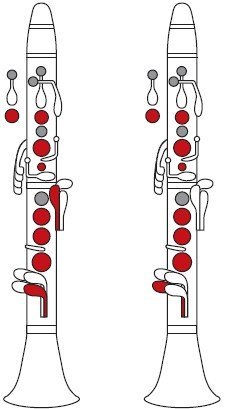
Receive a free PDF of the chart with clarinet fingering diagrams for every note!
On Bb clarinet, the B Dorian scale feels like a secret passage between classical phrasing and jazz language, between modal folk tunes and modern film scores. Once you hear it, you start to recognize it everywhere: in old recordings, in clarinet solos you love, in melodies that never quite resolve the way you expect.
The B Dorian scale on Bb clarinet is a minor-flavored mode built on B that uses the notes B, C#, D, E, F#, G#, and A. It blends minor warmth with a raised 6th, giving solos a smooth, modern sound and opening rich possibilities for jazz, folk, and film-style improvisation.
The sound story of the B Dorian scale
The B Dorian scale is like a cousin of B minor that stayed out a little later and listened to more jazz. You get the same moody pull from B to D, but the raised G# changes everything. That one pitch tilts the light in the room. Suddenly the line does not sigh and give up; it leans forward and keeps talking.
On Bb clarinet, that G# sits beautifully under the fingers, and the whole scale sings across the throat tones and clarion register. It has the warmth of Brahms and the edge of John Coltrane. You can bend it into klezmer cries, cool jazz phrases, or contemporary chamber music in a single breath.
B, C#, D, E, F#, G#, and A cover just over an octave on Bb clarinet, moving from throat tones into clarion. That mix of registers gives B Dorian its flexible color: velvety low notes for shadow, bright upper notes for intensity.
From ancient modes to modern clarinet: how B Dorian arrived on stage
Long before the Boehm system or the modern Bb clarinet, the Dorian mode was already haunting Gregorian chant in stone cathedrals. Organists and singers leaned on that raised 6th feeling without calling it “Dorian” in a theory book. The shape was simply part of the language.
By the time early clarinet pioneers like Anton Stadler and Heinrich Baermann were working with composers such as Mozart and Carl Maria von Weber, the old modal colors had not disappeared. They slipped into minor keys as modal inflections, little twists of color inside sonatas and concertos. In Weber's Clarinet Concerto No. 1 and in Mozart's Clarinet Concerto in A major K.622, you can hear turns of phrase and inner lines that hint at Dorian brightness inside minor passages.
As harmony evolved through the romantic era into Gustav Mahler, Claude Debussy, and later Igor Stravinsky, the Dorian sound returned more openly. Clarinet parts in works like Mahler's Symphony No. 1 or Ravel's “Daphnis et Chloe” breathe in and out of modal colors. If you sing through those lines slowly, you will find B Dorian fragments hiding inside chromatic phrases, especially in transitional passages.
By the 20th century, as jazz, film scoring, and modern classical music started to share ideas, the B Dorian scale became less of a hidden spice and more of a clear flavor. Composers began to write modal passages right on the page, and clarinetists embraced that cool, floating minor color with pride.
Clarinet legends who quietly lived in Dorian
Most clarinetists did not go on stage saying “Tonight I will feature the B Dorian scale.” They simply used it. Once your ears tune to that sound, you hear it in the phrasing of players across genres.
Classical voices with modal shadows
Listen to Sabine Meyer playing Debussy's “Premiere Rhapsodie” with the Berlin Philharmonic, or Martin Frost in Anders Hillborg's “Peacock Tales.” Both pieces shift in and out of modal harmony, including Dorian touches that give the clarinet line that restless, hovering tension. In certain lyrical passages, if you isolate the pitches, you can trace near-complete Dorian runs gliding underneath the orchestral color.
Richard Stoltzman, in recordings of Leonard Bernstein's “Sonata for Clarinet and Piano” and pieces by Toru Takemitsu, stretches the line through chromatic and modal zones so smoothly that B Dorian colors slip by almost unnoticed. His phrasing shows how this scale can be part of an expressive palette, not a dry exercise.
Jazz clarinet: B Dorian on smoky standards
For jazz players, Dorian is home turf. Put a Bb clarinet in the hands of Benny Goodman on a tune like “Soft Winds” or Artie Shaw on “Summit Ridge Drive,” and you hear modal thinking all over their minor-key improvisations. The exact key center might shift, but the language of minor with a raised 6th is everywhere.
Buddy DeFranco, who bridged bebop and clarinet tradition, frequently leaned on Dorian shapes when improvising over ii-V progressions. On a standard like “Autumn Leaves,” when the harmony moves to a minor ii chord, those quick, slithering runs often spell out Dorian scales. Move that concept into B minor territory, and you are hearing B Dorian in action, even if the band never says its name.
Klezmer and folk players keeping the mode alive
Klezmer artists like Giora Feidman and David Krakauer live in a world of modes. On tunes such as “Freilach 9” or “Der Heyser Bulgar,” they pivot between Freygish (a kind of Phrygian flavor), natural minor, and Dorian gestures constantly. Shift those gestures up so B is the home tone, and again the B Dorian sound appears in the ornaments, cries, and turns that make these tunes so gripping.
In various Balkan and Eastern European folk traditions, clarinetists and tárogató players treat modal scales as everyday language. B Dorian is effectively the sound of a minor tune that refuses to sink into sadness. That same energy shows up when jazz clarinetists solo over modern grooves, or when classical players color a phrase in a contemporary chamber work.
Iconic pieces, hidden B Dorian moments, and recordings to chase
You will not always see “B Dorian” printed in a clarinet part, but the sound is scattered through well-loved repertoire. Here are a few listening paths where that personality peeks out.
- Igor Stravinsky – “Three Pieces for Clarinet Solo” (especially the second piece): modal cells, including Dorian shapes, slide and twist, giving a chant-like modern monologue. Shift the patterns to start on B and you will hear how naturally they form a B Dorian color.
- Bela Bartok – “Contrasts” for clarinet, violin, and piano: Bartok's folk-inspired language often leans on Dorian modes. Clarinet passages in the first movement include scale fragments that map neatly to the Dorian pattern when transposed.
- Olivier Messiaen – “Quartet for the End of Time”, especially “Abime des oiseaux”: though Messiaen uses his own modes of limited transposition, clarinetists studying this piece often practice Dorian scales, including B Dorian, to shape the long, suspended melodic arcs.
On the jazz side, the clearest way to feel B Dorian in your bones is to listen to modal works and then move them mentally into B. For example:
- John Coltrane – “Impressions” and Miles Davis – “So What”: typically performed in D Dorian and E b Dorian. Move the fingering shapes so that B is your home note on Bb clarinet and you suddenly have the B Dorian scale as your modal playground.
- Don Byron, on albums like “Bug Music” and “Tuskegee Experiments”: his clarinet solos over minor vamps often slide into Dorian language. Isolate a phrase and move it so that B feels like home, and you will hear B Dorian sing.
Film scores give B Dorian a cinematic twist. Think of scores by Alexandre Desplat and Michael Giacchino, where clarinet lines sit over pulsing minor chords with a brighter inner color. In some cues from movies like “The Grand Budapest Hotel” or “Ratatouille,” you can hear the clarinet hover over chords that essentially invite a Dorian approach. Move the whole harmony to a center of B, and you are in B Dorian territory, with the same bittersweet lift.
| Context | Common Mode | How B Dorian Fits |
|---|---|---|
| Jazz ii chord in A major | B Dorian | Use B Dorian for solos over B minor 7 in ii-V-I progressions. |
| Folk tune starting on B | Dorian or natural minor | Raise G to G# to shift from natural minor to B Dorian color. |
| Film cue over B minor chord | B Dorian for lift | Use G# instead of G for a modern, hopeful minor mood. |
Why the B Dorian scale feels different under your fingers
On Bb clarinet, the B Dorian scale has a special physical feel. The move from B to C# to D connects throat tones to early clarion smoothly, and the G# and A near the top sit comfortably in the clarion register. You get an even, vocal arc from dark to bright without awkward jumps.
The emotional effect follows your fingers. That raised G# gives every rising line a glow. Instead of the heavier pull of B natural minor with its G natural, B Dorian holds the door open. Melodies sound like questions that might actually get a hopeful answer, like film themes that suggest the story could still end well.
Change just one note from B natural minor (G) to B Dorian (G#), and your clarinet line moves from tragic to quietly optimistic. This single semitone is a powerful emotional tool for phrasing and improvisation.
What the B Dorian scale opens up for your playing
Once B Dorian feels natural on your Bb clarinet, you start hearing options everywhere. A simple B minor backing track suddenly suggests new colors. A slow movement marked “espressivo” becomes a place to lean into modal turns. Even standard etudes by Cyrille Rose or Jean-Jean take on a different life when you experiment with Dorian-flavored ornaments.
For students, B Dorian is a gentle gateway into improvisation. It sounds sophisticated right away, even with simple patterns. For advanced players, it becomes a bridge between your classical control and your jazz vocabulary, a way to use long-tone beauty on modern harmonies without feeling locked into pure minor.
| Goal | How B Dorian Helps | Suggested Use |
|---|---|---|
| Improvisation practice | Provides a modern, minor-based sound that is easy to hear. | Solo over a B minor drone using only B Dorian. |
| Tone and phrasing | Connects throat tones and clarion in one expressive line. | Play B Dorian slowly as a long-tone etude. |
| Style flexibility | Shares DNA with jazz, folk, and film music. | Quote B Dorian turns inside classical excerpts. |
The fingering chart: a quick storytelling partner
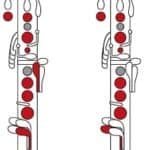
The free B Dorian fingering chart is not just a row of buttons to press. It is a map of the story your clarinet can tell in this mode. Starting on B and climbing to the upper A, you pass familiar landmarks: the throat B and C#, the clarion D and E, the comfortable F#, the expressive G#, and finally the singing A.
Most of the scale uses standard, textbook fingerings on a modern Boehm-system Bb clarinet. That simplicity is part of the magic: you can focus on sound, not gymnastics. The chart shows both ascending and descending notes, so you can see how to keep your right-hand fingers gently prepared for the upper notes while keeping the throat tones relaxed. One look, and your hands know where the story goes.
- Start on low or throat B and play slowly up the B Dorian scale using the chart.
- Repeat, but add a gentle swell on each note to feel how the clarinet vibrates.
- Once comfortable, start on other notes of the scale (like D or F#) and still use only B Dorian notes to make small melodies.
Light practice routine for living in B Dorian
You do not need hours to let this sound sink in. A focused 10 to 15 minutes with your Bb clarinet and the B Dorian fingering chart can completely change how you hear your own playing.
| Time | Activity | Focus Color |
|---|---|---|
| 3 minutes | Long-tone B Dorian up and down, mf dynamics. | Even tone from throat B to clarion A. |
| 4 minutes | Simple 3-note patterns (B-C#-D, C#-D-E, etc.). | Smooth finger coordination and legato tongue. |
| 4 minutes | Free improvisation on B Dorian over a B drone. | Phrasing, dynamics, personal sound. |
| 3 minutes | Quote B Dorian fragments inside a short etude or orchestral excerpt. | Blending modal color with existing repertoire. |
During that last step, try slipping a B Dorian turn into something you might play for auditions, such as a phrase from Brahms Symphony No. 3, Rachmaninoff's “Symphonic Dances,” or even the famous solo from Ravel's “Bolero.” You are not rewriting the piece, just letting your fingers remember how that modal shape feels.
Key Takeaways
- B Dorian on Bb clarinet blends minor warmth with a bright lift, perfect for jazz, folk, and expressive classical phrases.
- The free fingering chart lets you focus on color and phrasing instead of guessing fingerings.
- Even a short daily routine with B Dorian can refresh your improvisation, tone work, and musical imagination.
Frequently Asked Questions
What is Bb clarinet B Dorian scale fingering?
Bb clarinet B Dorian scale fingering is the sequence of fingerings used to play the notes B, C#, D, E, F#, G#, and A on a Bb clarinet. It follows comfortable, standard Boehm-system fingerings across throat and clarion registers, making it easy to focus on tone, phrasing, and improvisation over minor-style harmonies.
How is B Dorian different from B natural minor on clarinet?
B natural minor uses G, while B Dorian uses G#. That one note changes the mood from darker and more tragic to slightly brighter and more open. On Bb clarinet, the G# also feels smooth under the fingers, so B Dorian encourages flowing lines that work well in jazz, folk, and film settings.
Why should clarinet players practice the B Dorian scale?
Practicing the B Dorian scale trains your ear for modal harmony, strengthens your connection between throat tones and clarion notes, and gives you a stylish minor-based sound for improvisation. It also helps you interpret passages in classical, jazz, and klezmer music where composers hint at modal colors without labeling them directly in the part.
How often should I include B Dorian in my clarinet routine?
Including B Dorian for 5 to 10 minutes a day is enough to feel its impact. Use it as a warmup for long tones, then add a few simple patterns and a short improvisation. Over a few weeks, you will start hearing B Dorian options naturally while practicing etudes, orchestral excerpts, and jazz standards.
Can beginners use the B Dorian fingering chart effectively?
Yes. Beginners can follow the B Dorian chart just like any major scale chart. The fingerings are standard and comfortable on a Bb clarinet. Because the scale sounds stylish right away, even simple one-octave runs feel musical, which helps new players enjoy practice and connect theory to real sound more quickly.
For deeper clarinet stories, you can also wander through articles on historic Martin Freres clarinets, browse discussions of classic French-school tone concepts, or compare approaches to modern clarinet repertoire and practice routines on other pages of MartinFreres.net.