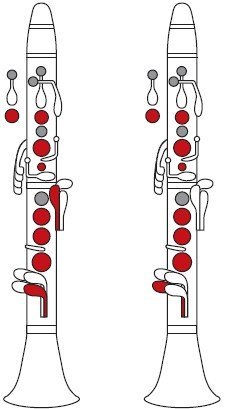
If the major scale is the clarinetist's daily bread, the C whole-tone scale is the late-night dessert: strange, shimmering, and just a little dangerous. On Bb clarinet, that C whole-tone scale opens the same mysterious door that Debussy, Ravel, and so many jazz and film composers walked through when they wanted music to float free of gravity.
Receive a free PDF of the chart with clarinet fingering diagrams for every note!
Play a simple C whole-tone scale slowly on your Bb clarinet, and you can almost hear the colors of early 20th-century Paris, the smoky air of a Benny Goodman rehearsal, or the surreal glow of a John Williams film cue. That single pattern of notes turns your clarinet from a polite storyteller into a dream machine.
Quick Answer: What is the C whole-tone scale on Bb clarinet?
The C whole-tone scale on Bb clarinet is a six-note symmetrical scale built from C using only whole steps. It creates a floating, dreamlike sound used in jazz, impressionist music, and film scores, and it helps clarinet players build flexible fingers and bold improvisational ideas.
From Debussy to Disney: How the C Whole-Tone Scale Found Its Voice
The C whole-tone scale did not start as a clarinet exercise. Composers like Claude Debussy and Maurice Ravel heard it first as a color, almost like a new paint on the harmonic palette. In pieces like Debussy's “Voiles” and Ravel's “Daphnis et Chloe,” the whole-tone sound drifts through the woodwind parts and gives the orchestra a soft, hazy glow.
Clarinetists in the Orchestre de la Societe des Concerts du Conservatoire and later the Orchestre de Paris learned to slide through those lines with the same ease a singer uses for a sigh. Their Boehm-system clarinets, paired with French-style mouthpieces and Vandoren-style reeds, were perfectly suited to that creamy whole-tone color.
Across Europe, players like Louis Cahuzac and later Jacques Lancelot carried that sound into the recital hall. Even when they were not officially “playing a C whole-tone scale,” the same pattern of notes kept showing up in Debussy-inspired solo works and French pieces for clarinet and piano.
Field Note: In the Martin Freres archives, there are early 20th-century French clarinets with handwritten practice sheets tucked into their cases. Several include sketched whole-tone patterns marked “Debussy” or simply “W.T.” as if the owner had discovered a secret code they wanted to remember for the next rehearsal.
By the time Hollywood composers like Max Steiner and later John Williams started writing for large orchestras, the whole-tone sound had become a shorthand for magic, dream sequences, or sudden shifts in reality. Clarinet sections from the London Symphony Orchestra to the Los Angeles Philharmonic have used that same C whole-tone motion to glide into scenes full of mystery and wonder.
Clarinet Legends Who Lived Inside the Whole-Tone Sound
Few clarinetists talk about “practicing the C whole-tone scale” into a microphone, but you can hear this sound all over their playing.
Benny Goodman loved symmetrical patterns. In his solos on tunes like “Sing, Sing, Sing” and “Stompin' at the Savoy” with the Benny Goodman Orchestra, you can spot whole-tone runs built off concert Bb and C that shimmer right over the horn section. When he leans into the upper register with his Albert-system clarinet, you hear that slippery, no-gravity quality of the scale.
Artie Shaw takes it in a slightly darker, more introspective direction. Listen to his solo on “Begin the Beguine” or the haunting lines in “Nightmare.” Between the chromatic flourishes and blues notes, there are moments where the whole-tone flavor appears, built around the same steps you practice in your C whole-tone scale on Bb clarinet.
Modern jazz artists push it even further. Buddy DeFranco, in his bebop recordings with Tommy Gumina and the Oscar Peterson Trio, uses whole-tone fragments to burn through altered dominant chords. Eddie Daniels slides between classical purity and jazz fire, often using whole-tone runs to leap cleanly from lush orchestral writing to raw improvisation.
On the classical side, Sabine Meyer and Martin Frost give the whole-tone sound a refined elegance. In Debussy-inspired programs and contemporary works by composers like Kalevi Aho or Anders Hillborg, their Buffet and Yamaha instruments sing through passages that are essentially sculpted from whole-tone material.
Richard Stoltzman, with his unmistakable jazz-inflected classical tone, shows how the whole-tone color can blur the line between genres. His recordings of Leonard Bernstein and Toru Takemitsu are dotted with gestures you can trace right back to your humble C whole-tone fingering pattern.
In klezmer, Giora Feidman and David Krakauer use similar symmetrical runs to add tension before heavy bends and cries. While klezmer scales often lean on augmented and harmonic minor flavors, the idea of a repeating whole-step pattern fits perfectly into their wild, almost vocal style of phrasing.
Iconic Pieces Where The Whole-Tone Color Shines
You might not see “C whole-tone scale” printed above a clarinet part very often, but you can hear it everywhere once your ears tune in.
Claude Debussy – “Premiere Rhapsodie” for clarinet and piano: Listen to the opening cadenza and later lyrical sections. The clarinet weaves whole-tone lines around sustained harmonies, especially in the upper chalumeau and clarion registers.
Maurice Ravel – “Bolero”: While better known for its snare drum and hypnotic theme, some of the ornamental figures passed through the woodwinds flirt with the same symmetrical space as whole-tone patterns.
Igor Stravinsky – “Three Pieces for Clarinet Solo”: The second and third pieces use angular patterns, including segments of whole-tone, to stretch the listener's sense of key.
Olivier Messiaen – “Quartet for the End of Time”: Whole-tone colors are embedded in his modes. The clarinet part, especially in “Abime des oiseaux,” glides through similar symmetrical territory.
Jazz standards like “Stella by Starlight” and “Have You Met Miss Jones”: Clarinetists in small jazz combos often use the C whole-tone scale over altered dominant chords, especially when the piano or guitar player is hinting at C7#5 or C7b5 colors.
Film scores by John Williams and Alan Silvestri: Think of the swirling, suspended clarinet and flute lines in fantasy or sci-fi scenes. Many of those gestures could be practiced simply as a C whole-tone scale pattern on Bb clarinet.
6 distinct notes before the octave
The C whole-tone scale uses only six different notes before repeating at the octave. That symmetry makes it faster to memorize on Bb clarinet and easier to move to other starting notes when you improvise or sightread modern scores.
Even classic clarinet concertos like those by Carl Maria von Weber and Jean Francaix occasionally brush against whole-tone fragments in their cadenzas and bravura passages. Composers love the way that symmetrical scale suddenly makes the listener feel like the floor just tilted.
How the C Whole-Tone Scale Feels Under Your Fingers and In Your Heart
Play a normal C major scale on your Bb clarinet, then immediately play the C whole-tone scale fingering from our chart. You will feel the difference in your right-hand pinky keys, but you will also feel a shift in mood. The major scale says “home.” The C whole-tone scale says “where are we going next?”
The sound has no strong pull to tonic, no clear dominant or subdominant. Every note feels equally important, like six planets in perfect orbit. On the clarinet, with its smooth legato and wide dynamic range from whispering chalumeau to ringing altissimo, that balance becomes incredibly expressive.
This is why jazz clarinetists use it to float over altered chords, and why composers use it for dream sequences, undersea scenes, and magical transitions. The listener cannot quite predict where the phrase will land, and that uncertainty creates a gentle tension that you, the player, get to shape with every breath and embouchure adjustment.
Emotionally, the C whole-tone scale can feel:
Dreamy, when played softly in the clarion register with plenty of air support
Edgy and surreal, when tongued lightly in rapid patterns
Majestic and open, when used in big, ascending arpeggios into altissimo
With a mouthpiece that responds easily in the high register and a well-balanced reed, you can turn this scale into a kind of musical question mark that never quite closes. That is its secret charm.
Why Practicing C Whole-Tone On Bb Clarinet Actually Feels Fun
Scales can feel like chores. The C whole-tone scale usually does not. Because the fingering pattern repeats in a symmetrical way, it invites you to play games with it: rhythmic twists, dynamic swells, and register jumps from chalumeau to altissimo.
Here is a simple practice routine that turns your free C whole-tone fingering chart into a compact daily workout:
Exercise
Time
Focus
Slow C whole-tone scale, slurred, 2 octaves
3 minutes
Tone quality in chalumeau and clarion
C whole-tone in triplets, tongued lightly
3 minutes
Articulation evenness
Random fragments over a C7 chord backing
4 minutes
Improvisation and ear training
Even 10 minutes like this can rewire how your fingers handle right-hand pinky combinations, throat-tone transitions, and shifts between open and covered tone holes.
A Quick Word On C Whole-Tone Fingerings (Then Back To Music)
The free chart on this page shows the exact Bb clarinet fingerings for every note in the C whole-tone scale, across 2 or more octaves. Think of it as a map: C, D, E, F#, G#, A#, then back to C. Every step is a whole tone, so the fingering jumps can feel a bit larger than a normal scale.
Instead of memorizing each note in isolation, try thinking of small shapes:
Start from low C and feel the shift to D and E as a single three-note “shape” in your left hand and right-hand lower joint.
Notice how the F# and G# connect through your right-hand pinky keys.
Let A# and the upper C feel like a single motion into clarion or altissimo, depending on the octave.
Range
Feeling
Practice Idea
Low C to middle C
Heavy, grounded, orchestral
Long tones on each scale degree
Middle C to high C
Vocal, singing, Debussy-like
Slurred arpeggios and broken patterns
Above high C
Electric, jazz-inflected
Short bursts in rhythmic motifs
Use the chart as a visual anchor, then let your ears and hands turn that pattern into music.
From Anton Stadler To Modern Film Sessions: Then And Now
Anton Stadler, the clarinetist who inspired Mozart's Clarinet Concerto, never played Debussy or jazz standards, but he absolutely knew the feeling of scales that bend harmony in unexpected ways. In Mozart's K.622 concerto and quintet, occasional augmented intervals hint at the same curiosity that later composers answered with full whole-tone writing.
Heinrich Baermann, for whom Weber wrote his clarinet concertos, pushed technical boundaries on 19th-century instruments. His rapid arpeggios and chromatic runs were the distant ancestors of modern whole-tone flashes. You can imagine Baermann, with his early mouthpiece and string ligature, being delighted by the idea of a C whole-tone race through the upper register.
By the late 19th century, the French school, including players tied to the Paris Conservatoire, was already coloring scales with augmented intervals. As whole-tone harmony blossomed in Debussy's and Ravel's scores, clarinetists had to adjust their embouchure, voicing, and finger technique to shape those alien-sounding intervals beautifully.
Fast forward to today: a studio clarinetist sitting in front of a Neumann or Shure microphone, reading a John Powell or Alexandre Desplat score, might see three bars of rapid notes labeled “misterioso” that are nothing but C whole-tone fragments. With a modern Boehm-system clarinet, carefully balanced keywork, and precise tone-hole placement, those runs can sound effortless and glassy.
Martin Freres instruments from the early 1900s, restored today, still speak clearly on whole-tone passages, a reminder that this color has been part of clarinet life for more than a century.
What The C Whole-Tone Scale Does For You As A Player
Beyond the cool factor and the history, why should you care about Bb clarinet C whole-tone scale fingering?
Improvisation freedom: Over a C7, C7#5, or C7b5 chord, this scale gives you instant tension and release options, perfect for small group jazz and big band solos.
Modern repertoire fluency: Contemporary pieces, from band works to solo clarinet music, often sneak in whole-tone patterns. Being comfortable with the scale removes the fear factor.
Finger agility: Whole-step-only motion forces you to practice less common combinations of left-hand and right-hand fingers, including pinky coordination and throat-tone transitions.
Ear training: Learning to recognize the whole-tone color helps you follow harmonic shifts in orchestra, wind ensemble, or chamber music more instinctively.
Whether you are playing a French contest piece, improvising over “All The Things You Are,” or adding a surreal edge to a solo in a school wind band, this one scale gives you a surprising amount of artistic power.
Key Takeaways
Use the C whole-tone scale to add a dreamy, floating color to your Bb clarinet playing in jazz, classical, and film-style music.
Practice the scale in small, repeating shapes using the free fingering chart to build finger agility and tonal control.
Listen to clarinetists like Benny Goodman, Sabine Meyer, and Martin Frost to hear how whole-tone colors shape expressive phrasing.
Frequently Asked Questions
What is Bb clarinet C whole-tone scale fingering?
Bb clarinet C whole-tone scale fingering is the pattern of keys you use to play the six-note whole-tone scale starting on written C. The notes are C, D, E, F#, G#, A#, then C again. Each step is a whole tone, which creates a floating, mysterious sound used in many styles.
How is the C whole-tone scale different from C major on Bb clarinet?
C major uses a mix of whole steps and half steps, giving a strong sense of key. The C whole-tone scale uses only whole steps, so it has six distinct notes and no strong pull to a tonic. On Bb clarinet it feels more symmetrical, modern, and harmonically unstable.
Where can I use the C whole-tone scale in jazz improvisation?
You can use the C whole-tone scale over C7, C7#5, C7b5, or as a passing color over G7alt resolving to C minor or C major. Try short runs or patterns instead of long straight scales, and listen to clarinetists like Buddy DeFranco and Eddie Daniels for phrasing ideas.
Does practicing the C whole-tone scale help classical clarinet playing?
Yes. Even if you never improvise, the scale improves finger coordination, throat-tone control, and altissimo accuracy. It also prepares you for Debussy, Ravel, Messiaen, and modern band or orchestral parts where whole-tone fragments appear in fast passages.
How often should I practice the C whole-tone scale on Bb clarinet?
Including it 3 to 4 times per week for 5 to 10 minutes is enough to make a difference. Rotate between slow, lyrical practice and short, rhythmic bursts. Over a few weeks you will feel more comfortable in unusual key patterns and complex harmonic settings.
For more clarinet stories and fingering ideas, you might also enjoy reading about Bb clarinet scales, alternate fingerings, and historical instruments on other Martin Freres pages.