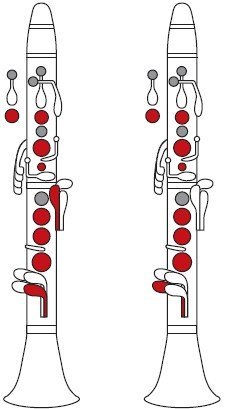
If you have ever taught a child, played in a school band concert, or sat in a little wooden chair at story time with a clarinet on your lap, you already know the magic of “The Wheels On The Bus” on Bb clarinet. A few simple notes, a steady rhythm, and suddenly the whole room starts to sing along.
Receive a free PDF of the chart with clarinet fingering diagrams for every note!
The Wheels On The Bus clarinet fingering chart is a note-by-note Bb clarinet guide for this classic children's song that shows exactly which keys to press, which fingers to use, and how to move between notes smoothly so beginners can play confidently and enjoy instant sing-along success.
How “The Wheels On The Bus” Rolled Into Clarinet History
“The Wheels On The Bus” first rolled through American classrooms in the 1930s, originally printed as a simple repetitive song for young voices and piano. It quickly spread through nursery schools and libraries, where upright pianos and simple percussion ruled the day. The clarinet joined later, quietly at first, carried in by music teachers who wanted more color than a single piano could give.
By the 1950s, clarinetists in school bands were already using this tune to learn their first notes. Veteran band directors would start a rehearsal with long tones on open G, A, and B, then smile and say, “Now make those wheels turn.” Suddenly the warm-up became music. That shift from raw sound to shared song is exactly why this little tune still matters for Bb clarinet players.
In the archives of Martin Freres, there are letters from teachers in the 1960s describing how they used simple songs like “The Wheels On The Bus” to introduce young players to breath support and embouchure control on wooden student clarinets. They were not searching for virtuosity. They were chasing connection: one reed, one bell, and a room full of laughing children.
Field Note: A 1964 Martin Freres workshop notebook describes a school visit where a technician adjusted a sticky register key so a young player could finally reach high C. The first tune that student played, now in tune and in control, was “The Wheels On The Bus,” followed by a proud bow to the classroom audience.
From Mozart Clarinetists To Jazz Legends: Who Played Songs Like This
You might not find Sabine Meyer or Martin Frost releasing a commercial recording of “The Wheels On The Bus,” but every great clarinetist has walked through similar songs as part of their story. Simple, repetitive tunes are the quiet foundation behind the fireworks of Mozart, Weber, and Gershwin.
Think of Anton Stadler, Mozart's legendary clarinetist, wrestling with his first folk melodies long before he premiered the Clarinet Concerto in A major, K. 622. Or Heinrich Baermann, whose warm tone inspired Carl Maria von Weber to write his Clarinet Concerto No. 1 in F minor. They learned early patterns just like “The Wheels On The Bus” before they ever touched those sweeping concertos.
Fast forward to the 20th century and picture Benny Goodman in his early years on Chicago's Maxwell Street, practicing simple tunes that kids could sing back. Before he led his famous big band, before he played the sparkling clarinet part in “Sing, Sing, Sing,” he relied on accessible melodies to polish his legato and articulation. That same approach works today when a new player shapes the line of “The Wheels On The Bus” with the same care they will later bring to Goodman's solo in “Stompin' at the Savoy.”
Artie Shaw once talked about making even the simplest melody “sing like a human voice.” Listen to his recording of “Begin the Beguine” and you will hear the same gentle phrasing choices you can experiment with in “The Wheels On The Bus” on Bb clarinet: breath-saving slurs, clear tonguing on repeated notes, and a sense of story across each phrase.
In klezmer, Giora Feidman and David Krakauer take tiny motifs and repeat them with ornaments, slides, and bends, a bit like how a music teacher will ask a student to play the “round and round” line of “The Wheels On The Bus” softer, then louder, then with a tiny crescendo into the word “town.” It is all the same craft, just pointed at different songs.
3 to 5 notes per phrase
Most versions of “The Wheels On The Bus” on Bb clarinet keep each phrase within a 3 to 5 note range, perfect for beginners to focus on tone quality, breath, and finger coordination without feeling overwhelmed.
From Nursery Rhyme To Concert Hall: How Simple Tunes Shape Big Music
On the surface, “The Wheels On The Bus” feels miles away from Mozart's Clarinet Quintet in A major, Weber's Concertino, or Brahms's Clarinet Sonata in F minor. But under the keys and pads, the same building blocks are at work: stepwise motion, repeated notes, and little rhythmic cells that spin around like the wheels in the lyric.
Listen to a recording of Sabine Meyer playing the slow movement of the Mozart Clarinet Concerto. The first bars are not far removed from the kind of gentle, rocking motion you feel when you play the first line of “The Wheels On The Bus” in a smooth legato on your Bb clarinet. The intervals are sometimes wider, the orchestration richer, but the basic idea is similar: a calm, rocking phrase that feels like a lullaby.
Richard Stoltzman, in his famous recording of Aaron Copland's Clarinet Concerto, starts with long, lyrical lines that could easily be practiced using the same air support and finger relaxation you work on in simple children's songs. When he reaches the jazzy second movement, the repeated syncopated figures echo the kind of pattern your fingers learn early with looping songs like “The Wheels On The Bus.”
In jazz, think about how a player like Buddy DeFranco treats a standard like “On the Sunny Side of the Street.” Under the swing feel and the harmonies, he often repeats short, singable motifs. If you can keep a steady pulse and clean fingering in “The Wheels On The Bus,” you are training the same rhythmic engine that will later drive a walking bass line or a big band shout chorus.
Film scores love this kind of melody. John Williams weaves simple, childlike motifs into scores such as “E.T.” and “Harry Potter,” and clarinetists in orchestras like the London Symphony Orchestra or the Berlin Philharmonic bring those shapes to life in the clarinet section. When a young player learns to shape a basic phrase from low E to G in “The Wheels On The Bus,” they are learning exactly the phrasing they will need someday in a soft clarinet line under a movie scene.
Song Type
Similar Clarinet Skill
Example Piece
Children's song (“The Wheels On The Bus”)
Smooth stepwise motion, basic rhythm
Traditional classroom versions, school concert arrangements
Classical concerto
Phrasing across repeated patterns
Mozart Clarinet Concerto in A, K. 622
Jazz standard
Swing feel on simple melodies
Benny Goodman: “On the Sunny Side of the Street”
A Short Journey: From Folk Tune To Bb Clarinet Classroom Classic
The earliest versions of “The Wheels On The Bus” were passed from teacher to teacher in print collections like other folk tunes of the time. Piano and voice were first, of course, but woodwinds were close behind. Flute and clarinet teachers realized that the repetitive structure made it perfect for beginning finger patterns on metal and wooden instruments.
As school band programs grew in the mid 20th century, Bb clarinet became a mainstay. Directors often wrote their own little clarinet parts for “The Wheels On The Bus” using just a handful of notes like G, A, B, C, and D. The tune fit nicely in C major or G major, which sits comfortably on the Bb clarinet with open G, left-hand fingers, and just a few right-hand notes before the break.
By the late 20th century, arrangements for concert band often included a clarinet soli on this song for beginner groups. On one side of the program you might see Weber's “Concertino” performed by an advanced student, and on the other, a beginning band medley featuring “The Wheels On The Bus” with all the young clarinetists proudly lined up at the front of the stage.
Today, publishers release graded clarinet books that place “The Wheels On The Bus” right next to folk tunes like “Twinkle, Twinkle, Little Star” and “Mary Had a Little Lamb.” The song shows up in method series used by teachers worldwide, from Paris to New York to Tokyo, giving Bb clarinetists a shared language across cultures.
Why This Little Song Hits So Deep For Clarinet Players
There is something disarming about pulling a clarinet out of its case and playing a tune that a toddler can sing. “The Wheels On The Bus” strips away ego. It is not about triple tonguing or altissimo high C. It is about breathing with the room and matching the way children speak the words “all through the town.”
On Bb clarinet, this song invites you to focus on tone more than technique. How warm can you make that middle-register C sound? Can you connect A to B with a single, unbroken line of air? Can you match the softness of a whispered lyric on the “shh, shh, shh” verse, using nothing but reed, ligature, and a little extra control of your embouchure?
Emotionally, this tune pulls up memories for listeners: school buses, early mornings, colorful carpets in kindergarten classrooms. When you play it with a gentle chalumeau register sound, you are not just running notes. You are telling a story about routine, community, and childhood.
What “The Wheels On The Bus” Unlocks For Your Clarinet Playing
Once you can play this song comfortably, slowly and in tune, you are ready for so much more than you might think. Those simple finger combinations are the same ones that appear in orchestral clarinet parts, clarinet choir pieces, and even klezmer tunes.
Giora Feidman often talks about playing “from the soul” rather than from the page. If you can take “The Wheels On The Bus” and shape it with dynamics, a little rubato, and expressive vibrato in the throat or jaw, you are already practicing that same concept. Later, when you face the opening solo of Klezmer-inspired works or the gentle lines in a Brahms sonata, those expression tools will feel familiar.
For teachers, this song is a quiet test of fundamentals. With only a few keys pressed at a time, you can hear if a student is covering the tone holes cleanly, if the thumb on the back ring is balanced, and if the embouchure on the mouthpiece and barrel is steady. Once the bus rolls smoothly, you know they are ready to travel further.
Skill Built With This Song
Later Clarinet Use
Piece Where It Appears
Smooth connection between A, B, C
Lyrical phrases
Brahms Clarinet Sonata in F minor, Op. 120 No. 1
Steady quarter note pulse
Jazz swing and big band charts
Benny Goodman: “Moonglow” clarinet part
Light articulation on repeated notes
Orchestral excerpts
Rimsky-Korsakov: “Scheherazade” clarinet solos
A Gentle Fingering Guide For “The Wheels On The Bus”
The free clarinet fingering chart for “The Wheels On The Bus” keeps everything in the most comfortable part of the Bb clarinet. You will spend most of your time on notes like low E, F, G, A, B, C, and D using simple combinations of left-hand index, middle, and ring fingers with the thumb on the back tone hole. No register key, no altissimo, just honest fundamental playing.
Think of it as a slow tour of the front of your clarinet body: upper joint tone holes, the bridge key between upper and lower joint, and the right-hand fingers settling into place for a stable D or C. Each verse uses the same fingering patterns in slightly different orders, so once the first phrase feels natural, the rest of the song feels like coasting downhill.
Start with a long, relaxed breath. Form a steady embouchure on the mouthpiece and reed.
Play open G and hold it, listening for a warm, centered sound from barrel to bell.
Add A and B with your left-hand fingers, moving slowly to feel each key and ring under your fingertips.
Use the fingering chart to follow the first phrase of “The Wheels On The Bus” note by note, staying in a soft dynamic.
Repeat the phrase 3 times, focusing once on fingers, once on air, and once on expression.
Practice Focus
Time
Frequency
Slow fingering with chart
5 minutes
Daily
Play-along at singing tempo
5 minutes
3 times per week
Expressive version with dynamics
5 minutes
2 times per week
Troubleshooting: Keeping The Wheels Turning Smoothly
Even with an easy song, the Bb clarinet can throw a few surprises: squeaks near the break between B and C, unsteady tone in the chalumeau register, or fingers leaking over tone holes. A small troubleshooting checklist can keep your bus from wobbling.
Problem
Likely Cause
Quick Fix
Squeaks on higher notes
Too much jaw pressure or loose left-hand fingers
Relax embouchure slightly, press tone holes firmly with flat fingertips
Notes not speaking clearly
Unsteady air or leaking pads
Blow a steady stream of air; check that all keys close fully
Rhythm feels uneven
Rushing fingers or uneven tongue
Tap your foot and speak the lyrics while fingering silently, then play again
Key Takeaways
Use “The Wheels On The Bus” to sharpen tone, breath, and finger coordination on your Bb clarinet without technical overload.
Treat this simple melody with the same care you would give to Mozart, Brahms, or Benny Goodman solos.
Return to this song often as a musical warm-up, expression exercise, and sing-along favorite for all ages.
Frequently Asked Questions
What is The Wheels On The Bus clarinet fingering chart?
The Wheels On The Bus clarinet fingering chart is a visual guide that shows exactly which keys to press on a Bb clarinet for every note in the song. It supports beginners by mapping fingers to notes, clarifying hand position on upper and lower joints, and helping players learn the melody confidently.
Is The Wheels On The Bus good for beginner Bb clarinet players?
Yes. The song mostly uses easy notes like G, A, B, C, and D in the staff, so new players can focus on breath, embouchure, and smooth finger motion. The repeating melody helps solidify muscle memory and makes early practice sessions feel musical and fun instead of technical.
Which register of the clarinet is used in this song?
Most arrangements of The Wheels On The Bus for Bb clarinet stay in the chalumeau and lower clarion registers, usually from low E up to D or E above the staff. This keeps fingerings simple and avoids the register key, making it ideal for students still stabilizing their tone and hand position.
How often should I practice The Wheels On The Bus on clarinet?
Short, frequent sessions work best. Try 5 to 10 minutes a day on this song as part of your warm-up. Start with long tones on the main notes, then play the melody slowly and musically. Over a few weeks, you should notice smoother finger changes, better pitch, and a more relaxed tone.
Can I use this song to teach dynamics and phrasing?
Absolutely. Ask students to play different verses soft, loud, or with crescendos and decrescendos on phrases like “all through the town.” Because the notes are simple, players can focus on shaping the line with air, tongue, and fingers, developing habits they will use in concertos and chamber music.
To keep growing with your Bb clarinet, pair this song with other accessible pieces and study materials on Martin Freres, from historical clarinet repertoire discussions to guides on instrument care and reed selection. Each small tune you master quietly prepares you for the bigger musical journeys ahead.