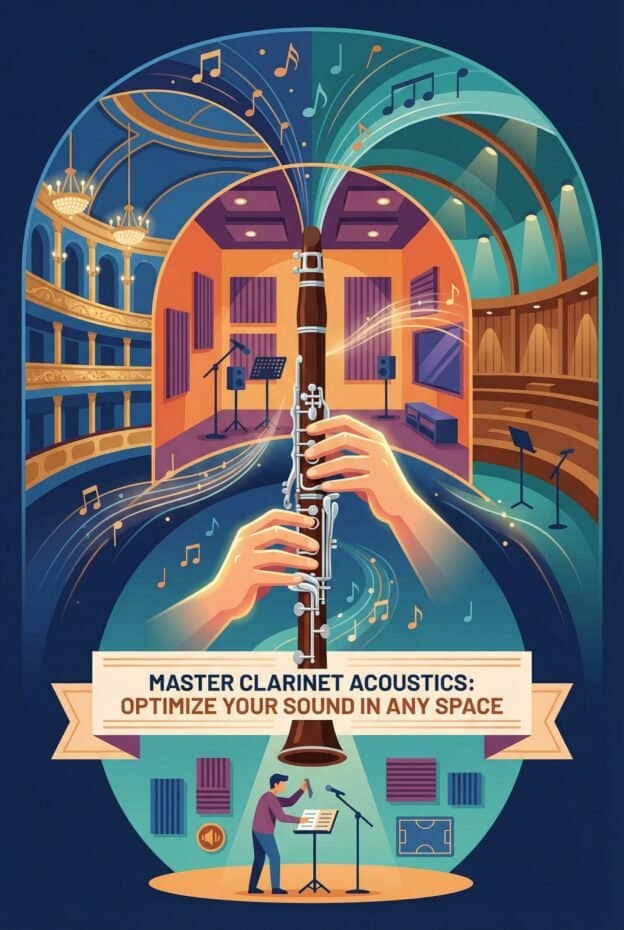
Best venues for clarinetists: recital rooms (intimate clarity), concert halls with balanced reverberation (projection for concertos), churches and cathedrals (rich, long reverb for slow repertoire), outdoor amphitheaters (projected sound for large audiences), and home studios (controlled acoustics for practice and recording).
Why Venue Matters for Clarinetists
The clarinet is unusually sensitive to room acoustics. Its wide dynamic range, focused projection and strong overtones mean that the same player can sound warm and singing in one venue and thin or muddy in another. Choosing the right clarinet venues directly affects tone color, articulation clarity and how easily you balance with colleagues.
For advanced students, freelancers and orchestral players, venue choice is also a career factor. A room that flatters your sound supports confident auditions, convincing concerto performances and reliable recording sessions. For conductors and venue managers, understanding clarinet needs helps with programming, stage layout and microphone strategy.
Engineers and acousticians also benefit from knowing how clarinet tone interacts with RT60, early reflections and absorption. Small changes in microphone distance, shell placement or riser height can transform the perceived quality of a clarinet performance. The right venue plus informed setup lets the instrument speak with its natural character instead of fighting the room.
Typical clarinet-friendly RT60:
Solo recital: 0.8 – 1.4 s
Chamber music: 1.2 – 1.8 s
Orchestral concerto: 1.8 – 2.2 s
How Acoustic Features Affect Clarinet Tone (RT60, Early Reflections, Absorption)
Clarinet venues are defined less by size and more by acoustic features. Three key variables shape what you and the audience hear: RT60 (reverberation time), early reflections and absorption. Understanding these lets you predict how a new space will treat your sound before you play a note.
RT60 is the time it takes for sound to decay by 60 dB after the source stops. Short RT60 (under 1 second) gives clarity and articulation but can feel dry and unforgiving. Longer RT60 (over 2 seconds) creates warmth and blend but can blur fast passages and soft attacks, especially in the low chalumeau register.
Early reflections are the first sound bounces from nearby surfaces, usually within the first 50 to 80 milliseconds. For clarinet, strong early reflections from side walls or a shell help projection and presence without adding too much blur. If those reflections arrive too late or from above only, the sound can feel distant on stage even if the hall sounds lush in the audience.
Absorption comes from seats, curtains, people and soft surfaces. Highly absorptive rooms can make the clarinet sound small and dry, especially at low dynamics. On the other hand, too little absorption in a reflective room can exaggerate brightness and key noise. The ideal clarinet venue balances absorption so that tone remains full while articulation stays clear.
Early reflection window for clarity:
0 – 20 ms: supports presence
20 – 80 ms: supports warmth
Over 80 ms: begins to feel like reverb
Top Venue Types for Clarinet Players
Different clarinet venues favor different repertoire, setups and performance goals. A Mozart concerto needs a different acoustic from a contemporary solo piece with multiphonics or a Brahms trio. Matching venue type to program and ensemble is one of the most powerful choices you can make.
Recital rooms typically seat 80 to 300 listeners and offer short to moderate RT60. They reward subtle dynamics, color changes and detailed articulation. Concert halls seat 800 to 2,500 and often have adjustable acoustics. They support large ensembles and concertos but demand careful balance and projection strategies for clarinetists.
Churches and cathedrals provide long RT60 and rich, diffuse reverberation. They can make lyrical clarinet lines glow, especially in Romantic or sacred repertoire, but can punish fast staccato or complex textures. Outdoor amphitheaters and nontraditional spaces like galleries or warehouses remove or radically alter natural reverb, so you must rely on projection, microphones and staging.
Home studios and small recording rooms are increasingly important clarinet venues. These spaces prioritize control and repeatability over natural bloom. With proper treatment and mic placement, they let you capture a consistent, high quality clarinet sound for auditions, remote sessions and educational content.
Recital Rooms: Intimacy, Clarity and Setup Tips
Recital rooms are often the best clarinet venues for solo and chamber repertoire. Shorter distances between player and audience, moderate RT60 and supportive early reflections favor the clarinet's nuanced tone and articulation. Listeners can hear breath control, color changes and subtle dynamic shading that might be lost in a large hall.
In these rooms, aim your bell slightly above the first row rather than straight at the floor. This spreads sound more evenly and avoids harshness for the closest listeners. If the stage is shallow, experiment with standing 1 to 2 meters behind the front edge so early reflections from the floor and front wall arrive in a supportive time window.
Choose a reed and mouthpiece setup that gives full tone without excessive brightness. Many players prefer a slightly darker, more flexible reed for recital rooms, since you do not need extreme projection. Articulation can be lighter and more legato, as the room will not smear fast passages as much as a large hall or church.
For chamber music, sit or stand so that your bell is not blocked by music stands or colleagues. Clarinet sound is directional, especially in the upper register. A stand directly in front of the bell can strip overtones and make you sound dull. Angle the stand slightly to one side and keep at least 30 centimeters of open air in front of the bell.
Concert Halls: Projection, Balance and Reverb Management
Large concert halls are challenging clarinet venues because they magnify both strengths and weaknesses. The clarinet's focused projection can carry beautifully over an orchestra, but only if you manage reverb, ensemble balance and your own on-stage perception. What you hear on stage often differs from what the audience hears in the back rows.
In a hall with RT60 around 2 seconds, choose a reed that speaks clearly at soft dynamics and allows a bit more core in the sound. Slightly stronger reeds or brighter mouthpieces can help projection, but avoid setups that make the tone edgy. Aim for a centered, compact sound that the hall can expand naturally.
Stage placement matters. For concertos, ask to stand slightly in front of the conductor and not buried inside the string section. This reduces masking from violins and gives your direct sound a clear path to the audience. In orchestral parts, angle your bell toward the audience or a reflective shell rather than directly into neighboring players.
Reverb management in concert halls is mostly about articulation and timing. Shorten staccato slightly and keep note lengths very consistent. In fast passages, think of slightly earlier finger action so that the ensemble stays tight in the listener's perspective. Use clear, focused air at mezzo forte and above so that the hall carries the sound instead of you forcing.
Stage check in large halls:
Walk to back row and balcony during rehearsal.
Listen for: articulation clarity, dynamic contrast, blend with strings.
Adjust reed or placement if clarity is below 7/10.
Churches & Cathedrals: Using Long Reverb Musically
Churches and cathedrals can be magical clarinet venues when used thoughtfully. Long RT60, often 3 to 6 seconds or more, adds a halo to the clarinet's sound, especially in lyrical lines and sustained chords. This suits slow movements, chant-like phrases and Romantic or sacred works that benefit from spaciousness.
However, long reverb can blur fast articulation and complex counterpoint. To keep clarity, simplify tonguing and slightly reduce dynamic extremes. Play staccato more detached than you think you need, and keep forte dynamics narrower to avoid overwhelming the space. Use more resonance in the middle register, which carries well without harshness.
Position yourself so that your sound can develop in the nave, not trapped under a low balcony. If possible, stand a few meters in front of a reflective wall or column so early reflections support your tone. Avoid corners that create strong echoes or uneven response between registers.
Equipment choices in churches favor stability and control. Use reeds that respond easily at pianissimo and allow smooth slurs across the break. A slightly darker mouthpiece can prevent shrillness in the upper clarion and altissimo registers, which can become piercing in highly reflective stone spaces.
Outdoor Amphitheaters & Nontraditional Spaces: Challenges and Opportunities
Outdoor amphitheaters, plazas and nontraditional venues like galleries or warehouses remove or radically change natural reverberation. In open air, there is almost no RT60, so every note stops as soon as you stop blowing. This exposes articulation and pitch but can make the clarinet feel small without amplification.
In amphitheaters with reflective shells, treat the shell as your main acoustic partner. Aim your bell toward the shell so it can project sound back to the audience. Ask for a short sound check from several audience positions. What feels too bright on stage often sounds just right 30 meters away in open air.
Nontraditional indoor spaces can have unpredictable reflections and resonances. Warehouses may have long flutter echoes, while galleries with hard floors and glass can exaggerate brightness and key noise. In such clarinet venues, prioritize microphone placement and modest dynamics. Let the PA system create warmth rather than forcing the room.
Choose reeds that respond quickly and give a clear core to the sound. Slightly brighter setups can help outdoors, but balance this with listener comfort. Wind noise is a real issue in open air. Use windshields on microphones and secure your music with clips. Practice visual cueing with colleagues in case sound delays make audio cues unreliable.
Home Studios and Recording Spaces: Controlling the Sound
Home studios and small recording rooms are increasingly common clarinet venues for auditions, remote sessions and educational content. These spaces prioritize control, repeatability and isolation. The goal is a neutral, clear sound that can be shaped later with reverb and EQ, rather than relying on the room itself.
Basic acoustic treatment makes a big difference. Use broadband absorbers at first reflection points to tame harshness, and add some diffusion or bookshelves behind you to avoid a dead, boxy sound. Aim for RT60 around 0.3 to 0.5 seconds so the room does not color the clarinet tone excessively.
For microphone placement, start with a small diaphragm condenser or ribbon mic 0.7 to 1.2 meters from the clarinet, slightly above the bell, aimed between the left hand and the barrel. This captures a balanced mix of body and brightness. Avoid placing the mic directly at the bell, which exaggerates key noise and harshness.
Choose a reed that is stable and consistent over several takes. Slightly softer reeds can reduce fatigue during long sessions. Monitor with good headphones or speakers at moderate volume so you can judge articulation and noise. Record short test passages at different distances and angles, then choose the most natural, least boxy sound.
Preparing Your Instrument and Team for the Venue (Practical Maintenance & Pre-Show Checklist)
Clarinet venues only help you if the instrument and team are ready. A structured pre-show routine reduces surprises and lets you focus on music. Adjust this checklist for recital rooms, concert halls, churches or outdoor stages, but keep the core steps consistent.
60 – 90 minutes before playing
Swab the bore lightly and check for moisture or warping, especially after travel. Inspect pads for leaks with a feeler gauge or cigarette paper on critical keys (register, throat A, low F/C). Gently oil tenon corks if they feel dry, but avoid over-lubrication that can cause joints to slip during performance.
Reed selection and rotation
Choose 3 to 5 reeds suitable for the venue's acoustic. For live halls and outdoors, slightly stronger or more projecting reeds help clarity. For very live churches, slightly softer, more flexible reeds can help control. Wet and test each reed 30 to 60 minutes before the performance, then rotate during warmup to keep them stable.
30 minutes before playing
Assemble the clarinet and check key action, spring tension and regulation screws. Test all registers with slow scales and slurred intervals across the break. Listen for uneven response that might indicate a leak. Swab again lightly if condensation builds up, especially in cold or humid venues.
Team and staging checklist
With your conductor, colleagues or engineer, confirm stage layout, stand placement and microphone positions. In large halls, ask for a quick check from the back of the room. In outdoor or amplified settings, confirm monitor levels and agree on visual cues in case of audio delays or wind noise.
Martin Freres field note: Early 20th century Martin Freres recital programs in Paris and Lyon often included printed reminders about reed rotation and pad checks before salon concerts. Surviving ads highlight their focus on reliable keywork and stable intonation in small, reflective rooms, a concern that remains central for clarinetists today.
Troubleshooting Common Venue Problems and On-Stage Fixes
Even the best clarinet venues can present problems on the day. Quick, practical fixes help you adapt without panic. Think in terms of three levers: technique, equipment and placement. Adjust the smallest variable that solves the issue so you do not disrupt your overall setup.
Problem: Excessive reverb, blurred articulation
Shorten note lengths slightly, especially in staccato and fast passages. Use a more defined tongue stroke closer to the tip of the reed. Reduce extreme dynamics and aim for a narrower mezzo piano to mezzo forte band. If possible, move a bit closer to absorbent surfaces or ask colleagues to reduce volume in busy textures.
Problem: Poor projection, you feel buried
Angle your bell toward the audience or a reflective shell, not the floor. Move slightly forward on the stage or to the edge of a riser. If you have time, switch to a reed with more core and resistance or a slightly brighter mouthpiece. Increase air speed rather than biting to gain projection.
Problem: Wind noise or outdoor distractions
Use windshields on microphones and secure music with clips or magnets. Shorten page turns by copying tricky pages. Rely more on visual cues with colleagues, since sound may be blown off course. If gusts hit your sound, time phrases between gusts when possible and keep embouchure stable to avoid pitch wobble.
Problem: You cannot hear yourself in a large ensemble
Ask for a small shift in seating so your bell is not blocked. Request a modest increase in your monitor level if amplified. Focus on a clear, centered tone and slightly more front to the sound. Use peripheral hearing to lock with principal winds or concertmaster rather than relying solely on what you hear under your ear.
Case Studies & Notable Clarinet-Friendly Venues (archive references and measurements)
Some halls have become benchmark clarinet venues because of their supportive acoustics and history. Studying these spaces helps you recognize what works. It also offers context for how clarinet repertoire evolved alongside specific rooms and audiences.
Wigmore Hall in London, with RT60 around 1.4 to 1.6 seconds when full, is renowned for chamber music and clarinet recitals. The combination of clear early reflections and warm decay lets clarinetists shape long lines without losing articulation. Many leading players have recorded Brahms, Poulenc and contemporary works there with consistent results.
The Musikverein in Vienna, especially the Goldener Saal, offers RT60 around 2 seconds and rich, enveloping sound. Clarinet concertos by Mozart and Brahms resonate beautifully in this space, where the balance between soloist and orchestra feels natural. The hall's shoebox shape and reflective surfaces support the clarinet's focused projection.
Berlin's major venues, such as the Philharmonie, have hosted historic clarinet performances with the Berlin Philharmonic. The vineyard-style seating and carefully tuned reflections create a sense of intimacy even in a large hall. Clarinetists often comment on the clarity of ensemble and the ability to hear inner voices from the stage.
In early 20th century France, salon and small hall concerts often featured clarinetists using instruments from makers like Martin Freres. Archival programs from Parisian salons show clarinet works by Debussy and his contemporaries presented in rooms with RT60 likely under 1 second, favoring clarity and color over sheer volume. These spaces shaped expectations for French clarinet tone and articulation.
Conclusion: Choosing a Venue That Helps You Sound Your Best
Clarinet venues are not neutral backdrops. They shape tone, projection, articulation and even your confidence on stage. By understanding RT60, early reflections and absorption, you can predict how a room will respond and choose spaces that match your repertoire, ensemble and artistic goals.
Use recital rooms for detailed, intimate programs, concert halls for large-scale works and concertos, churches for lyrical and spacious repertoire, and home studios for controlled recording. Adapt reeds, mouthpieces, articulation and stage placement to each environment. A simple pre-show checklist and troubleshooting plan will keep you flexible.
Over time, track how different venues affect your playing and audience feedback. Treat each hall as a collaborator rather than an obstacle. With experience, you will know within a few notes how to adjust so that any room becomes a clarinet-friendly space that lets your sound and ideas reach listeners clearly.
Key Takeaways
- Match clarinet venues to repertoire: intimate rooms for detail, larger halls for concertos, churches for lyrical works and studios for controlled recording.
- Use acoustic concepts like RT60, early reflections and absorption to predict how a room will affect tone, projection and articulation.
- Prepare with a consistent maintenance and reed rotation routine, and adapt quickly with small changes in articulation, equipment and stage placement.
FAQ
What is clarinet venues?
Clarinet venues are performance and recording spaces where clarinet is featured, such as recital rooms, concert halls, churches, outdoor amphitheaters and studios. Each type of venue has different acoustics that affect clarinet tone, projection, articulation and balance with other instruments.
Which venues make a clarinet sound best and why?
Recital rooms and well designed concert halls usually make clarinets sound best because they balance clarity and warmth. Moderate RT60, supportive early reflections and controlled absorption let the clarinet project without harshness and preserve articulation while still giving the sound a pleasant bloom.
How should I prepare my clarinet and reeds for a reverberant church?
For a reverberant church, choose reeds that respond easily at soft dynamics and allow smooth legato. Test several reeds 30 to 60 minutes before playing and select slightly more flexible ones. Check pads and joints carefully, warm the instrument thoroughly and plan to use lighter articulation and narrower dynamics to control the long reverb.
What mic placement works best for clarinet in a small hall or outdoor stage?
In a small hall, place a condenser mic 0.7 to 1.2 meters from the clarinet, slightly above the bell, aimed between the left hand and barrel. Outdoors, use a similar distance but add a windshield and rely more on the PA for warmth. Avoid pointing the mic directly into the bell to reduce harshness and key noise.
How can I avoid getting lost in ensemble passages in a large concert hall?
In a large hall, angle your bell toward the audience or shell, not into colleagues. Ask for small seating adjustments if you feel buried. Focus on a centered, compact tone, clear articulation and slightly earlier finger action in fast passages. Use visual cues with conductor and principal players to stay locked in rhythmically.
Are there historically important venues associated with the clarinet or Martin Freres instruments?
Yes. Venues like Wigmore Hall in London, the Musikverein in Vienna and the Berlin Philharmonie have hosted landmark clarinet performances and recordings. In early 20th century France, salon and small hall concerts often featured clarinetists using instruments from makers such as Martin Freres, shaping expectations for clarinet tone and articulation in intimate, reflective rooms.
Related Posts: