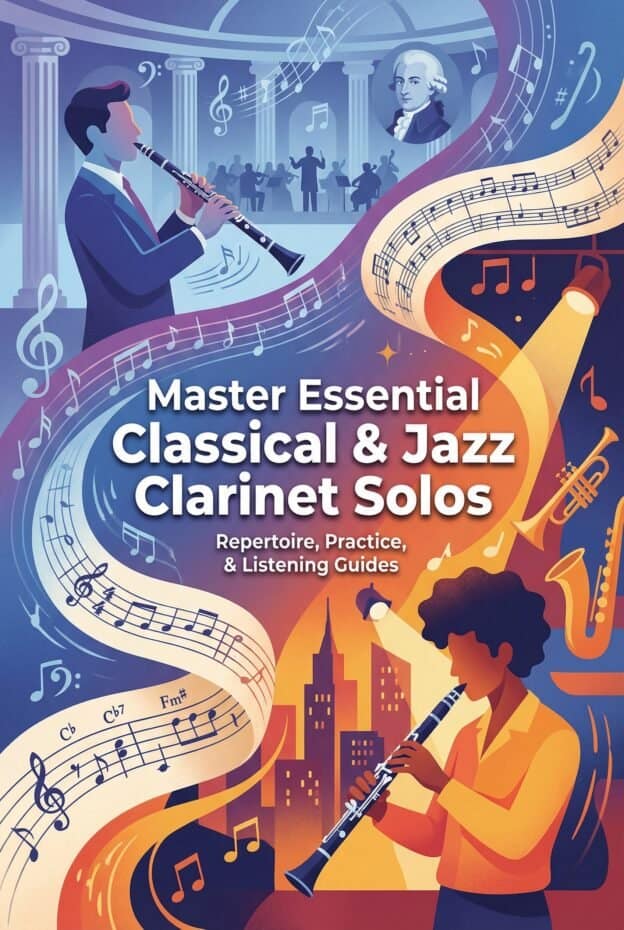
Top clarinet solos include Mozart's Clarinet Concerto in A major K.622, Copland's Clarinet Concerto, Gershwin's Rhapsody in Blue, Debussy's Première Rhapsodie, Rossini's Introduction, Theme and Variations, and key Dixieland solos by Sidney Bechet. Each highlights a different voice of the clarinet. Practice slowly with clear phrase goals, focused articulation, and register control tailored to each style.
Overview: Why Clarinet Solos Matter – Genres and Voice
Clarinet solos sit at the center of the instrument's identity, from Mozart and Debussy to Gershwin and Sidney Bechet. They test tone, technique, and style in ways that orchestral parts rarely do. For students, teachers, and listeners, these works show how one clarinet can sing, dance, and improvise across genres.
In classical concertos, the clarinet acts like a singer with orchestra, moving from chalumeau warmth to brilliant clarion and altissimo. In jazz and Dixieland, solos highlight swing, inflection, and personal sound. Learning both traditions trains flexible phrasing, articulation choices, and comfort in every register of the instrument.
Clarinet solos also shape recital programming. A balanced program often includes one classical concerto movement, one 20th-century piece, and one jazz-influenced work. This mix lets players demonstrate legato control, technical fireworks, and stylistic versatility, all while building a personal repertoire that can grow over many years.
Top Classical Clarinet Concertos and Solo Pieces (Mozart K.622, Copland, Debussy, Rossini)
Mozart's Clarinet Concerto in A major, K.622, written for Anton Stadler, is the cornerstone of clarinet solos. Its three movements demand lyrical breath control, even tone across chalumeau and clarion, and poised classical style. The concerto's range and phrasing still define how teachers and orchestras judge clarinet artistry.
Aaron Copland's Clarinet Concerto, commissioned by Benny Goodman, bridges classical and jazz. The first movement is lyrical and transparent, with exposed high clarion lines. The second movement and cadenza introduce jazz inflections, offbeat accents, and flexible rubato. Players must blend classical clarity with a relaxed, almost improvisatory feel.
Claude Debussy's Première Rhapsodie explores color and nuance. Written for the Paris Conservatoire, it features fluid register shifts, delicate dynamics, and impressionistic harmony. The piece tests legato between chalumeau and clarion, soft attacks, and control of vibrato or vibrato-like inflection without losing core tone.
Gioachino Rossini's Introduction, Theme and Variations is a classic showpiece. The introduction highlights singing tone, while the variations demand rapid articulation, agile fingerwork in the high clarion, and clean leaps. It is often used in competitions to demonstrate virtuosity and stamina, especially in the altissimo register.
Other important solo works include Weber's Concertos in F minor and E flat major, Poulenc's Clarinet Sonata, and Saint-Saëns's Sonata. Each adds a different voice: Weber for Romantic drama, Poulenc for wit and lyricism, Saint-Saëns for classical clarity with late-Romantic color. Together with Mozart, Copland, Debussy, and Rossini, they form a core classical solo library.
Iconic Jazz and Dixieland Clarinet Solos (Gershwin, Sidney Bechet, Goodman-era repertoire)
George Gershwin's Rhapsody in Blue opens with one of the most famous clarinet solos in history: a low chalumeau trill that glides up to a high clarion smear. This solo demands flexible embouchure, smooth glissando technique, and a confident, vocal sound. It is a bridge between classical concert music and jazz idiom.
Sidney Bechet, a key Dixieland and early jazz clarinetist and soprano saxophonist, left iconic solos on recordings like “Petite Fleur” and “Summertime.” His playing features wide vibrato, expressive portamento, and strong rhythmic drive. Studying his solos by ear trains phrasing, swing feel, and personal ornamentation beyond what is written on the page.
Benny Goodman, the “King of Swing,” expanded the clarinet's role in big band and small group jazz. Solos from pieces like “Sing, Sing, Sing” and “Stompin' at the Savoy” show tight articulation, clean altissimo, and precise swing. Goodman's collaboration with Copland on the Clarinet Concerto illustrates how jazz phrasing can inform classical works.
Other important jazz clarinet voices include Artie Shaw, Buddy DeFranco, and modern players like Anat Cohen and Ken Peplowski. Their solos demonstrate different approaches to time feel, articulation, and tone color. Transcribing even short phrases from these players helps classical clarinetists internalize swing and flexible articulation patterns.
For clarinetists, jazz solos are not only about improvisation. They sharpen rhythmic accuracy, ear training, and comfort in the upper clarion and altissimo registers. Combining classical studies with jazz transcription builds a more complete musical vocabulary and a more personal sound on the instrument.
Important Études and Technical Studies (Paul Jeanjean and others) for Solo Preparation
Études connect technique to repertoire. For clarinet solos, Paul Jeanjean's “18 Études de Perfectionnement” and “16 Études Modernes” are central. They target wide interval leaps, rapid articulation, and complex rhythms similar to those in Debussy, Copland, and Rossini. Many teachers assign specific Jeanjean numbers to match solo passages.
Rose 32 Études and 40 Studies are foundational for Mozart and Weber. They focus on classical phrasing, clear articulation, and even tone across chalumeau and clarion. Practicing Rose with strict rhythm and elegant dynamics directly improves control in Mozart K.622, especially in the Allegro and Rondo movements.
Baermann and Klosé method books address scale and arpeggio patterns that appear in Rossini and Weber. Regular work on full-range scales, broken chords, and thirds smooths register transitions and stabilizes finger coordination. These patterns also support Copland's wide intervals and Debussy's chromatic lines.
For jazz-oriented solos, players benefit from articulation and pattern studies such as the “Universal Method” by Klosé and modern jazz clarinet books that include swing eighth-note exercises. Combining these with transcription of short phrases from Goodman or Bechet creates a practical bridge between written studies and real solos.
When choosing études, match them to repertoire challenges. For example, use Jeanjean for altissimo leaps before tackling the highest Rossini variations, or Rose slow lyrical studies before shaping the Mozart Adagio. This targeted approach saves time and creates clear technical goals for each practice week.
Movement-by-Movement Practice Notes (e.g., Mozart: Allegro / Adagio / Rondo)
Mozart's Allegro from K.622 requires clean articulation, light staccato, and stable intonation in the clarion register. Practice in small two-bar units with a tuner, focusing on even fingers and consistent air. Use dotted-rhythm and reverse-dotted practice to stabilize tricky sixteenth-note runs and leaps across the break.
The Adagio centers on long phrases and breath control. Aim to play full phrases without obvious gasps, planning breaths at cadences. Practice with a drone to stabilize pitch in the chalumeau and low clarion. Use soft, supported attacks and experiment with minimal vibrato or gentle inflection appropriate to Classical style.
The Rondo (Allegro) combines playful character with technical clarity. Articulation must stay light and precise, especially in repeated-note figures. Practice at half tempo with exaggerated dynamic contrasts, then gradually increase speed. Pay attention to even tone when moving between low chalumeau and high clarion in rapid passages.
For Copland's Concerto, treat the first movement as a study in legato and color. Practice long tones on key notes of each phrase, then connect them with smooth finger motion. In the cadenza and second movement, isolate syncopated rhythms and offbeats, counting subdivisions aloud to internalize the jazz-influenced groove.
In Debussy's Première Rhapsodie, mark every register shift and dynamic change. Practice slurred octave and twelfth jumps on long tones before adding the written rhythm. For Rossini's Introduction, Theme and Variations, separate the lyrical introduction from the fast variations. Build speed only after you can play each variation slowly with perfect rhythm and even tone.
Technique and Interpretation: Articulation, Phrasing, Tone Across Registers
Clarinet solos demand control of all registers: chalumeau (low), clarion (middle), and altissimo (high). Mozart and Debussy require smooth transitions between chalumeau warmth and clarion brightness. Practice slow scales that cross the break, focusing on steady air and relaxed fingers to avoid squeaks and uneven tone.
Articulation style changes with genre. In Mozart and Rossini, aim for light, precise tonguing near the tip of the reed, with minimal tongue motion. In jazz and Gershwin, articulation can be more varied, mixing legato tongue, ghosted notes, and accented offbeats. Listening to Benny Goodman and Sidney Bechet helps internalize these differences.
Tone production starts with embouchure and air. For lyrical solos like the Mozart Adagio or Debussy, keep a stable embouchure with firm corners and flexible jaw, using warm, fast air. For brighter, more projecting tone in Rossini or big band jazz, adjust reed and mouthpiece choice and slightly increase air speed without biting.
Phrasing in classical solos often follows harmonic and melodic structure. Mark phrase peaks and cadences in Mozart, Debussy, and Copland, then shape dynamics to match. In jazz solos, phrasing follows the groove and chord changes. Practice singing or scatting jazz lines before playing them to develop natural, speech-like inflection.
Interpretation also involves stylistic choices like vibrato use, rubato, and ornamentation. In Mozart, keep vibrato minimal and ornaments tasteful, often based on classical performance practice. In Copland and Gershwin, a bit more flexibility in time and color is appropriate. Listening to multiple recordings by artists such as Sabine Meyer, Martin Fröst, and Richard Stoltzman offers contrasting but valid approaches.
Recordings, Scores, and Editions to Study (what to look for and where to find them)
When choosing recordings of clarinet solos, look for clarity of sound, stylistic authenticity, and reliable tempo choices. For Mozart K.622, compare versions by artists like Sabine Meyer, Martin Fröst, and Karl Leister. Note differences in ornamentation, vibrato, and phrasing, then decide what aligns with your musical goals and your teacher's guidance.
For Copland's Clarinet Concerto, listen to Benny Goodman's own recording, along with modern interpretations by players such as Richard Stoltzman. Pay attention to how each clarinetist handles the cadenza, rubato, and jazz-influenced rhythms. For Debussy's Première Rhapsodie, recordings by French-school players highlight traditional tone and color choices.
Scores can be found through major publishers and public-domain libraries for older works. When possible, use urtext or scholarly editions for Mozart and Weber, which minimize editorial changes. For Debussy, Copland, and Rossini, choose editions that clearly mark articulations, dynamics, and tempo indications, and avoid versions with excessive editorial phrasing marks.
Jazz solos by Sidney Bechet, Benny Goodman, and Artie Shaw are best studied from recordings and transcriptions. Many published transcription books include accurate notation of classic solos. Always check that the transcription matches a specific recording date and band, since arrangements and details can change between performances.
When studying from score, mark technical problem spots, phrase peaks, and breathing points. Use a pencil to note fingerings for difficult altissimo notes or alternate clarion fingerings. Treat the score as a living document that records your evolving understanding of the piece rather than a static page.
Practice Plan, Troubleshooting, and Expected Player Outcomes
A focused practice plan for clarinet solos should combine tone work, technical drills, and repertoire segments. A typical 60-minute session might include 10 minutes of long tones across registers, 15 minutes of scales and arpeggios, 15 minutes of targeted études, and 20 minutes of slow, detailed solo practice with metronome and tuner.
Common problems include squeaks on altissimo notes, uneven tone between chalumeau and clarion, and unstable tempo in fast movements. To fix squeaks, check embouchure pressure and finger coverage, then practice slow register slurs with steady air. For tone consistency, use long-tone exercises that cross the break, listening for color changes and adjusting voicing.
Rhythmic issues in jazz-influenced solos often come from unclear subdivision. Practice Gershwin or Copland syncopations at very slow tempos, counting sixteenth-note subdivisions aloud. Clap or tap the rhythm away from the instrument, then add the notes. For swing feel, listen and play along with recordings, matching articulation and placement behind or on the beat.
Maintenance before solo performance includes checking reeds, swabbing the bore, and inspecting pads for leaks. Choose a reed strength and tip opening that allow both soft attacks in the Mozart Adagio and clear projection in Rossini or jazz passages. Apply cork grease to tenons for secure assembly, and test all keys quietly before walking on stage.
With consistent work, players can expect measurable outcomes: sustaining full Mozart Adagio phrases at tempo with stable intonation, executing Rossini variations cleanly near marked speed, and switching comfortably between classical legato and jazz swing. These skills translate directly to auditions, competitions, and confident recital performances.
Key Takeaways
- Mozart K.622, Copland's Concerto, Debussy's Première Rhapsodie, Rossini's Introduction, Theme and Variations, and Gershwin's Rhapsody in Blue form a core clarinet solo repertoire across classical and jazz styles.
- Targeted études by Jeanjean, Rose, Baermann, and Klosé directly support the technical and lyrical demands of these solos, especially register transitions and articulation.
- Listening to recordings by Mozart specialists and jazz legends like Sidney Bechet and Benny Goodman sharpens stylistic awareness and informs phrasing, tone, and swing feel.
- A structured practice plan combining tone work, technical drills, and slow, detailed repertoire practice leads to reliable performance outcomes and audition-ready solos.
FAQ
What is clarinet solos?
Clarinet solos are pieces or sections of music where the clarinet is the primary melodic voice, either with piano, orchestra, band, or rhythm section. They include classical concertos, recital pieces, and jazz improvisations, all designed to showcase the instrument's tone, range, and expressive possibilities.
Which clarinet concertos and solos are important for every player?
Important clarinet solos include Mozart's Clarinet Concerto K.622, Weber's Concertos, Debussy's Première Rhapsodie, Rossini's Introduction, Theme and Variations, Poulenc's Sonata, and Copland's Clarinet Concerto. On the jazz side, the opening of Gershwin's Rhapsody in Blue and solos by Sidney Bechet and Benny Goodman are key listening and transcription material.
How should I practice Mozart's Clarinet Concerto Adagio?
Practice the Mozart Adagio at a slow tempo, focusing on breath planning and phrase shape. Use a tuner or drone to stabilize pitch in the chalumeau and clarion registers. Aim to play full phrases without tension, with soft, supported attacks and clear dynamic direction toward and away from cadences.
What études help prepare me for clarinet solos?
Jeanjean's “18 Études de Perfectionnement” and “16 Études Modernes” prepare you for wide leaps and complex rhythms found in Copland, Debussy, and Rossini. Rose 32 Études and 40 Studies support Mozart and Weber with classical phrasing and articulation. Baermann and Klosé methods strengthen scales, arpeggios, and register transitions used in nearly all major solos.
Where can I find reliable editions and recordings of famous clarinet solos?
Reliable editions of Mozart, Weber, and other standard works are available from major classical publishers and public-domain libraries for older pieces. For Debussy, Copland, and Rossini, choose editions from established publishers with clear markings. Recordings by artists like Sabine Meyer, Martin Fröst, Karl Leister, Benny Goodman, and Sidney Bechet provide strong reference points for style and interpretation.
Related Posts: