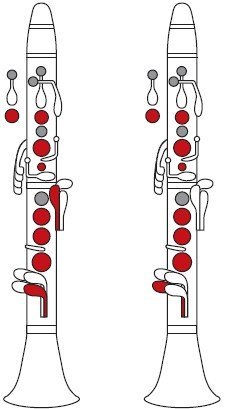
If you close your eyes, you can almost hear it: a single Bb clarinet singing the melody of “Jack And Jill” in a quiet classroom, or in a living room where the music stand is balancing on a carpet that is just a bit too soft. “Jack And Jill” is often one of the first songs that a new clarinetist learns, but it carries the same emotional weight as any Mozart concerto or Benny Goodman solo: it is the doorway where music stops being theory and starts becoming part of your own story.
Receive a free PDF of the chart with clarinet fingering diagrams for every note!
The Jack And Jill clarinet fingering chart is a simple Bb clarinet guide that shows which keys to press for every note in the melody. It helps beginners read the tune quickly, build confidence in tone and rhythm, and turn an easy nursery song into a real musical experience.
The Secret Power Of Jack And Jill On Bb Clarinet
On paper, “Jack And Jill” looks innocent: a small range, mostly stepwise motion, and a rhythm that any beginner can count. But ask any clarinet teacher who has watched a student light up after playing it correctly from start to finish, and you will hear the same thing: this little rhyme is a rite of passage.
For many players, that first full performance of “Jack And Jill” is where holding the Bb clarinet finally feels natural. The left thumb finds the register key without panic, the right hand settles near the F and E tone holes, and the embouchure stops fighting the mouthpiece. That tiny melody carries the promise that bigger things are coming: Mozart, Weber, Brahms, maybe even a Gershwin cadenza in a concert hall someday.
From Nursery Rhyme To Concert Stage: A Quiet Historical Journey
The nursery rhyme “Jack And Jill” dates back to at least the 18th century, long before the modern Boehm-system Bb clarinet took its familiar shape. While children were chanting those words in English villages, clarinet pioneers like Anton Stadler and Heinrich Baermann were playing early clarinets in courts and theaters across Europe.
Imagine the musical world around 1780: Stadler inspiring Wolfgang Amadeus Mozart to write the Clarinet Concerto in A major, K. 622, while young voices outside the concert hall sang simple tunes like “Jack And Jill” and “Hot Cross Buns.” That contrast between grand concerto and street song has followed the clarinet ever since. The same instrument that soars in the slow movement of the Mozart Clarinet Concerto can whisper a nursery rhyme with equal honesty.
By the time the clarinet matured in the 19th century, composers like Carl Maria von Weber and Johannes Brahms were stretching its lyrical range in concertos and sonatas. Yet in conservatories and small town studios, students still warmed up with folk songs and rhymes. “Jack And Jill” and other short tunes gave teachers a gentle way to introduce legato phrasing, breath control, and the mystery of playing in tune with a piano or a second clarinet.
Field Note: In the Martin Freres archives, there are early 20th century teaching booklets that pair simple songs like “Jack And Jill” with fingering illustrations for French-system clarinets. Many of those charts include penciled-in alternate fingerings from teachers, showing how even the simplest tune became a personal conversation between student, instrument, and mentor.
How Great Clarinetists Grew From Simple Songs
No one hears Benny Goodman play “Sing, Sing, Sing” or Sabine Meyer perform the Brahms Clarinet Quintet and thinks about nursery rhymes. Yet almost every major clarinetist started with songs just like “Jack And Jill” on a student Bb clarinet, sitting on a squeaky chair under fluorescent lights.
Anton Stadler, the clarinetist for whom Mozart wrote the Clarinet Quintet in A major K. 581 and the famous concerto, grew up in a time when folk tunes and simple songs were constant companions. While we do not have recordings, we know that players like Stadler and Heinrich Baermann trained their breath and finger coordination on straightforward melodies before attempting arpeggios and concertos.
Fast forward to the 20th century: Benny Goodman practiced basic études and folk-style melodies as a child in Chicago before ever stepping into Carnegie Hall. Artie Shaw did the same with method books that mixed technical studies with short, singable songs. The ability to phrase a simple melody was exactly what later let them shape jazz standards like “Body and Soul” and “Stardust” with such natural speech-like flow.
In classical circles, Sabine Meyer has often spoken about the importance of clear, song-like playing. Listen to her recording of the Mozart Clarinet Concerto with the Staatskapelle Dresden and you will hear the same kind of simplicity in her phrasing that a beginner reaches for in “Jack And Jill”: a sense that every note belongs to a line you could hum without the instrument.
Martin Frost, known for his performances of Anders Hillborg's Clarinet Concerto and Aaron Copland's Clarinet Concerto, often leans into folk-like inflection, even in complex modern music. That ability starts with pieces that fit in the hand easily: tunes in concert Bb, F, and C, very much like the range used in most “Jack And Jill” arrangements for Bb clarinet.
Range spotlight: about 5 to 8 notes
Most “Jack And Jill” clarinet arrangements sit between written G below the staff and E just above, using only 5 to 8 notes. That small range lets you focus fully on tone, rhythm, and breathing instead of worrying about register shifts or pinky-key gymnastics.
From Jack And Jill To Mozart And Jazz: Shared Musical DNA
Look closely at the “Jack And Jill” clarinet fingering chart and you will notice something quietly beautiful: the stepwise motion of the melody is the same musical language that appears in major works for clarinet, just in miniature.
Here are a few surprising connections:
The gentle rise and fall in “Jack And Jill” mirrors the contour of the opening theme in Mozart's Clarinet Concerto K. 622, just compressed into a tiny range.
The simple rhythmic flow foreshadows the smooth legato phrases in Carl Maria von Weber's Clarinet Concerto No. 1 in F minor, where the solo clarinet sings over the orchestra with the same kind of speech-like pacing.
The scalar fragments are distant cousins of the patterns in Rose 32 Études and Baermann Method studies, staples for advanced classical students.
In jazz, pieces like “Do You Know What It Means to Miss New Orleans” or “I'm Confessin' That I Love You” often use similar stepwise motion in the clarinet line. Benny Goodman and Buddy DeFranco turned those shapes into rich swing and bebop language, but the building blocks remain familiar to anyone who has played a nursery tune.
Even in klezmer, where clarinetists like Giora Feidman and David Krakauer bend pitches, slide between notes, and ornament simple themes, the core melodies are as singable as “Jack And Jill.” Tunes such as “Der Heyser Bulgar” and “Ale Brider” rely on clear, memorable lines that any child could hum, then expand them with ornaments and cries from the clarinet's chalumeau and clarion registers.
Film composers have followed the same path. Listen to the clarinet writing in John Williams's score for “Schindler's List” or Alexandre Desplat's clarinet lines in “The Grand Budapest Hotel.” Underneath the sophisticated harmony is the same basic idea: a melody that would still move you if it were played on a Bb clarinet by a student with only a few months of experience.
Why Jack And Jill Matters Emotionally On Clarinet
There is something disarming about hearing a clarinet play a nursery rhyme. The instrument that can roar over a full big band in a Goodman chart suddenly sounds fragile and human. “Jack And Jill” strips away all bravado and leaves only the question: can you make a single line of notes speak with honesty?
When a beginner finally plays it in time, with a steady airstream and a clear embouchure, there is often a little pause afterwards. Teacher and student look at each other, surprised that it suddenly sounded like real music instead of exercises. That small shock is emotional. It says: “This is not just a plastic clarinet and a paper book. This is me, speaking in sound.”
For an advanced player, returning to “Jack And Jill” can be a quiet reset. After wrestling with fast passages in Brahms's Clarinet Sonata in F minor or the rapid-fire articulation in Artie Shaw's “Concerto for Clarinet,” going back to a simple tune can reveal whether the breath is free, whether the fingers are relaxed, whether the throat tone A and B are singing or pinched.
That is the secret value of this song: it keeps the clarinet honest. No fancy altissimo note or double-tongue trick will hide a shaky sense of line when the melody is this exposed.
How The Jack And Jill Clarinet Fingering Chart Fits Into Your Playing
The fingering chart for “Jack And Jill” is intentionally plain. On a Bb clarinet, most versions are written in an easy key like concert Bb or F, so you spend your time on the basics: left-hand position, right-hand support, and a relaxed thumb on the register key. The chart shows exactly which keys to press for each note in the melody, so there is no guessing.
That clarity matters whether you play a modern plastic student clarinet or a vintage Martin Freres wooden instrument with aged grenadilla and silver-plated keys. The fingering positions remain the same. Once you understand that map for a tune this simple, your fingers are ready for more ambitious melodies in method books, orchestral parts, and jazz charts.
Melody type
Typical range on Bb clarinet
How it prepares you
“Jack And Jill”
G below staff to E above
Introduces basic finger patterns and steady breath
Folk songs in method books
Low E to A above staff
Prepares hand for full chalumeau and clarion usage
Mozart concerto themes
Low E to high C and above
Develops advanced phrasing and register transitions
Turning Jack And Jill Into A Real Musical Study
Once you have the fingering chart in front of you, the fun begins. You can treat “Jack And Jill” as your own little clarinet lab. Classical players, jazz enthusiasts, and klezmer fans can all use the same melody for very different goals.
Here is a simple practice plan that works on any Bb clarinet setup, from a basic 2.5 reed and student mouthpiece to a professional Vandoren or Selmer setup with a 3.5 reed and custom ligature.
Practice focus
Time
How to use “Jack And Jill”
Tone and breath
5 minutes
Play the song as slowly as possible with one long breath for each phrase. Focus on even sound between throat tones and chalumeau notes.
Rhythm and pulse
5 minutes
Use a metronome and clap the rhythm, then play while keeping a steady foot tap. This builds time feel for later jazz or ensemble work.
Articulation
5 minutes
Repeat the melody with all slurs, all tongued, and then in two-note slurs. This echoes the kind of work you will do later in Rose 40 Studies.
Quick Troubleshooting For Common Jack And Jill Issues
Because the melody is so transparent, tiny problems stand out. Here is a quick-reference guide for typical challenges when using the Jack And Jill clarinet fingering chart.
Problem
Likely cause
Simple fix
Notes squeak on higher pitches
Too much lip pressure or weak air support
Relax the jaw, keep a firm but gentle embouchure, and blow a strong, steady air stream like saying “ho.”
Melody sounds choppy
Tongue hitting too hard or stopping air
Think of the tongue as saying “du” on the tip of the reed while air flows constantly behind it.
Fingers feel tense
Gripping the keys instead of resting lightly
Check that the left thumb covers the tone hole comfortably, and let the fingers curve like holding a small orange.
How Jack And Jill Prepares You For Bigger Clarinet Adventures
Learning “Jack And Jill” with a clear fingering chart is not just about getting through a beginner tune. It is a quiet rehearsal for later clarinet dreams. The same breath that carries this nursery rhyme will one day carry the long lines of the Brahms Clarinet Sonata in E flat or the haunting solo in Rachmaninoff's Symphony No. 2.
The careful hand position that makes transitions between written A, B, and C comfortable will support the more demanding finger patterns in Debussy's “Premiere Rhapsodie” and the chalumeau leaps in George Gershwin's Rhapsody in Blue. The rhythmic steadiness you practice here prepares you for playing in wind ensembles, concert bands, klezmer groups, and jazz combos.
For students exploring other MartinFreres.net learning materials, pieces like “Jack And Jill” often appear alongside simple scales, tone studies, and folk songs. Together, they form a small but powerful foundation that later supports orchestral excerpts, chamber music, and even studio work for film and television scores.
Key Takeaways
Use the Jack And Jill clarinet fingering chart to focus on tone, breath, and relaxed hand position without technical overload.
Treat this simple melody like a miniature concerto: shape phrases, refine rhythm, and listen for a singing sound on every note.
Return to Jack And Jill regularly as a checkup piece while you grow into Mozart, Weber, jazz standards, and klezmer tunes.
Frequently Asked Questions
What is Jack And Jill clarinet fingering chart?
The Jack And Jill clarinet fingering chart is a simple visual guide for Bb clarinet that shows which keys to press for every note in the “Jack And Jill” melody. It helps beginners connect written notes to finger positions quickly so they can focus on sound, rhythm, and musical expression.
Is Jack And Jill a good first song for Bb clarinet?
Yes, “Jack And Jill” is excellent for beginners. It uses a small range, mostly stepwise motion, and an easy rhythm. That combination lets new players work on embouchure, air support, and hand position without being overwhelmed. It is also familiar, which makes reading and memorizing much less stressful.
Which notes are usually used in Jack And Jill on clarinet?
Most Bb clarinet versions of “Jack And Jill” stick to notes like G, A, B, C, D, and E in the staff area, sometimes dipping to low F or rising to E above the staff. This keeps the melody in the comfortable chalumeau and lower clarion registers so beginners can focus on clear fingerings and steady tone.
How can advanced players use Jack And Jill for practice?
Advanced players can treat “Jack And Jill” as a tone and phrasing study. Try it with different articulations, varied dynamics, transposed to new keys, or played in contrasting styles such as classical legato, swing, or klezmer-style inflection. The simplicity of the tune exposes small issues in breath, finger tension, and intonation.
Do I need special equipment to play Jack And Jill on clarinet?
No special equipment is needed. Any standard Bb clarinet, a comfortable reed strength such as 2.5 or 3, and a reliable mouthpiece will work. A music stand, metronome, and the fingering chart are helpful. The most important “equipment” is a relaxed embouchure, steady air, and a willingness to listen closely.