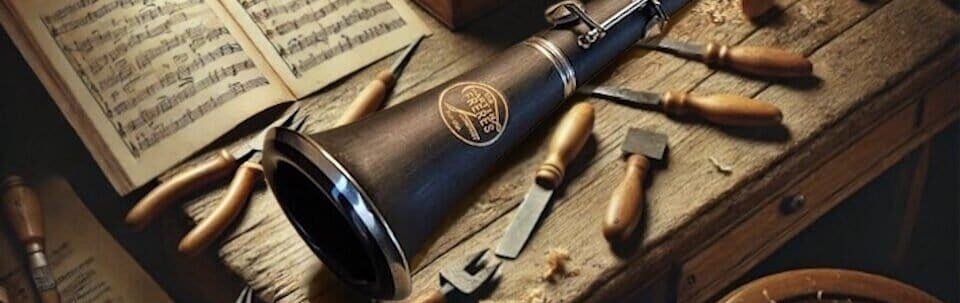
Historical clarinet tuning fork usage refers to the practice, common in the 18th-19th centuries, of using a struck metal tuning fork (typically A=435-A=440 Hz) as an external reference pitch to tune clarinet intonation by adjusting barrel length, reed position, and embouchure. Clarinetists relied on this stable pitch source to align with regional standards and ensemble tuning.
Introduction: Why Tuning Forks Mattered for Clarinetists
For clarinetists of the 18th and 19th centuries, the tuning fork was not a curiosity but a daily tool. Before electronic tuners, a small steel fork provided the only portable, stable pitch reference. Clarinet players used it to set their A, match local pitch standards, and control intonation across changing venues and ensembles.
Because clarinets are highly sensitive to barrel length, mouthpiece setup, and temperature, a reliable reference pitch was important. A tuning fork allowed a player to verify whether the instrument, the reed, or the player was responsible for pitch drift. This practice shaped rehearsal habits, instrument design, and even how clarinetists thought about tone and blend.
Historical tuning fork usage also reveals how flexible pitch actually was. Surviving forks and written sources show that A could vary widely between cities and institutions. Understanding how clarinetists worked with these forks helps modern players interpret old parts, restore period instruments, and perform with historically informed intonation.
Typical 19th century orchestral pitch: A ~ 435 Hz in France and much of continental Europe, rising toward A ~ 440 Hz by the early 20th century.
Historical Context: 18th-19th Century Pitch Standards and Regional Variants
Pitch in the 18th and 19th centuries was anything but fixed. Surviving tuning forks from Paris, Vienna, London, and Leipzig show A values from roughly 420 Hz to over 450 Hz. Clarinetists had to adapt constantly, and the tuning fork was the bridge between their personal instrument and the local standard.
In France, sources connected with the Paris Conservatoire and makers like Buffet and Martin Freres point toward a gradual stabilization around A=435 in the mid to late 19th century. This pitch, sometimes called diapason normal, was legally adopted in France in 1859. Many French orchestras and opera houses used forks stamped near A=435 well into the early 20th century.
German-speaking regions, including Berlin, Dresden, and Vienna, often favored slightly higher pitches. Surviving forks from the Vienna Court Opera and the Leipzig Gewandhaus suggest A values around 438 to 445 Hz in the later 19th century. Clarinetists moving between cities could not assume a single standard and often carried multiple forks or recalibrated their expectations.
In 1859, France officially adopted A=435 Hz as “diapason normal” for state institutions, influencing clarinet makers and conservatory training.
In England, the situation was even more complex. Some London orchestras used the so-called “high pitch” around A=452 Hz in the late 19th century, while others moved toward “low pitch” closer to A=439-440 Hz. Clarinetists in military bands, theater orchestras, and symphonic groups might encounter different forks and had to adjust barrel length and mouthpiece choice accordingly.
Period treatises by authors such as Carl Baermann, Hyacinthe Klosé, and later Georges Labroque discuss tuning practices, even when they do not always mention tuning forks explicitly. Combined with surviving forks stamped with makers' names, orchestral inscriptions, and dates, these sources show that clarinetists used forks to reconcile their instrument's natural pitch with the pitch demanded by the ensemble.
Archive Evidence and Case Studies (including Martin Freres instruments)
Archival evidence for historical clarinet tuning fork usage appears in letters, conservatory regulations, and instrument makers' records. For example, correspondence from Paris Conservatoire professors in the late 19th century mentions the use of official forks for examinations, ensuring that clarinet students tuned to the same A as the piano and wind ensemble.
In German archives, documents from the Dresden Court Orchestra and Leipzig Gewandhaus reference the distribution of standardized forks to principal players. Clarinetists were expected to tune their instruments to the concertmaster's fork before rehearsal. Surviving forks engraved with orchestral names confirm that these were not personal accessories but institutional tools.
From Martin Freres archival notes: Several late-19th-century French clarinets are annotated with remarks like “accordé au diapason 435” in workshop books. These entries suggest that makers checked new instruments against a reference fork, adjusting barrel length and bore to align with the prevailing French standard.
Martin Freres instruments from the late 1800s and early 1900s often show bore dimensions and barrel lengths consistent with A=435 or slightly higher. When these instruments are tested today with a historical fork, they tend to sit comfortably at that pitch with a period-style mouthpiece and reed. This supports the idea that makers built clarinets around a specific fork-based standard.
Case studies from museum collections, such as the Musée de la Musique in Paris or the Germanisches Nationalmuseum in Nuremberg, show clarinets preserved together with tuning forks in the same provenance group. In some estates, a clarinet, a fork stamped A=435, and handwritten notes on tuning appear together, providing a direct link between the player's daily practice and the physical tools they used.
Letters from touring clarinetists in the late 19th century mention the need to “raise” or “lower” their instrument by changing barrels or mouthpieces when playing in different cities. These letters sometimes refer to the local “diapason” or to the pitch of the piano, which itself was set using a tuning fork. The fork, even when not named directly, sat at the root of these adjustments.
Acoustic Science: How Tuning Forks Produce a Stable Reference Pitch
A tuning fork is a precisely shaped steel resonator. When struck, its two prongs vibrate at a specific frequency determined by their length, thickness, and material. For historical clarinetists, the key value was the fundamental frequency, usually labeled as A, which produced a clear, stable tone that changed very little with moderate temperature shifts.
Unlike a clarinet, which radiates sound from tone holes and the bell, a tuning fork radiates weakly from the prongs themselves. The strongest sound comes when the base of the fork is coupled to a resonant surface, such as a wooden table, a small sound box, or even the clarinet's barrel or bell. This coupling amplifies the fork's vibration without changing its pitch.
Because the fork's pitch depends mostly on its geometry and the elastic properties of the steel, it is much less affected by air temperature than a wind instrument. A clarinet might shift 5 to 10 cents with a small temperature change, but a fork's shift is minimal. That stability made it ideal as a reference for clarinetists who needed to check intonation throughout a rehearsal or concert day.
A temperature change of 10 °C can alter a clarinet's pitch by roughly 15-20 cents, while a steel tuning fork might shift by only 1-3 cents.
Acoustically, clarinetists used the tuning fork to generate beats. When they played an A against the fork, any small frequency difference produced audible pulsations. Slowing or eliminating these beats by adjusting barrel position, embouchure, or reed placement allowed them to align their pitch precisely with the fork's stable frequency.
Historical forks were not perfectly uniform, and some drifted slightly with age or corrosion. However, compared to the variability of pianos, organs, and wind instruments, the tuning fork remained the most reliable portable reference. Clarinetists trusted it to define pitch even when other instruments in the ensemble were less stable.
Clarinet Anatomy and Pitch Adjustments (barrel, reed, embouchure, bore)
To understand historical clarinet tuning fork usage, it helps to link specific clarinet parts to their effect on pitch. Clarinetists of the 18th and 19th centuries did not speak in modern acoustic terms, but their practical methods match what we now know about the instrument's physics.
Barrel length vs effective length of the air column
The barrel is the most obvious tuning point. Pulling the barrel out lengthens the air column, lowering pitch; pushing it in shortens the column, raising pitch. Historical clarinetists typically tuned their A by adjusting the barrel against the tuning fork, then checked other notes to ensure that the instrument's internal scale remained balanced.
Period clarinets often came with multiple barrels of slightly different lengths. A clarinetist might use a shorter barrel in a higher pitch city and a longer one in a lower pitch environment. The tuning fork provided the reference that told the player which barrel would place the instrument's natural scale closest to the local standard.
Mouthpiece and reed setup
Mouthpiece design and reed placement have a strong effect on pitch. A more closed mouthpiece or harder reed can encourage sharper playing, while a more open mouthpiece or softer reed can lower pitch. Historical mouthpieces were generally shorter and more closed than many modern designs, which aligns with lower pitch standards like A=435.
Clarinetists historically slid the reed slightly up or down on the mouthpiece table to fine tune. Moving the reed tip closer to the mouthpiece tip can sharpen the response; moving it slightly down can flatten it. When used with a tuning fork, this adjustment helped align the upper register or correct a persistent tendency to play sharp or flat.
Bore profile and keywork
The internal bore profile, especially in the upper joint, strongly influences the tuning of specific notes. Makers like Martin Freres and Buffet adjusted bore diameters and undercut tone holes to balance the scale around the chosen reference pitch. Once built, the player had limited control over these features but could choose fingerings and voicing strategies informed by the tuning fork.
Keywork also affects tuning indirectly. Historical clarinets with fewer keys often required cross fingerings that altered the effective length and venting of the air column. Clarinetists used the tuning fork to test these cross fingerings, learning which notes needed embouchure correction or alternative fingerings to match the reference A.
Embouchure and voicing
Embouchure pressure and tongue position, sometimes called voicing, can shift pitch by several cents. A firmer embouchure and higher tongue tend to raise pitch; a more relaxed embouchure and lower tongue tend to lower it. Historical methods often advised players to practice long tones against a fork to stabilize embouchure and voicing around the chosen pitch standard.
By combining barrel adjustment, mouthpiece and reed setup, and embouchure control, clarinetists could align their entire scale with the tuning fork. This multi-layered approach is central to understanding how they used forks in daily practice, not just as a one-time tuning check.
Practical Techniques: How Clarinetists Historically Used a Tuning Fork
Historical clarinet tuning fork usage involved specific, repeatable routines. While exact instructions vary by source, common patterns appear in conservatory traditions and players' notes. These techniques can be reconstructed and applied today for both period and modern instruments.
Basic tuning routine with a fork
1. Warm the clarinet by playing gentle long tones for 3 to 5 minutes.
2. Strike the tuning fork on a firm but non-damaging surface, such as the knee or a rubber pad.
3. Place the base of the fork on a resonant surface, often a wooden table or the clarinet's barrel cap.
4. Play written A (concert A) in the chalumeau or clarion register, depending on local practice, and listen for beats.
5. Adjust the barrel in or out until beats slow or disappear, aligning your A with the fork.
Some 19th century methods suggest checking both A in the lower register and A in the clarion register. If both cannot be aligned perfectly, clarinetists were taught to compromise slightly, favoring the pitch that best matched the ensemble's main register, often the clarion for orchestral work.
Using the fork to train ear and embouchure
Clarinet teachers historically used tuning forks as ear training tools. Students would sustain an A against the fork, then stop playing while mentally hearing the pitch, and re-enter to see if they matched. This exercise improved internal pitch memory and embouchure stability, critical skills before the era of visual tuners.
Advanced players practiced slow scales and intervals, periodically checking reference notes against the fork. For example, a player might tune A, then check E and D to see how the instrument's internal tuning related to the reference. This practice helped them learn where to adjust with embouchure or alternate fingerings.
Ensemble protocols
In orchestras and wind bands, the concertmaster or principal oboist usually held the official tuning fork. Clarinetists tuned to that fork indirectly by matching the oboe's A. However, many principals also carried personal forks to check their own pitch before giving the tuning note.
In smaller ensembles, such as chamber groups or military bands, the clarinetist might own the only fork. Surviving forks engraved with players' names suggest that some clarinetists took responsibility for establishing pitch in their group, especially when no fixed-pitch keyboard was present.
Maintenance and Care: Historical Tuning Forks and Period Clarinet Setups
Antique tuning forks and period clarinets require careful handling. While forks are mechanically simple, improper cleaning or storage can alter their pitch slightly. Period clarinets, especially those made of boxwood or early African blackwood, are vulnerable to cracking if tuned aggressively without proper warm-up.
Step-by-step care for historical tuning forks
1. Handle the fork by the stem, not the prongs, to avoid bending.
2. Remove loose dust with a soft, dry cloth.
3. For light corrosion, use a very mild metal polish on the stem only, avoiding the prongs if possible.
4. Never file, sand, or reshape the prongs, as this changes the pitch.
5. Store the fork in a dry, padded container away from humidity and extreme temperature changes.
For valuable or museum-grade forks, consult a conservator before any cleaning. Even small material losses can shift the frequency. Documenting the fork's current pitch with a high quality tuner helps track any future changes and supports historical research.
Aligning a period clarinet to a historical fork
1. Warm the clarinet gradually, starting with low, gentle playing.
2. Strike the historical fork and verify its approximate frequency with a modern tuner, noting any deviation from its stamped value.
3. Choose a barrel that brings the clarinet closest to the fork's pitch without extreme pull-out.
4. Adjust reed strength and mouthpiece choice to fine tune overall pitch tendency.
5. Use small barrel adjustments and embouchure work to align key notes, especially A and E, with the fork.
When working with an antique clarinet, avoid pulling the barrel out so far that the tenon seal becomes unstable. Excessive pull-out can cause air leaks and mechanical stress. Instead, consider using a slightly longer barrel or a mouthpiece designed for the target pitch standard.
Troubleshooting: Common Tuning Problems and Fork-Based Solutions
Historical clarinet tuning fork usage is especially helpful when diagnosing persistent tuning problems. The fork provides a neutral reference that separates instrument issues from player habits and reed variability.
Problem: Clarinet consistently sharp to the fork
If the clarinet plays consistently sharp compared to the fork, even with the barrel pulled out, the instrument may be built for a higher pitch standard. Historical German or English clarinets designed for high pitch often behave this way when tested against A=435 forks.
Solutions include using a longer barrel, choosing a slightly more open mouthpiece, or selecting reeds that encourage a slightly lower pitch. The tuning fork helps confirm that the issue lies in the instrument's natural pitch rather than inconsistent embouchure.
Problem: Clarinet flat in the upper register
Some period clarinets play flat in the clarion register while matching the fork in the lower register. Testing A and E against the fork reveals this imbalance. Historical players often compensated with embouchure, voicing, or alternate fingerings.
Using the fork, a player can practice long tones on clarion A and E, gradually raising the tongue and firming the embouchure until the beats slow. This targeted work, guided by the fork, helps stabilize the upper register without over-pulling the barrel and disturbing the lower register.
Problem: Unstable pitch across sessions
If pitch varies widely from day to day, the tuning fork can reveal whether temperature, reed condition, or player setup is the main cause. By checking A against the fork at the start of each session and recording barrel position, a clarinetist can see patterns in how the instrument responds to environment and equipment.
Over time, this data helps separate normal seasonal shifts from genuine mechanical issues, such as leaks or warping. The fork serves as a constant reference against which all other variables can be measured.
Quick fork-based diagnostic checklist
1. Check A in both registers against the fork and note barrel position.
2. Test key scale notes (E, D, B) for beats against the fork by playing octaves or fifths.
3. Swap reeds while keeping the same barrel setting to see how much pitch changes.
4. Repeat on different days and compare results to identify consistent patterns.
Modern Relevance: Blending Tuning Forks with Digital Tuners and Historic Performance
Modern clarinetists have access to precise digital tuners, yet historical tuning fork usage still offers unique benefits. Forks encourage listening rather than watching, and they connect players directly to the pitch standards of the music they perform, especially in historically informed performance.
One practical approach is to calibrate a digital tuner to match a historical fork. For example, if a 19th century fork measures at A=437 Hz, the player can set the tuner to 437 and then use both tools. The fork trains the ear and embouchure, while the tuner provides visual confirmation and helps map the instrument's scale.
In period ensembles, some directors prefer to tune using a fork and oboe, following 19th century practice. Clarinetists who understand fork-based tuning can integrate smoothly into these settings, adjusting barrels and mouthpieces to match the chosen pitch standard rather than assuming A=440 by default.
Even in modern orchestras, a personal tuning fork can help a clarinetist stabilize their sense of pitch in noisy backstage environments where electronic tuners are hard to read. The fork also remains useful during power outages, outdoor performances, or situations where electronic devices are discouraged.
Preservation, Collecting, and Where to Find Authentic Historical Tuning Forks
Historical tuning forks are valuable tools and research objects. Collectors, restorers, and clarinetists interested in historical practice often seek forks from specific regions or institutions, such as Parisian makers or German orchestras, to match the instruments and repertoire they focus on.
Authentic forks appear in auction catalogs, specialized instrument dealers, and estate sales of musicians. Museums such as the Smithsonian Institution and the British Museum hold important collections that can be studied by appointment. Their documented forks, often linked to named players or ensembles, provide reference points for private collectors.
When acquiring a historical fork, buyers should look for clear inscriptions, such as maker's name, city, and sometimes pitch designation. Comparing the fork's actual measured frequency with its stamped value can reveal how well it has survived. Serious collectors often keep detailed records of measurements, provenance, and any conservation work.
Preserving both forks and period clarinets together strengthens their historical value. A clarinet from a known maker, accompanied by a fork from the same city and period, offers powerful insight into the pitch environment for which the instrument was built. For brands like Martin Freres, such pairings help reconstruct workshop practices and performance traditions.
Key Takeaways
Historical clarinet tuning fork usage centered on using a stable A reference, typically around 435-440 Hz, to align barrel length, reed setup, and embouchure with local pitch standards.
Regional pitch differences in France, Germany, and England meant clarinetists often adapted their instruments and technique to multiple forks across their careers.
Modern players can use historical forks to inform period performance, diagnose tuning issues, and connect more closely with the sound world of 18th and 19th century clarinetists.
FAQ
What is historical clarinet tuning fork usage?
Historical clarinet tuning fork usage refers to how 18th and 19th century clarinetists used metal tuning forks as stable pitch references, usually for A around 435-440 Hz. Players tuned their clarinets by adjusting barrel position, reed placement, and embouchure to match the fork, aligning with local pitch standards and ensemble practice.
How did 18th- and 19th-century clarinetists use tuning forks to adjust pitch?
Clarinetists warmed their instruments, struck the tuning fork, and placed its base on a resonant surface. They then played A and listened for beats between their tone and the fork. By pulling the barrel out or pushing it in, and refining embouchure and reed position, they minimized beats and matched the fork's pitch.
Why were A=435 and A=440 used at different times, and how does that affect tuning a period clarinet?
A=435 became a legal standard in France in 1859, influencing many European institutions. Over time, international practice drifted upward toward A=440, which became common in the 20th century. A period clarinet built for A=435 will play sharp at A=440 unless the player uses longer barrels, suitable mouthpieces, and careful tuning strategies.
Can I safely use an antique tuning fork to tune a modern clarinet?
Yes, you can use an antique tuning fork with a modern clarinet, provided the fork is structurally sound. First measure its actual frequency with a digital tuner. Then decide whether to tune your clarinet to that historical pitch or treat the fork as an ear-training tool while maintaining modern A=440 practice.
How do I maintain and preserve a historical tuning fork?
Handle the fork by the stem, keep it clean and dry, and avoid aggressive polishing or reshaping. Store it in a padded container away from humidity and rapid temperature changes. For valuable forks, consult a conservator before cleaning, and document the fork's measured pitch and any conservation work for future reference.
Where can I find authentic historical tuning forks or period documentation?
Authentic historical tuning forks appear in instrument auctions, specialized dealers, and estates of musicians. Museums such as the Smithsonian Institution and the British Museum hold documented examples. Period documentation, including maker catalogs, conservatory regulations, and players' letters, is often preserved in national libraries and music archives.