There is a special hush that falls over a room when a clarinet starts the first notes of “Away in a Manger.” The sound feels like candlelight: soft, warm, and quietly glowing. On a Bb clarinet, this carol sits right in that sweet register where the instrument almost seems to sing the words for you.
Receive a free PDF of the chart with clarinet fingering diagrams for every note!
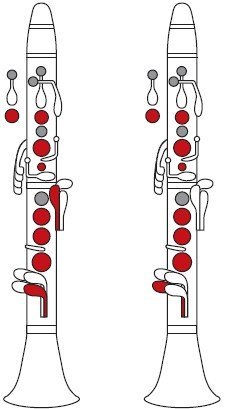
An Away in a Manger clarinet fingering chart is a note-by-note Bb clarinet guide that shows exactly which keys to press for every pitch in the carol. It lets beginners and advanced players focus on phrasing, tone, and emotion instead of worrying about note locations.
The quiet magic of Away in a Manger on clarinet
“Away in a Manger” has a curious story. For a long time it was credited to Martin Luther, the German reformer, but historians later discovered that the text most likely appeared in late 19th century American hymn collections. The two melodies we know best, “Mueller” and “Cradle Song,” were penned by James R. Murray and William J. Kirkpatrick, both hymn writers with a gift for singing lines that feel natural on wind instruments.
On Bb clarinet, the tune often sits in the clarion and throat tone area, where notes like A, B, C, and D can sound like a child humming to themselves. That modest range is part of why the melody shows up in school bands, church services, jazz arrangements, and chamber concerts alike. It is simple enough for a first-year student, yet expressive enough to bring a seasoned soloist back to pure, uncomplicated lyricism.
16 to 24 bars of melody
Most clarinet arrangements of “Away in a Manger” span just 16 to 24 measures. That short length makes it perfect for warmups, tone studies, and quick holiday performances without overtaxing the embouchure or fingers.
How great clarinetists have touched Away in a Manger
Even if you do not see “Away in a Manger” printed on their album covers, many legendary clarinetists have shaped the way we phrase and color carols like this. Their recordings of hymns, chorales, and lyrical slow pieces are the blueprint for how this tune can breathe on clarinet.
In the classical world, Sabine Meyer often shapes simple lines with a singer's sense of air. Listen to her Mozart Clarinet Concerto with the Berliner Philharmoniker and focus on how she floats the long phrases in the Adagio. That same slow, supported air is exactly what gives “Away in a Manger” its floating cradle-rock motion on clarinet.
Martin Frost brings a different energy. In his performances of the Nielsen Clarinet Concerto and his arrangements of Swedish folk songs, his control of pianissimo attacks and gentle swells on sustained notes shows how a clarinet can whisper without losing color. When you play the opening phrase of “Away in a Manger,” you can almost imagine Frost shaping each note like a spoken word, with tiny inflections at the ends of phrases.
Richard Stoltzman, with his recordings of spirituals and American songs, often blurs the line between classical phrasing and jazz-style inflection. His work on albums of sacred music, including gentle hymn arrangements, gives a wonderful model for adding tasteful vibrato and rubato to a melody like “Away in a Manger.” His approach invites clarinetists to bend the tempo just a little, like a choir breathing together.
On the jazz side, think about Benny Goodman's treatment of ballads such as “Body and Soul” or his warm lead playing on Christmas radio broadcasts. He almost certainly played carols like this on air and in church or community events, even if they were not all recorded. His sound concept in the chalumeau register, especially on low E and G, offers a model for a soft, woody tone on the lower notes of “Away in a Manger.”
Artie Shaw, who balanced big-band brilliance with lyrical solos, showed in tunes like “Begin the Beguine” how to glide smoothly across registers. That crossover from throat tone A up to clarion D and E is exactly the kind of motion you meet in many arrangements of “Away in a Manger.” His legato between registers is a helpful reference for practicing the carol without bumps.
Klezmer players, including Giora Feidman and David Krakauer, have also influenced how clarinetists bring folk-style expressiveness into sacred music. Their use of krekhts (those crying ornamental slides), portamento, and flexible intonation in pieces like “Der Heyser Bulgar” or “A Yiddishe Mame” hints at what is possible if you ever arrange “Away in a Manger” in a klezmer or folk style. A gentle slide into a note, or a small bend toward a cadence, can make the melody sound both ancient and new.
From cathedrals to club stages: iconic uses of Away in a Manger
Clarinetists have recorded “Away in a Manger” in dozens of settings, each one casting the same tune in a new light. British clarinetist Emma Johnson has appeared in Christmas concerts where the clarinet doubles the soprano line on carols, often including this one, blending the woodwind color with choir and organ. Her warm upper clarion tone is a clear reference point for anyone playing the melody in church.
Many wind band arrangements feature a clarinet solo or soli on the second verse. Publishers often use soft clarinet choir textures around the melody, with Bb clarinet leading and bass clarinet and alto clarinet holding soft sustained chords underneath. If you listen to holiday recordings by ensembles like the Dallas Wind Symphony or the Royal Northern College of Music Wind Orchestra, you will often hear “Away in a Manger” tucked inside medleys where the principal clarinetist gets a brief, singing solo.
Film and television have also given this carol some subtle clarinet moments. Holiday soundtracks sometimes use solo clarinet to underline quiet scenes of a child in a bedroom or a snow-covered street at night, quoting a line or two of “Away in a Manger” as an instrumental motif. The combination of clarinet and celesta, or clarinet and harp, is common in these scores, because the clarinet can whisper the melody without dominating the scene.
In jazz and lounge recordings, clarinetists have arranged “Away in a Manger” over gentle reharmonizations. A player might outline ii-V progressions with soft swing phrasing, adding light ornamentation to the cadences. Some recordings pair clarinet with piano and upright bass for an almost Bill Evans style harmonic cushion under the tune, giving the melody a reflective, late-night feel.
Chamber music has also adopted the carol. Clarinet and string quartet arrangements often give the clarinet the second or third verse, with violin or viola taking the first. In this setting, the clarinet can lean into expressive devices like slight portato articulation, subtle vibrato, and long swells that match the bowing patterns of the strings. It becomes less of a simple church carol and more of a lullaby that could sit next to a Brahms Intermezzo.
Setting
Clarinet Role
Typical Style
Church service with organ
Unison with congregation or solo verse
Straight rhythm, vocal phrasing
Wind band medley
Featured clarinet solo or soli
Legato, expressive dynamics
Jazz trio
Melody and light improvisation
Swing or rubato, reharmonized chords
From Victorian hymnbooks to jazz clubs: a short history
“Away in a Manger” started life not as a clarinet piece, but as a simple children's hymn. Nineteenth-century hymn collections in the United States printed the text with straightforward melodies meant for singing in Sunday schools and homes. The tunes were crafted so children could memorize them easily, which is exactly why the melody falls so naturally under the fingers on a Bb clarinet today.
As the clarinet became a staple of bands and orchestras in the late 19th and early 20th centuries, carols like this migrated into instrumental collections. While Anton Stadler and Heinrich Baermann did not know this carol, their long, singing lines in the Mozart and Weber concertos laid the foundation for how clarinetists think about melody. The same breath control that carries the Mozart Adagio also carries the long notes in “Away in a Manger.”
Moving into the romantic and early 20th century periods, clarinetists brought hymn-like warmth into concert music. Brahms wrote his Clarinet Sonatas for Richard Muhlfeld with a church-chorale sensibility in mind, especially in the slow movements. That blend of sacred and intimate lyricism influences how many players now treat “Away in a Manger”: as something more personal than a big, public fanfare.
In the swing era, bands often played holiday broadcasts that included carols arranged for full ensemble, with clarinet leading the reed section. Benny Goodman and Artie Shaw helped shape an American sound where the clarinet could both dance and pray. Even if the charts are lost, the phrasing habits from that period survive in the way jazz clarinetists approach slow Christmas standards today.
By the late 20th century, clarinetists such as Sabine Meyer, Sharon Kam, and Martin Frost began recording crossover albums that mixed classical, sacred, and folk repertoire. Carols including “Away in a Manger” started to appear in recital encores, either as arranged miniatures or as part of seasonal programs with piano, harp, or guitar. The clarinet became the storyteller of the carol, not just the accompanist.
Field Note: In the Martin Freres archives, there are early 20th century clarinets that still carry traces of candle wax and wax crayon on their cases from church players who marked Christmas services. Several handwritten parts include simple carol melodies like “Away in a Manger” penciled above basic hymn harmonies, a reminder that clarinetists have been quietly leading carols in small congregations for over 100 years.
Why Away in a Manger feels so natural on Bb clarinet
There is a reason so many young players learn this tune early. The melody lies mostly in the comfortable throat and clarion registers, where the reed responds easily and the keys fall under relaxed fingers. This lets you forget about mechanics and lean into storytelling. You can focus on breath, color, and the slow rocking motion that makes the carol feel like a lullaby.
Emotionally, “Away in a Manger” asks for tenderness. On clarinet, that often means starting notes from the air rather than from the tongue, especially on soft phrases. You can experiment with almost flute-like attacks on notes such as A, B, and C in the clarion register. Slight crescendos into the tops of phrases, then relaxed decrescendos into cadences, give the sense of a cradle gently swaying.
For many players, this carol is also tied to memory. Maybe you played it in a school concert with a plastic clarinet and a wobbly music stand, or you came back to your hometown and brought your wooden clarinet to a late-night service. The tune holds those moments, and each time you play it, you can hear a little of that history in your sound.
What Away in a Manger teaches you as a clarinetist
Mastering “Away in a Manger” on Bb clarinet is not about perfection. It is about learning how to say a lot with very little. The range is small. The rhythm is simple. There are no flashy altissimo runs. Instead, you get a quiet laboratory for tone and phrasing.
Learning this melody well will help you:
Shape long phrases like in the Mozart Clarinet Concerto Adagio
Control soft dynamics like those in the Brahms Clarinet Sonatas
Blend with choir or organ, as you would in a church or film score session
Experiment with tasteful vibrato and rubato, like Richard Stoltzman or Emma Johnson
You can also use the tune as a mini-composition lab. Try changing the articulation pattern on each repetition, or shift from a classical straight tone to a gentle jazz-influenced vibrato over a reharmonized piano part. Think of it as a short story you keep rewriting with new emotional colors.
Practice routine idea:
Session Part
Time
Focus
Slow melody, no metronome
5 minutes
Breath and phrase shapes
With metronome
5 minutes
Even notes and clean finger changes
Free rubato version
5 minutes
Expression, dynamics, vibrato
A gentle guide to the Away in a Manger clarinet fingering chart
The free “Away in a Manger” clarinet fingering chart lays out every note for Bb clarinet, verse by verse. You will mostly see familiar fingerings in the low and middle registers, with notes such as low G, A, B, middle C, D, and E. Many arrangements sit in concert F or concert Eb, which means you may play in G or F major on Bb clarinet, with simple key signatures.
Here is a simple step-by-step way to use the chart effectively:
Scan the key signature and note if you are in G major (one sharp) or F major (one flat).
Look at each phrase and circle any notes that cross the break between A and B.
Match those circled notes to the fingerings on the chart before you play.
Play slowly, watching the fingerings the first few times, then look away and trust your hands.
Passage
Common Fingering Question
Tip
Throat A to clarion B
Break feels choppy
Keep left-hand index finger close and practice slow slurs
Low G to middle D
Uneven timing
Use a metronome, tongue lightly on each note for clarity
Soft endings on high note
Tone cracks
Relax embouchure corners and support with steady air
Common Away in a Manger clarinet issues and quick fixes
Even a gentle carol can expose small issues in embouchure, breath support, or hand position. A few simple adjustments can make your “Away in a Manger” sound closer to the singing tone of players like Sabine Meyer or Richard Stoltzman.
Problem
Likely Cause
Quick Fix
Notes crack on soft entrances
Too little air support, tense throat
Breathe deeper, start notes with warm air before tongue
Break between registers feels rough
Fingers lifting too far from keys
Keep fingers close, practice slow slurred thirds
Melody sounds flat or lifeless
No dynamic contrast
Shape each phrase with clear crescendos and decrescendos
Key Takeaways
Use the Away in a Manger clarinet fingering chart to free your mind from note worries so you can focus on phrasing and tone.
Listen to great clarinetists in lyrical works and borrow their breath, dynamics, and color for this gentle carol.
Treat each performance as a short story: keep the technique simple and let the emotion do the talking.
Frequently Asked Questions
What is Away in a Manger clarinet fingering chart?
An Away in a Manger clarinet fingering chart is a visual guide that shows which keys to press on Bb clarinet for every note in the carol. It matches the melody, bar by bar, so players can learn the tune reliably and then focus on breath, tone, and musical expression.
Is Away in a Manger suitable for beginner clarinet players?
Yes. The range is comfortable, the rhythm is simple, and most versions use friendly keys like G or F major. Beginners can use the fingering chart to learn the notes slowly, then work on gentle dynamics and smooth slurs, building skills that help with band pieces and future solos.
Which register of the Bb clarinet is used most in Away in a Manger?
Most clarinet arrangements of “Away in a Manger” stay in the chalumeau and lower clarion registers, around low G up to about high E. This area responds easily on most mouthpieces and reeds, allowing players to work on tone, breath support, and phrasing without struggling in the altissimo range.
How can I make Away in a Manger sound more expressive on clarinet?
Think like a singer. Shape phrases with clear crescendos and decrescendos, use warm air for soft entries, and allow gentle rubato at cadences. Listening to lyrical recordings by Sabine Meyer, Martin Frost, or Richard Stoltzman can inspire ideas for color, vibrato, and breath pacing.
Can I play Away in a Manger with other instruments?
Absolutely. Bb clarinet blends well with piano, guitar, organ, string quartet, and voice. You can read a Bb lead sheet and transpose from concert keys like F or Eb. The fingering chart helps you learn the melody securely so you can listen more closely to your partners while you play.
For more lyrical clarinet inspiration, you might also enjoy reading about tone and expression on other classic melodies and studies at Martin Freres, including guides that discuss melodic shaping, historical clarinet artistry, and expressive practice strategies.